
Audit trail
Summary. An audit trail answers "who did what, on what, when, with what outcome, on whose behalf" to somebody who does not trust the application: an auditor, a customer, a regulator. In this kit it is recorded around the use cases, never by them: authorization decisions, executed commands and integration events already pass through three places, and the entries are written there. Entries are append-only and hash-chained, so a change, a removal or a reordering is detectable; they hold identifiers and codes, never content, which is also what lets an append-only chain coexist with the right to erasure. The chain proves that what was recorded was not rewritten. It does not prove that everything was recorded.
What it is not
Section titled “What it is not”| It is not | Because |
|---|---|
| a log | logs are sampled, rotated, filtered by level and lost; nobody can prove a line was not removed |
| event sourcing | it does not rebuild state; it records that something happened and how it ended |
| audit columns | created_by and updated_by name the last writer of a row, not the history, and not the refusals |
| a debugging tool | it carries no payload, no message, no stack trace |
The four can coexist, each with its own retention and readers. Mixing them is how a log ends up holding personal data for ten years, or an audit trail ends up unreadable.
Why handlers never write it
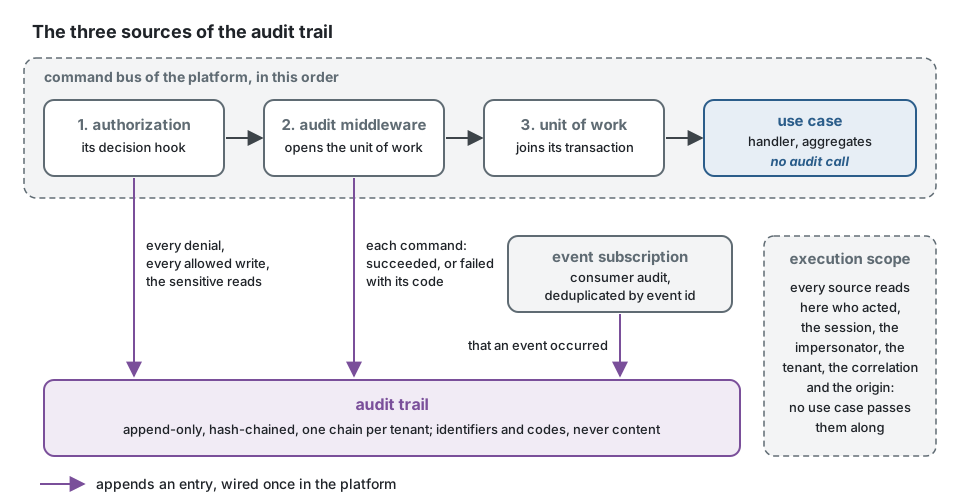
Section titled “Why handlers never write it”A handler that must remember to call the audit will one day forget, and nothing will fail. An aggregate that calls it has stopped being a model. So the kit records from three places every unit of work already crosses, wired once in the platform:
| Source | Records | Mechanism |
|---|---|---|
| authorization decisions | every denial; every allowed action that is not a read; the allowed reads you declare sensitive | the decision hook of the authorization middleware |
| commands | each command with succeeded or failed and the code of the error |
a bus middleware placed before the unit of work |
| integration events | that an event of a given type occurred, from its envelope only | one idempotent subscription |
A request a guard refuses at the HTTP edge (a role, a scope, a tenant the caller does not
belong to) never reaches the bus: the HTTP pipeline reports it to auditGuardRefusals, which
records it as an authorization entry, denied, for authenticated callers only (a caller
without a credential belongs to the access log and to rate limiting). A fourth, exceptional
source exists for what none of these can see: an explicit record written by infrastructure,
such as a bulk export. A call to the trail from domain/ or
application/ is the defect the design exists to prevent.
Who acted, in which session, impersonated by whom, for which tenant, with which correlation id and from which origin: all of it comes from the execution scope (The actor and the execution scope), never threaded through a use case.
Instead of a handler that remembers to record:
// instead of: the audit inside the use caseasync execute(command: CancelAppointment): Promise<void> { const appointment = await this.appointments.findById(command.appointmentId); appointment.cancel(this.clock.now()); await this.appointments.save(appointment); await this.trail.record({ category: 'command', action: 'CancelAppointment', outcome: 'succeeded', ... }); // forgotten in the next handler, lost on a failure}write a handler that only does its work, and wire the trail once, on the bus. Assembled by hand, with the in-memory pieces of the kernel and the package, so that it runs as it is:
import {  AuthorizedCommand,  ConceptError,  FixedExecutionScope,  InMemoryCommandBus,  InMemoryUnitOfWork,  SequentialIdGenerator,  SystemClock,  executionContext,  unitOfWorkMiddleware,  type Actor,} from '@ddd-ts-kit/kernel';import { InMemoryAuditTrail, auditMiddleware, auditedFields } from '@ddd-ts-kit/audit';
// the use case: a command and its handler, with no audit call anywhereclass AppointmentError extends ConceptError {  static cancellationWindowPassed(appointmentId: string) {    return AppointmentError.refusal('CANCELLATION_WINDOW_PASSED', `Appointment ${appointmentId} starts in less than 24 hours.`, { appointmentId });  }}
class CancelAppointment extends AuthorizedCommand<void> {  constructor(    actor: Actor,    readonly appointmentId: string,  ) {    super(actor);  }}
const handler = {  async execute(command: CancelAppointment): Promise<void> {    throw AppointmentError.cancellationWindowPassed(command.appointmentId);  },};
// the platform: who acts comes from the execution scope, what is recorded is declared hereconst ada: Actor = { id: 'user-ada', type: 'user', roles: ['client'], attributes: {} };const scope = new FixedExecutionScope(executionContext({ correlationId: 'corr-1', actor: ada, origin: 'http' }));const trail = new InMemoryAuditTrail();const unitOfWork = new InMemoryUnitOfWork();
const commands = new InMemoryCommandBus()  .use(    auditMiddleware(trail, {      scope,      clock: new SystemClock(),      ids: new SequentialIdGenerator('audit'),      unitOfWork,      fields: [        auditedFields(CancelAppointment, ['appointmentId'], {          resource: (command) => ({ type: 'appointment', id: command.appointmentId }),          context: 'appointments',        }),      ],    }),  )  .use(unitOfWorkMiddleware(unitOfWork))  .register(CancelAppointment, handler);
await commands.execute(new CancelAppointment(ada, '8f2')).catch(() => undefined);
const [entry] = trail.entries;console.log(entry?.category, entry?.action, entry?.outcome, entry?.reason);// command CancelAppointment failed CANCELLATION_WINDOW_PASSED
In a project generated with stack.audit on, this wiring is already written under
src/platform/audit/, with the PostgreSQL store, the authorization hook and the event
subscription; the @ddd-ts-kit/audit README shows each
piece.
The transaction problem
Section titled “The transaction problem”Two requirements pull in opposite directions. The entry of a failed command must survive the rollback. The entry of a succeeded command must not exist if its transaction did not commit.
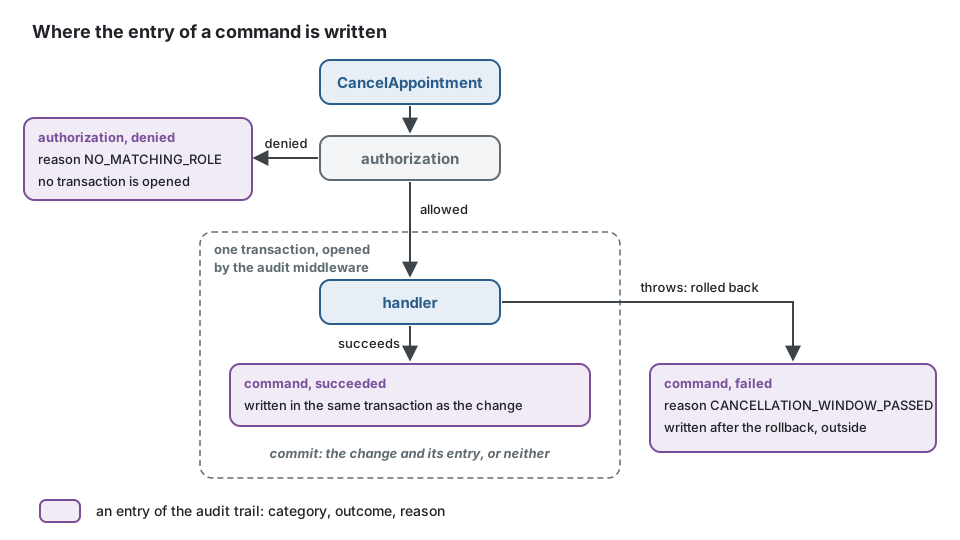
A middleware inside the unit of work loses the failures; one outside loses atomicity for the successes. Hence the arrangement above: the audit middleware sits before the unit of work and opens it itself. A success and its entry commit together or neither exists; if the entry cannot be written, the command fails. Recording through the outbox would be atomic for successes too, but an outbox row shares the fate of its transaction and cannot carry the failures.
Order matters for the same reason: authorization first, so a refused command leaves one
denied entry and opens no transaction.
The entry
Section titled “The entry”An entry names a category (authorization, command, integration-event, data-access, ...),
an action (a permission id, a command name, an event type), an outcome (allowed, denied,
succeeded, failed), a stable reason code, the actor, the tenant, an optional resource, the
correlation and causation ids, the origin, and its place in a chain. For the running domain:
| category | action | outcome | reason | resource |
|---|---|---|---|---|
| authorization | appointments:appointment.cancel |
denied | NO_MATCHING_ROLE |
appointment 8f2 |
| command | CancelAppointment |
failed | CANCELLATION_WINDOW_PASSED |
appointment 8f2 |
| command | RescheduleAppointment |
succeeded | appointment 8f2 | |
| integration-event | appointments.appointment.rescheduled |
succeeded |
Redaction: identifiers and codes, never content
Section titled “Redaction: identifiers and codes, never content”By default an entry carries no payload at all. A value enters only when the project declares
it, field by field, for one command: the new startsAt of a rescheduled appointment, for
instance. A field that is not declared is never read, and the compiler refuses a name the
command does not have.
// src/platform/audit: given to auditMiddleware as `fields`, with `masker: hmacMasker(secret, { keyId: 'k1' })`auditedFields(RescheduleAppointment, ['startsAt', masked('clientEmail')], { resource: (command) => ({ type: 'appointment', id: command.appointmentId }),});// the entry then carries: changes: { startsAt: '2026-03-02T09:00:00.000Z', clientEmail: { masked: 'k1:5d0e...' } }Personal data that must be correlated ("every entry about this client") is stored masked: a keyed hash of the value. Two entries about the same email carry the same mask, so the question can be answered by masking the email again, while the email itself is not there and a guess cannot be checked without the secret. A plain hash would not do: an email or a phone number is guessed in seconds.
What never goes in, declared or not: free text typed by a user, credentials and tokens (even hashed), whole payloads or aggregates, error messages and stack traces (the code is recorded), and special categories of personal data unless a decision record says why. In a health-related scheduling product, the reason of an appointment belongs to that last group.
The hash chain
Section titled “The hash chain”Each entry stores the hash of the previous one and its own hash, computed over a canonical form that any program in any language can recompute. Changing, removing or reordering an entry breaks the chain at a place the verification names: altered content, a missing entry, or a reordering.
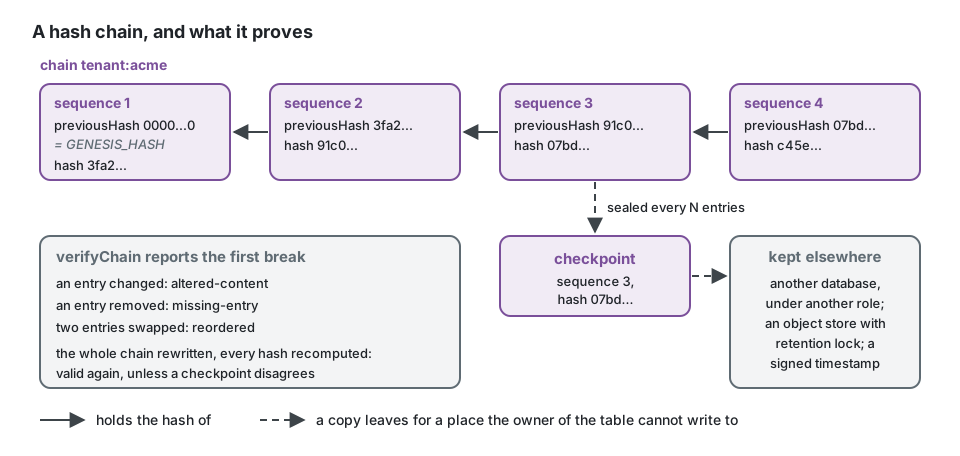
The hash is a SHA-256 of the entry without its own hash, so previousHash, chain and
sequence are sealed too; the first entry of a chain links to GENESIS_HASH, 64 zeros.
When somebody turns a failure into a success in an export, its verification says where:
import { verifyChain, type AuditEntry } from '@ddd-ts-kit/audit';
declare const exported: AuditEntry[]; // the entries of one chain, as an export hands them over
const untouched = await verifyChain(exported, { chain: 'tenant:acme' });// { valid: true, checked: 3 }
const second = exported[1];if (second !== undefined) {  exported[1] = { ...second, outcome: 'succeeded' }; // somebody turns a failure into a success}
const tampered = await verifyChain(exported, { chain: 'tenant:acme' });// { valid: false, checked: 1, break: { kind: 'altered-content', chain: 'tenant:acme', position: 1, sequence: 2, entryId: '...' } }console.log(untouched, tampered);
The kit keeps one chain per tenant by default. A tenant can then be verified, exported and handed over without the entries of the others, appends of different tenants do not wait for each other, and an offboarded tenant leaves chains that still verify. The price: the order between entries of two tenants is given by their timestamps only, not proven by a hash.
The store refuses update and delete at the database level too (triggers), and the application's database role should own neither the table nor the triggers.
Verification and anchoring
Section titled “Verification and anchoring”A chain protects against whoever can change some rows. Whoever can rewrite the whole table (a database administrator, an attacker holding the owner role) can recompute every hash from the altered entry onwards, and the result is a perfectly valid chain. The only defence is a copy of some hashes where that person cannot write. That is anchoring: at intervals, a checkpoint (the hash at a given position) leaves for somewhere else, such as another database under another role, an object store with retention lock, a transparency log or a signed timestamp. Later verification compares the chain with those checkpoints. A truncated tail is only seen by comparing with a later checkpoint.
Verification should run on a schedule and alert; a chain nobody verifies proves nothing in practice.
The right to erasure and an append-only chain
Section titled “The right to erasure and an append-only chain”An entry cannot be deleted without breaking its chain, and a regulation such as the GDPR (article 17) may require erasure of personal data. The two coexist as long as the chain never holds the data:
- Keep personal data out. An actor id, a resource id and a permission id are identifiers. If the identifiers are themselves personal (an email used as user id), fix that first.
- Mask what must be correlated. A masked value is unreadable but still linked to a person for whoever holds the secret.
- Crypto-shredding for erasure. Derive one masking key per data subject from a key store. Erasing a person is deleting their key: the masks become tokens nobody can recompute, the entries stay, the hashes stay valid.
What remains after erasure is "an actor with this opaque id did this at that time". Whether that is acceptable is a legal question for the project, to be answered before the first entry is written. The key store then becomes the system to protect; the kit does not provide one.
Reading it
Section titled “Reading it”Reading the audit trail is itself a sensitive act. It is exposed as a use case like any other: its own permission, pagination, the filter narrowed to the tenant of the actor, and its reads recorded. Whoever reads the trail leaves an entry in it. Support staff acting as a user appear as such: the impersonator is on the entry.
// the handler of SearchAuditEntriesQuery, which depends on the AuditReader port of the kernelconst page = await this.reader.search( { ...query.filter, tenantId: query.tenantId, category: 'authorization', outcome: 'denied' }, cursorPage({ limit: 50, sort: [{ field: 'occurredAt', direction: 'desc' }] }),);In a multitenant project, TenantAuditReader bound to AuditReader confines every search to
the tenant of the work, whatever its filter says.
Limits and when not to use it
Section titled “Limits and when not to use it”These are stated by @ddd-ts-kit/audit:
- Integrity, not completeness. A fact that never reached a source (a script writing to the
database, a route bypassing the bus) is not in the trail. Keeping every route on the bus is
what
authz/declaredand the dependency rules are for. - PostgreSQL only for the SQL stores shipped (Knex and Drizzle). With Prisma, TypeORM, a
custom ORM or no ORM, the generated project starts on an in-memory trail behind a
TODO(platform); another database is another adapter held to the contract suite. - Appends to one chain are serialized. The head of a chain stays locked until the commit; a handler that records by hand early and then works for long makes the other writers of its tenant wait.
- The timestamp is the clock of the instance that recorded. Inside a chain the order is the sequence.
- No retention or archiving policy is provided. How long entries are kept and where old chains go is a decision of the project.
- Anchoring is a hook, not a service. Without checkpoints kept elsewhere, a full rewrite of the table is undetectable.
- Verification reads its range into memory: verify long chains by ranges.
- When not to use it. A prototype, or a system with no accountability requirement, pays the
serialized append and the storage for nothing: the trail can be switched off in the config,
stack.audit: "off"(see Configuration). If what you want is to reconstruct state or debug a request, you want event sourcing or tracing, not this.
Sources
Section titled “Sources”- Bruce Schneier and John Kelsey, "Secure Audit Logs to Support Computer Forensics", ACM Transactions on Information and System Security, 1999: hash-chained log entries.
- Scott A. Crosby and Dan S. Wallach, "Efficient Data Structures for Tamper-Evident Logging", USENIX Security Symposium, 2009.
- Regulation (EU) 2016/679 (GDPR), article 17 (right to erasure) and article 5(1)(c) (data minimisation).
- NIST Special Publication 800-92, Guide to Computer Security Log Management, 2006.
- Martin Fowler, "Event Sourcing" and "Audit Log", martinfowler.com: what an audit log is next to event sourcing.
@ddd-ts-kit/audit: the entry, the sources, the stores and the limits quoted above.
See also
Section titled “See also”- Authentication and authorization
- The actor and the execution scope
- Observability
- Transactional outbox
- Scheduled jobs: where the periodic verification runs
- Architecture reference: "Standard interfaces", "Cross-cutting behaviour"