
CQRS as used here
Summary. Command Query Responsibility Segregation separates the code that changes state from the code that answers questions. This kit applies the light form: every use case is either a command or a query, each with one handler, reached through a command bus or a query bus. A command goes through the aggregate and returns at most an identifier; a query never changes state and may read a projection through a port without loading aggregates. Aggregates keep their state in tables unless one is chosen to be event-sourced, and there is no second database by default. This page says what that buys, what it does not, and when the split is not worth having.
From a method rule to an architecture rule
Section titled “From a method rule to an architecture rule”Bertrand Meyer's command-query separation is a rule about methods: a method either changes state or returns a value, not both. Greg Young and Udi Dahan lifted it to the level of the model: use one model to write and another to read, because the two have different shapes and different loads. Fowler's summary and warning is the usual reference: the split helps in a minority of complex domains and adds risk elsewhere.
The kit takes the part that costs little and pays in every project:
| Element | Rule in this kit |
|---|---|
| a use case | one command or one query, in its own folder, with one handler |
| a command | changes state through one aggregate; returns nothing or an identifier |
| a query | changes nothing; returns a view shaped for the caller |
| the way in | CommandBus and QueryBus, never a handler class |
| what is common to all use cases | a bus middleware, not code repeated in handlers |
The normative text is ARCHITECTURE.md section 4 ("Use cases", "Buses");
the shape of a handler is application/handler-shape, and a query that saves, deletes or
publishes is reported by application/command-query-separation.
The two paths, on the scheduling application
Section titled “The two paths, on the scheduling application”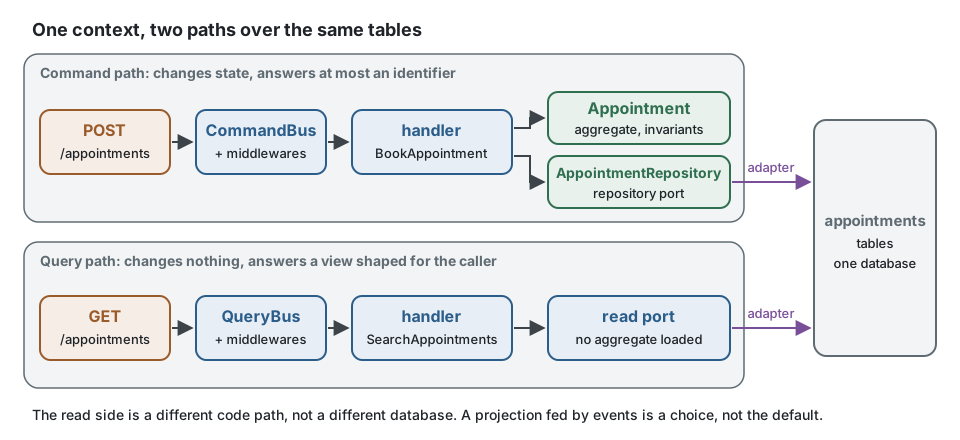
Command. BookAppointment carries the actor and the requested slot. The handler loads what
it needs, calls one intention method (Appointment.book(...)), saves through the repository
port and does nothing else: the save hands the recorded events over, and the unit of work
dispatches them once the handler has returned, before the commit. It answers the identifier of
the new appointment and nothing else: the client that wants to display the appointment sends
GetAppointment. Returning the whole aggregate would tie the response to the write model.
Query. SearchAppointments needs twenty rows of five columns, filtered by what the actor may
see and paginated. Loading twenty aggregates with their invariants to throw most of the state
away is waste. The handler asks a read port, whose adapter queries the tables directly and
returns the shape the port declares. The access scope computed by the authorizer goes into that
query, so nothing is filtered in memory after loading (see
Authentication and authorization).
Both paths read the same tables. The read side is a different code path, not a different database.
The query path in code
Section titled “The query path in code”A query names its answer in its type, a read port declares the shape the caller needs, and the handler asks the port. The bus infers the answer from the query, so the route gets a typed result without knowing the handler:
import { definePermissions } from '@ddd-ts-kit/auth';import { AuthorizedQuery, InMemoryQueryBus, type Actor, type BusMiddleware, type Logger } from '@ddd-ts-kit/kernel';import { QueryHandler, Requires } from '@ddd-ts-kit/kernel/declarations';
const appointmentsPermissions = definePermissions('appointments', {  'appointment.search': { description: 'Search the appointments of a practitioner' },});
// application/ports/appointment-lines.port.ts: the shape the screen needs, not the aggregateexport interface AppointmentLine {  readonly id: string;  readonly startsAt: string;  readonly clientName: string;}
export abstract class AppointmentLines {  abstract ofPractitioner(practitionerId: string, limit: number): Promise<readonly AppointmentLine[]>;}
// application/queries/search-appointments/search-appointments.query.ts@Requires(appointmentsPermissions['appointment.search'])export class SearchAppointments extends AuthorizedQuery<readonly AppointmentLine[]> {  constructor(    actor: Actor,    readonly practitionerId: string,  ) {    super(actor);  }}
// application/queries/search-appointments/search-appointments.handler.ts: reads, never saves@QueryHandler(SearchAppointments)export class SearchAppointmentsHandler implements QueryHandler<SearchAppointments> {  constructor(private readonly lines: AppointmentLines) {}
  execute(query: SearchAppointments): Promise<readonly AppointmentLine[]> {    return this.lines.ofPractitioner(query.practitionerId, 20);  }}
// platform/buses/: what every query goes through, written once for all of themdeclare const logger: Logger;declare const lines: AppointmentLines; // the adapter the platform binds to the port
const logged: BusMiddleware = async (message, next, info) => {  logger.info('use case', { kind: info.kind, name: info.name });
  return next();};
const queryBus = new InMemoryQueryBus()  .use(logged)  .register(SearchAppointments, new SearchAppointmentsHandler(lines), { context: 'appointments' });
// presentation/: the route knows the bus and the query, never the handlerexport async function appointmentsOf(actor: Actor, practitionerId: string): Promise<readonly AppointmentLine[]> {  return queryBus.execute(new SearchAppointments(actor, practitionerId));}
In a generated project the buses are built in src/platform/buses/. In the declared style the
handlers are registered from their declarations; in the explicit style the module of the
context calls register for each one, as the sample does to show what the bus holds (see
Ports and composition).
Two habits the rules hold
Section titled “Two habits the rules hold”Instead of a command that hands the aggregate back to the caller:
export class BookAppointment extends AuthorizedCommand<Appointment> { /* ... */ }// the route serialises the aggregate: the response is now tied to the write modelwrite a command that answers its identifier, and a query for what the client displays:
export class BookAppointment extends AuthorizedCommand<string> { /* ... */ }const id = await commandBus.execute(new BookAppointment(actor, calendarId, startsAt));const appointment = await queryBus.execute(new GetAppointment(actor, id));Instead of a query that changes state on the way:
async execute(query: GetAppointment): Promise<AppointmentView> { const appointment = await this.appointments.findById(query.appointmentId); appointment.markSeenBy(query.actor.id); await this.appointments.save(appointment); // application/command-query-separation return toView(appointment);}write the change as a command of its own (MarkAppointmentSeen), sent by the caller that
wants it, and keep the query a pure read.
Why buses
Section titled “Why buses”A route could call a handler directly. The buses exist for three reasons:
-
One place for what every use case needs. The generated platform (
src/platform/buses/) puts on the buses, as middlewares and outermost first: the report of an unexpected failure (when the stack has an error tracker), the log entry, the measure, the permission check, the span of the use case, the staging of an uploaded file and the wake-up of the outbox relay (commands only, when the stack has them), the audit entry (when the audit trail is on) and, for commands, the unit of work. A handler contains none of it, so none of it can be forgotten in a new handler.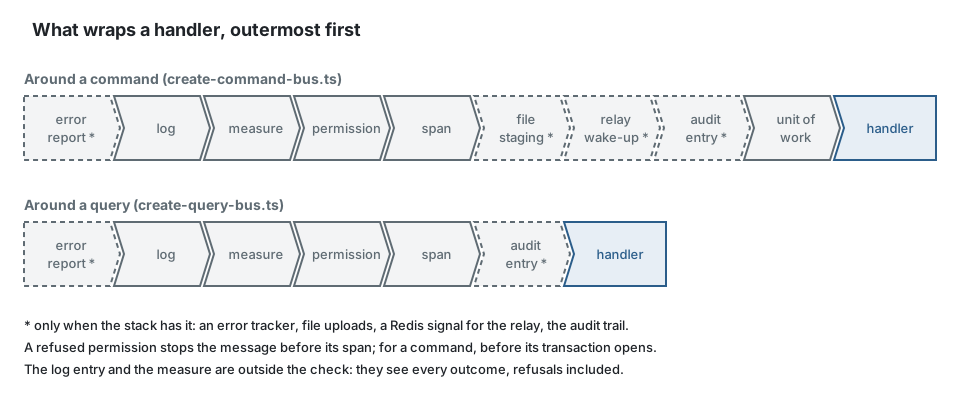
-
One way in for every caller. A route, an integration event handler and a scheduled job all send a command. The use case is authorized, audited and run in a transaction the same way whoever started it.
-
A seam. The buses are ports of the kernel with in-process implementations. Another transport is an adapter chosen in the composition root; the callers do not change.
The price is one level of indirection: "go to definition" on execute lands on the bus, not on
the handler. The handler lives next to its command, in the same folder, which is how it is
found.
What it buys
Section titled “What it buys”- Use cases are visible. The list of commands and queries of a context is its functional
surface:
ddd-ts-kit describe <context>prints it, and a permission is declared on each (authz/declared). - Reads stop bending the model. An aggregate is sized for its invariants (see Aggregates), not for the screens that display it. A new column in a list is a change of a read adapter.
- Each side is tested the way it deserves: behaviour for commands, the returned shape for queries.
- Commands are easy to make idempotent and to audit: they are named data, sent through one place.
- The door to a separate read store stays open. A read port can later be served by a
projection fed by events, as
availabilityis, without touching the callers.
What it does not buy, and what the kit does not do
Section titled “What it does not buy, and what the kit does not do”- Event sourcing is a choice per aggregate, not part of CQRS. Aggregates are stored as state by default, and their domain events are recorded to be dispatched at the end of the unit of work, not to rebuild them. CQRS and event sourcing are independent patterns that are often presented together: one aggregate whose history is the business can be event-sourced while the others keep their rows (Event sourcing, per aggregate).
- No separate read database, and no generated read store. A projection is a table of the
consuming context. The runtime packages carry the read side:
Criteria(filters, sort and page of a list, checked against a definition), hydration, theReadModelStoreport with a SQL table store, the@Projectionand@Ondeclarations of a projector and a rebuild (kernel README, "Criteria", "Hydration" and "Projections"). The CLI generates part of it:generate query --searchwrites a read port with an in-memory adapter and a fake, andgenerate projection <context> <Name> <event-type>writes a projector and its spec, in the declared style only (in the explicit style the generator refuses: the projector is written by hand inapplication/projections/and included in the module file of its context withbuilder.include(<Name>Projection)); the port of the read model and its store adapter come fromgenerate portand the ORM package. The status of each part is in the read side proposal. - No performance by itself. Two code paths over one database scale like one database.
- No asynchronous commands by default. The in-process buses are awaited. A command answered "accepted" and processed later is a design the project builds on events.
When a projection is the right read model
Section titled “When a projection is the right read model”availability answers FindOpenSlots. The answer combines the working hours and time off held
by calendars with the appointments held by appointments. Asking both contexts at each search
would couple three contexts at run time. Instead availability keeps its own table of open
slots, updated when calendars.calendar.working-hours-changed,
appointments.appointment.booked or appointments.appointment.cancelled arrive. The search is
one local query. The cost is that the answer can be a moment late: a slot shown as open may have
been taken a second ago, and appointments is what refuses the double booking (see
Eventual consistency).
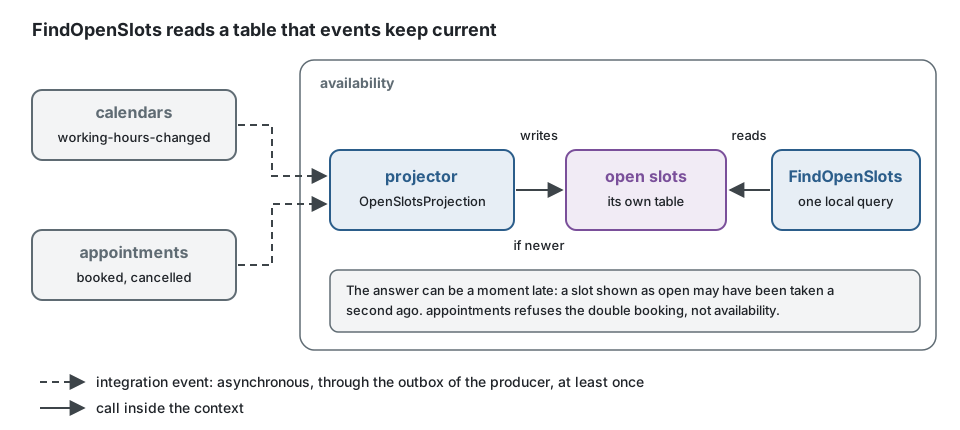
The projector applies each event to one row, and its store writes only when the event is newer than the one the row holds, so a redelivery or a late event changes nothing:
import { defineIntegrationEvent, type PayloadOf } from '@ddd-ts-kit/events';import { ReadModelStore, stampOf, type IntegrationEvent, type ReadModelWrite } from '@ddd-ts-kit/kernel';import { On, Projection } from '@ddd-ts-kit/kernel/declarations';import { zodSchema } from '@ddd-ts-kit/validation/zod';import { z } from 'zod';
// appointments/published-language/: what availability may know of a bookingconst slotTaken = z.object({ appointmentId: z.string(), calendarId: z.string(), startsAt: z.iso.datetime() });
export const appointmentBooked = defineIntegrationEvent({  type: 'appointments.appointment.booked',  version: 1,  payload: zodSchema(slotTaken),});
export const appointmentCancelled = defineIntegrationEvent({  type: 'appointments.appointment.cancelled',  version: 1,  payload: zodSchema(slotTaken),});
// availability/application/ports/open-slots.port.ts: the read model, one row per slotexport interface OpenSlotRow {  readonly calendarId: string;  readonly startsAt: string;  readonly open: boolean;}
export abstract class OpenSlots extends ReadModelStore<OpenSlotRow> {}
// availability/application/projections/open-slots.projection.tsconst keyOf = ({ calendarId, startsAt }: PayloadOf<typeof appointmentBooked>) => `${calendarId}@${startsAt}`;
@Projection('availability.open-slots')export class OpenSlotsProjection {  constructor(private readonly slots: OpenSlots) {}
  @On(appointmentBooked)  booked(event: IntegrationEvent<PayloadOf<typeof appointmentBooked>>): Promise<ReadModelWrite> {    // a slot outside the working hours has no row: answering undefined writes nothing    return this.slots.upsertIfNewer(keyOf(event.payload), stampOf(event), (row) =>      row === undefined ? undefined : { ...row, open: false },    );  }
  @On(appointmentCancelled)  cancelled(event: IntegrationEvent<PayloadOf<typeof appointmentCancelled>>): Promise<ReadModelWrite> {    return this.slots.upsertIfNewer(keyOf(event.payload), stampOf(event), (row) =>      row === undefined ? undefined : { ...row, open: true },    );  }}
FindOpenSlots then reads OpenSlots with a criteria, like any other read port. The
projector sends no command and reads no other context: it only keeps its table current.
Limits and when not to use it
Section titled “Limits and when not to use it”- A CRUD context with no rules (a list of rooms, a settings screen) gains little from a
command, a handler, a bus and a read port per operation. The generator makes the files cheap
to create, not cheap to read. A
genericor thinsupportingcontext can keep a trivial model; whether to drop the split for it is a recorded decision, not a habit. - "A command returns at most an identifier" has friction. A client that needs the created resource makes a second call. That is deliberate; when the round trip matters, the route can send the query after the command and answer its result.
- Read-your-own-writes is not automatic once a read comes from a projection fed by events. Either read that screen from the write tables, or design the UI for the delay.
- Middleware order matters and is invisible from a handler. Read
src/platform/buses/create-command-bus.tsandcreate-query-bus.tsto know what wraps a use case. - A query handler that needs a rule of the domain (a price, an eligibility) should call the domain for it, not copy it into SQL. Bypassing aggregates is for shape, not for logic.
Sources
Section titled “Sources”- Bertrand Meyer, Object-Oriented Software Construction, 2nd edition, Prentice Hall, 1997 (command-query separation).
- Greg Young, "CQRS Documents", 2010, https://cqrs.files.wordpress.com/2010/11/cqrs_documents.pdf
- Martin Fowler, "CQRS", 2011, https://martinfowler.com/bliki/CQRS.html
- Martin Fowler, "Event Sourcing", 2005, https://martinfowler.com/eaaDev/EventSourcing.html
- Vaughn Vernon, Implementing Domain-Driven Design, Addison-Wesley, 2013, chapter 4 ("Architecture", the CQRS section).
- Vlad Khononov, Learning Domain-Driven Design, O'Reilly, 2021, chapter 8 (CQRS).