
ddd-ts-kit.config.json
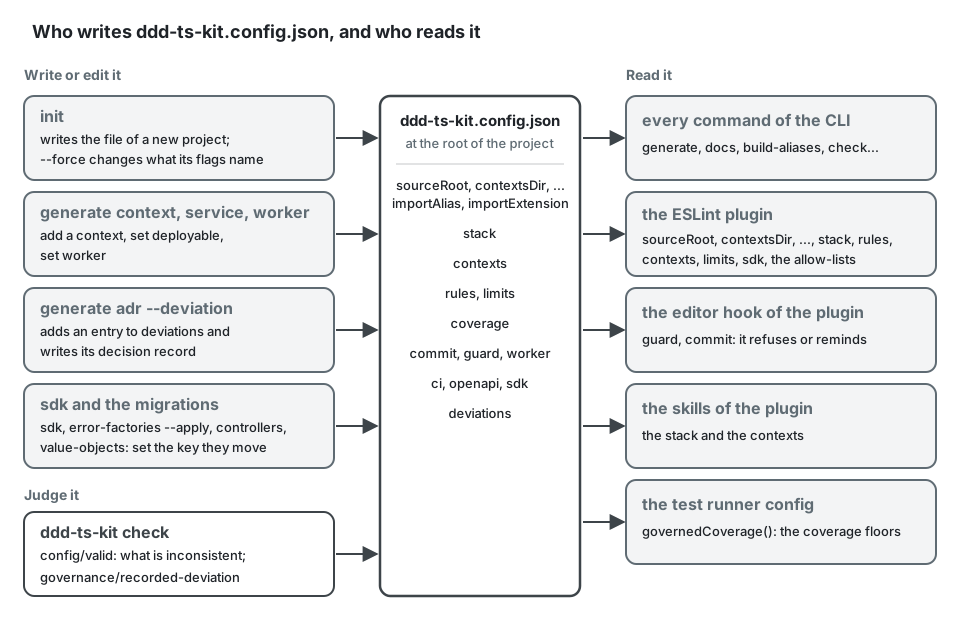
Read by the CLI, the ESLint plugin, the editor hook and the skills. It lives at the root of
the consuming project. ddd-ts-kit init writes it; generate context, generate service,
generate worker and generate adr --deviation edit it, and so do ddd-ts-kit sdk and the
commands that move a project from one form of code to another (error-factories --apply,
controllers, value-objects), each setting the key it moves; ddd-ts-kit check reports what
is inconsistent in it as config/valid.
It is the one place a decision of the project is written. A decision changes here first, then
the files that follow from it are brought in line, and how depends on the file. Two are held by
a rule of ddd-ts-kit check, which reports them when they no longer agree with their key: the
paths, module and moduleResolution of tsconfig.json (imports/alias-declared, from
importAlias and importExtension), and the coverage settings of the test runner, which read
the measured layers and their floors from this file instead of repeating them
(test/coverage-governed). The others are only rewritten by a command and are not checked: the
scripts, pipelines and git hooks in the dialect of the package manager follow
stack.packageManager when init --force --package-manager <pm> rewrites them, and a key
changed by hand leaves them as they were.
The example below is what init --context billing:core --context catalog:supporting writes,
after generate context shipping --classification supporting --upstream billing. It holds no
deviation.
{ "sourceRoot": "src", "contextsDir": "src/contexts", "sharedKernelDir": "src/shared-kernel", "platformDir": "src/platform", "importAlias": "@/", "importExtension": "none", "stack": { "http": "express", "validation": "zod", "di": "tsyringe", "events": "outbox", "orm": "drizzle", "database": "postgres", "tests": "vitest", "docsUi": "swagger", "ci": "github", "authn": "jwt", "authz": "rbac", "broker": "none", "cache": "none", "httpCache": "none", "storage": "local", "audit": "on", "errors": "none", "logger": "stdout", "style": "declared", "refusals": "factories", "routes": "controllers", "schemas": "shared", "valueObjects": "throwing", "literals": "named", "values": "classes", "queue": "database", "assembly": "barrel", "dependencies": "signature", "packageManager": "pnpm", "representations": "negotiated", "forms": "on" }, "contexts": { "billing": { "classification": "core", "upstreams": [] }, "catalog": { "classification": "supporting", "upstreams": [] }, "shipping": { "classification": "supporting", "upstreams": [{ "context": "billing", "relationship": "published-language" }] } }, "rules": {}, "domainAllowedPackages": ["@ddd-ts-kit/kernel"], "applicationAllowedPackages": ["@ddd-ts-kit/kernel", "@ddd-ts-kit/auth"]}init spells every default out, so that the file documents the project. Three keys are written
only when they say something: stack.assembly and stack.dependencies in the declared style
only, stack.tenancy when it is not none. The optional keys (coverage, deviations,
commit, worker, ci, openapi, sdk, ...) appear once a project sets them.
How a key is read
Section titled “How a key is read”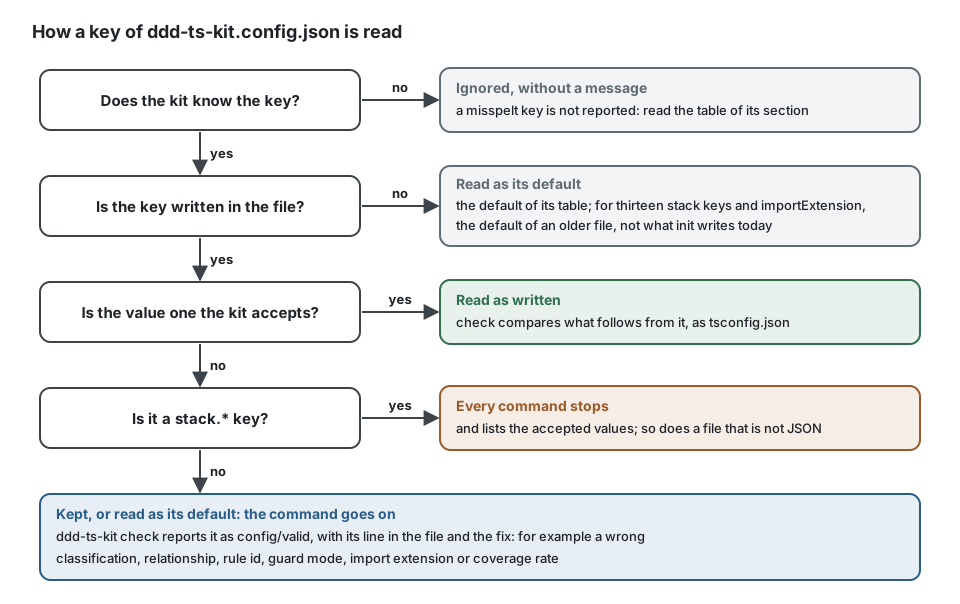
A wrong stack.* value stops every command before it does anything, with the list of accepted
values:
$ npx ddd-ts-kit listError: ddd-ts-kit.config.json: "stack.http" is "expres". fix: Set "stack.http" to one of: express, fastify, hono, nest, none.Any other wrong value lets the commands run, and ddd-ts-kit check reports it with its line in
the file:
$ npx ddd-ts-kit check --rule config/validddd-ts-kit.config.json:39 error config/valid The context "billing" has the classification "central". fix: Set contexts.billing.classification to one of: core, supporting, generic.A key that is not written is not always read as what init writes today: a file without the key
was written by a version that did not know it, and the kit reads it the way that version
worked, so that an upgrade of the packages changes nothing in an existing project. The thirteen keys
concerned are in the table of the Stack section, and importExtension
below. The exact rules of the parser are in Limits.
| Key | Meaning | Default |
|---|---|---|
sourceRoot |
where the sources live | src |
contextsDir |
the bounded contexts, one directory each | <sourceRoot>/contexts |
sharedKernelDir |
the shared kernel | <sourceRoot>/shared-kernel |
platformDir |
the technical platform | <sourceRoot>/platform |
importAlias |
the prefix that names sourceRoot in imports: @/, or $, one name in lower case (letters, digits, hyphens) and /. Every file of the project is imported by it (imports/alias-only) |
@/ |
importExtension |
what an import of a file of the project ends with: none, nothing (@/contexts/billing/domain/aggregates/invoice.aggregate), or js, the extension of the file the compiler emits (.../invoice.aggregate.js). Held by imports/extension |
none in what init writes; js when the key is absent |
importAlias is the one place a person writes the alias. init (flag --import-alias)
derives the paths of tsconfig.json from it, and ddd-ts-kit build-aliases reads it when it
rewrites the compiled output; ddd-ts-kit check compares them and everything that has to
follow (imports/alias-declared). Only a prefix that cannot be the name of a package is
accepted: #<name>/ is refused (a Node subpath import is another mechanism), @<name>/ is
refused (it is how the packages of a scope are named, and dependency-cruiser would resolve an
installed one first), and so is a bare name/. $test/, $scripts/ and $generated/ are
taken: they name test/, scripts/ and the client Prisma generates, and are not configurable.
To rename the alias of an existing project: change the key, write the paths entry the finding
gives, and replace the prefix in the sources. See tools/import-aliases.md.
What imports/alias-only asks of a source, here in a handler of the billing context:
// Instead of: a relative path, which counts "../" and changes when the file movesimport { Invoice } from '../../../domain/aggregates/invoice.aggregate';import { IssueInvoiceCommand } from './issue-invoice.command';
// Write: the alias, which names the context and the layer from the root of the sourcesimport { IssueInvoiceCommand } from '@/contexts/billing/application/commands/issue-invoice/issue-invoice.command';import { Invoice } from '@/contexts/billing/domain/aggregates/invoice.aggregate';
eslint --fix rewrites the first form into the second.
importExtension is the one place a person says how an import ends. init writes none
(flag --import-extension none|js) and derives three things from it, which
imports/alias-declared holds to the key:
none |
js |
|
|---|---|---|
module, moduleResolution and customConditions in tsconfig.json |
ESNext, Bundler, ["node"] |
NodeNext, NodeNext, none |
each moduleNameMapper entry of a jest config |
'^@/(.*)$': '<rootDir>/src/$1.ts' |
'^@/(.*)\\.js$': '<rootDir>/src/$1.ts' |
what ddd-ts-kit build-aliases reads in the compiled output |
@/x, which names x.js |
@/x.js |
The same import under each value, and what the build makes of it:
// importExtension "none": the source names the file, without an extensionimport { Invoice } from '@/contexts/billing/domain/aggregates/invoice.aggregate';
// importExtension "js": the source names the file the compiler emitsimport { Invoice } from '@/contexts/billing/domain/aggregates/invoice.aggregate.js';
// Either way, ddd-ts-kit build-aliases writes in// dist/src/contexts/billing/application/commands/issue-invoice/issue-invoice.handler.js:import { Invoice } from '../../../domain/aggregates/invoice.aggregate.js';
Either way the build writes a relative path ending in .js, which is what Node resolves. A
config file without the key is read as js: a project generated by a version that did not
know it keeps its imports, its tsconfig.json and its build untouched, and init run again
(with or without --force) keeps js for it. A value that is neither is reported by
config/valid and read as js.
To move an existing project to imports without an extension:
- set
"importExtension": "none"; - run
ddd-ts-kit check:imports/alias-declaredgives themodule,moduleResolutionandcustomConditionsto write intsconfig.json, and the jest mapping of a project on jest;imports/extensionlists every import to change; - run
eslint --fix(npm run lint:fix), which removes the extension of each of them, thennpm run format: a shorter import may now fit on one line; - run
ddd-ts-kit docs, which rewrites the declarations barrels, thennpm run verify.
init --force --import-extension none does steps 1 and 2 and rewrites the files init owns;
steps 3 and 4 remain. Under none an import names a file, never a directory: the bundler
resolution of the compiler would complete .../published-language with its index.ts, the
build does not, and ddd-ts-kit check reports it. What the compiler no longer models under
none is said in tools/import-aliases.md, "Limits".
The "Default" column is what ddd-ts-kit init writes when the flag is left out. A value
outside the list stops every command with the list of accepted values.
| Key | Values | Default |
|---|---|---|
stack.http |
express, fastify, hono (Hono 4 on Node through @hono/node-server), nest, none |
express |
stack.validation |
zod, class-validator, typebox (TypeBox 1, the typebox package), standard-schema, none |
zod |
stack.di |
tsyringe, nest, manual; init accepts nest with http: nest and only with it |
tsyringe (nest when http is nest) |
stack.events |
in-memory, outbox, custom; init offers in-memory and outbox |
outbox when an ORM is set (anything else then needs a stack.events deviation), in-memory otherwise |
stack.orm |
drizzle, knex, prisma, typeorm, custom, none. With a migration tool, npm run db:generate <what-it-does> names every migration <timestamp>_<what-it-does> and persistence/migration-history checks their order (persistence) |
drizzle (none with database: none) |
stack.database |
postgres, mysql, sqlite, mongodb, none. The generated adapters are written for PostgreSQL: init refuses another database with drizzle, knex, prisma or typeorm, and its --database flag does not offer mongodb |
postgres with one of the four ORMs, none otherwise |
stack.tests |
vitest, jest |
vitest |
stack.docsUi |
swagger, scalar, redoc, none |
swagger (none when http is none) |
stack.ci |
github, gitlab, both, none |
github |
stack.authn |
jwt, keycloak, none |
jwt |
stack.authz |
rbac, abac, rebac, custom |
rbac |
stack.broker |
none, rabbitmq, kafka, nats, redis (Redis Streams), custom; init refuses a broker without an ORM, since a broker is reached through the outbox |
none |
stack.cache |
none, redis: what backs the kernel Cache port, the wake-up of the outbox relay, the rate limiter and the lock of the scheduled jobs |
none |
stack.httpCache |
none, varnish: the shared HTTP cache in front of the API. varnish (init --http-cache varnish, with an HTTP framework and events: outbox) adds the Varnish 9.1.0 service to the compose file with its VCL in docker/varnish/default.vcl (it keeps only an answer whose Cache-Control allows it by max-age or s-maxage, and lets a purge in from its machine or with VARNISH_PURGE_KEY), reads VARNISH_URL and VARNISH_PURGE_KEY, tags the public answers in xkey (cacheTags of the HTTP boundary), and hands the purge requests of the outbox to VarnishCachePurger in main.ts and in every entry point generate service writes; the end-to-end application records them instead (purges.purged). On di: manual and nest, the platform gains cacheInvalidation, what a before-commit handler asks to purge. With stack.tenancy other than none, the tags of the answers and of the purges are filed under the tenant (perTenant), and the HTTP boundary reads the tenant of a request from x-tenant-id (resolveTenant: tenantFromHeader()), so that a public call names its tenant and its answers vary on it. A config without the key is none: nothing changes. See HTTP caches |
none |
stack.storage |
local, s3, none: where the content of files lives, never in the database. local: a directory in development (FILES_DIRECTORY, .data/files), the memory of the process in the tests and the tools, the signed links answered by the application under /files; s3: a bucket of any provider of the S3 protocol (@ddd-ts-kit/s3, MinIO in the compose stack, S3_* variables), the memory in the tests; none: no file storage wired. Either way platform/files/ binds FileStorage, FileKeys, FileScanner and FileStaging, registers the hourly purge of staged files, stages the file a command carries on the command bus before the transaction, and mounts the upload reader; generate file-upload needs it. With local, FILES_PUBLIC_URL and FILES_SIGNING_SECRET are required in production. See file storage |
local in what init writes; none when the key is absent |
stack.audit |
on, off: whether the audit trail is wired; on also records the refusals of the guards at the edge of authenticated callers (onGuardRefusal), never those of a caller without a credential |
on when an ORM is set, off otherwise |
stack.errors |
none, sentry: where unexpected failures are reported; sentry binds the kernel ErrorReporter to @ddd-ts-kit/sentry (Sentry or GlitchTip) |
none |
stack.logger |
stdout, pino, winston: what implements the kernel Logger port |
stdout |
stack.style |
declared: each class declares what it is with a decorator and a context has no module file; explicit: every binding is written in <context>.module.ts. init accepts declared with di: tsyringe only |
declared with di: tsyringe, explicit otherwise |
stack.assembly |
barrel, discovery: how a declared context reaches the composition root, one generated <context>.declarations.ts or a scan at startup. init accepts the flag in the declared style only |
barrel |
stack.dependencies |
signature, listed: where a declared class states what it depends on. signature: in its constructor and nowhere else; ddd-ts-kit docs reads the signatures into the generated file of each context, and a list left in a decorator is reported (declarations/constructor-injection, which ESLint fixes). listed: in the last argument of its decorator, as 0.1 wrote it. Both forms run in either: a class that lists is given its list, a class that does not is given what its constructor takes. init accepts the flag in the declared style only |
signature |
stack.refusals |
factories, classes: how a domain error is written. factories: one error class per concept of the model, each refusal built by a static factory named in the words of the business (AppointmentError.slotTaken(..)), held by the errors/* rules, and generate error <context> <Concept> <refusal> adds one. classes: one class per error, built with new, as 0.1 and 0.2 wrote them; generate domain-error writes one, and no errors/* rule judges. Both forms run in either: ConceptError and DomainError are one family |
factories |
stack.routes |
controllers, functions: how a route is written. controllers: one class per route carrying @Controller of @ddd-ts-kit/http, in a folder of its own under presentation/http/<resource>/<use-case>/, behind the guards of its @RouteGroup; generate route writes it, with --mapper and --serializer when asked. functions: one defineRoute function per route, listed in <context>.routes.ts, as 0.1 to 0.3 wrote them. Both forms run in either, and in one project during a migration: generate controller writes a controller whatever the key says, and ddd-ts-kit controllers turns the function routes of a context into controllers |
controllers |
stack.schemas |
shared, per-route: how the schemas of the HTTP contract are written. shared: a shape several routes use is declared once, presentation/http/shared/<name>.schema.ts of its context or presentation/<name>.schema.ts of the shared kernel (generate schema), shared (a zod .meta({ id }), classSchema(Dto, { shared: true }), sharedSchema), documented once in components.schemas and referenced by $ref; a command answers its identifier with acceptedSchema of @ddd-ts-kit/http; schema/no-duplicate-shape and schema/presentation-only judge. per-route: each route declares its own schemas, an identifier answer included (<use-case>.accepted.ts with class-validator), as 0.1 to 0.5 wrote them, and no schema/* rule judges |
shared |
stack.valueObjects |
throwing, result: how the factory of a value object refuses. throwing: create returns the value object or throws the refusal built by the static factory of its concept (throw PersonError.invalidEmail(raw)), as an aggregate refuses; a caller takes the value as it is, and a spec asserts expectRefusal(() => Email.create(raw), 'INVALID_EMAIL'). result: create returns a Result of the kernel, err(PersonError.invalidEmail(raw)), that a caller unwraps with unwrap(..), as 0.1 to 0.5 wrote them. generate value-object writes the form the key says; Result, ok, err and unwrap stay in the kernel for a project that keeps them. Validation at the edge (the schema of a request) is not concerned: a value refused there never reaches the factory |
throwing |
stack.literals |
named, free: how the code writes a closed value and a number. named: a value a closed vocabulary of the project declares is read through it, AppointmentStatus.NoShow, billingPermissions['invoice.issue'], Role.Admin, never written again as a string (language/declared-vocabulary, checker and ESLint), and a number of domain/ or application/ other than 0, 1, -1 and an index has a name (clean/no-magic-number, ESLint). free: both rules are silent, as 0.1 to 0.5 wrote code. The rules templates init writes say the rules under named only |
named |
stack.values |
classes, free: how a value of the model is written. classes: a value object class extending ValueObject, built through static factories (generate value-object writes one), and never a function that builds a plain object; domain/value-object-class (checker and ESLint) holds the files of domain/value-objects/ and the functions of domain/ and of the shared kernel (Entities and value objects). free: the rule is silent, as 0.1 to 0.15 wrote code. The rules template init writes names the rule under classes only |
classes |
stack.tenancy |
none, shared-table; read also: row-level-security, schema-per-tenant, database-per-tenant. How the data of one tenant is kept from the others (Multitenancy). shared-table: every generated repository, on Knex or Drizzle, confines its statements to the tenant of the work through tenantTable and ownTenantTable or tenantCondition and ownTenantCondition, the outbox keeps the tenant of each event so that consumers run in it, and tenancy/scoped-statement reports a statement that bypasses the helpers. init --tenancy offers none and shared-table, and refuses shared-table with Prisma, TypeORM, custom or no ORM; the three other strategies are shipped by the persistence packages and wired by hand (init refuses them with what to add). Absent: none, and the file says nothing of tenancy |
absent (none) |
stack.representations |
negotiated, json: what a route answers in. negotiated: src/platform/http/presentation-of.ts registers Representations.standard() of @ddd-ts-kit/http in the HTTP boundary and the contract script, so each request is answered in the media type its Accept header prefers among JSON and what its route declares in produces (XML, CSV, 406 when none fits), an XML body is read on a route that declares consumes, and the fields a schema reserves with withFieldAccess are decided through the Access of the application; generate representation adds produces to a controller. json: JSON whatever the request accepts, as before the key existed. init writes json without an HTTP stack |
negotiated (json with http: none) |
stack.forms |
on, off: whether a route that declares form is served as a form. on: src/platform/http/with-forms.ts adds formRoutes of @ddd-ts-kit/http to the routes, one GET /forms/<operationId> per such route (JSON Forms, or ?format=blocks), fields hidden or read-only for each caller by the same field access, and npm run docs:generate writes each form whole to openapi/forms/<operationId>.json; generate form gives a controller its hints. off: no form is served |
on (off with http: none) |
stack.queue |
database, redis, memory. Where the background jobs and the instances of the process managers are kept (Background jobs, Sagas and process managers). database: the background_jobs and process_instances tables of @ddd-ts-kit/knex or @ddd-ts-kit/drizzle in the messaging schema, created by the first migration, bound in place of the stores in memory by the platform module: a job enqueued by a command exists if and only if the command committed. redis: RedisJobStore on the server of the cache (--cache redis, Dragonfly in docker-compose and in CI), written once the command committed; the process instances stay in the database with Knex or Drizzle. memory: in the process, which a worker of another process does not see. init --queue defaults to database on Knex or Drizzle with --di tsyringe, memory otherwise; it refuses a store with another container than tsyringe, database with another ORM, and redis without --cache redis. generate background-job and generate process need --di tsyringe. With memory and a worker, each process consumes the queue in its own memory, its jobs on or off: the API runs the jobs it enqueues, the worker those its scheduled jobs enqueue, and a restart loses what waits. With redis, a job write lost after its command committed is logged and reported (reportLostJobs of @ddd-ts-kit/redis, bound by the platform module). Absent: memory, the store of a project initialised before background jobs existed |
database on Knex or Drizzle with tsyringe, memory otherwise |
stack.packageManager |
npm, pnpm: what installs the dependencies and runs the scripts. Every command the CLI writes is in its dialect: the scripts of package.json, the pipelines, the git hooks, the Dockerfile, the README and the notes init and generate print (pnpm run verify and pnpm exec ddd-ts-kit, or npm run verify and npx ddd-ts-kit). pnpm is pinned by the packageManager field of package.json, which corepack provides (corepack enable, once per machine); npm comes with Node and is not pinned. init --package-manager npm|pnpm |
pnpm in what init writes; npm when the key is absent |
A key left out of stack
Section titled “A key left out of stack”A config file that omits a stack key is read with the defaults of the table above, except for
thirteen keys. A file without one of them was written by a version that did not have the choice, and
it is read the way that version worked:
| Key | Left out, read as | What init writes |
To move a project |
|---|---|---|---|
stack.style |
explicit |
declared with tsyringe |
no command moves it |
stack.dependencies |
listed, in the declared style |
signature |
set the key, eslint --fix, then ddd-ts-kit docs |
stack.refusals |
classes |
factories |
error-factories --plan, then --apply |
stack.routes |
functions |
controllers |
controllers, or controllers <context> |
stack.storage |
none |
local |
init --force --storage local (or s3) |
stack.valueObjects |
result |
throwing |
value-objects |
stack.literals |
free |
named |
set the key, then follow check and ESLint |
stack.queue |
memory |
database on Knex or Drizzle with tsyringe, memory otherwise |
init --force --queue database |
stack.schemas |
per-route |
shared |
set the key, then follow check --rule schema/no-duplicate-shape |
stack.packageManager |
npm |
pnpm |
init --force --package-manager pnpm |
stack.representations |
json |
negotiated (json with http: none) |
init --force --representations negotiated |
stack.forms |
off |
on (off with http: none) |
init --force --forms on |
stack.values |
free |
classes |
set the key, then follow check --rule domain/value-object-class and ESLint |
The paragraphs below say why for each, and what each move leaves to a person.
The first two: without stack.style the project is read as explicit, whatever stack.di says, because
such a file was written before the declared style existed; and without stack.dependencies
a declared project is read as listed, because such a file was written when every decorator
listed its dependencies. A 0.1 project therefore keeps working untouched after it upgrades
the packages. To move it to constructor signatures: set "dependencies": "signature", run
npx eslint . --fix (the rule removes every list that repeats its constructor and reports
the ones that differ), then npx ddd-ts-kit docs, and add
--import ddd-ts-kit/dist/refresh-declarations.js to the dev script as init writes it.
The third: without stack.refusals the project is read as classes, because such a file was
written when a domain error was a class built with new. Nothing new is reported there. To
move it to factories: npx ddd-ts-kit error-factories --plan writes
error-factories.plan.json, one entry per error class with the concept proposed for it (the
aggregate its name starts or ends with, nothing when none does); give each entry its concept,
then npx ddd-ts-kit error-factories --apply writes the error classes of the concepts, moves
each spec under the name of its factory, rewrites every usage (new, thenError, toThrow,
expect.any, toBeInstanceOf, instanceof, imports and types) and sets the key. It ends
with what is left to a person: the facts to expose, the factories that still take a sentence,
the properties that became facts.
The fourth: without stack.routes the project is read as functions, because such a file was
written when every route was a defineRoute function. Nothing changes there: the functions
stay supported, generate route keeps writing one, and no rule about controllers reports
anything. To move it: npx ddd-ts-kit controllers --dry-run says what would move, context by
context; npx ddd-ts-kit controllers (or controllers <context>, one context at a time) turns
each <name>.route.ts into <resource>/<name>/<name>.controller.ts behind the route group of
its resource, moves its schema files and its spec with it, rewrites every import, removes the
list of a declared context and sets "routes": "controllers" once no function route is left
in the contexts. A context is turned whole or not at all: a route that answers several
statuses, sets headers or is not written as defineRoute(spec, async (input) => { .. }) is
named with the reason, and stays a function, which keeps running next to the controllers.
What the command leaves to you is printed: run the formatter and ddd-ts-kit docs, move the
helpers a controller kept to a mapper or a serializer, give the groups their guards, and, in a
project initialised before 0.4, add the line that mounts the declared controllers to
compose-application.ts.
The fifth: without stack.storage the project is read as none, because such a file was
written before the kit kept files: nothing is wired, nothing changes. To add file storage:
npx ddd-ts-kit init --force --storage local (or s3) records the key and writes the files of
platform/files/ and platform/config/read-files.ts with the files init owns; then
npx ddd-ts-kit generate file-upload <context> <UseCase> writes the first upload. A project
that keeps local sets FILES_PUBLIC_URL and FILES_SIGNING_SECRET in production, even before
it receives a file: the start refuses without them.
The sixth: without stack.valueObjects the project is read as result, because such a file was
written when every value object returned a Result. Nothing changes there: generate value-object keeps writing a Result. To move it: npx ddd-ts-kit value-objects --dry-run
says what would change, npx ddd-ts-kit value-objects rewrites it. In every class that extends
ValueObject, each method returning Result<T, E> returns T; return err(refusal) becomes
throw refusal, return ok(value) becomes return value, and return valid ? ok(value) : err(refusal) becomes an if and a throw. In every source of the project, unwrap(..) of one
of those calls goes, nested and multi-line ones included; a spec that asserted the Result
asserts the factory: expect(result.ok).toBe(true) becomes expect(() => ..).not.toThrow(),
toMatchObject({ ok: false, error: { code } }) becomes expectRefusal(() => .., code), and a
const result = Email.create(raw) read only by such assertions is inlined. The imports of err,
ok, Result and unwrap nothing reads any more are dropped, expectRefusal is imported where
it is now called, and the key is set. What is left to a person is printed with its line: a
refusal asserted with its facts, a caller that branched on .ok or read .error, an err(..)
that was not returned. The example application was moved by it: 28 refusals thrown, 168
unwrap removed, 31 assertions rewritten, nothing left by hand.
The two forms side by side, on the Email of a person. Under result, create returns a
Result that every caller unwraps:
import { ConceptError, err, ok, type Result, unwrap, ValueObject } from '@ddd-ts-kit/kernel';
export class PersonError extends ConceptError {  static invalidEmail(value: string) {    return PersonError.refusal('INVALID_EMAIL', `"${value}" is not an address the platform can write to.`, { value });  }}
const ADDRESS = /^[^\s@]+@[^\s@]+\.[^\s@]+$/;
export class Email extends ValueObject<{ readonly value: string }> {  // stack.valueObjects "result": the refusal is a value the caller has to unwrap  static create(value: string): Result<Email, PersonError> {    const normalized = value.trim().toLowerCase();
    return ADDRESS.test(normalized) ? ok(new Email({ value: normalized })) : err(PersonError.invalidEmail(value));  }}
const email = unwrap(Email.create('ada@example.com'));
Under throwing, the form init writes, create returns the value object or throws the refusal,
as an aggregate refuses, and a spec asserts it with expectRefusal:
import { ConceptError, ValueObject } from '@ddd-ts-kit/kernel';import { expectRefusal } from '@ddd-ts-kit/testing';
export class PersonError extends ConceptError {  static invalidEmail(value: string) {    return PersonError.refusal('INVALID_EMAIL', `"${value}" is not an address the platform can write to.`, { value });  }}
const ADDRESS = /^[^\s@]+@[^\s@]+\.[^\s@]+$/;
export class Email extends ValueObject<{ readonly value: string }> {  // stack.valueObjects "throwing": the caller takes the value as it is  static create(value: string): Email {    const normalized = value.trim().toLowerCase();
    if (!ADDRESS.test(normalized)) {      throw PersonError.invalidEmail(value);    }
    return new Email({ value: normalized });  }}
const email = Email.create('ada@example.com');
// in a specexpectRefusal(() => Email.create('ada@'), 'INVALID_EMAIL');
The seventh: without stack.literals the project is read as free, because such a file was
written before the two rules existed, and code the kit generated then spells some values raw:
generate job wrote the grant of a system actor by its permission id ('billing:invoice.cancel',
in roles.ts, permit('system-..', ['billing:invoice.cancel'], ..) in attribute-policies.ts).
Nothing is reported there, and a job generated again finds that grant and does not add a second
one. To name the literals: set "literals": "named" under stack and run npx ddd-ts-kit check and
ESLint. Each value is reported with what to write instead (billingPermissions['invoice.cancel'],
imported from the permissions file of the context); a closed list of your own becomes a
vocabulary with npx ddd-ts-kit generate vocabulary <context> <Name> --value .., and the roles
an object Role in <platformDir>/auth/role.ts written the same way. A number of the model
becomes a constant of the module or a static readonly. Until it is done, a rule can stay at
warn under rules, recorded in deviations.
The eighth: without stack.queue the project is read as memory, because such a file was
written before background jobs existed, and its platform module binds no store: the kernel
module keeps jobs and process instances in the process, which consumes them even next to a
worker (RUN_JOBS off): nothing a process enqueues is left unrun, but nothing survives its
restart. To keep them in the database: add the
tables to the schema (createJobTable and createProcessTable of @ddd-ts-kit/knex in a new
migration, or jobsTable and processesTable of @ddd-ts-kit/drizzle/postgres and npm run db:generate), give Persistence the stores (KnexJobStore, KnexProcessStore, or their
Drizzle twins), rebind JobStore and ProcessStore in the platform module, add
@ddd-ts-kit/scheduling to the dependencies and set "queue": "database"; init --force --queue database on a clean tree writes the same.
The ninth: without stack.schemas the project is read as per-route, because such a file was
written when each route declared its own schemas. Nothing is reported there, and generate route keeps writing an identifier answer per route. To move it: set "schemas": "shared", run
npx ddd-ts-kit check --rule schema/no-duplicate-shape, and for each shape it reports keep one
declaration (generate schema writes its file), share it and use it from every route; replace
each { id } answer by acceptedSchema of @ddd-ts-kit/http and delete its class; then
npm run docs:generate. The wire format does not change; the contract then refers to one
component per shape instead of a copy per route.
The tenth: without stack.packageManager the project is read as npm, because such a file was
written before the choice existed, when the kit wrote npm commands. Nothing changes there: the scripts, the
pipelines and the notes keep saying npm run and npx. To move it to pnpm:
npx ddd-ts-kit init --force --package-manager pnpm records the key, pins pnpm in the
packageManager field of package.json and rewrites the files init owns in its dialect; then
corepack enable, pnpm install (which writes pnpm-lock.yaml) and pnpm run verify.
The eleventh and the twelfth: without stack.representations the project is read as json, and
without stack.forms as off, because such a file was written before either existed. Nothing
changes there: every answer stays JSON, no form is served, and a schema marked with
withFieldAccess hides its restricted fields from everybody until a decider is given. To move
it: npx ddd-ts-kit init --force --representations negotiated --forms on sets both keys and
rewrites the files init owns (http-boundary.ts, compose-application.ts,
scripts/openapi.ts, with the new presentation-of.ts and with-forms.ts); then
npm run docs:generate, which lists the media types of every route and writes the forms. A
project that rewrote one of those files by hand reapplies its change, as for any init --force.
The thirteenth: without stack.values the project is read as free, because such a file was
written before domain/value-object-class existed, and a hand-written value may be a function
that builds a plain object. Nothing is reported there. To move it:
- Set
"stack.values": "classes"and runnpx ddd-ts-kit check --rule domain/value-object-classand ESLint: each value written as a function, each value object class with a public constructor or no factory, and each helper a value object file exports is reported. - For a value written as a function,
npx ddd-ts-kit generate value-object <context> <Name>writes the class and its spec; move the checks the callers made into its static factory, the helpers that took the record into methods, and replacemoney(a, c)byMoney.of(a, c), a field-by-field comparison byequals, and a mapper that read the fields byinstanceofandtoJSON(). - For a value object class, make the constructor private (protected on a base) and add the static factory the rule names; a helper exported next to it becomes a static factory or a method.
Until it is done, the rule can stay at warn under rules, recorded in deviations with the
ADR that says when it goes, as any other relaxed rule (governance/recorded-deviation).
Pipeline
Section titled “Pipeline”| Key | Values | Default |
|---|---|---|
ci.extras[] |
jobs added to the pipeline over the free gates, each needing a paid plan on a private repository or reporting into a merge request only in a paid tier: codeql (.github/workflows/codeql.yml; free on a public repository, GitHub Code Security on a private one), dependency-review (a step of the security job; free on a public repository, GitHub Code Security or Advanced Security on a private one), gitlab-sast and gitlab-secret-detection (GitLab's templates: they run on every tier, their findings reach a merge request on Ultimate only), gitlab-dependency-scanning (Ultimate). init --ci-extras codeql,dependency-review writes them and records the list; --ci-extras none removes them on init --force. init refuses an unknown name, or a job of a platform stack.ci does not cover; config/valid reports an unknown name written by hand. The table of every tool, its class and its source is in pipeline/README.md |
[]: none, the key is left out |
Contracts
Section titled “Contracts”| Key | Values | Default |
|---|---|---|
openapi.format |
yaml, json: how npm run docs:generate writes the generated contracts, openapi/openapi.yaml and docs/integration/asyncapi.yaml, or their .json twins. Switching regenerates them under the new name and removes the old files; docs:check reports a contract left in the other format |
yaml |
openapi.documents[] |
{ "name", "title"?, "groups"?, "contexts"?, "tags"? }: splits the OpenAPI contract into documents, openapi/<name>.yaml each, when one would hold too many routes. A route belongs to a document when its route group or a group above it (groups, by class name), its context (contexts, read from the routes each context declares) or one of its tags (tags) is listed; a route may belong to several on purpose, and a route that belongs to none stops docs:generate with its method, path and operation. Each document is self-contained: the schemas it uses are copied into it, never referenced across files. npx ddd-ts-kit docs writes the split into <platformDir>/http/openapi-documents.ts, which the contract script and the documentation page read (/openapi/<name>.json, and a selector between the documents on /docs). config/valid reports a document without a file-safe name, two of one name, one that names nothing, and an unknown context |
none: one document, openapi/openapi.yaml |
"openapi": { "documents": [ { "name": "public", "title": "Booking API", "contexts": ["scheduling"], "groups": ["PeopleRoutes"] }, { "name": "back-office", "title": "Back office", "contexts": ["identity", "analytics"], "tags": ["audit"] } ]}Clients of the contract
Section titled “Clients of the contract”| Key | Values | Default |
|---|---|---|
sdk |
{ "name", "access"? }: generates a typed client of each document of the contract, one workspace package per document under clients/<document> (clients/api for the whole contract, clients/<name> for each document of a split one), regenerated by npm run docs:generate and compared by docs:check (ddd-ts-kit sdk, ddd-ts-kit sdk --check). init --sdk writes it with the default name; ddd-ts-kit sdk writes it in a project that has none. The command also wires the project: the clients listed as workspace packages ("workspaces", or pnpm-workspace.yaml under pnpm), their package names resolved to their sources in the paths of tsconfig.json, their sources left out of Biome and knip (and of the ESLint preset, which reads the key), and the scripts sdk:generate, sdk:build (tsc -b clients, run by ci:build) |
none: no client, the scripts and files as before |
sdk.name |
a package name holding {document}, and {project} for the name in package.json: "@acme/{project}-{document}-client" |
{project}-{document}-client |
sdk.access |
public, restricted: written to publishConfig.access of each client. restricted needs a scoped name. Publishing stays a manual step (client SDK) |
none: npm decides (a scoped package is restricted) |
config/valid reports an sdk that is not an object, a name npm would refuse or without
{document}, an unknown access, and restricted on a name without a scope.
Contexts
Section titled “Contexts”| Key | Values | Default |
|---|---|---|
contexts.<name>.classification |
core, supporting, generic |
required |
contexts.<name>.upstreams[] |
a context name, or { "context", "relationship" } |
[] |
contexts.<name>.upstreams[].relationship |
published-language, customer-supplier, conformist, anti-corruption-layer, open-host-service, shared-kernel |
published-language |
contexts.<name>.extraDirectories[] |
a path inside the context, or { "path", "reason" }: a directory added to the canonical tree. Each one is a deviation |
[] |
contexts.<name>.deployable |
true, false: the context has its own entry point src/apps/<name>/main.ts; generate service <name> sets it |
false |
The contexts of the config and the directories of contextsDir must be the same set.
No key records a preset. init --preset identity and generate context <name> --preset identity
write a context once, as the generators would have written it piece by piece, then declare it
here like any other (generic unless --classification or --context <name>:<classification>
says otherwise); from then on its files are the code of the project, and a config without a
preset behaves as before. See
Bootstrap with well-designed contexts.
Rules and limits
Section titled “Rules and limits”| Key | Values | Default |
|---|---|---|
rules.<id> |
error, warn, off, for a rule id of ARCHITECTURE.md section 3 (ddd-ts-kit rules lists them) |
the severity ddd-ts-kit rules prints: error, except the seven rules that default to warn |
limits |
{ "maxParameters": 3, "maxFunctionLines": 30 }, read by clean/function-size; maxFunctionLines is at most 100, a larger value is read as 100 and reported |
as shown |
onePerFile.allow |
[{ "file": "<path or glob>", "reason": "<why these exports are one thing>" }]: exempts a file from the count of clean/one-export-per-file, never from its file name check. An entry without file or without reason allows nothing and is reported |
[] |
standardInterfaces |
{ "<DeclaredName>": "<kernel interface to use instead>" }, merged over the default names of standard/no-parallel-interface; false drops a default name |
{} |
businessNames |
{ "words": ["<word>"], "allow": ["<word>"] }, read by naming/business-name (by ddd-ts-kit check and by ESLint, whose words and allow options come over it): words replaces the generic words the rule reports, allow removes some of them; an entry that is not a word is left out |
the words of the rule (target, targets, data, item, items, obj, object, thing, things, stuff, info, element, el, tmp, temp, foo, bar, baz), none allowed |
coverage |
{ "<layer>": { "<rate>": <0 to 100> } } for the layers domain, application, presentation, infrastructure and the rates statements, branches, functions, lines: the minimum test coverage of each layer, applied to every context. A rate left out is the reference; a rate that is not a percentage, an unknown layer or an unknown rate is reported (config/valid). init does not write the key: the reference applies until a project changes a rate |
domain 90, 85, 90, 90; application 85, 80, 85, 85; presentation 80, 70, 80, 80; infrastructure 70, 60, 70, 70 |
domainAllowedPackages |
packages domain/ may import |
["@ddd-ts-kit/kernel"] |
applicationAllowedPackages |
packages application/ may import |
["@ddd-ts-kit/kernel", "@ddd-ts-kit/auth"] |
publishedLanguageAllowedPackages |
packages published-language/ may import |
@ddd-ts-kit/kernel, @ddd-ts-kit/events, @ddd-ts-kit/validation and the schema library of stack.validation (zod; class-validator with class-transformer; typebox; none for standard-schema and none) |
@ddd-ts-kit/aspects, @ddd-ts-kit/audit, @ddd-ts-kit/redis, @ddd-ts-kit/s3, @ddd-ts-kit/scheduling,
@ddd-ts-kit/sentry and @ddd-ts-kit/tracing stay refused in domain/ and application/
even when listed in an allow-list.
Working agreements
Section titled “Working agreements”| Key | Values | Default |
|---|---|---|
commit |
{ "maxFiles": 20, "maxLines": 600 }: advised size of one commit, read by ddd-ts-kit check --commit-size (advisory, --strict exits 1) and by the editor hook (a reminder, never blocking). Generated files are not counted. A limit that is not a positive integer is read as its default and reported |
as shown |
guard |
enforce, advise, off: how the editor hook of the plugin reacts to a violation. The environment variable DDD_TS_KIT_GUARD takes precedence over it |
enforce |
worker |
true, false: the project has src/apps/worker/main.ts; scheduled jobs then run there and not in the API process. generate worker sets it |
false |
deviations[] |
{ "what", "adr", "reason" }: a recorded exception; adr names an existing docs/adr/<number>-*.md |
[] |
Deviations
Section titled “Deviations”These settings relax the reference, and governance/recorded-deviation reports each one that
has no entry in deviations:
| Setting | what of its deviation |
|---|---|
a rule set to off, or to warn when its default is error |
rules.<id> |
| an extra directory in a context | contexts.<name>.extraDirectories.<path> |
| a package added to an allow-list | domainAllowedPackages.<package>, applicationAllowedPackages.<package>, publishedLanguageAllowedPackages.<package> |
| a coverage threshold under the reference | coverage.<layer>.<rate>, for example coverage.infrastructure.branches |
a guard that is not enforce |
guard |
| an ORM with events off the outbox | stack.events |
npx ddd-ts-kit generate adr "<title>" --deviation <what> --reason "<why>" writes the
decision record and the entry together.
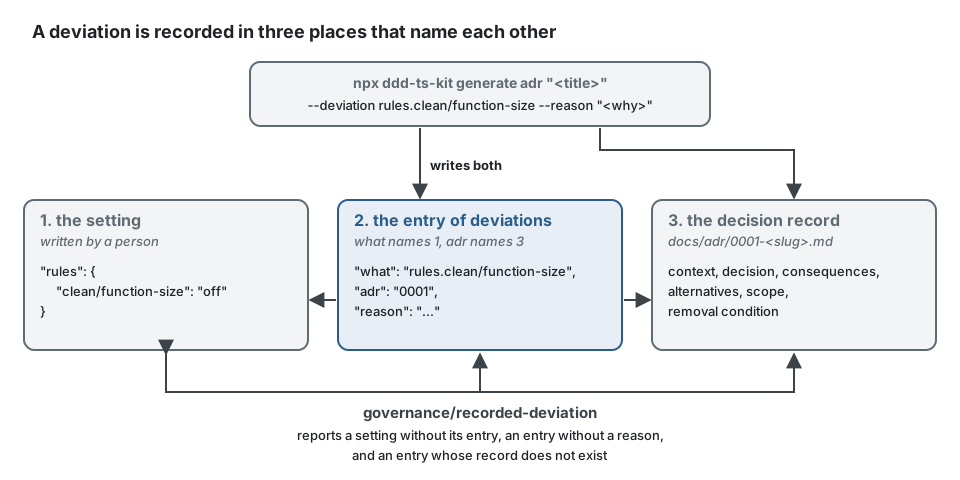
A worked example. A team turns clean/function-size off, and check asks why:
"rules": { "clean/function-size": "off" }$ npx ddd-ts-kit check --rule governance/recorded-deviationddd-ts-kit.config.json:57 error governance/recorded-deviation The rule "clean/function-size" is lowered to "off", and no deviation records why. fix: Restore the default, or add { "what": "rules.clean/function-size", "adr": "NNNN", "reason": "<why>" } to "deviations" in ddd-ts-kit.config.json and write docs/adr/NNNN-<slug>.md (context, what is deviated from, why, scope, condition for removing it).One command records the decision:
npx ddd-ts-kit generate adr "Long mapping functions in the billing adapters" \ --deviation rules.clean/function-size \ --reason "The generated mappers of the legacy ledger are long and regenerated, never edited."It writes docs/adr/0001-long-mapping-functions-in-the-billing-adapters.md, with its context
opened with the reason, and a TODO(domain) in every section a person completes (the context
included, then decision, consequences, alternatives, scope, removal condition), and adds the
entry:
"deviations": [ { "what": "rules.clean/function-size", "adr": "0001", "reason": "The generated mappers of the legacy ledger are long and regenerated, never edited." }]check --rule governance/recorded-deviation then reports nothing. An entry without a reason, or whose adr names a record that
docs/adr/ does not hold, is reported too. A suppression comment in the code follows the same
rule: // ddd-ts-kit-disable-next-line <rule> -- ADR-0001: <reason>.
Coverage thresholds
Section titled “Coverage thresholds”The test runner config writes no number: it spreads governedCoverage(mode) (governedJestCoverage()
under jest) of @ddd-ts-kit/testing/coverage, which reads the coverage key each time a run
starts. One place holds a threshold, and check holds that place.
Instead of writing a number in the runner config, which test/coverage-governed refuses:
export default defineConfig({ test: { coverage: { provider: 'v8', thresholds: { branches: 80 } } },});write what init writes, the measure and the floors read from the config file:
import { governedCoverage } from '@ddd-ts-kit/testing/coverage';import { defineConfig } from 'vitest/config';
export default defineConfig(({ mode }) => ({  test: {    coverage: {      provider: 'v8',      // What is measured and the floor of each layer come from "coverage" in ddd-ts-kit.config.json.      ...governedCoverage(mode),    },  },}));
Under jest, export default { coverageProvider: 'v8', ...governedJestCoverage() };. In the
example application, governedCoverage('unit') measures three layers of every context and gives
one floor per context and layer that holds a source file; here those of its first context,
analytics, at the reference, since the example sets no coverage:
{ "include": ["src/contexts/*/domain/**/*.ts", "src/contexts/*/application/**/*.ts", "src/contexts/*/presentation/**/*.ts"], "thresholds": { "src/contexts/analytics/domain/**/*.ts": { "statements": 90, "branches": 85, "functions": 90, "lines": 90 }, "src/contexts/analytics/application/**/*.ts": { "statements": 85, "branches": 80, "functions": 85, "lines": 85 }, "src/contexts/analytics/presentation/**/*.ts": { "statements": 80, "branches": 70, "functions": 80, "lines": 80 } }}The coverage key raises or lowers a floor; a floor under the reference comes with its
deviation:
"coverage": { "domain": { "branches": 95 }, "infrastructure": { "branches": 50 } },"deviations": [ { "what": "coverage.infrastructure.branches", "adr": "0011", "reason": "The failure branches of the driver are held by its contract suite." }]| Layer | Reference (statements, branches, functions, lines) | Why this floor |
|---|---|---|
domain |
90, 85, 90, 90 | the highest: pure code that needs no double and holds the rules of the business; nothing but a missing test keeps a line from running |
application |
85, 80, 85, 85 | handlers orchestrate through ports, each with a fake: every path is reachable, a few are wiring |
presentation |
80, 70, 80, 80 | mapping and status translation; the error paths of a transport are also held by the end-to-end specs, which are not measured |
infrastructure |
70, 60, 70, 70 | the lowest: the failure branches of a driver are hard to provoke and are not the adapter's to prove; what an adapter promises is held by the contract suites of the integration specs |
- Raising a rate is free. Lowering one under the reference is a deviation (
governance/recorded-deviation) with its decision record. - Each context is held on its own: the thresholds of a layer apply to
contexts/<name>/<layer>/of every context, so a well tested context does not hide another. - An empty layer is held to nothing, and to its threshold from its first source file (a spec or a document is not one). A project just initialised passes; the first route of a context brings the presentation floor with it.
- A run is held to the layers it executes:
npm run test:coverage, the run ofverify, executes every spec and measures the four layers; in the pipelineci:test:unit(--mode unit) measures domain, application and presentation,ci:test:integration(--mode integration) measures infrastructure. Jest runs every spec in one run. - The measure cannot be narrowed quietly (
test/coverage-governed): noinclude,excludeorthresholdsby hand in the runner config, no such flag in a script, nov8 ignoreoristanbul ignorecomment without-- ADR-NNNN: <reason>. - Under the legacy decorator mode the generated Vitest config lists
decoratorCoverage()of@ddd-ts-kit/testing/vitest: the statements the transform writes to apply decorators hold a branch per named type that no test can take, and are kept out of the measure.
Limits
Section titled “Limits”The parser is tolerant: a key it does not know is ignored without a message, and a wrong
classification, relationship, rule id, guard mode, import extension or coverage rate is reported by check as config/valid,
not when the file is read. Only a wrong stack.* value, or a file that is not a JSON object,
stops a command.