
@ddd-ts-kit/events
Integration events between bounded contexts, independent of any broker: typed declarations, a registry, validated publication and consumption, a transactional outbox, and the AsyncAPI document and event catalog generated from the declarations.
npm i @ddd-ts-kit/events @ddd-ts-kit/validation zod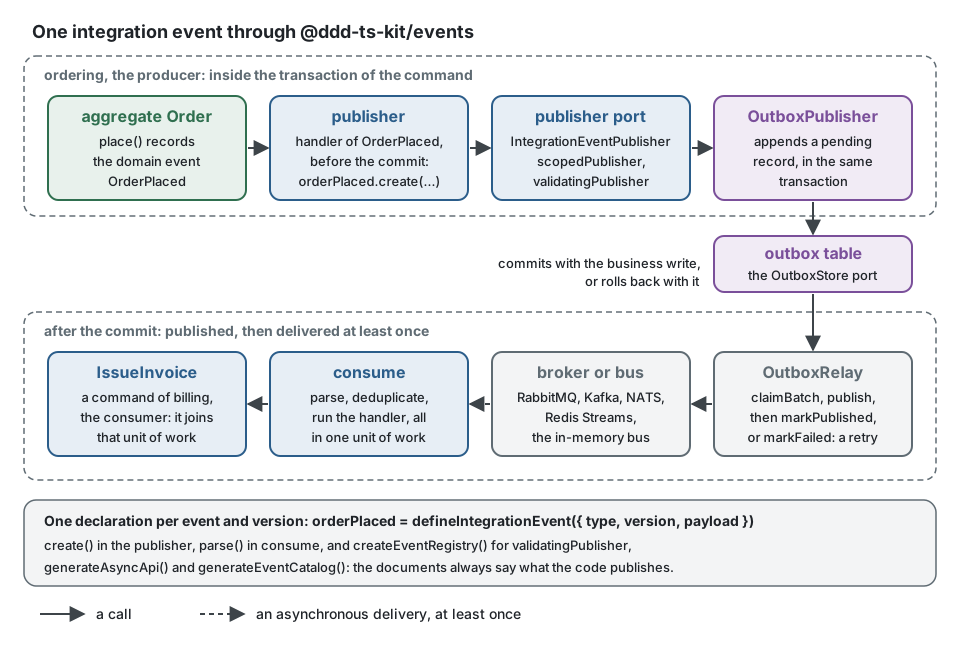
What is in the package
Section titled “What is in the package”| Step | What it is for | Exports |
|---|---|---|
| Declare | the contract of one event and version, owned by the producer | defineIntegrationEvent, PayloadOf |
| Register | every event a system publishes, to validate what goes out and to generate the documents | createEventRegistry, EventRegistry, validatingPublisher |
| Store | write the event in the transaction of the command | OutboxPublisher, the OutboxStore port, InMemoryOutboxStore |
| Relay | publish what was stored, after the commit, with retries | OutboxRelay, the RelaySignal port, InMemoryRelaySignal |
| Consume | typed, validated, deduplicated handling | consume, on, subscribeAll |
| Document | the AsyncAPI document and the event catalog | generateAsyncApi (@ddd-ts-kit/events/asyncapi), generateEventCatalog |
The concepts behind it are in The transactional outbox, Delivery and idempotency and Event versioning.
The whole loop in one process
Section titled “The whole loop in one process”Everything below is in memory, so it runs as it is: one declaration, a consumer, the outbox, the relay, and a redelivery the consumer absorbs. A real application swaps the in-memory pieces for its database and its broker; the code of the producer and of the consumer does not change.
import { z } from 'zod';import { zodSchema } from '@ddd-ts-kit/validation/zod';import { InMemoryEventBus, InMemoryProcessedEventStore, InMemoryUnitOfWork, SystemClock } from '@ddd-ts-kit/kernel';import {  consume,  defineIntegrationEvent,  InMemoryOutboxStore,  OutboxPublisher,  OutboxRelay,  subscribeAll,} from '@ddd-ts-kit/events';
// 1. The contract, declared once by the producer.const orderPlaced = defineIntegrationEvent({  type: 'ordering.order.placed',  version: 1,  payload: zodSchema(z.object({ orderId: z.string(), total: z.number().int() })),});
// 2. A consumer of another context: deduplicated, in one unit of work.const bus = new InMemoryEventBus();const invoiced: string[] = [];
subscribeAll(bus, [  consume(    orderPlaced,    {      consumer: 'billing.invoice-on-order-placed',      processed: new InMemoryProcessedEventStore(),      unitOfWork: new InMemoryUnitOfWork(),    },    async (event) => {      invoiced.push(event.payload.orderId); // typed: { orderId: string; total: number }    },  ),]);
// 3. The producer only stores: nothing leaves yet.const store = new InMemoryOutboxStore();const event = orderPlaced.create({ orderId: 'order-1', total: 3000 }, { id: 'evt-1', occurredAt: new Date() });
await new OutboxPublisher(store).publish([event]);console.log(await store.stats()); // { pending: 1, failed: 0, dead: 0 }
// 4. The relay publishes what was stored, then marks it published.const relay = new OutboxRelay({ store, publisher: bus, clock: new SystemClock() });
console.log(await relay.tick()); // { published: 1, failed: 0 }
// 5. The same event delivered again is absorbed by the consumer.await bus.publish([event]);console.log(invoiced); // [ 'order-1' ]
The sections below take each step in turn, as a real application writes it.
Declare
Section titled “Declare”One declaration per event and version, in the producer's published-language/. It gives the
payload type, validates what is published and consumed, and feeds the generators.
import { z } from 'zod';import { zodSchema } from '@ddd-ts-kit/validation/zod';import { defineIntegrationEvent, type PayloadOf } from '@ddd-ts-kit/events';
export const orderPlaced = defineIntegrationEvent({  type: 'ordering.order.placed', // <context>.<aggregate>.<fact>, kebab-case segments  version: 1,  description: 'An order was placed by a customer.',  payload: zodSchema(    z.object({      orderId: z.string().describe('Identifier of the order.'),      total: z.object({ amount: z.number().int(), currency: z.enum(['EUR', 'USD']) }),      lines: z.array(z.object({ sku: z.string(), quantity: z.number().int().positive() })),    }),  ),});
export type OrderPlaced = PayloadOf<typeof orderPlaced>;
The type is checked when the module loads: three kebab-case segments, <context>.<aggregate>.<fact>,
and a positive integer version, or defineIntegrationEvent throws InvalidEventDefinitionError.
The producer is the first segment of the type unless producer names it. The declaration then
answers three questions, one per side:
| Member | Side | What it does |
|---|---|---|
create(payload, { id, occurredAt, correlationId?, traceparent? }) |
producer | validates the payload and builds the envelope; throws InvalidEventPayloadError, because publishing an invalid event is a bug |
parse(event) |
consumer | checks type, version and payload and answers a Result; never throws |
is(event) |
either | a cheap guard on type and version only, for a payload already trusted |
A breaking change is a new declaration with version: 2; mark the old one deprecated: true
and keep publishing both until the consumers have moved. Instead of changing the payload of
version: 1 under the feet of its consumers:
import { z } from 'zod';import { zodSchema } from '@ddd-ts-kit/validation/zod';import { defineIntegrationEvent } from '@ddd-ts-kit/events';
// `amount` renamed `minorUnits`, any ISO currency accepted: a consumer of version 1 would break, so a new version.export const orderPlacedV2 = defineIntegrationEvent({  type: 'ordering.order.placed',  version: 2,  description: 'An order was placed by a customer.',  payload: zodSchema(    z.object({      orderId: z.string(),      total: z.object({ minorUnits: z.number().int(), currency: z.string().length(3) }),    }),  ),});
// order-placed.v1.integration-event.ts keeps its payload and gains `deprecated: true`;// the publisher publishes both versions until no consumer reads version 1.
A consumer subscribed to version 1 skips version 2 and the other way round, so both live side by side. The AsyncAPI document lists both versions on the channel of the type, and the catalog marks the deprecated one.
Publish through the outbox
Section titled “Publish through the outbox”A publisher is a handler of a domain event of its own context: it maps the fact to the public
payload and publishes to an IntegrationEventPublisher, knowing nothing else. With a
database, that publisher is the OutboxPublisher: it only stores. Domain events are dispatched
at the end of the unit of work of the command, before its commit (the before-commit phase,
the default), so the integration event commits or rolls back with the business write: the
relay publishes it after the commit, never for a command that rolled back. A publisher is
never declared phase: 'after-commit': the transaction that would hold its outbox row is over.
import { IdGenerator, IntegrationEventPublisher } from '@ddd-ts-kit/kernel';import { DomainEventHandler } from '@ddd-ts-kit/kernel/declarations';
@DomainEventHandler(OrderPlacedEvent)export class OrderPlacedPublisher implements DomainEventHandler<OrderPlacedEvent> {  constructor(    private readonly publisher: IntegrationEventPublisher,    private readonly ids: IdGenerator,  ) {}
  async handle(event: OrderPlacedEvent): Promise<void> {    const published = orderPlaced.create(      { orderId: event.aggregateId, total: event.total, lines: event.lines },      { id: this.ids.next(), occurredAt: event.occurredAt },    ); // throws InvalidEventPayloadError: publishing an invalid event is a bug
    await this.publisher.publish([published]);  }}
The correlation id is not passed by hand: scopedPublisher stamps it (see "The execution
context of a consumed event").
The publisher knows the port, never the transport. Instead of talking to a broker from the handler, which sends the event even when the transaction then rolls back:
// Reported by events/outbox-required: the event leaves before the commit, or without it.export class OrderPlacedPublisher { constructor(private readonly bus: RabbitMqEventBus) {}}write to IntegrationEventPublisher, as above, and let the composition root decide where it
goes. The rule events/outbox-required reports two things. In domain/ or application/, an
import of a broker client, of any event bus (the EventBus port of the kernel included), of
OutboxRelay, of OutboxPublisher or of OutboxStore. In application/integration/publishers/,
a constructor parameter typed as a bus or a relay (a type whose name ends in EventBus or
Relay): the sample above is reported this way, import or not.
The composition root binds the store under its port, OutboxStore, and hands the outbox to
the kernel module as the publisher handlers use. Ports are abstract classes and the class is
what a module binds and resolves:
import { defineContextModule } from '@ddd-ts-kit/di';import { OutboxStore } from '@ddd-ts-kit/events';
export const messagingModule = defineContextModule({ name: 'messaging', register(builder) { // The adapter of your database, or InMemoryOutboxStore in a single process. builder.bind(OutboxStore).toClass(SqlOutboxStore, [Database]); },});import { createApplication, kernelModule, type ContextModule } from '@ddd-ts-kit/di';import { Clock, ExecutionScope, Logger, scopedPublisher, type IntegrationEventPublisher } from '@ddd-ts-kit/kernel';import { createEventRegistry, OutboxPublisher, OutboxRelay, OutboxStore, validatingPublisher, type AnyIntegrationEventDefinition,} from '@ddd-ts-kit/events';
// Written elsewhere in the project.declare const persistenceModule: ContextModule, messagingModule: ContextModule, orderingModule: ContextModule;declare const orderPlaced: AnyIntegrationEventDefinition, invoiceIssued: AnyIntegrationEventDefinition;declare const broker: IntegrationEventPublisher; // the real provider: a broker adapter, or the in-memory bus
const registry = createEventRegistry([orderPlaced, invoiceIssued]);
const app = createApplication({ modules: [ kernelModule({ // What handlers publish to: the outbox, behind the registry, with the correlation stamped. eventPublisher: (resolve) => scopedPublisher( validatingPublisher(new OutboxPublisher(resolve(OutboxStore)), registry, { unknown: 'reject' }), resolve(ExecutionScope), ), }), persistenceModule, messagingModule, orderingModule, ],});const logger = app.resolve(Logger);
const relay = new OutboxRelay({ store: app.resolve(OutboxStore), publisher: broker, clock: app.resolve(Clock), maxAttempts: 8, onFailure: (failure) => logger.warn('outbox relay failure', { ...failure }), // codes only, never an error message});relay.start({ intervalMs: 500 });process.on('SIGTERM', () => void relay.stop()); // waits for the tick in progressGive the outbox to kernelModule({ eventPublisher }) rather than rebinding
IntegrationEventPublisher in a later module: the instrumentation of the kernel module wraps
the publisher it binds, and only that one, so a publisher rebound elsewhere has no
outbox append span and stores no traceparent with its events.
An adapter implements OutboxStore and never extends it: the port has abstract members only.
Without a container the same objects are built by hand:
new OutboxPublisher(store), new OutboxRelay({ store, publisher: broker, clock }).
The outbox also carries the purge requests of the HTTP caches (CacheInvalidation of the
kernel): the relay publishes through new PurgingPublisher(purger, broker), which hands them to
the CachePurger instead of the broker. See "Cache tags and purge after the commit" in the
README of @ddd-ts-kit/http.
relay.tick() claims a batch, publishes each event, marks it published, or schedules a retry
with an exponential backoff; after maxAttempts the record is dead until
store.retryDead(ids, now). store.stats() gives { pending, failed, dead } for a health
check, store.purgePublished(before) keeps the table small.
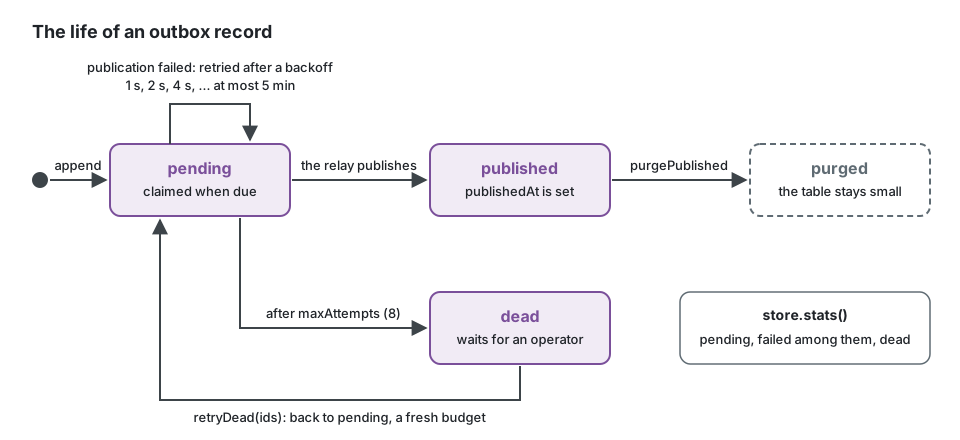
The relay publishes the records of a batch one by one, so one event the provider refuses does
not fail its neighbours. With the defaults (baseMs: 1000, factor: 2, maxMs: 300000,
maxAttempts: 8) a record that always fails goes like this:
| Attempt that failed | Next attempt | onFailure receives |
|---|---|---|
| 1 | 1 s later | { kind: 'publish', eventId, eventType, code, attempts: 1, dead: false } |
| 2 | 2 s later | attempts: 2, dead: false |
| 3 to 7 | 4, 8, 16, 32, then 64 s later | attempts from 3 to 7, dead: false |
| 8 | none: the record is dead |
attempts: 8, dead: true |
The delay is min(maxMs, baseMs * factor ** (attempts - 1)); pass backoff: { baseMs, factor, maxMs }
to change it. code is the code of the error when it is shaped like an identifier, else its
class name: never its message, which may quote the payload, so onFailure can be logged as it
is.
Tracing across the outbox. The envelope carries traceparent, and every outbox store
persists and restores it exactly (the contract suite checks it). With
kernelModule({ instrumentation: traceApplication(), eventPublisher: outbox }) the context of
the request is stamped when the event is appended, and new OutboxRelay({ store, publisher: tracedPublisher(broker), clock })
continues that trace when it publishes later: the relay has no span of its own, and a tick
that publishes nothing makes none. OutboxPublisher names itself messagingSystem: 'outbox',
which validatingPublisher and scopedPublisher pass on. See the README of
@ddd-ts-kit/tracing.
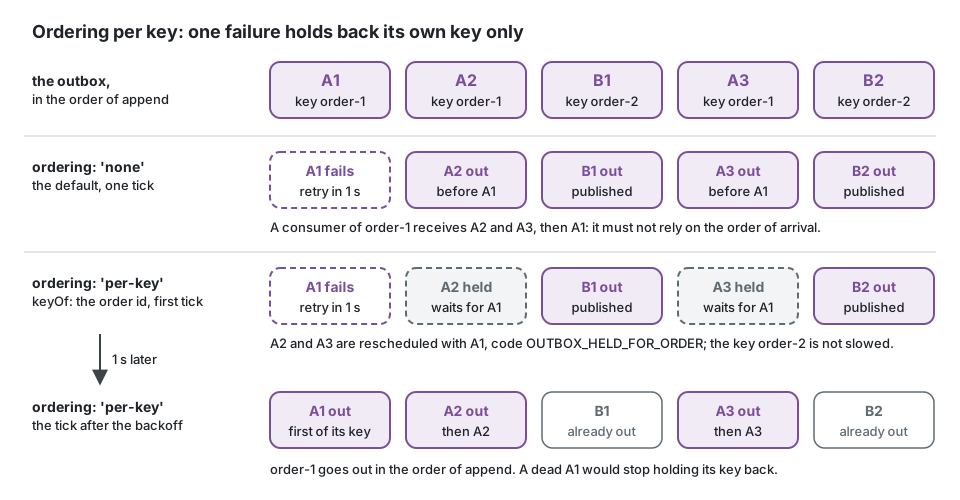
Delivery is at least once. By default ordering is not guaranteed, not even per aggregate: a failed event is retried while its successors go out, and several relays may run side by side. When order matters, carry a sequence or a version in the payload, or ask the relay for it (below).
Waking the relay instead of polling fast
Section titled “Waking the relay instead of polling fast”A relay can sleep on a long interval and still publish at once, when the store tells it that
something was appended. wakeOn takes a RelaySignal, a port of one method
(subscribe(listener): { unsubscribe() }): PostgreSQL LISTEN/NOTIFY, a change stream,
or InMemoryRelaySignal in a single process. A module binds it like the store,
builder.bind(RelaySignal).toClass(PostgresRelaySignal, [Database]), and the relay takes
wakeOn: app.resolve(RelaySignal).
const signal = new InMemoryRelaySignal();const store = new InMemoryOutboxStore({ signal }); // notifies after each appendconst relay = new OutboxRelay({ store, publisher: broker, clock, wakeOn: signal });relay.start({ intervalMs: 30_000 }); // the interval is now only the safety netBursts are coalesced: one tick runs, at most one more is queued, whatever the number of
notifications. Polling stays as the safety net: a signal is a hint, and a notification
missed while the listener reconnects or the process restarts must only delay the publication
until the next interval, never lose it. So keep intervalMs at the longest delay you accept
for that case, and never rely on the signal alone. A transactional store must notify after
the commit (PostgreSQL does it by itself: NOTIFY is delivered at commit).
Ordering per key
Section titled “Ordering per key”const relay = new OutboxRelay({ store, publisher: broker, clock, ordering: 'per-key', keyOf: (event) => (orderPlaced.is(event) ? event.payload.orderId : undefined),});With ordering: 'per-key' a record is never published while an earlier record with the same
key is still pending or failed. The price is head-of-line blocking: one event that cannot be
published holds back every later event of its key (and only of its key) until it goes out or
is dead. Events for which keyOf gives undefined are not ordered.
What it relies on, and what it does not give:
- Run a single relay. The memory of which record blocks which key lives in the relay, not
in the store: the
OutboxStoreport is unchanged, andclaimBatchalone cannot tell that an earlier record is waiting for its retry. Two relays side by side publish concurrently. - A restart forgets it. If the process restarts while a record is in backoff or leased, a later record of the same key that becomes due first is published first, once. Strict ordering across restarts needs the key stored with the record and a claim that skips keys with an earlier unpublished row: a change of the port and of the table, not done here.
- A record held back is rescheduled with the head of its key and shows in
stats().failedwith the codeOUTBOX_HELD_FOR_ORDER; the claims it spends waiting are not counted as delivery attempts by this relay. - A dead record stops blocking its key (
onFailurereports it withdead: true). SetmaxAttempts: Infinityif a key must rather stay blocked than skip an event. - The broker and the consumer must keep the order too: one partition or one queue with a single active consumer per key, and a consumer that does not retry out of order.
An OutboxStore leases what it hands out: claimBatch hides the claimed records for the
lease of the store, so a relay that dies lets them come back. Adapters are held to
outboxStoreContract of @ddd-ts-kit/testing/contracts.
Consume idempotently
Section titled “Consume idempotently”With @ddd-ts-kit/di, a declared integration event handler is idempotent with nothing to
write: its idempotency mark and its work run in one unit of work whenever a UnitOfWork and a
ProcessedEventStore are bound, which kernelModule() does. The composition root builds no
handler by hand:
import { CommandBus, type IntegrationEvent } from '@ddd-ts-kit/kernel';import { IntegrationEventHandler } from '@ddd-ts-kit/kernel/declarations';import { orderPlaced, type OrderPlaced } from '@/contexts/ordering/published-language/index';
@IntegrationEventHandler(orderPlaced, { consumer: 'billing.invoice-on-order-placed' })export class InvoiceOnOrderPlaced {  constructor(private readonly commands: CommandBus) {}
  async handle(event: IntegrationEvent<OrderPlaced>): Promise<void> {    await this.commands.execute(new IssueInvoice(event.payload.orderId, event.payload.total));  }}
consume is the tool of a project that wires without di. Instead of subscribing a plain
callback, which handles a redelivered event a second time and issues a second invoice:
// Reported by events/consumer-idempotent in application/ and in the module file:// no consumer name, no processed-event store, and a payload neither typed nor validated.subscriber.subscribe(orderPlaced.type, async (event) => { const { orderId, total } = event.payload as OrderPlaced; await commandBus.execute(new IssueInvoice(orderId, total));});give the same semantics as the declared handler to a plain function:
import { consume, subscribeAll } from '@ddd-ts-kit/events';
export const billingSubscriptions = ({ commandBus, processed, unitOfWork }: BillingDependencies) => [  consume(orderPlaced, { consumer: 'billing.invoice-on-order-placed', processed, unitOfWork }, async (event) => {    await commandBus.execute(new IssueInvoice(event.payload.orderId, event.payload.total));  }),];
// main.tsconst subscription = subscribeAll(subscriber, billingSubscriptions(dependencies));
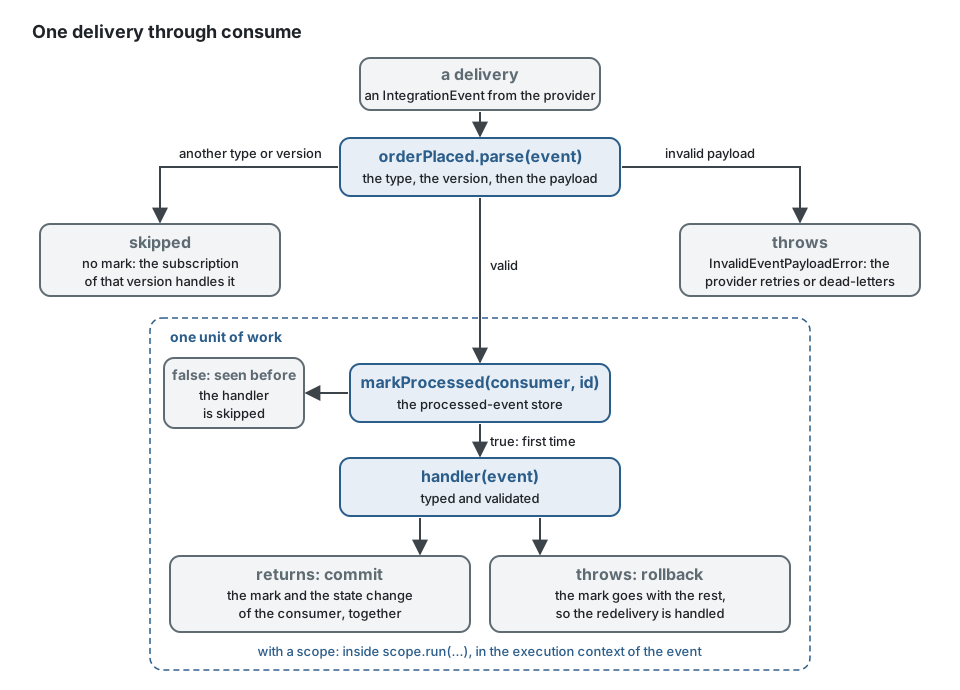
The handler receives a typed, validated event. An event of another version of the same type is skipped (subscribe to it with its own declaration); an invalid payload throws, so the provider retries or dead-letters.
consume runs the deduplication and the handler in one unit of work: the mark in the
processed-event store and the state change of the consumer commit together. A redelivery is
handled once per consumer, and an event whose handler threw is handled again when it comes
back, because its mark was rolled back with the rest. The command bus middleware joins that
unit of work (a nested run joins the outer transaction), so the handler needs nothing
special.
The consumer name is the idempotency scope: two consumers of the same event each handle it
once, and renaming a consumer makes it handle again every event it is redelivered. Write it
once, as <context>.<reaction>, and never derive it.
on(definition, handler, { consumer, processed, unitOfWork }) is the same thing with
optional parts, for a consumer that needs no deduplication or has no transaction. Mind one
case: with processed and no unitOfWork, the mark is taken before the handler runs. If the
handler then fails, a transactional store keeps the mark (it was committed on its own) and the
redelivery is skipped: the event is lost for that consumer. Without a database, use a store
that can take its mark back, a ReleasableProcessedEventStore such as the
InMemoryProcessedEventStore of the kernel: on and consume release the mark of a handler
that failed. ReleasableProcessedEventStore is a type, not a port of its own: it is the
ProcessedEventStore port of the kernel with its optional release made mandatory, and such
a store is bound under ProcessedEventStore.
The execution context of a consumed event
Section titled “The execution context of a consumed event”consume and on take the ExecutionScope of the kernel and run everything, the unit of
work and the idempotency mark included, inside it:
consume(orderPlaced, { consumer: 'billing.invoice-on-order-placed', processed, unitOfWork, scope }, handler);| Field of the context | Value |
|---|---|
origin |
event |
correlationId |
the correlationId of the event, or its id when it names none |
causationId |
the id of the event |
actor |
systemActor(consumer), unless actorOf(event) answers one |
tenantId |
the tenantId of the event, when it names one: the consumer reads and writes in that tenant only |
So the repositories of the consuming context stamp audit columns with
system:billing.invoice-on-order-placed, and a log line of the consumer carries the correlation
of the request that started it all. The envelope carries no actor by default, on purpose: an
actor is personal data, and a broker keeps messages. A project that decides to put a reference
in its own payload or envelope maps it with actorOf: (event) => Actor | undefined.
On the publishing side, scopedPublisher of the kernel fills the correlation in, and the
tenant of the work in progress, so use cases never pass them by hand. It is the outer wrapper
of the publisher given to kernelModule in main.ts above:
eventPublisher: (resolve) => scopedPublisher(new OutboxPublisher(resolve(OutboxStore)), resolve(ExecutionScope)),An event created with a correlationId or a tenantId keeps it; one published outside of any
execution context is left as it is. It is a decorator, not an option of OutboxPublisher or of
defineIntegrationEvent(...).create: both stay pure, and the stamp applies to every provider.
Generate the AsyncAPI document and the catalog
Section titled “Generate the AsyncAPI document and the catalog”import { readFile, writeFile } from 'node:fs/promises';import { generateEventCatalog, type EventRegistry } from '@ddd-ts-kit/events';import { checkAsyncApiDrift, generateAsyncApi, stringifyAsyncApi } from '@ddd-ts-kit/events/asyncapi';
declare const registry: EventRegistry; // createEventRegistry([...every published declaration])
const document = generateAsyncApi({ info: { title: 'Shop events', version: '1.4.0' }, registry, servers: { production: { host: 'broker.example.com:5671', protocol: 'amqps' } },});await writeFile('docs/integration/asyncapi.json', stringifyAsyncApi(document));await writeFile( 'docs/integration/event-catalog.md', generateEventCatalog(registry, { consumers: { 'ordering.order.placed': ['billing', 'shipping'] } }),);
// In CI: fail when the committed file is stale.if (checkAsyncApiDrift(document, await readFile('docs/integration/asyncapi.json', 'utf8')).drift) { process.exit(1);}stringifyAsyncApi writes two-space JSON. A project generated by the CLI commits
docs/integration/asyncapi.yaml instead, written by stringifyContract(document, 'yaml') of
ddd-ts-kit/dist/contracts.js in its scripts/events.ts (openapi.format: json of its config
keeps JSON).
The AsyncAPI 3.0.0 document has one channel per event type (its address is the type), one
message per version whose payload is the envelope (id, type, version, occurredAt,
payload, traceparent, correlationId), and one send operation per channel. The catalog
is Markdown: one section per producer, a table of versions per event, and the payload fields
flattened (customer.email, lines[].sku). Both outputs depend only on the declarations,
never on their registration order, so they can be committed and diffed.
A project generated by the CLI has this script as scripts/events.ts, with the same two
paths.
Choosing the strategy for your transport
Section titled “Choosing the strategy for your transport”The rule is one, whatever the tools: the handler writes the event to the outbox in the transaction of the command, a relay publishes it afterwards, the consumer deduplicates. What changes with the transport is how the relay runs and what the consumer side must do.
| Transport | Relay | Consumer side |
|---|---|---|
| same process, no broker | polling relay to the in-memory bus (or woken by the database: PostgreSQL LISTEN/NOTIFY) |
processed-event store in the consumer's transaction |
| RabbitMQ and other queue brokers | polling relay publishing with publisher confirms, mark published on confirm | durable queue per consumer, manual ack after commit, dead-letter exchange after bounded retries |
| Kafka and other logs | polling relay, or change data capture reading the outbox table (Debezium outbox router); key = aggregate id for per-aggregate order | consumer group per consumer, offset committed after the handler's transaction, processed-event store for redelivery |
| cloud queues and topics (SQS/SNS, Pub/Sub) | polling relay, batch publish | visibility timeout above the handler's worst case, redrive policy to a dead-letter queue |
Without a database there is nothing to be atomic with: publish to the bus directly, no outbox.
The kit has a provider package for RabbitMQ (@ddd-ts-kit/rabbitmq), Kafka
(@ddd-ts-kit/kafka), NATS JetStream (@ddd-ts-kit/nats) and Redis Streams
(@ddd-ts-kit/redis/event-bus); each README says how it meets the requirements below and what it does
not guarantee.
Same process, no broker
Section titled “Same process, no broker”- Relay mode.
OutboxRelaypublishing to theInMemoryEventBus. Wake it withwakeOn(the in-memory signal, orLISTEN/NOTIFYon PostgreSQL) and keep a long interval as the safety net. - Publisher requirements. None beyond the port. The in-memory bus runs the handlers inside
publishand rejects when one fails: the relay then retries the record, so the retry policy of the consumers IS the backoff of the relay. - Consumer requirements.
consumewith the processed-event store and the unit of work of the consuming context. A redelivery runs every handler of the type again, so every one of them deduplicates. - Ordering.
per-keygives it here with nothing else to set up: one relay, one process, handlers awaited in order (the restart caveat of the relay still applies). - Dead-lettering. The outbox is the dead-letter store: a record is
deadaftermaxAttempts, and comes back withstore.retryDead(ids, now). - Monitor.
stats():dead > 0is an alert;failedrising means a consumer keeps failing; the age of the oldest pending record is the delivery delay.
Queue brokers (RabbitMQ, ActiveMQ)
Section titled “Queue brokers (RabbitMQ, ActiveMQ)”- Relay mode. Polling or woken relay. The record is marked published only when the broker confirmed it.
- Publisher requirements.
publishmust resolve only on the confirmation of the broker (publisher confirms) and reject otherwise, with durable exchanges and persistent messages. A confirmation lost after the broker took the message makes the relay publish it again: duplicates are expected.@ddd-ts-kit/rabbitmqimplements this row. - Consumer requirements. One durable queue per consumer and event type, manual
acknowledgement after the unit of work of the handler committed,
consumefor the deduplication. Never acknowledge before the commit. - Ordering. None by default: retries and competing consumers reorder. Per key only with
the
per-keyrelay AND a single active consumer on the queue AND no retry queue, which is rarely worth it; prefer a version in the payload. - Dead-lettering. Two places. Publishing side: the outbox (
dead,retryDead). Consuming side: a bounded number of delayed retries, then a dead queue per consumer queue. - Monitor. Outbox
stats(), and on the broker the depth of each work queue (a consumer that lags), of each dead queue (must be empty) and the unacknowledged count.
Logs (Kafka, Redpanda, Pulsar, Kinesis)
Section titled “Logs (Kafka, Redpanda, Pulsar, Kinesis)”- Relay mode. Polling relay, or change data capture (below).
- Publisher requirements. Idempotent producer with
acks=all;publishresolves on the acknowledgement of the write. The message key is the aggregate id, so one aggregate lives in one partition. Topic per event type or per context, chosen once. - Consumer requirements. One consumer group per consuming context. The offset is committed after the transaction of the handler, never before; a crash in between redelivers, hence the processed-event store. A handler that keeps failing blocks its partition: retry in place a bounded number of times, then publish the record to a dead-letter topic and commit.
- Ordering. Per partition, so per key, provided the relay keeps it:
ordering: 'per-key'withkeyOfreturning the same aggregate id, a single relay, andmax.in.flight.requests.per.connectionat most 5 with idempotence on. - Dead-lettering. Outbox on the publishing side, a dead-letter topic per consumer group on the consuming side.
- Monitor. Outbox
stats(), consumer lag per group and partition, dead-letter topic size.
Cloud queues and topics (SQS/SNS, Pub/Sub)
Section titled “Cloud queues and topics (SQS/SNS, Pub/Sub)”- Relay mode. Polling relay. Batch publication (10 entries per call on SQS and SNS) is allowed, but the result is per entry: publish, then reject if any entry failed, so the relay retries; the entries that did pass are published twice, which the consumer absorbs.
- Publisher requirements. Topic with one subscription (queue) per consumer.
publishresolves on the service acknowledgement. Message attributes carry type, version and trace. - Consumer requirements. Visibility timeout (ack deadline) above the worst case of the
handler, extended while it runs if needed; delete (ack) the message after the commit.
consumefor the deduplication: these services redeliver by design. - Ordering. None on standard queues. FIFO queues and ordering keys give it per message
group, at a throughput cost, with the
per-keyrelay and the group id =keyOf. - Dead-lettering. Outbox on the publishing side; a redrive policy (
maxReceiveCount) to a dead-letter queue per consumer queue. - Monitor. Outbox
stats(), age of the oldest message per queue, dead-letter queue depth.
What to monitor on the outbox
Section titled “What to monitor on the outbox”store.stats() gives { pending, failed, dead }; expose them as gauges.
| Signal | Meaning | Reaction |
|---|---|---|
dead > 0 |
records gave up after maxAttempts |
alert; fix the cause, then retryDead |
failed > 0 for long |
the provider refuses or is down; under per-key, held records count here too (OUTBOX_HELD_FOR_ORDER) |
look at the codes given to onFailure |
pending growing |
the relay is slower than the producers, or stopped | check that it runs; raise batchSize |
| age of the oldest pending record | the real delivery delay | alert above your tolerance; it is one query on the table (min(created_at) where status = 'pending'), stats() does not carry it |
onFailure({ kind: 'tick' }) |
the store itself failed | database health |
Purge published records regularly (purgePublished(before)), or the table and its index grow
without bound.
Where change data capture fits
Section titled “Where change data capture fits”Change data capture (Debezium and its outbox event router, or a logical replication reader) replaces the relay, never the table. Handlers still write the event to the outbox table in the transaction of the command; instead of a process polling that table, the capture reads the same rows from the transaction log of the database and publishes them, in commit order. Consequences:
- nothing changes in the handlers, in
OutboxPublisheror in the consumers; - do not run an
OutboxRelayon the same table for the same destination: one or the other; status,attemptsandnext_attempt_atare no longer maintained: retries and failures are those of the connector, so monitor the connector (lag, failed tasks) instead ofstats(), and purge by age;- the event router must map the columns:
idto the message id,typeto the topic or routing key, the aggregate id to the message key,payloadand the trace columns to the body and headers, so the consumer receives the same envelope as from the relay; - ordering per key comes for free (the log is ordered), which is the main reason to choose it.
Writing to the broker from the handler and "capturing" the business tables instead is not this pattern: it publishes rows, not events, and couples consumers to the schema.