
HTTP frameworks: Express, Fastify, Hono, NestJS
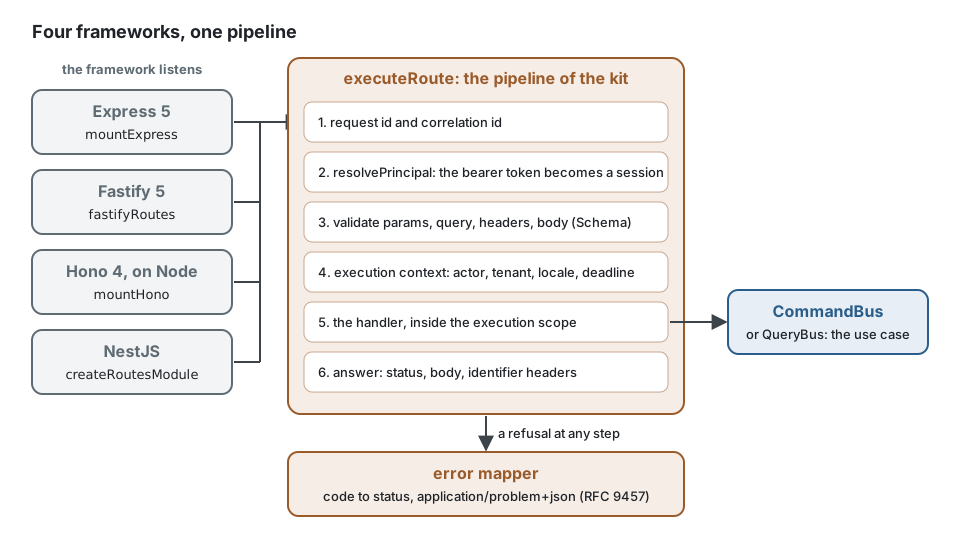
Summary. In this kit a route is declared once, as data plus a handler, and mounted on
Express 5, Fastify 5, Hono 4 (on Node) or NestJS by an adapter of @ddd-ts-kit/http. All four
go through the same pipeline (validation, handler, error mapping), so the framework decides how
the server is operated, not how a use case is reached. Which framework goes with which
validation library, with measured numbers, is in contract pairs. The choice therefore rests on the team's habits, the
ecosystem it needs and how much of the framework it is ready to leave unused. With NestJS the
price of framework-agnostic routes is the highest: they bypass most of what makes a Nest
controller a Nest controller.
What the framework is asked to do here
Section titled “What the framework is asked to do here”The presentation layer is thin by rule (layer/presentation-no-infrastructure,
authz/in-application in ARCHITECTURE.md): a route validates the shape of
its input, builds a command or a query carrying the actor, sends it on a bus and maps the
answer. In the running domain:
The route is written once, as data plus a handler, and knows no framework:
import { z } from 'zod';import { acceptedSchema, defineRoute, defineRoutes } from '@ddd-ts-kit/http';import { AuthorizedCommand, type Actor, type CommandBus } from '@ddd-ts-kit/kernel';import { zodSchema } from '@ddd-ts-kit/validation/zod';
// application/commands/book-appointment/book-appointment.command.ts (declared here for the sample)declare class BookAppointment extends AuthorizedCommand<string> {  constructor(actor: Actor, practitionerId: string, startsAt: Date);}
const body = zodSchema(z.object({ practitionerId: z.uuid(), startsAt: z.iso.datetime() }));
export const appointmentRoutes = (commands: CommandBus) =>  defineRoutes(    defineRoute(      {        method: 'POST',        path: '/appointments',        operationId: 'bookAppointment',        summary: 'Book an appointment',        tags: ['scheduling'],        request: { body },        responses: { 201: { description: 'Booked; the body carries its identifier.', body: acceptedSchema } },        errors: ['SLOT_TAKEN'],        security: ['bearer'],      },      // body is typed from its schema: { practitionerId: string; startsAt: string }      async ({ body: { practitionerId, startsAt }, context }) => {        const id = await commands.execute(new BookAppointment(context.execution.actor, practitionerId, new Date(startsAt)));
        return { status: 201, body: { id } };      },    ),  );
The framework only mounts that list. Each adapter is a subpath of @ddd-ts-kit/http, and the
three mounts below serve the same routes with the same behaviour:
// platform/http/start-http-server.ts: one of these, chosen by `stack.http`import { serve } from '@hono/node-server';import express from 'express';import Fastify from 'fastify';import { Hono } from 'hono';import type { ExecuteOptions, Route } from '@ddd-ts-kit/http';import { mountExpress } from '@ddd-ts-kit/http/express';import { fastifyRoutes } from '@ddd-ts-kit/http/fastify';import { mountHono } from '@ddd-ts-kit/http/hono';
declare const routes: readonly Route[]; // appointmentRoutes(commands), and the routes of the other contextsdeclare const options: ExecuteOptions; // resolvePrincipal, executionScope, errorMapper...
export function onExpress(): void {  const app = express();  app.use(express.json()); // the adapter does not parse bodies  mountExpress(app, routes, options);  app.listen(3000);}
export async function onFastify(): Promise<void> {  const app = Fastify();  await app.register(fastifyRoutes(routes, options));  await app.listen({ port: 3000 });}
export function onHono(): void {  const app = new Hono();  mountHono(app, routes, options); // reads the JSON body itself, up to bodyLimit  serve({ fetch: app.fetch, port: 3000 });}
What a route of the kit replaces is a handler written against the framework. Instead of:
// presentation/http/book-appointment.ts: an Express handler of its ownapp.post('/appointments', async (req, res) => { if (typeof req.body.startsAt !== 'string') { return res.status(400).json({ error: 'startsAt is required' }); // a format of its own, absent from the contract } try { const id = await commands.execute(new BookAppointment(req.user, req.body.practitionerId, new Date(req.body.startsAt))); res.status(201).json({ id }); } catch (error) { res.status(409).json({ message: (error as Error).message }); // every failure is a 409, and its message leaks }});write the declaration above: the schema validates and documents the body, the handler only
maps the request to a command, and a refusal of the use case (SLOT_TAKEN) is answered as a
problem with the status the error mapper gives its code, on every framework alike.
What stays the framework's: listening, body parsing, plugins or middlewares in front of the routes (compression, CORS, rate limiting), and its own answer to a body it refuses before the pipeline runs (on Hono the adapter reads the body, and answers those refusals as problems).
Comparison
Section titled “Comparison”Versions and figures checked on 2026-10-10 against the npm registry.
| Express | Fastify | Hono | NestJS | |
|---|---|---|---|---|
| Current major | 5 (5.3.0; 4.x still published under latest-4) |
5 (5.12.5) | 4 (4.13.13, with @hono/node-server 2.1.4 on Node) |
12 (12.1.2; 11.x under legacy) |
| Licence | MIT | MIT | MIT | MIT |
| Node required by the package | 18 or later | not checked | 16.9 or later (hono) |
20 or later |
| Weekly downloads | about 141 million | about 15 million | not checked | about 16 million (@nestjs/core) |
| Nature | minimal router and middleware chain | router with schemas, hooks, encapsulated plugins, a logger (pino) | router on Web standard Request and Response, for Node, Bun, Deno and edge runtimes |
application framework: modules, DI container, decorators, on top of Express or Fastify |
| Own validation | none | JSON Schema per route | validator middlewares | pipes, usually class-validator |
| Own DI | none | none (decorators on the instance) | none | yes, central to the framework |
| Decorators | none | none | none | everywhere; legacy decorator mode in the generated projects of this kit |
| What the kit's routes use of it | the router | the router, as routes or as a plugin with a prefix | the router; the adapter reads the JSON body itself | the underlying HTTP server only |
The download figures say how widely each is installed, nothing about fitness. Performance is measured in contract pairs: the pipeline of the kit costs about a microsecond per request plus validation, the request rates of the four frameworks were within the noise of a shared machine, and only the cold start of Nest stood apart. In a service that talks to a database the framework is rarely where the time goes.
Selection criteria
Section titled “Selection criteria”- What the team already runs. Operational knowledge (middlewares, plugins, error handling, graceful shutdown) is the real cost of a framework.
- What surrounds the routes. Server-side rendering, WebSockets, GraphQL: these live outside
@ddd-ts-kit/httpand come from the framework's ecosystem. File uploads do not: a controller declares its upload, read the same way on the three frameworks (see file storage). - The logger. Fastify speaks pino; the kit has a pino adapter of its
Loggerport (observability tools). - Whether a second container is acceptable. NestJS brings its own; see dependency injection.
- Decorator mode. NestJS and class-validator impose the legacy mode on the whole program. The kit's own decorators work in both modes, so this constrains other libraries, not the kit.
What "framework-agnostic routes" costs with Nest
Section titled “What "framework-agnostic routes" costs with Nest”createRoutesModule mounts the routes on the HTTP server underneath Nest at module init,
whether Nest runs on Express or on Fastify. No decorator per route; handlers get their
dependencies by closure:
import { Module } from '@nestjs/common';import type { ExecuteOptions, Route } from '@ddd-ts-kit/http';import { createRoutesModule } from '@ddd-ts-kit/http/nest';
declare const routes: readonly Route[]; // the same list Express, Fastify or Hono would mountdeclare const options: ExecuteOptions;
@Module({ imports: [createRoutesModule(routes, options)] })export class AppModule {}
The package README is explicit about the consequence: these routes bypass Nest's pipes, guards, interceptors, exception filters and global prefix. In practice:
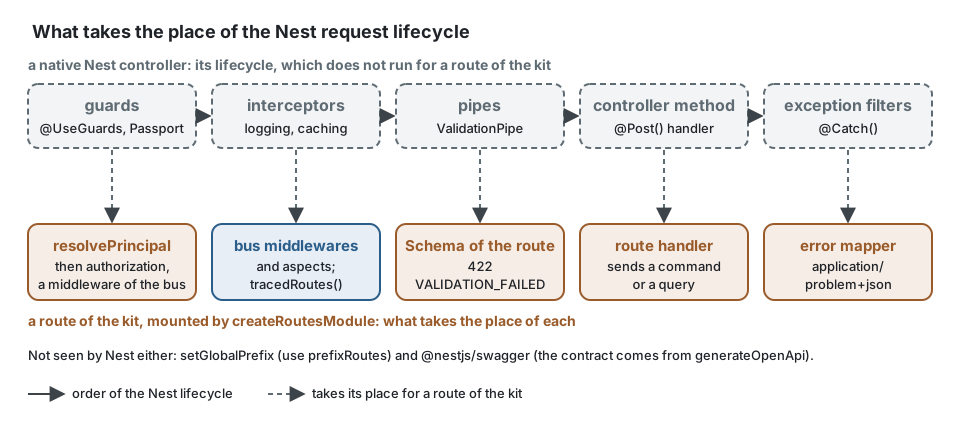
| Nest feature | For a route of the kit |
|---|---|
ValidationPipe and other pipes |
not run; validation is the Schema of the route |
guards (@UseGuards, Passport strategies) |
not run; authentication is resolvePrincipal, authorization the bus middleware |
| interceptors (logging, caching, transformation) | not run; use bus middlewares and aspects |
| exception filters | not run; errors become RFC 9457 problems through the error mapper |
setGlobalPrefix |
ignored; use prefixRoutes |
@nestjs/swagger |
does not see these routes; the contract is generated by the kit |
Three further costs follow from choosing Nest in this kit:
- Wiring is Nest's.
--http nestand--di nestgo together: the CLI refuses one without the other, and refuses the declared style with--di nest. Contexts are written in the explicit style, as a<context>.module.tsthat is a function of the platform, and@Injectable()is kept out ofdomain/andapplication/. - Legacy decorators. The generated
tsconfig.jsonsetsexperimentalDecorators(andemitDecoratorMetadata) for Nest. - Two ways to do everything. A team that also writes native Nest controllers has two validation paths, two error formats and two contracts to keep coherent. Pick one for the API of the bounded contexts.
What Nest still gives: its module system for the parts that are not use cases (health, WebSocket gateways, GraphQL, queues), its CLI and its hiring pool. If those are the reason for Nest, the cost is fair. If Nest was chosen for its controllers, guards and pipes, the kit's routes remove exactly that, and Express or Fastify does the same job with less machinery.
What this kit supports and verified
Section titled “What this kit supports and verified”From packages/http/README.md and
packages/cli/README.md:
- Adapters for Express 5, Fastify 5, Hono 4 and NestJS, all through one pipeline
(
executeRoute); one test suite proves the behaviour of the routes is the same on the four, and uploads and signed file links are proven on Express, Fastify and Hono. - Errors answered as
application/problem+json(RFC 9457) from one error mapper; an unexpected error answers 500 without detail. securityis mandatory on every route; a route is never public by omission (authz/declared).- OpenAPI 3.1 generated from the same declarations, deterministic, with a drift check for CI.
- Content negotiation (JSON, XML, CSV, streamed lists) and XML bodies the same way on the four:
mountExpressputs a text parser on each route thatconsumesanother media type,mountFastifyregisters a content type parser,mountHonoreads such a body as text under itsbodyLimit, Nest goes through Express or Fastify; the shared suite of the adapters holds it (representations and forms). - Every request runs inside the execution scope with its correlation id when the scope is given in the options.
- The CLI's end-to-end proofs install and run generated projects:
proven-stacks.spec.tseight of them, seven on Express and one on Fastify (with--di manual), andcontract-pairs.spec.tsone per pair of contract pairs, Express, Fastify, Hono on Node and NestJS (with--di nestand class-validator), each held to zero finding, its specs, its end-to-end specs and a current contract.
Limits and when not to use it
Section titled “Limits and when not to use it”- A body the framework itself refuses (malformed JSON, payload too large) is answered by the
framework's own error handler on Express (
express.json(), 100 kB by default), Fastify (1 MiB) and NestJS, before the pipeline: its format is not the problem format unless you configure it. On Hono the adapter reads the body: a body beyondbodyLimit(1 MiB by default) is answered 413BODY_TOO_LARGEand malformed JSON 400MALFORMED_BODY, both as problems. - Routes are JSON first. A handler may answer a string, bytes or a stream with its own
content-type. An upload is declared on its controller and streams to the handler (multipart/form-data, size and media types in the contract); a large download goes through a signed link of the storage. Server-sent events and WebSockets are written natively in the framework, outside the generated contract. - Express needs
express.json()installed by you: the adapter does not parse bodies. - Paths are literal segments and
:nameparameters only, the form Express and Fastify share: no regular expression routes, no wildcards. - Query values arrive as strings: coerce in the schema.
- With
stack.http: nonethere is no authenticator and no boundary generated: the application is driven by events, jobs or a transport of your own.
Do not use the kit's routes for a backend-for-frontend that mostly proxies and streams, or for a GraphQL API: the route declaration models request and response JSON over REST.
Recommendation by situation
Section titled “Recommendation by situation”| Situation | Choice |
|---|---|
| No strong habit, a plain JSON API | Express: the kit's default, the smallest surface, the widest knowledge |
| High request volume, pino already in place, plugin encapsulation wanted | Fastify |
| A service that may move to Bun, Deno or an edge runtime, or a team at home with Web standard requests | Hono (proven on Node only) |
| An existing Nest application adopting the kit context by context | NestJS, explicit style, routes of the kit for the contexts and native Nest for the rest |
| A new project, Nest chosen "because it has structure" | reconsider: the structure here comes from the kit's tree and rules; Express or Fastify with tsyringe keeps the declared style |
| No HTTP at all (worker, consumer) | none |
Changing later is a change of mount in the composition root and of the platform's server
file, not of routes, handlers or contract: that is what the declaration buys. Going from
Express to Fastify, for instance, is the difference between onExpress and onFastify in the
mounting sample above, plus the server's own plugins; appointmentRoutes and the OpenAPI
document stay as they are.
Sources
Section titled “Sources”- Express, release notes and migration guide for version 5: https://expressjs.com
- Hono on Node: https://hono.dev/docs/getting-started/nodejs
- Fastify documentation (hooks, encapsulation, validation): https://fastify.dev/docs/latest/
- NestJS documentation (pipes, guards, interceptors, exception filters, request lifecycle): https://docs.nestjs.com/faq/request-lifecycle
- npm registry,
express,fastify,@nestjs/core: versions, licences, engines and weekly downloads read on 2026-10-10. - RFC 9457, Problem Details for HTTP APIs: https://www.rfc-editor.org/rfc/rfc9457
- OpenAPI Specification 3.1: https://spec.openapis.org/oas/v3.1.0
- Not verified: whether NestJS 12 can run without the legacy decorator mode. No official statement was found; the kit generates the legacy mode for Nest.