
Multitenancy
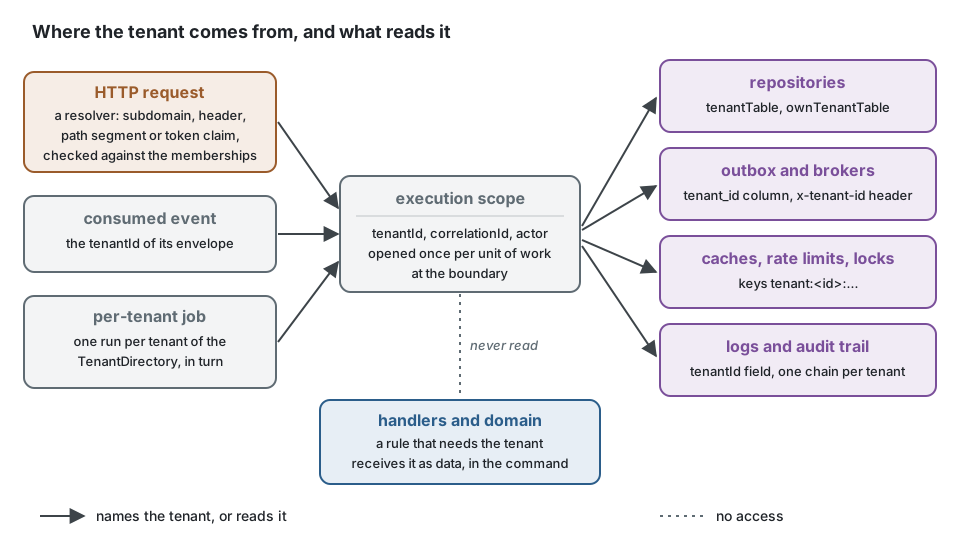
Summary. A multi-tenant application serves several customers (tenants) from one deployment, and no tenant may ever read or change what belongs to another. The kit treats the tenant like the correlation id: it is resolved once at the boundary, carried by the execution context of every unit of work (a request, a consumed event, a job run), and read by infrastructure only. Isolation is then enforced where data lives, by one of several strategies chosen per project, and proven by a contract that runs against each adapter. Use cases never filter by tenant by hand: forgetting a condition is a leak, so the condition is not theirs to write.
What a tenant is, and what it is not
Section titled “What a tenant is, and what it is not”A tenant is the customer whose data it is: a clinic, a company, a school. It is not a role (what someone may do), nor an attribute of an element that a permission compares (the department of a document). The test: if two tenants were two separate installations, would this datum be in one of them only? Then it is tenant data.
Some data belongs to no tenant: the catalogue of the platform, the tenants themselves, the plans. It lives in tables without a tenant column, and the work that reads it names no tenant.
The tenant in the execution scope
Section titled “The tenant in the execution scope”| Origin | Where the tenant comes from |
|---|---|
| HTTP request | the resolver of the edge (subdomain, header, path segment or token claim), checked against the memberships of the actor; the actor's own tenant by default |
| Consumed integration event | the tenantId of the envelope, stamped by the publisher from the work that published it |
| Scheduled job | none for a global job; each tenant of the TenantDirectory in turn for a per-tenant one |
| Platform staff | none of their own: they reach tenants through an explicit, audited elevation |
A tenant id has one grammar, isTenantId: letters, digits, _ and -, at most 63 characters
(a slug or a UUID). Every entry refuses any other: the edge answers 404 to a request that names
one, a broker treats an envelope that carries one as poison, executionContext,
InMemoryTenantDirectory and the settings of row-level security throw InvalidTenantIdError,
and acrossTenants refuses an elevation that names one (InvalidTenantElevationError). Nothing
a tenant id holds can then be read as a wildcard (*), a list (a,b) or a part of a key
(a:b).
tenantScopeOf(scope) answers the one tenant a write names and refuses work that names none
(NoCurrentTenantError): a statement cannot run unscoped by omission. tenantReachOf(scope) is
the read side: the tenant of the work, or the tenants of an elevation. With the test double of
the scope, what each answers:
import {  executionContext,  FixedExecutionScope,  NoCurrentTenantError,  systemActor,  tenantKey,  tenantReachOf,  tenantScopeOf,} from '@ddd-ts-kit/kernel';
const inAcme = new FixedExecutionScope(  executionContext({ correlationId: 'req-42', actor: systemActor('demo'), origin: 'cli', tenantId: 'acme' }),);
console.log(tenantScopeOf(inAcme)); // { tenantId: 'acme' }: the one tenant a write namesconsole.log(tenantReachOf(inAcme)); // { kind: 'tenant', tenantId: 'acme' }: what a read may seeconsole.log(tenantKey(inAcme, 'reminders', 'a:b')); // 'tenant:acme:reminders:a%3Ab'
const inNoTenant = new FixedExecutionScope(  executionContext({ correlationId: 'req-43', actor: systemActor('demo'), origin: 'cli' }),);
try {  tenantScopeOf(inNoTenant);} catch (error) {  console.log(error instanceof NoCurrentTenantError); // true: no tenant, no statement}
Isolation: four strategies
Section titled “Isolation: four strategies”The tenant reaches the storage through the execution scope; the strategy decides what stops a statement from crossing to another tenant.
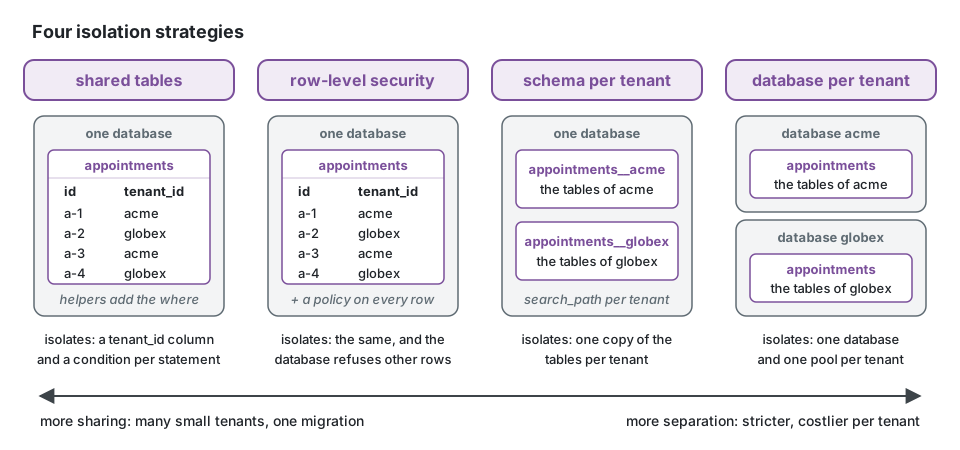
| Strategy | What isolates | Choose it when | It costs |
|---|---|---|---|
| Shared tables | a tenant_id column, and a condition the kit adds to every statement |
many small tenants, one schema to migrate, reports across tenants | one forgotten condition is a leak: the helpers and a rule of the checker are what prevent it |
| Shared tables under row-level security | the same, and a PostgreSQL policy that refuses another tenant's row even to a statement without its condition | the shared-table case, with a second line of defence | a non-superuser role, every statement inside a transaction |
| Schema per tenant | one copy of the tables of a context per tenant (<schema>__<tenant>) |
tenants that want their data apart, export or delete a tenant at once, a few hundred tenants | migrations run once per tenant; thousands of schemas strain the catalogue |
| Database per tenant | one database per tenant, one bounded pool each | strict separation (contracts, regions), large tenants, per-tenant backup and restore | connections (maxTenants * pool.max per instance), one migration run per tenant |
What each adapter ships, proven by tenantIsolationContract (@ddd-ts-kit/testing/contracts)
on PostgreSQL:
| Strategy | Knex | Drizzle | Prisma | TypeORM |
|---|---|---|---|---|
| Shared tables | tenantTable, ownTenantTable, whereTenant, derivedTable; read models with tenant; addTenantColumn to migrate |
tenantCondition, ownTenantCondition; read models with tenant |
by hand: tenantScopeOf and tenantReachOf in every statement, no helper, no contract run |
by hand, as Prisma |
| Row-level security | enableTenantIsolation, tenantSession |
tenantPolicies, forceRowLevelSecurity, tenantSession |
not shipped | not shipped |
| Schema per tenant | tenantSchemaTable, migrateTenantSchema, tenantSearchPath |
not shipped: a drizzle table is bound to its schema where it is declared | not shipped | not shipped |
| Database per tenant | TenantDatabases, createTenantRoutedUnitOfWork, migrateEveryTenant |
not shipped | not shipped | not shipped |
init --tenancy shared-table generates the first strategy on Knex and Drizzle: every repository
through the helpers, the outbox keeping the tenant, and the rule tenancy/scoped-statement of the
checker reporting a statement that reaches a table straight from the executor. The three others
are wired by hand from the packages for now; init refuses them and says what to add.
A repository on shared tables, a simplified version of what the generator writes on Knex (the
audit columns and the Clock they need are left out): every statement goes through
a helper that reads the tenant from the scope, reads through tenantTable, writes through
ownTenantTable, and an insert names its tenant with tenantRow:
import { AggregateRoot, tenantScopeOf, type ExecutionScope } from '@ddd-ts-kit/kernel';import {  insertIgnoringConflict,  optimisticUpdate,  ownTenantTable,  tenantRow,  tenantTable,  type KnexContext,  type TenantRow,} from '@ddd-ts-kit/knex';
interface AppointmentColumns {  readonly id: string;  readonly practitioner_id: string;  readonly status: 'booked' | 'cancelled';}type VersionedAppointment = AppointmentColumns & { readonly version: number };type AppointmentRow = VersionedAppointment & TenantRow;
// The aggregate and its mapper, in domain/ and infrastructure/persistence/:declare class Appointment extends AggregateRoot<string> {  private constructor();}declare const AppointmentMapper: {  toDomain(row: AppointmentRow): Appointment;  toRow(appointment: Appointment): AppointmentColumns;};
const TABLE = { schema: 'appointments', table: 'appointments' };
export class KnexAppointmentRepository {  constructor(    private readonly database: KnexContext,    private readonly scope: ExecutionScope,  ) {}
  async findById(id: string): Promise<Appointment | undefined> {    // Instead of: this.database.executor()<AppointmentRow, AppointmentRow[]>('appointments').where({ id }),    // which reads the rows of every tenant (tenancy/scoped-statement). Write:    const row = await tenantTable<AppointmentRow>(this.database, this.scope, TABLE).where({ id }).first();
    return row === undefined ? undefined : AppointmentMapper.toDomain(row);  }
  async save(appointment: Appointment): Promise<void> {    await optimisticUpdate(appointment, async ({ expected, next }) => {      const state = { ...AppointmentMapper.toRow(appointment), version: next };
      return expected === 0 ? this.insert(state) : this.update(state, expected);    });  }
  private async insert(state: VersionedAppointment): Promise<number> {    const row = { ...state, ...tenantRow(tenantScopeOf(this.scope)) }; // { tenant_id: 'acme' }    const table = ownTenantTable<AppointmentRow>(this.database, this.scope, TABLE);    const inserted = await insertIgnoringConflict(this.database.executor(), table, { row, conflict: 'id' });
    return inserted ? 1 : 0;  }
  private async update(state: VersionedAppointment, expected: number): Promise<number> {    // The one tenant of the work, even under an elevation: reads may widen, writes never.    return ownTenantTable<AppointmentRow>(this.database, this.scope, TABLE)      .where({ id: state.id, version: expected })      .update(state);  }}
A project of one customer that becomes multi-tenant keeps its data: on Knex, a migration calls
addTenantColumn(knex, { schema, table, tenantOfExistingRows }) for each table of tenant data
(the rows already there go to the customer it served, then the column is required and indexed)
and addOutboxTenantColumn(knex, { schema, tenantOfUnpublished }) for the outbox (the events not
published yet go to that customer too, so that their consumers run in its tenant). A table that already has the column is left alone, so
the migration also runs on a database built from the current schema. The example application
went this way (its ADR-0003): one network of practices is one tenant.
The outbox keeps the tenant of each event on Knex (tenant: true) and Drizzle
(tenantOutboxTable); the Prisma and TypeORM outboxes do not store it yet, so their consumers
run in no tenant.
Three rules hold whatever the strategy:
- Reads may widen, writes never. An elevation widens what a read reaches; an update or a
delete always names the one tenant of the work (
ownTenantTable,ownTenantCondition), so a staff session reading across tenants cannot write across them. Under row-level security the database holds it too: one policy per command, the select reading the reach, the insert, the update and the delete only the tenant (ddd_ts_kit.tenant_id), and the reach of an elevation kept in settings of its own that work which is not elevated leaves empty. - No tenant, no data. Work that names no tenant is refused before any SQL
(
NoCurrentTenantError) on shared tables and schemas, and reaches no database at all on database per tenant. Under row-level security, a statement without the tenant settings sees nothing. - Keys are unique across tenants. Identifiers are generated (UUIDs), so that a key never names two rows; the isolation contract checks that another tenant saving under an existing id changes nothing.
Propagation: every hop keeps the tenant
Section titled “Propagation: every hop keeps the tenant”- Integration events.
scopedPublisherstamps the tenant of the work on every event published without one; the outbox keeps it (tenant_id, see the persistence packages); the brokers carry it in the envelope and in a header (x-tenant-id,tenant-idfor Redis Streams);executionContextOfEventopens the consumer's scope in that tenant. A consumer therefore reads and writes the tenant of the fact it handles, and nothing else. - Scheduled jobs. A job states
tenancy: 'global'(the default) or'per-tenant'. A per-tenant job runs once per tenant, one after the other, each run in that tenant's scope; one tenant failing does not stop the others. - Caches, rate limits and locks. A key of a shared store is confined to the tenant:
tenantCacheKey(scope, ...),tenantKey(scope, ...), each segment percent-encoded so that two lists of segments never give one key. A key built without it is shared by every tenant, which is right for platform data only. - Logs, traces, error reports and the audit trail.
logFieldsOfwritestenantIdon every line; the audit trail keeps one hash chain per tenant (tenant:<id>), so that a tenant's history can be handed over and verified alone. Its search is confined to the tenant of the work byTenantAuditReader, whichinit --tenancy shared-tablewires into the read side of the trail: an actor that names no tenant reads nothing, and platform staff read another tenant's trail only insideacrossTenants. A refusal at the edge of a caller without a credential is not recorded, so that no unauthenticated request opens a chain.
Resolution at the edge
Section titled “Resolution at the edge”The HTTP pipeline names the tenant of a request with a resolver of @ddd-ts-kit/http: the
subdomain (acme.app.example.com), a header (x-tenant-id), a path segment
(/tenants/:tenantId/...) or the claim of the token, or the first of several. Whatever names
it, the pipeline checks it against the memberships of the caller before anything runs, and
answers 403 to a caller that does not belong to it: the tenant a client asks for is a request,
never an authority. An authenticated caller is held to its tenants on public routes too; an
anonymous caller keeps the tenant it addressed there. The guard TenantMember keeps a group of routes for the members of the tenant
of the request.
Which to choose: the claim alone when a user belongs to one tenant; a subdomain when tenants
have their own address (and their own cookies); a path segment or a header when one user works in
several tenants and picks one per request, the token then listing every membership (a tenant
claim holding a list, or the organization claim of Keycloak, gives the actor its tenants).
A tenant the deployment does not serve, one its directory of tenants (the tenants its jobs run
for) does not list, is best not found at all: servedTenantOf(resolver, served) answers 404
whoever names it, so that a credential issued for a tenant the deployment knows nothing of never
writes data no job and no operator would see. The example application serves the networks of
NETWORKS this way.
Platform staff: elevation, never implicit
Section titled “Platform staff: elevation, never implicit”Support and operations sometimes need to read across tenants. The kit refuses to infer it from a role: a role that silently widened every query would turn one stolen session into a breach of every tenant. Instead:
- A use case or a guard decides the permission to elevate, like any permission.
- The platform calls
acrossTenants({ scope, trail, clock, ids }, { reason, tenants }, work): a stable reason code and the tenants reached (allor a list) are required. - The elevation is written to the audit trail (action
tenancy:elevate) before the work runs; a trail that cannot record it refuses it. - Inside, reads see the tenants named; writes still name one tenant.
import { acrossTenants, type AuditTrail, type Clock, type ExecutionScope, type IdGenerator } from '@ddd-ts-kit/kernel';
// Resolved from the container by the platform:declare const scope: ExecutionScope;declare const trail: AuditTrail;declare const clock: Clock;declare const ids: IdGenerator;// A read through tenantTable, which follows the reach of the scope:declare function searchAppointments(practitionerId: string): Promise<readonly { readonly id: string }[]>;
export async function appointmentsForATicket(practitionerId: string, tenants: readonly string[]) {  // The permission to elevate was decided before this call, like any permission.  return acrossTenants(    { scope, trail, clock, ids },    { reason: 'SUPPORT_TICKET', tenants }, // a stable code, and the tenants reached ('all' or a list)    () => searchAppointments(practitionerId), // recorded as tenancy:elevate before it runs  );}
Limits and when not to use it
Section titled “Limits and when not to use it”- One tenant per unit of work. A request that must write to two tenants is two units of
work, on purpose: one transaction never spans tenants. On database per tenant, work of another
tenant run inside an open unit of work is refused (
CrossTenantUnitOfWorkError); on shared tables and schemas it would join the first tenant's transaction, so open a unit of work per tenant (an elevation reads only, and needs none). - The tenant is infrastructure's. A business rule that depends on the tenant (a plan, a setting) receives it as data in the command, like the actor; it does not read the scope.
- A single-customer product does not need any of this. The strategies cost a column, a policy, a schema or a database per tenant, and the discipline of proving isolation.
Sources
Section titled “Sources”- Microsoft, "Tenancy models for SaaS applications" (Azure SQL Database documentation): shared tables, schema and database per tenant, and their trade-offs.
- PostgreSQL documentation, "Row Security Policies" (section 5.9 of the manual).
- AWS SaaS Lens, "Tenant isolation" (Well-Architected Framework).