
Validation libraries: zod, class-validator, TypeBox, Standard Schema
Summary. Validation in this kit means one thing: checking the shape of what crosses a
boundary (an HTTP request, an integration event payload). It is done behind a small Schema
port of @ddd-ts-kit/validation, with adapters for zod, class-validator, TypeBox and any
library that implements Standard Schema (valibot, arktype and others). Because routes, events and the
OpenAPI generator depend on the port, the library is replaceable; what differs between the
four adapters is the quality of the generated contract, the error codes and the decorator
mode they impose. Business rules are not validation and never use these libraries.
Where validation sits
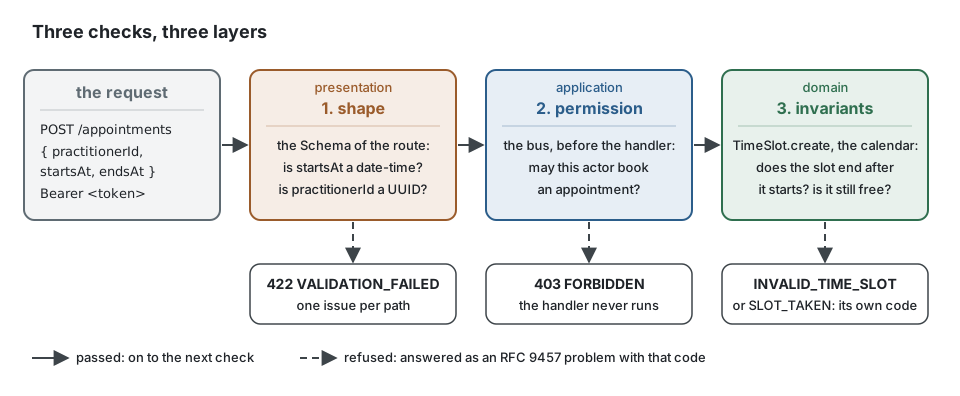
Section titled “Where validation sits”"startsAt is an ISO date-time" is validation: it is true or false of the text alone. "The
slot is still free" is an invariant of appointments; "only the client who booked may cancel"
is a permission. The three live in three places
(invariants, permissions and validation),
and layer/domain-purity in ARCHITECTURE.md refuses a validation library
in domain/.
// contexts/appointments/presentation/http/book-appointment.schema.ts: the shape of the request, nothing elseimport { z } from 'zod';import type { Infer } from '@ddd-ts-kit/validation';import { zodSchema } from '@ddd-ts-kit/validation/zod';
export const bookAppointmentBody = zodSchema(  z.object({    practitionerId: z.uuid(),    startsAt: z.iso.datetime(),    endsAt: z.iso.datetime(),  }),);
// { practitionerId: string; startsAt: string; endsAt: string }export type BookAppointmentBody = Infer<typeof bookAppointmentBody>;
That endsAt is after startsAt is decided once, by the TimeSlot value object, whoever
calls: a route, an integration event handler or a job. Instead of writing the rule into the
schema of one route:
// presentation/http: the rule holds for this route only, and its refusal is a VALIDATION_FAILEDconst bookAppointmentBody = zodSchema( z .object({ practitionerId: z.uuid(), startsAt: z.iso.datetime(), endsAt: z.iso.datetime() }) .refine((body) => body.endsAt > body.startsAt, { message: 'endsAt must follow startsAt' }),);write it in the domain, where every caller meets it, with a code of its own:
import { ConceptError, ValueObject } from '@ddd-ts-kit/kernel';
export class TimeSlotError extends ConceptError {  static endsBeforeItStarts(startsAt: Date, endsAt: Date) {    return TimeSlotError.refusal('INVALID_TIME_SLOT', 'A slot ends after it starts.', { startsAt, endsAt });  }}
export class TimeSlot extends ValueObject<{ readonly startsAt: Date; readonly endsAt: Date }> {  static create(startsAt: Date, endsAt: Date): TimeSlot {    if (endsAt.getTime() <= startsAt.getTime()) {      throw TimeSlotError.endsBeforeItStarts(startsAt, endsAt);    }
    return new TimeSlot({ startsAt, endsAt });  }}
The port
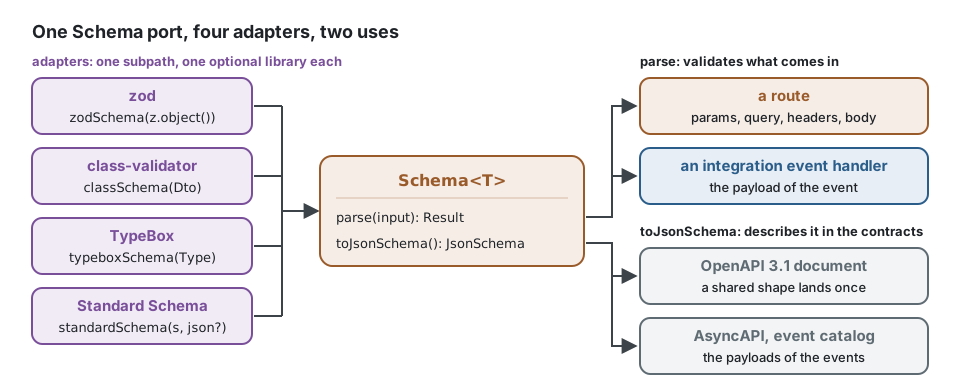
Section titled “The port”interface Schema<T> { parse(input: unknown): Result<T, ValidationIssue[]>; // never throws for an invalid input toJsonSchema(): JsonSchema; // feeds OpenAPI and AsyncAPI}A schema is a value handed to the route or the event that validates with it. It is never bound
in a container, which is why it is an interface and not an injectable port. parseOrThrow
raises a ValidationError, a DomainError with the code VALIDATION_FAILED, which the HTTP
pipeline answers as a 422 problem with one issue per path.
What a caller gets back, with the zod schema above and a body that misses endsAt and carries a
malformed id:
import { z } from 'zod';import { parseOrThrow, ValidationError } from '@ddd-ts-kit/validation';import { zodSchema } from '@ddd-ts-kit/validation/zod';
const bookAppointmentBody = zodSchema(  z.object({ practitionerId: z.uuid(), startsAt: z.iso.datetime(), endsAt: z.iso.datetime() }),);const input: unknown = { practitionerId: 'nope', startsAt: '2026-03-02T09:00:00Z' };
// parse never throws for an invalid input: it answers a Resultconst result = bookAppointmentBody.parse(input);
if (!result.ok) {  // [{ path: 'practitionerId', code: 'invalid_format', message: 'Invalid UUID' },  //  { path: 'endsAt', code: 'invalid_type', message: 'Invalid input: expected string, received undefined' }]  console.log(result.error);}
// parseOrThrow answers the value, or throws what the HTTP pipeline answers as a 422 problemtry {  parseOrThrow(bookAppointmentBody, input);} catch (error) {  if (error instanceof ValidationError) {    console.log(error.code, error.issues.length); // VALIDATION_FAILED 2  }}
A route never calls either itself: the pipeline of @ddd-ts-kit/http parses each part with the
schema the route declares, and the handler receives the parsed value. A property the schema
does not declare is dropped by zod and TypeBox, and refused by class-validator.
Comparison
Section titled “Comparison”Versions, licences and downloads checked on 2026-10-10 against the npm registry and GitHub.
| zod | class-validator | TypeBox | Standard Schema (valibot, arktype, ...) | |
|---|---|---|---|---|
| What it is | schema builder, types inferred from the schema | decorators on DTO classes, with class-transformer | JSON Schema builder with static types, compiled validators | a common interface that schema libraries implement, not a library |
| Current version | 4.6.5 | 0.15.1 (February 2026); class-transformer 0.5.1 dates from November 2021 | typebox 1.3.36 (2026-10-06; @sinclair/typebox 0.34 is its predecessor) |
spec 1.1.0; valibot 1.5.0, arktype 2.2.8 |
| Licence | MIT | MIT | MIT | MIT |
| Weekly downloads | about 326 million | about 12 million | not checked | valibot about 22 million, arktype about 2 million |
| Decorators | none | legacy mode required for the whole program | none | none |
| Type from schema | yes, inferred | the class is the type, written by hand | yes, inferred (Static) |
yes, inferred |
| JSON Schema for the contract | built in (z.toJSONSchema, draft 2020-12) |
through class-validator-jsonschema, a separate package |
the schema is JSON Schema | the library's own when it implements Standard JSON Schema (verified with zod 4; arktype and valibot through @valibot/to-json-schema not verified), or the one you supply |
| Shared once in the contract | .meta({ id }), kept when nested |
classSchema(Dto, { shared: true }); a nested class always is |
$id in the options, kept when nested |
the library's ids, or sharedSchema(name, schema) |
| Reuse in part | .pick, .omit, .partial, .extend |
pickClass, omitClass, partialClass of the kit, extends |
Type.Pick, Type.Omit, Type.Partial, Type.Intersect (keeps the reference) or Type.Interface (a flat copy) |
the library's own (v.pick, v.omit, ...) |
| Issue codes | the library's (too_small, ...) |
the constraint name | the JSON Schema keyword (minLength, format) |
always invalid |
| Cost of one parse, measured (contract pairs) | about 0.5 µs | about 5 to 9 µs | about 6 to 11 µs (its own check alone, 0.75 µs) | not measured |
| Asynchronous schemas | not at the boundary | not at the boundary | not at the boundary | parse throws |
The same body in each library
Section titled “The same body in each library”The body of the booking route, four times. Each line ends in the same Schema, which a route
takes as it is.
class-validator, with legacy decorators and reflect-metadata:
import 'reflect-metadata';import { IsISO8601, IsUUID } from 'class-validator';import { classSchema } from '@ddd-ts-kit/validation/class-validator';
class BookAppointmentDto {  @IsUUID() practitionerId = '';  @IsISO8601({ strict: true }) startsAt = '';  @IsISO8601({ strict: true }) endsAt = '';}
// parse answers an instance of BookAppointmentDto; an undeclared property is an issueexport const bookAppointmentBody = classSchema(BookAppointmentDto);
TypeBox, whose schema is JSON Schema already:
import Type from 'typebox';import { typeboxSchema } from '@ddd-ts-kit/validation/typebox';
// issue codes are the JSON Schema keywords: 'required' for endsAt, 'format' for practitionerIdexport const bookAppointmentBody = typeboxSchema(  Type.Object({    practitionerId: Type.String({ format: 'uuid' }),    startsAt: Type.String({ format: 'date-time' }),    endsAt: Type.String({ format: 'date-time' }),  }),);
valibot through Standard Schema, with the JSON Schema of the contract given by hand:
import * as v from 'valibot';import { standardSchema } from '@ddd-ts-kit/validation/standard-schema';
const instant = { type: 'string', format: 'date-time' };
// every issue has the code 'invalid'; without the second argument the contract would show {}export const bookAppointmentBody = standardSchema(  v.object({    practitionerId: v.pipe(v.string(), v.uuid()),    startsAt: v.pipe(v.string(), v.isoTimestamp()),    endsAt: v.pipe(v.string(), v.isoTimestamp()),  }),  {    type: 'object',    required: ['practitionerId', 'startsAt', 'endsAt'],    properties: { practitionerId: { type: 'string', format: 'uuid' }, startsAt: instant, endsAt: instant },  },);
zod is the first sample of this page.
Selection criteria
Section titled “Selection criteria”- The contract. The OpenAPI and AsyncAPI documents are generated from
toJsonSchema(). A library that cannot describe itself produces an empty contract unless you write the JSON Schema twice. - Decorator mode. class-validator forces
experimentalDecoratorson the program. The kit's own decorators work in both modes, but other libraries may not. - What the team already has. A NestJS code base usually holds hundreds of DTO classes; rewriting them buys nothing.
- Error detail. Clients that branch on issue codes need a library that provides them.
- Maintenance. class-validator still releases; its companion class-transformer has had no release since 2021 (checked today). That is a fact to weigh, not a verdict: the package is small and stable.
What this kit supports and verified
Section titled “What this kit supports and verified”From packages/validation/README.md:
- zod.
zodSchema(schema, { io? }). The JSON Schema comes from zod 4's own export and is usable as is in OpenAPI 3.1; it describes the input side by default,{ io: 'output' }for a response body..describe(...)on a field flows into the event catalog and the contract. - class-validator.
classSchema(Dto, options?).parsereturns an instance of the class;whitelistandforbidNonWhitelistedare on by default, so an undeclared property is an issue; nested errors are flattened (items.0.quantity), one issue per failed constraint; nested classes land under$defs. Needsclass-transformer,class-validator-jsonschemaandreflect-metadata, andexperimentalDecoratorsin the project. - Standard Schema.
standardSchema(schema, jsonSchema?, { io? })accepts any implementing library; without a JSON Schema it documents the one the library converts itself through Standard JSON Schema, when it implements it and can convert that schema (verified with zod 4), else{}. - Shared schemas. A shape declared once is documented once: the OpenAPI generator writes it in
components.schemasand every route refers to it, whole or nested.sharedSchema(name, schema)shares anySchema; the platform sharesacceptedSchema(Accepted), the page of a shared item (<Item>Page) and the problem document. Under"stack.schemas": "shared"(a new project),generate schemawrites one andschema/no-duplicate-shapereports a shape declared twice in one context (configuration). customSchema(parse, jsonSchema?)builds a schema from a plain function, for the rare input no library describes:
import { err, ok } from '@ddd-ts-kit/kernel';import { customSchema } from '@ddd-ts-kit/validation';
// a practitioner reference written "<practiceId>.<practitionerId>", split on the way inexport const practitionerKey = customSchema(  (input: unknown) => {    const [practiceId, practitionerId, ...rest] = typeof input === 'string' ? input.split('.') : [];
return practiceId && practitionerId && rest.length === 0 ? ok({ practiceId, practitionerId }) : err([{ path: '', code: 'practitioner_key', message: 'Expected <practiceId>.<practitionerId>' }]); }, { type: 'string', pattern: '^[^.]+\\.[^.]+$' },);- The root entry imports no third-party package; each adapter is a subpath with its library as an optional peer.
- The CLI generates DTO files with class-validator and schemas otherwise; the "first-class
stack" proven end to end by the CLI uses
--validation class-validatorin the legacy decorator mode, and the default stack uses zod (packages/cli/README.md).
Limits and when not to use it
Section titled “Limits and when not to use it”- Standard Schema adapter and the contract. Standard Schema itself has no JSON Schema
export; its companion specification, Standard JSON Schema (V1), has one, and the adapter reads
it when the library implements it (zod 4 does, checked with 4.6.5; valibot only through
toStandardJsonSchemaof@valibot/to-json-schema). For any other library, pass the JSON Schema by hand or accept an empty contract for that input. - class-validator in part.
pickClass,omitClassandpartialClasscopy the metadata of class-validator and class-transformer onto a new class meant to be extended. A derived class nested in another through@Typedeclares a property of its own, because class-validator-jsonschema documents a class from its own decorators only. - Two shapes under one name. zod documents the input and the output side of a schema with
defaults differently: a shared schema used as a body and as a response gets two components
(
Slot,Slot_2). Give the response an id of its own. - Standard Schema issue codes. The specification carries none: every issue has the code
invalid. - No asynchronous validation at the boundary: a schema that validates asynchronously makes
parsethrow. A check that needs I/O (does this practitioner exist?) is not validation; it belongs to the use case. - class-validator returns class instances, and transformation happens through
class-transformer: a DTO with defaults or
@Typeconversions changes what the handler receives. Keep DTOs free of behaviour. - Query strings are strings. Coercion (
z.coerce.number(),@Type(() => Number)) is part of the schema. - A schema is not a model. Reusing a presentation schema in
application/ordomain/is a defect the layer rules report; a response schema is a presentation DTO, mapped from the model. - Tightening a schema on a deployed API is a breaking change for clients that were sending what used to be tolerated.
Do not reach for a validation library to protect an aggregate: a value object's create does
it, with a DomainError and a stable code, and it holds for every caller.
Recommendation by situation
Section titled “Recommendation by situation”| Situation | Choice |
|---|---|
| New project, no constraint | zod: the default of the kit, inferred types, the contract generated without a second description |
| NestJS, or an existing base of decorated DTO classes | class-validator: keep the DTOs, accept the legacy decorator mode |
| The contract must be exactly the schema, or Fastify is already in place | TypeBox: the schema is JSON Schema, composed with Type.Pick, Type.Omit, Type.Intersect |
| The team already standardised on valibot or arktype, or bundle size at the edge matters | Standard Schema adapter, with the JSON Schema supplied for every public input |
| Integration event payloads | the same library as the routes: one vocabulary of schemas for both contracts |
| An input no library fits | customSchema, with its JSON Schema |
Mixing is possible (any Schema works in a route) and rarely wise: two issue vocabularies in
one API confuse its clients.
Sources
Section titled “Sources”- zod documentation, JSON Schema conversion: https://zod.dev/json-schema
- class-validator: https://github.com/typestack/class-validator ; class-transformer: https://github.com/typestack/class-transformer (repository activity and releases read on 2026-10-10)
- Standard Schema and Standard JSON Schema: https://standardschema.dev
- valibot: https://valibot.dev ; arktype: https://arktype.io
- TypeBox: https://github.com/sinclairzx81/typebox
- npm registry: versions, licences and weekly downloads read on 2026-10-10.
- JSON Schema draft 2020-12: https://json-schema.org/draft/2020-12
- Standard JSON Schema read by the adapter: verified with zod 4.6.5, whose schemas implement
~standard.jsonSchema(inputandoutput, targetdraft-2020-12); not verified with arktype or with@valibot/to-json-schema.