
Resilience
Summary. A call that leaves the process can be slow, fail, or never answer. Five patterns deal with that: retry, timeout, circuit breaker, bulkhead and cache. Each one solves a precise problem and each one has a failure mode that makes things worse when it is applied without thought: a retry storm, a duplicated payment, a timeout that leaves the work running, a breaker that hides an outage, a cache that serves a stale decision. This page explains what each pattern does, when it harms, in which order they compose, and how the kit applies them from outside the business code so that a handler never contains one.
Where they apply
Section titled “Where they apply”Resilience policies belong on calls to what you do not control: an outside system (the SMS
provider of notifications) or another context reached synchronously through a gateway
(appointments asking calendars for working hours). They do not belong inside a use case,
around a repository of aggregates by default, or in the domain.
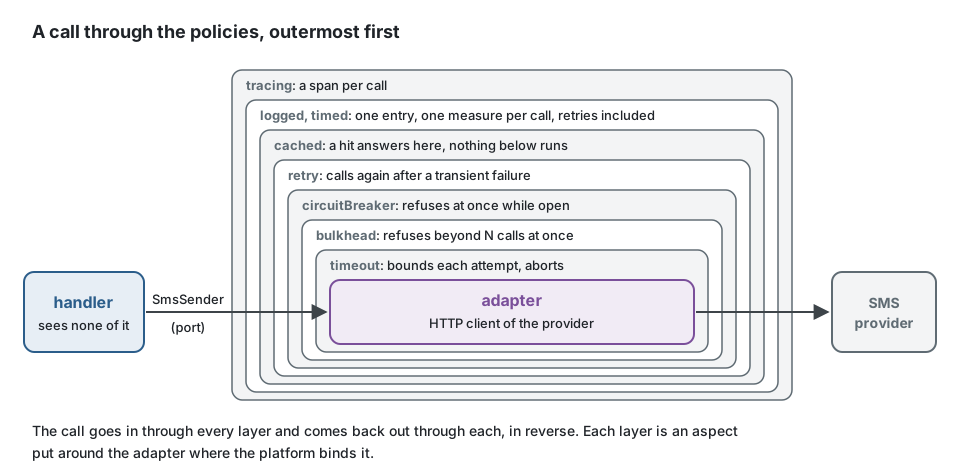
The handler depends on the port and sees none of the boxes in between.
The five patterns
Section titled “The five patterns”Timeout
Section titled “Timeout”Bounds how long a caller waits. Without one, a provider that stops answering holds a connection, a request and eventually every worker of the process. Every outbound call needs a timeout; it is the one policy with no good reason to be absent.
Failure modes.
- A timeout that does not cancel. Rejecting the promise does not stop the underlying call: it goes on, holds its socket, and may still succeed after the caller gave up. The kit's timeout aspect only stops the call when the adapter accepts an abort signal and passes it on.
- A timed-out write is an unknown outcome, not a failure. The SMS may have been sent.
- Timeouts longer than the caller's. If the route's client gives up after 5 seconds, an inner timeout of 30 seconds only wastes resources. Budgets shrink going inward.
An adapter that can be cancelled takes the signal as its last parameter and hands it to the
call; timeout(2000, { signal: true }) then aborts the request itself, not only the wait:
export abstract class SmsSender {  abstract send(phone: string, text: string, signal?: AbortSignal): Promise<void>;}
export class HttpSmsSender implements SmsSender {  constructor(private readonly baseUrl: string) {}
  // `signal` last, without a default value: the timeout aspect fills it  async send(phone: string, text: string, signal?: AbortSignal): Promise<void> {    const response = await fetch(`${this.baseUrl}/messages`, {      method: 'POST',      headers: { 'content-type': 'application/json' },      body: JSON.stringify({ to: phone, text }),      ...(signal === undefined ? {} : { signal }),    });
if (!response.ok) { throw new Error(`The SMS provider answered ${String(response.status)}.`); } }}Calls again after a failure, on the bet that the fault was transient (a dropped connection, a restart, a brief overload). Good retries wait between attempts with exponential backoff and add jitter, a random share of the delay, so that many callers do not come back at the same instant.
Failure modes.
- Retrying what is not safe to repeat. A retry repeats the call as it is. Charging a card or sending an SMS twice is a business incident unless the operation is idempotent, usually through an idempotency key the provider honours.
- Retry storms. Each layer that retries multiplies the load: three attempts at each of three layers is twenty-seven calls on a dependency that is already struggling. Retry at one layer, the one closest to the fault.
- Retrying a refusal. A business refusal or a validation error will fail the same way every
time. The kit's retry never repeats after a
DomainError, an open circuit or a full bulkhead. - Synchronised retries. Without jitter, all clients that failed together retry together.
declare abstract class SmsSender {  abstract send(phone: string, text: string): Promise<void>;}
// Instead of: a retry written in the use case, without backoff, jitter or a view on what failed;// it retries a refusal as readily as a dropped connection, and every handler writes its ownexport class SendReminderRetrying {  constructor(private readonly sms: SmsSender) {}
  async execute(phone: string): Promise<void> {    for (let attempt = 1; ; attempt += 1) {      try {        await this.sms.send(phone, 'Your appointment is tomorrow.');        return;      } catch (error) {        if (attempt === 3) {          throw error;        }      }    }  }}
// Write: the handler calls the port once; the policy is put on the binding of the adapter,// where it is read, tuned and tested in one place (see "Three forms, one implementation")export class SendReminder {  constructor(private readonly sms: SmsSender) {}
  async execute(phone: string): Promise<void> {    await this.sms.send(phone, 'Your appointment is tomorrow.');  }}
Circuit breaker
Section titled “Circuit breaker”Counts consecutive failures of a dependency and, past a threshold, refuses calls at once for a while instead of letting each one wait for its timeout. After the pause it lets a trial call through (half-open) and closes again on success. It protects the caller (fast failure) and the callee (room to recover).
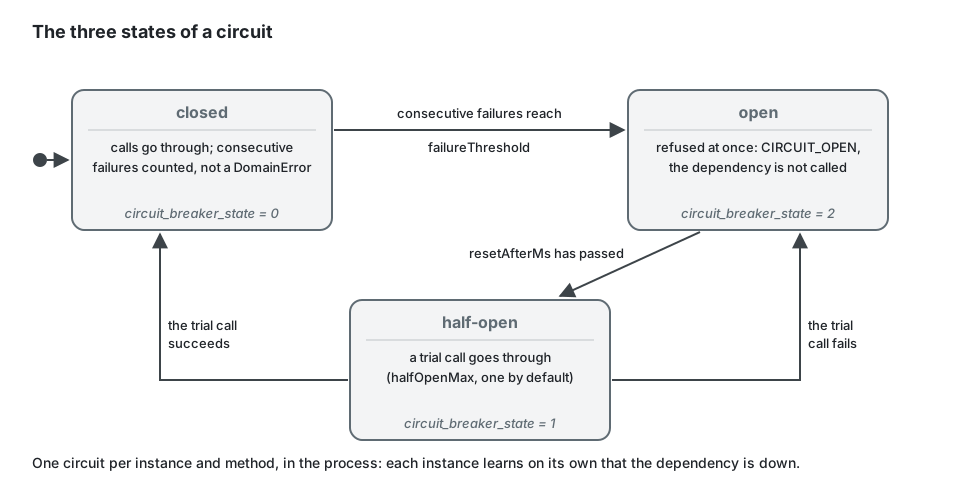
Failure modes.
- A breaker that hides a real outage. Calls are refused quickly and quietly, dashboards of latency look healthy, and nobody notices that no reminder left for an hour. Publish the state of each circuit as a metric and alert on "open".
- One circuit for too much. A breaker shared by all methods of an adapter opens for everyone when one endpoint fails. The kit keeps one circuit per instance and method by default.
- State per process. Each instance learns on its own that the provider is down; with many instances the dependency still receives many trial calls.
- Business refusals counted as failures open the circuit on normal traffic. A
DomainErroris not a failure for the kit's breaker.
Bulkhead
Section titled “Bulkhead”Bounds how many calls run at once towards one dependency, and refuses beyond. Named after the watertight compartments of a ship: a slow SMS provider may fill its own compartment, but it cannot take every connection of the process and sink booking with it.
Failure modes. A limit set too low refuses healthy traffic; a queue in front of it converts refusals into latency and memory. Like the breaker, its state is per process.
Answers a repeated read from memory or from a shared store instead of calling again. It lowers latency and load, and it can keep a read working while its source is briefly down.
Failure modes.
- Stale data presented as fresh. Every cached answer is an answer from the past. The time to live is a business decision: for how long may working hours be wrong?
- A cached aggregate. An aggregate served from a cache behind its repository hides that it is stale, and the next command decides on old state: an appointment booked on a slot that was taken a second ago. The kit's cache aspect refuses repositories and use cases unless explicitly allowed, which is a decision to record. Cache reads of gateways and outside systems, never the model you decide on.
- Stampede. When a popular entry expires, every request that misses it recomputes it at the
same time. Sharing one computation among concurrent callers (single flight) solves it inside
a process; across processes it needs a lock, as
@ddd-ts-kit/redisdescribes. - Caching failures or per-user answers under a shared key. A wrong key leaks one user's answer to another.
Summary table
Section titled “Summary table”| Pattern | Protects against | Typical failure mode | Needs |
|---|---|---|---|
| timeout | waiting forever | work continuing behind; unknown outcome of a write | an abort signal passed to the call |
| retry | transient faults | duplicates; storms | an idempotent operation; backoff and jitter |
| circuit breaker | hammering a dependency that is down | a silent outage | a metric and an alert on its state |
| bulkhead | one dependency exhausting shared resources | refusing healthy traffic | a limit sized from measurements |
| cache | repeated reads, brief unavailability | stale decisions | a time to live chosen by the business; reads only |
Order of composition
Section titled “Order of composition”The policies wrap each other, and the order changes the meaning. Read outermost first:
tracing, logged, timed, cached, retry, circuitBreaker, bulkhead, timeout, the adapter- Retry outside timeout: each attempt has its own time limit. The other way round, one limit covers all attempts and the waits between them.
- Circuit breaker inside retry: each failed attempt counts towards the threshold, and an open circuit ends the retries at once, since an open circuit is not retried.
- Logging and metrics outside retry: one measurement per call as the caller lived it, retries included.
- Cache outside retry and breaker: a hit costs nothing and is not refused by an open circuit.
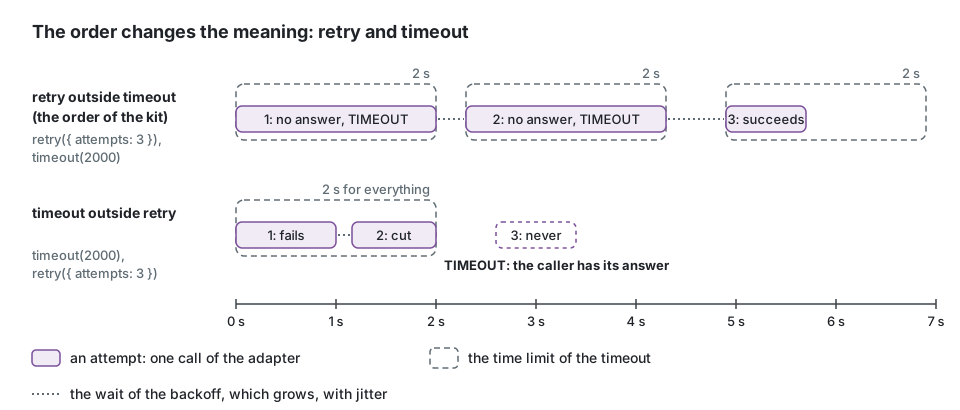
This is the order of @ddd-ts-kit/aspects, and it follows
from the code: its retry does not repeat a CircuitOpenError. The other order exists in the
literature (a breaker outside the retry sees one outcome per logical call); the kit does not
use it.
Three forms, one implementation
Section titled “Three forms, one implementation”The kit applies the same policy in three ways, in this order of preference:
- On one binding. In the declared style the declaration of the adapter states it,
@Adapter(SmsSender, { kind: 'external', aspects: [ownPolicy(retry(...), timeout(2000))] }), which is whatddd-ts-kit generate adapterwrites; in an explicit module the binding does,.with(retry(...), timeout(...)). The methods of the class contain no policy.ownPolicyis a helper of the project (src/platform/resilience/own-policy.ts): on tsyringe the firstgenerate adapterwrites it, so that a project without an adapter holds no file nothing imports; wired by hand,initwrites it, because the platform itself uses it. - On every binding of a kind, in the platform module:
builder.around(['external', 'gateway'], ...). The generated platform (src/platform/resilience/) gives every adapter that leaves the process and states no policy of its own three attempts with backoff and a time limit per attempt, both read from the configuration. - As a decorator on the adapter class, in
infrastructure/or the platform, when the policy is part of what the adapter is: a client of a provider that documents its own retry rules.
The first form, in an explicit module, with the order of the page:
import { cached, circuitBreaker, circuitStateGauge, retry, timeout } from '@ddd-ts-kit/aspects';import { defineContextModule } from '@ddd-ts-kit/di';
declare abstract class SmsSender {  abstract send(phone: string, text: string, signal?: AbortSignal): Promise<void>;}declare class HttpSmsSender implements SmsSender {  send(phone: string, text: string, signal?: AbortSignal): Promise<void>;}declare abstract class WorkingHours {  abstract findForDay(calendarId: string, day: string): Promise<readonly string[]>;}declare class CalendarsWorkingHours implements WorkingHours {  findForDay(calendarId: string, day: string): Promise<readonly string[]>;}
export const notificationsModule = defineContextModule({  name: 'notifications',  register(builder) {    builder      .bind(SmsSender)      .toClass(HttpSmsSender)      .as('external')      .with(        retry({ attempts: 3 }), // 100 ms doubling, with full jitter; never after a DomainError        circuitBreaker({ failureThreshold: 5, resetAfterMs: 30_000, onStateChange: circuitStateGauge() }),        timeout(2000, { signal: true }), // each attempt, aborted through the signal      );
    // a read of another context: how long may working hours be stale? the business says a minute    builder      .bind(WorkingHours)      .toClass(CalendarsWorkingHours)      .as('gateway')      .with(cached({ key: (method, args) => `${method}:${args.join(':')}`, ttlMs: 60_000 }), timeout(1000));  },});
The same policy in the declared style, where generate adapter writes the declaration, and as
decorators of the class, the form for a policy that belongs to the adapter itself:
import { retry, timeout, type Aspect } from '@ddd-ts-kit/aspects';import { Retry, Timeout } from '@ddd-ts-kit/aspects/decorators';import { Adapter } from '@ddd-ts-kit/kernel/declarations';
declare abstract class SmsSender {  abstract send(phone: string, text: string, signal?: AbortSignal): Promise<void>;}declare abstract class Mailer {  abstract deliver(address: string, body: string): Promise<void>;}// src/platform/resilience/own-policy.ts of a generated project: this policy, in place of the default onedeclare function ownPolicy(...policy: readonly Aspect[]): Aspect;declare function post(path: string, payload: object, signal?: AbortSignal): Promise<void>;
// 1. declared style: the policy is part of the declaration, the methods hold none@Adapter(SmsSender, { kind: 'external', aspects: [ownPolicy(retry({ attempts: 3 }), timeout(2000, { signal: true }))] })export class HttpSmsSender implements SmsSender {  async send(phone: string, text: string, signal?: AbortSignal): Promise<void> {    await post('/messages', { to: phone, text }, signal);  }}
// 3. decorators: the provider documents its own retry rules; ownPolicy() without argument//    tells the platform that the class carries its policy, so the default one is not added@Adapter(Mailer, { kind: 'external', aspects: [ownPolicy()] })export class ProviderMailer implements Mailer {  async deliver(address: string, body: string): Promise<void> {    await this.send({ to: address, body });  }
  @Retry({ attempts: 3, backoff: { baseMs: 100 } })  @Timeout(2000, { signal: true })  async send(payload: object, signal?: AbortSignal): Promise<void> {    await post('/mails', payload, signal);  }}
Use cases get their cross-cutting behaviour from bus middlewares instead. None of the three
forms is allowed in domain/ or application/: rule
aspects/outside-in and the two layer/* rules.
Do not apply the same aspect in two forms: it would run twice.
What an aspect records follows the tracing rule: class, method, context, duration, error code; never arguments, results or error messages.
Synchronous calls are the expensive case
Section titled “Synchronous calls are the expensive case”Most of this page disappears when two contexts collaborate through events. notifications
reacting to appointments.appointment.booked needs no timeout, retry or breaker towards
appointments: the broker and the outbox carry the retry, and the consumer is idempotent.
Resilience policies are the price of a synchronous dependency; prefer a local projection fed
by events when the data is needed often. See
Delivery and idempotency.
Limits and when not to use it
Section titled “Limits and when not to use it”- State lives in the process, per wrapped instance: circuits, compartments and single flight are not shared between instances.
- Retry assumes idempotence and the kit cannot verify it. Only the author of the adapter knows whether the call is safe to repeat.
- Timeout without a signal does not stop the call.
- Only asynchronous methods are advised, and a wrapped call always answers a promise: an object whose methods return a chainable query builder must not be wrapped.
- A policy is not a guarantee of delivery. Work that must not be lost and must be retried for hours belongs to the outbox and integration events, not to a retry in memory that dies with the process.
- Do not wrap repositories by reflex. A database retry inside a transaction can repeat half of a unit of work; the unit of work is the retry boundary.
- Every policy adds configuration to tune and a behaviour to test. A policy is tested once, on the adapter, with a fake that fails on demand; use cases are tested without it.
Sources
Section titled “Sources”- Michael T. Nygard, Release It!, 2nd edition, Pragmatic Bookshelf, 2018, chapter 5 "Stability Patterns": Timeouts, Circuit Breaker, Bulkheads, Fail Fast.
- Martin Fowler, "CircuitBreaker", martinfowler.com, 2014.
- Marc Brooker, "Exponential Backoff And Jitter", AWS Architecture Blog, 2015; "Timeouts, retries, and backoff with jitter", Amazon Builders' Library.
- Sam Newman, Building Microservices, 2nd edition, O'Reilly, 2021, chapter 12 "Resiliency".
- Martin Kleppmann, Designing Data-Intensive Applications, O'Reilly, 2017, chapter 8 "The Trouble with Distributed Systems": timeouts and unknown outcomes.
@ddd-ts-kit/aspects: the aspects, their defaults, the order and the limits quoted above.
See also
Section titled “See also”- Observability
- Scheduled jobs
- Ports and composition
- Delivery and idempotency
- Cache and coordination tools
- HTTP caching: the cache in front of the API, and its purge after the commit
- Architecture reference: "Cross-cutting behaviour", rule
aspects/outside-in