
@ddd-ts-kit/audit
A tamper-evident audit trail that the use cases never write to. Who was allowed or refused what, which command ran and how it ended, which integration event occurred: each fact is an append-only entry, hash-chained to the one before it, recorded by a bus middleware, the authorization hook, the HTTP pipeline when a guard refuses, or an event subscription. No handler and no aggregate contains an audit call.
npm i @ddd-ts-kit/auditnpm i knex pg # only for @ddd-ts-kit/audit/knexnpm i drizzle-orm # only for @ddd-ts-kit/audit/drizzle| Entry | Holds | Imports |
|---|---|---|
@ddd-ts-kit/audit |
InMemoryAuditTrail, the sources (auditDecisions, auditGuardRefusals, auditMiddleware, auditIntegrationEvents) and auditRecordOf, auditedFields, auditedProjection and masked, the AuditMasker port and hmacMasker, verifyChain, TenantAuditReader, the chain primitives (canonicalize, hashOf, GENESIS_HASH, chainOfTenant); re-exported from the kernel: AuditEntry, the AuditTrail and AuditReader ports and the types they name |
the kernel only |
@ddd-ts-kit/audit/knex |
KnexAuditTrail, createAuditTables, dropAuditTables |
knex (optional peer) |
@ddd-ts-kit/audit/drizzle |
DrizzleAuditTrail, auditEntriesTable, auditChainsTable, auditGuardStatements |
drizzle-orm (optional peer) |
@ddd-ts-kit/audit/testing |
auditTrailContract |
@ddd-ts-kit/testing (optional peer), the runner you pass |
The idea
Section titled “The idea”An audit trail answers "who did what, when, and was it allowed" to somebody who does not trust the application: an auditor, a customer, a regulator. Three consequences:
- It is fed from outside the use cases. A handler that must remember to call the audit will forget, and an aggregate that calls it has stopped being a model. Authorization decisions, refusals at the HTTP edge, commands and integration events already pass through a few places (the authorization middleware, the HTTP pipeline, the buses, the event subscriptions); the entries are written there.
- It is append-only and each entry seals the previous one. Changing, removing or
reordering an entry breaks the chain at a place
verifyChainnames. - It holds identifiers and codes, never content. Same rule as tracing and the aspects package: class names, permission ids, error codes; never arguments, results or messages. A value only enters when the project declares it, field by field.
It is not a log (logs are sampled, rotated and lost), not event sourcing (it does not rebuild
state) and not the AuditStamp of the kernel (createdBy, updatedBy: the last writer of a
row, not the history).
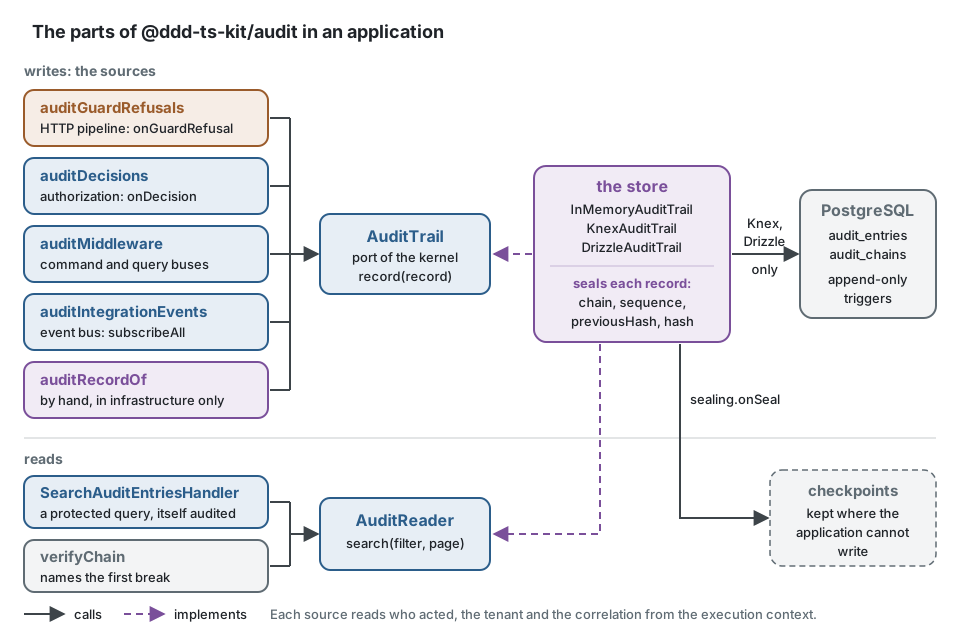
The diagram is the map of this page: the entry and its hash, the sources, redaction, verification, the stores and querying.
A first trail, in memory
Section titled “A first trail, in memory”Everything at once, in one file that runs: a command bus with the audit middleware, the
declaration of what the entry of one command carries, two commands, then the verification of
the chain and what a changed entry does to it. InMemoryAuditTrail is the fake of the tests;
in production a SQL store takes its place and nothing else changes.
import {  AuthorizedCommand,  FixedClock,  FixedExecutionScope,  InMemoryCommandBus,  SequentialIdGenerator,  executionContext,  type Actor,} from '@ddd-ts-kit/kernel';import { InMemoryAuditTrail, auditMiddleware, auditedFields, hmacMasker, masked, verifyChain } from '@ddd-ts-kit/audit';
class RescheduleAppointmentCommand extends AuthorizedCommand {  constructor(    actor: Actor,    readonly appointmentId: string,    readonly startsAt: Date,    readonly patientEmail: string,    readonly note: string,  ) {    super(actor);  }}
const ada: Actor = { id: 'ada', type: 'user', tenantId: 'acme', roles: ['practitioner'], attributes: {} };
// In an application, the HTTP boundary opens this scope for each request.const scope = new FixedExecutionScope(executionContext({ correlationId: 'request-1', actor: ada, origin: 'http' }));const trail = new InMemoryAuditTrail();
const commands = new InMemoryCommandBus()  .use(    auditMiddleware(trail, {      scope,      clock: new FixedClock(new Date('2026-03-01T10:00:00.000Z')),      ids: new SequentialIdGenerator('audit'),      masker: hmacMasker('a secret of the configuration', { keyId: 'k1' }),      fields: [        auditedFields(RescheduleAppointmentCommand, ['startsAt', masked('patientEmail')], {          resource: (command) => ({ type: 'appointment', id: command.appointmentId }),          context: 'scheduling',        }),      ],    }),  )  .register(RescheduleAppointmentCommand, { execute: async () => undefined }); // the handler: no audit call
const startsAt = new Date('2026-03-04T09:30:00.000Z');await commands.execute(new RescheduleAppointmentCommand(ada, 'apt-1', startsAt, 'lin@example.org', 'Family matter'));await commands.execute(new RescheduleAppointmentCommand(ada, 'apt-1', startsAt, 'lin@example.org', 'Again'));
// trail.entries[0]:// { id: 'audit-1', chain: 'tenant:acme', sequence: 1, occurredAt: 2026-03-01T10:00:00.000Z,//   category: 'command', action: 'RescheduleAppointmentCommand', outcome: 'succeeded',//   resource: { type: 'appointment', id: 'apt-1' }, context: 'scheduling',//   changes: { startsAt: '2026-03-04T09:30:00.000Z', patientEmail: { masked: 'k1:f3997a...' } },//   actor: { id: 'ada', type: 'user', tenantId: 'acme' }, tenantId: 'acme',//   correlationId: 'request-1', origin: 'http', extensions: {},//   previousHash: '0000...0000', hash: 'f65501...' }// No `note`: it was not declared, so it was never read.
await verifyChain(trail.entries); // { valid: true, checked: 2 }
// Somebody moves the appointment by one hour, in the trail itself:const first = trail.entries[0];
if (first !== undefined) {  trail.entries[0] = { ...first, changes: { ...first.changes, startsAt: '2026-03-04T10:30:00.000Z' } };}
await verifyChain(trail.entries);// { valid: false, checked: 0,//   break: { kind: 'altered-content', chain: 'tenant:acme', position: 0, sequence: 1, entryId: 'audit-1' } }
Ada works in the tenant acme, so her entries go to the chain tenant:acme; the second one
carries the hash of the first as its previousHash. The rest of this page takes each piece in
turn.
The entry
Section titled “The entry”The entry is a standard type of the kernel, and the two ports, AuditTrail and AuditReader,
are abstract classes of the kernel, so that code which records or lists depends on the kernel
alone. A port class is also what a binding is keyed by: there is no token beside it. This
package re-exports them, and holds everything that makes a trail tamper-evident: the chain, the
sources, redaction, verification and the stores.
interface AuditEntry { id: string; chain: string; // 'tenant:<id>', or 'global' for work that names no tenant sequence: number; // position in the chain: 1, 2, 3, without a gap occurredAt: Date; category: 'authorization' | 'command' | 'query' | 'integration-event' | 'authentication' | 'data-access' | string; action: string; // a permission id, a command name, an event type outcome: 'allowed' | 'denied' | 'succeeded' | 'failed'; reason?: string; // a stable code: NO_MATCHING_ROLE, the code of a DomainError actor: { id: string; type: ActorType | 'unknown'; tenantId?: string }; tenantId?: string; // the tenant of the work in progress impersonatedBy?: string; sessionId?: string; resource?: { type: string; id: string }; context?: string; // bounded context correlationId: string; causationId?: string; origin: ExecutionOrigin; // 'http', 'event', 'schedule', 'cli', ... changes?: Record<string, string | number | boolean | null | { masked: string }>; extensions: AuditEntryExtensionValues; previousHash: string; hash: string;}A source hands an AuditRecord (the entry without chain, sequence, previousHash and
hash) to the trail, which seals it. Actor, tenant, session, impersonation, correlation,
causation and origin are read from the kernel ExecutionScope, never threaded through a use
case.
A project adds its own fields by declaration merging, as for the kernel Session. They live
under extensions, are optional when read, and must be JSON (a Date or a class reads as
never), since they are hashed and stored as they are. The interface is the kernel's: augment
@ddd-ts-kit/kernel, next to the other extensions of the project (augmenting
@ddd-ts-kit/audit still works):
declare module '@ddd-ts-kit/kernel' { interface AuditEntryExtensions { readonly region: 'eu' | 'us'; }}One chain per tenant
Section titled “One chain per tenant”Each entry belongs to one chain: tenant:<id> when the work in progress names a tenant,
global otherwise (chainOfTenant). The reasons: a tenant can be verified, exported and
handed over without the entries of the others; appends to a chain are serialized, so one chain
for everything would make every command of the system wait for the same lock; and an
offboarded tenant leaves chains that still verify. The price: the order between entries of two
tenants is given by occurredAt only, not proven by a hash. Pass chainOf to a trail to
decide otherwise (one chain per bounded context, a single chain for a small system).
The hash
Section titled “The hash”hash is the SHA-256, in lower-case hexadecimal, of the canonical form of the entry without
hash, so previousHash, chain and sequence are part of what is sealed. The canonical
form (canonicalize) is meant to be computed again by any program, in any language:
- JSON without whitespace, encoded in UTF-8;
- the keys of every object sorted by UTF-16 code unit, at every depth;
- a property whose value is
undefinedleft out; occurredAtwritten in ISO 8601 UTC with milliseconds (2026-03-01T10:00:00.000Z);- strings and numbers as
JSON.stringifywrites them.
The first entry of a chain has previousHash equal to GENESIS_HASH (64 zeros).
Wiring the sources
Section titled “Wiring the sources”Everything happens in the composition root. Assembled by hand first; the same pieces bound in
an application of @ddd-ts-kit/di come after the sources.
The order of the command middlewares matters:
import { unitOfWorkMiddleware } from '@ddd-ts-kit/kernel';import { authorizationMiddleware } from '@ddd-ts-kit/auth';import { subscribeAll } from '@ddd-ts-kit/events';import { auditDecisions, auditIntegrationEvents, auditMiddleware, auditedFields, hmacMasker, masked } from '@ddd-ts-kit/audit';import { KnexAuditTrail } from '@ddd-ts-kit/audit/knex';
const trail = new KnexAuditTrail(unitOfWork, { schema: 'audit' }); // anything with `executor()`: the unit of work of @ddd-ts-kit/knex, or its contextconst source = { scope, clock, ids };
commandBus  // 1. who may: refused before any transaction opens  .use(authorizationMiddleware({ authorizer, map, onDecision: auditDecisions(trail, { ...source, sensitivePermissions: ['records:medical-file.read'] }) }))  // 2. what ran and how it ended: opens the unit of work itself  .use(auditMiddleware(trail, {    ...source,    unitOfWork,    masker: hmacMasker(config.auditMaskingSecret, { keyId: 'k1' }),    fields: [auditedFields(RescheduleAppointmentCommand, ['status', 'startsAt', masked('patientEmail')], {      resource: (command) => ({ type: 'appointment', id: command.appointmentId }),      context: 'scheduling',    })],  }))  // 3. joins the transaction opened by 2  .use(unitOfWorkMiddleware(unitOfWork));
// 4. what occurred between contextssubscribeAll(eventBus, auditIntegrationEvents(trail, { registry, clock, ids, processed, unitOfWork }));
a. Authorization decisions
Section titled “a. Authorization decisions”auditDecisions(trail, options) returns the onDecision function of the authorization
middleware of @ddd-ts-kit/auth. The types match structurally: this package does not depend on
the auth package. Each entry has category authorization, the permission id as action,
allowed or denied as outcome, the denial code as reason, the resource of the decision.
What is recorded by default:
| Decision | Recorded |
|---|---|
| denied, command or query | always |
| allowed, anything that is not a read | always |
allowed read of a permission listed in sensitivePermissions |
always |
| any other allowed read | no |
Recording every list and every page view drowns the trail and makes it expensive to keep, so
the allowed reads are the ones you choose. allowedReads: 'all' records them all,
allowedReads: { sample: 0.01 } one in a hundred. A read is, by default, a decision whose
kind is query: the middleware takes it from the bus that carried the message, whatever the
class is named. A decision taken outside a bus names no kind and is recorded. Pass isRead to
decide otherwise.
When the decision concerns another actor than the one of the execution context (a consumer
sending a command on behalf of a user), the entry names the actor of the decision with type
unknown: its type and tenant are not in what the hook receives.
a'. Refusals at the edge
Section titled “a'. Refusals at the edge”A request a guard refuses (HasRole, HasScope, TenantMember, a tenant the caller does not
belong to) never reaches a use case, so the authorization middleware does not see it. The HTTP
pipeline reports it to onGuardRefusal, and auditGuardRefusals(trail, { clock, ids }) records
it: category authorization, action http:<operationId>, outcome denied, the code of the
refusal as reason (FORBIDDEN, UNAUTHORIZED), and the actor, session, tenant and correlation
of the request. A caller without a credential is not recorded: it is no one to hold to account,
the tenant it addressed is its own choice, and recording it would let unauthenticated traffic
write to the trail (and open hash chains) without bound; those refusals belong to the access log
and to rate limiting. A recorded refusal is in the tenant of the caller's credential. A guard
that fails instead of refusing (a lookup that threw, not a DomainError) is not reported.
mountExpress(app, routes, { ...boundary, onGuardRefusal: auditGuardRefusals(trail, { clock, ids }) });b. Commands, and the unit of work
Section titled “b. Commands, and the unit of work”auditMiddleware records each command with outcome succeeded or failed, and the code of
the DomainError as reason. A failure that is not a DomainError is recorded as
UNEXPECTED_ERROR: neither its class nor its message enters the trail, they quote data.
queries: [ReadMedicalFileQuery] or queries: 'all' records queries too.
Two requirements pull in opposite directions: the entry of a failed command must survive
the rollback, and the entry of a succeeded command must not exist if its transaction did
not commit. A middleware placed inside the unit of work loses the first, one placed outside
loses the second (a crash between the commit and the record, or an entry written for a commit
that was then refused). Hence the arrangement: the middleware is installed before
unitOfWorkMiddleware and is given the unit of work.
- It opens the unit of work itself;
unitOfWorkMiddleware, and any nestedrun, join that transaction. - After the handler returns, it writes the
succeededentry in that transaction. The entry and the state change commit together, or neither exists. If the entry cannot be written, the command fails and rolls back: no state change without its trace. - When the handler throws, or the commit is refused, the transaction is gone; the middleware
then writes the
failedentry outside of it, and rethrows the failure of the use case. If that write fails too, the caller still receives the failure of the use case, andonLostRecordis told.
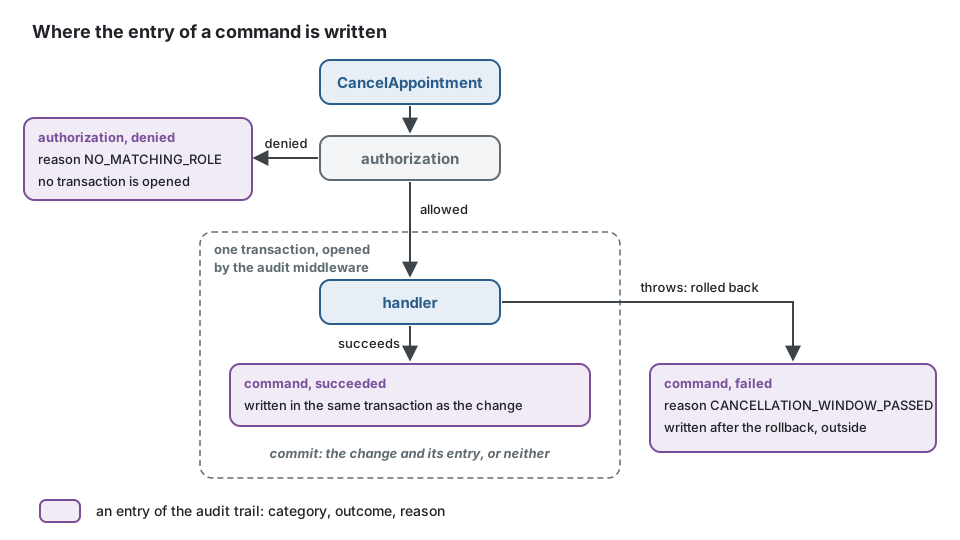
Without unitOfWork (no database, the in-memory trail) the middleware records after the
handler. Recording through the outbox would also be atomic for successes, but an outbox row
shares the fate of the transaction, so it cannot carry the failures: it solves half of the
problem.
Put the authorization middleware before this one. A refused command then leaves one
authorization denied entry and opens no transaction; with the opposite order it would also
leave a command failed entry with reason FORBIDDEN.
c. Integration events
Section titled “c. Integration events”auditIntegrationEvents(trail, options) returns one subscription per event type of the
registry, to hand to subscribeAll. It reads the envelope only (type, id, correlation), never
the payload: the entry says that billing.invoice.issued occurred, with the event id as
causationId and the correlation of the envelope. Delivery is at least once, so it
deduplicates by event id through the ProcessedEventStore it is given, under the consumer
name audit; with unitOfWork, the mark and the entry commit together.
d. By hand, the exception
Section titled “d. By hand, the exception”AuditTrail.record stays available for what none of the sources can see: a
data-access entry written by infrastructure, such as an export. auditRecordOf fills
everything the scope knows:
await trail.record(auditRecordOf({ scope, clock, ids }, { category: 'data-access', action: 'scheduling.appointments.export', outcome: 'succeeded', changes: { rows: 2000, format: 'csv' },}));This is infrastructure code. A call to the trail in domain/ or application/ is the defect
this package exists to prevent, and
layer/application-inward reports
an import of @ddd-ts-kit/audit in application/. What a handler is tempted to write, and what
replaces it:
import { AuthorizedCommand, type Actor, type AuditTrail, type Clock, type ExecutionScope, type IdGenerator } from '@ddd-ts-kit/kernel';import { auditRecordOf, auditedFields } from '@ddd-ts-kit/audit';
class CancelAppointmentCommand extends AuthorizedCommand {  constructor(    actor: Actor,    readonly appointmentId: string,  ) {    super(actor);  }}
// Instead of: the handler records its own entry. Each handler must remember to, a failure// leaves no entry at all, and the use case now depends on the audit.export class CancelAppointmentHandler {  constructor(    private readonly trail: AuditTrail,    private readonly source: { scope: ExecutionScope; clock: Clock; ids: IdGenerator },  ) {}
  async execute(command: CancelAppointmentCommand): Promise<void> {    // ... cancel the appointment ...    await this.trail.record(      auditRecordOf(this.source, {        category: 'command',        action: 'CancelAppointmentCommand',        outcome: 'succeeded',        resource: { type: 'appointment', id: command.appointmentId },      }),    );  }}
// Write: the handler only cancels. In the composition root, one declaration says what the entry// carries, and `auditMiddleware` records every outcome, failures included, with their code.export const cancelAppointmentAudit = auditedFields(CancelAppointmentCommand, [], {  resource: (command) => ({ type: 'appointment', id: command.appointmentId }),  context: 'scheduling',});
In an application of @ddd-ts-kit/di
Section titled “In an application of @ddd-ts-kit/di”The store is bound to both ports, and the masker to its own, each under its class:
import { AuditReader, AuditTrail } from '@ddd-ts-kit/kernel';import { defineContextModule } from '@ddd-ts-kit/di';import { AuditMasker, hmacMasker } from '@ddd-ts-kit/audit';import { KnexAuditTrail } from '@ddd-ts-kit/audit/knex';
export const trail = new KnexAuditTrail(unitOfWork, { schema: 'audit' }); // the unit of work bound to `UnitOfWork` and `KnexContext`
export const auditModule = defineContextModule({  name: 'audit',  register(builder) {    builder.bind(AuditTrail).toValue(trail);    builder.bind(AuditReader).toValue(trail);    builder.bind(AuditMasker).toValue(hmacMasker(config.auditMaskingSecret, { keyId: 'k1' }));  },});
builder.bind(AuditTrail).toClass(KnexAuditTrail, [KnexContext]) binds a store with its default
options instead, KnexContext being the port of @ddd-ts-kit/knex.
The sources are installed where the buses are built. The command bus of kernelModule() runs
the use case guard, then the unit of work; the audit middleware has to sit between the two, so
the bus is given through the options:
import { AuditTrail, InMemoryCommandBus, unitOfWorkMiddleware } from '@ddd-ts-kit/kernel';import { UseCaseGuard, createApplication, kernelModule } from '@ddd-ts-kit/di';import { authorizationModule } from '@ddd-ts-kit/auth/di';import { AuditMasker, auditDecisions, auditMiddleware } from '@ddd-ts-kit/audit';
const source = { scope, clock, ids };
const app = createApplication({  modules: [    kernelModule({      executionScope: scope,      clock,      ids,      unitOfWork,      commandBus: (resolve) =>        new InMemoryCommandBus()          .use((message, next, info) => resolve(UseCaseGuard).check(message, next, info))          .use(auditMiddleware(resolve(AuditTrail), { ...source, unitOfWork, masker: resolve(AuditMasker), fields }))          .use(unitOfWorkMiddleware(unitOfWork)),    }),    auditModule,    schedulingModule,    authorizationModule({ authorizer, onDecision: auditDecisions(trail, { ...source, sensitivePermissions: ['records:medical-file.read'] }) }),  ],  authorization: 'required',});
A project generated by the CLI with --audit on (the default) has this wiring under
src/platform/audit/: create-audit.ts builds the trail and its sources,
audit.module.ts binds the two ports, subscribes the integration events under the consumer
name audit and registers the protected SearchAuditEntriesQuery, and
src/platform/buses/create-command-bus.ts places the audit middleware between the use case
guard and the unit of work.
A handler or an adapter that needs the trail names the port in its dependencies and receives
the store: [AuditReader] for the query that lists entries (see Querying),
[AuditTrail] for the infrastructure adapter that records by hand.
Redaction
Section titled “Redaction”By default an entry carries no payload. changes exists only for what was declared:
auditedFields(RescheduleAppointmentCommand, ['status', 'startsAt', masked('patientEmail')]);auditedProjection(ExportAppointmentsCommand, (command) => ({ plain: { format: command.options.format } }));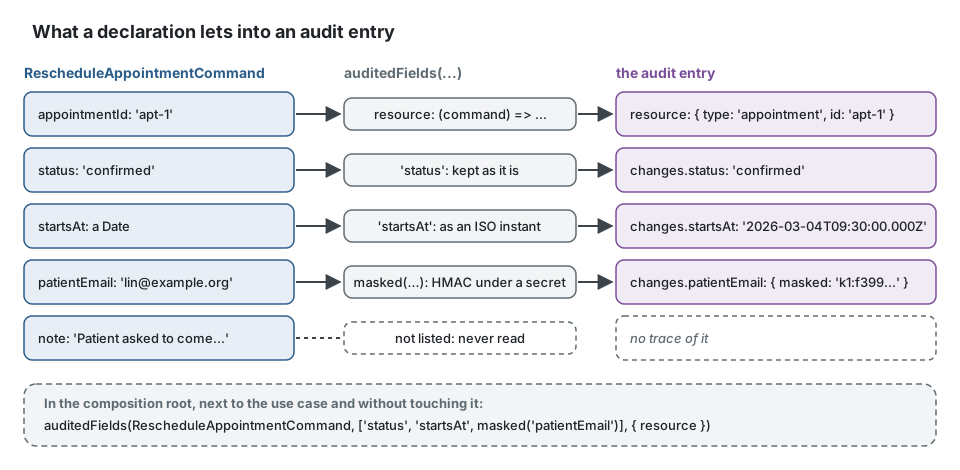
- A field that is not listed is never read. The compiler refuses a name the message does not have.
- A value is kept only if it is a string, a number, a boolean,
null, a bigint (as text) or aDate(as an ISO instant). An object is never stored whole: pick its scalars withauditedProjection. masked('patientEmail')stores{ masked: '<keyId>:<hex>' }: the HMAC-SHA-256 of the value under a secret (hmacMasker). Two entries about the same email carry the same mask, so "every entry about this person" can be answered by masking the email again; the email itself is not there, and without the secret a guess cannot be checked. A plain hash would not do: an email or a phone number is guessed in seconds.- A field declared
maskedwithout a masker is refused when the middleware is built; a projection that asks for a mask without one fails the command at its first use.
What must never go in, declared or not:
- free text (a comment, a reason typed by a user, a message body): it contains anything;
- credentials and tokens, session cookies, API keys, one-time codes, even hashed;
- whole payloads, request bodies, aggregates, results of queries;
- error messages and stack traces: record the
code; - special categories of personal data (health, opinions, biometrics), even masked, unless a decision record says why.
The right to erasure and an append-only chain
Section titled “The right to erasure and an append-only chain”An entry cannot be deleted without breaking its chain, and a regulation may require that personal data be erased. The two coexist as long as the chain never holds the data:
-
Keep personal data out. An actor id, a resource id, a permission id are identifiers. If your identifiers are themselves personal data (an email as user id), fix that first, or mask them at the boundary.
-
Mask what you must correlate. A masked value is not readable; it is still linked to a person for whoever holds the secret.
-
Crypto-shredding for erasure. Write a masker that derives one key per data subject (or per tenant) from a key store, using the
MaskingSubjectit receives (actorId,tenantId,resource).AuditMaskeris a port, an abstract class with the one methodmask: the adapterimplementsit and is bound under it:infrastructure/external/per-subject-masker.ts export class PerSubjectMasker implements AuditMasker {constructor(private readonly keys: SubjectKeys) {}async mask(value: AuditScalar, subject: MaskingSubject): Promise<string> {const key = await this.keys.keyOf(subject.resource?.id ?? subject.actorId); // created on first usereturn hmacMasker(key.secret, { keyId: key.id }).mask(value, subject);}}builder.bind(AuditMasker).toClass(PerSubjectMasker, [SubjectKeys]);Erasing a person is deleting their key: every mask made with it becomes a random-looking token nobody can recompute, the entries stay, the hashes stay valid. The key store is then the system to protect and to back up with care; this package does not provide one.
What stays after erasure is "an actor with this opaque id did this at that time". Whether that is acceptable is a legal question for the project, to answer before the first entry is written.
Verification and anchoring
Section titled “Verification and anchoring”const outcome = await verifyChain(reader, { chain: 'tenant:acme' });// { valid: true, checked: 1842 }// { valid: false, checked: 311, break: { kind: 'altered-content', chain: 'tenant:acme', position: 311, sequence: 312, entryId: '...' } }verifyChain(entries | reader, { chain?, from?, to?, checkpoints? }) walks a chain in the
order given and reports the first place where it stops holding:
| Kind | Meaning |
|---|---|
altered-content |
the entry does not hash to its hash, does not link to the entry before it, or disagrees with a checkpoint |
missing-entry |
the expected sequence is nowhere in what was examined (a hole, a missing head, a chain shorter than to) |
reordered |
the expected sequence exists elsewhere, or a position appears twice |
position is the index among the examined entries of the chain, sequence the sequence that
was expected there. Given entries (an export), every chain found is verified, and the entries
are never sorted first: a shuffled file is reported as such. Given a reader, chain is
required and the range is read page by page, then held in memory: verify long chains by ranges
(from, to). A range starting above 1 trusts the entry before it.
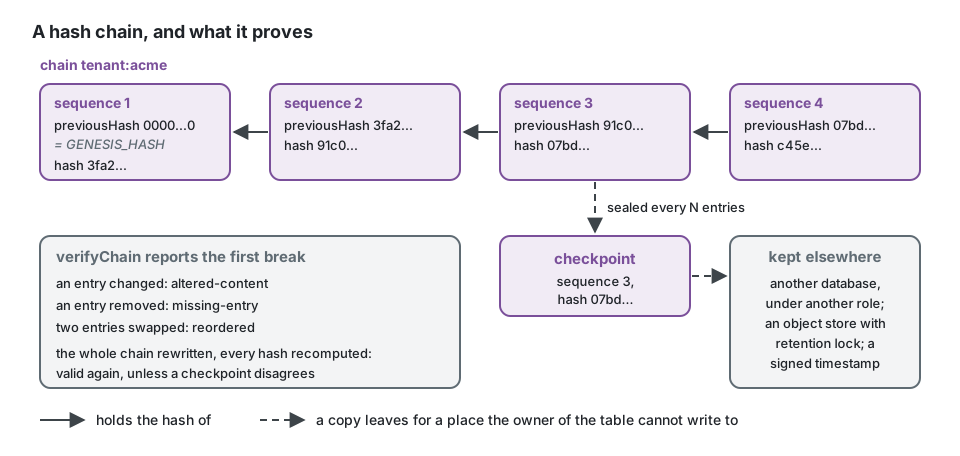
Why anchoring. The chain protects against whoever can change some rows. Whoever can
rewrite the whole table (a database administrator, an attacker with the owner's role) can
recompute every hash from the altered entry onwards: the result is a perfectly valid chain. The
only defence is a copy of some hashes where that person cannot write. sealing hands a
checkpoint over every N entries of a chain:
new KnexAuditTrail(unitOfWork, { schema: 'audit', sealing: { every: 1000, onSeal: (checkpoint) => outbox.append([auditChainSealed.create(checkpoint, meta)]) },});// later, against the checkpoints kept elsewhere:await verifyChain(reader, { chain, checkpoints });The hook runs when the entry is written, inside the unit of work when there is one. Appending
the checkpoint to the outbox there makes it leave only if the entry commits; a hook that calls
a remote service directly may anchor an entry whose transaction rolls back afterwards. Where
the checkpoints go is the project's choice: another database under another role, an object
store with retention lock, a transparency log, a signed timestamp. A truncated tail (the last
entries removed) is only seen by comparing with a later checkpoint or by asking for to.
Stores
Section titled “Stores”InMemoryAuditTrail implements both ports: the fake for tests (entries is the store, to
assert and to tamper with) and enough for an application without a database.
The SQL stores are for PostgreSQL. They write on the executor of the unit of work
(KnexContext.executor(), DrizzleContext.executor()): inside a transaction the entry shares
its fate, outside it is written at once in a transaction of its own.
// knex: a migration of the projectimport { createAuditTables, dropAuditTables } from '@ddd-ts-kit/audit/knex';export const up = (knex) => createAuditTables(knex, { schema: 'audit' });export const down = (knex) => dropAuditTables(knex, { schema: 'audit' });
// drizzle: in the schema files drizzle-kit readsimport { auditChainsTable, auditEntriesTable, auditGuardStatements } from '@ddd-ts-kit/audit/drizzle';export const auditEntries = auditEntriesTable('audit');export const auditChains = auditChainsTable('audit');// and in a custom migration (drizzle-kit generate --custom), since drizzle-kit writes no trigger:for (const statement of auditGuardStatements('audit')) {  await db.execute(sql.raw(statement));}
new DrizzleAuditTrail(unitOfWork, { schema: 'audit' });
Two tables: audit_entries (primary key (chain, sequence), unique id, indexes for the
reader) and audit_chains, one row per chain holding its last sequence and hash.
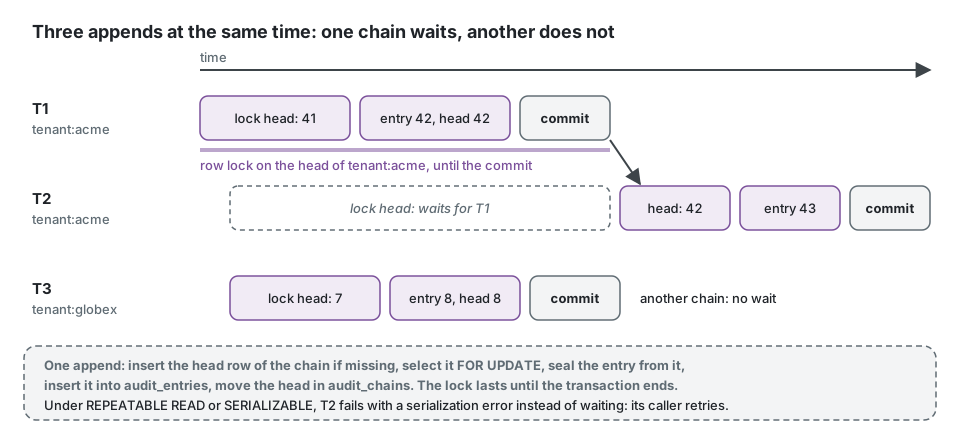
Concurrency. An append inserts the head row of its chain if it is missing, then takes it
with SELECT ... FOR UPDATE, computes the entry from it, inserts the entry and moves the head.
The row lock lasts until the transaction ends, so two appends to one chain never read the same
head and the chain cannot fork; appends to other chains do not wait. The primary key refuses a
duplicate position should the lock ever be bypassed. Under REPEATABLE READ or SERIALIZABLE
the second append fails with a serialization error instead of waiting, and its caller retries
the unit of work, as for any other statement under those levels: the kit does not retry it.
Append-only in the database too. The migration helper creates the function
audit_entries_append_only and two triggers: UPDATE, DELETE and TRUNCATE on
audit_entries raise SQLSTATE 23001, whoever asks. Triggers stop mistakes and application
bugs; a role that owns the table can drop them. So the application should not own the table.
Run the migrations with an owner role and give the application role only what it needs:
revoke all on all tables in schema "audit" from public;grant usage on schema "audit" to app;grant select, insert on "audit"."audit_entries" to app;grant select, insert, update on "audit"."audit_chains" to app;The application can then neither rewrite an entry, nor disable or drop the guard. What remains is the owner role and the superuser, which is what anchoring is for.
A new store passes the same suite as these:
import { auditTrailContract } from '@ddd-ts-kit/audit/testing';auditTrailContract({ describe, it, expect, beforeEach }, { name: 'MyAuditTrail', createTrail: () => freshTrail(), tamper });Querying
Section titled “Querying”const page = await reader.search( { tenantId: 'acme', actorId: 'ada', category: 'authorization', outcome: 'denied', from, to }, cursorPage({ limit: 50, sort: [{ field: 'occurredAt', direction: 'desc' }] }),);Filters: actorId, resource ({ type, id? }), action, category, outcome, period
(from included, to excluded), correlationId, tenantId, chain, fromSequence,
toSequence. Pagination uses the kernel types: an offset page answers total, a cursor page
nextCursor. Sort by occurredAt (then chain and sequence, the order a person reads in) or by
sequence (chain by chain, the order of verification).
AuditReader is a port of its own because reading the trail is itself a sensitive act. Expose
it as a use case like any other, which makes it protected and audited by the mechanisms above:
import { AuthorizedQuery, type AuditEntry, type Page } from '@ddd-ts-kit/kernel';
export class SearchAuditEntriesQuery extends AuthorizedQuery<Page<AuditEntry>> { /* actor, tenantId, filter, page */ }
// authorization: deny by default, one permission, flagged sensitiverequires(SearchAuditEntriesQuery, auditPermissions['trail.read']);auditDecisions(trail, { ...source, sensitivePermissions: ['audit:trail.read'] });auditMiddleware(trail, { ...source, queries: [SearchAuditEntriesQuery] });import { AuditReader, type AuditEntry, type Page } from '@ddd-ts-kit/kernel';import { QueryHandler } from '@ddd-ts-kit/kernel/declarations';
@QueryHandler(SearchAuditEntriesQuery)export class SearchAuditEntriesHandler { constructor(private readonly reader: AuditReader) {}
execute(query: SearchAuditEntriesQuery): Promise<Page<AuditEntry>> { return this.reader.search({ ...query.filter, tenantId: query.tenantId }, query.page); }}Whoever reads the trail leaves an entry in it. The handler depends on AuditReader of the
kernel, which application/ may import, and receives the store bound to it. It scopes the
filter to the tenant of the actor (an access scope computed by the authorizer), so one tenant
never lists another's entries.
In a multi-tenant project, bind new TenantAuditReader(store, executionScope) to
AuditReader instead of the store itself: every search is then confined to the tenant of the
work whatever its filter says (a filter naming another tenant or another chain finds nothing),
platform staff read across tenants only under an elevation (acrossTenants of the kernel, itself
recorded), and work that names neither is refused (NoCurrentTenantError).
Limits
Section titled “Limits”- PostgreSQL only for the SQL stores: row locks, row comparison for cursors,
jsonb, triggers. Another database is another adapter of the two ports, held to the contract suite. - Appends to one chain are serialized, and inside a unit of work the head stays locked
until the commit.
auditMiddlewarewrites last, so the window is short; a handler that records by hand early and then works for long makes the other writers of its tenant wait. - A rolled back unit of work frees its positions: the next entry reuses the sequence. There is never a gap, and never an entry for work that did not commit.
- A command sent from inside another unit of work (a consumer whose
consumeopened one) shares its fate: if that outer transaction rolls back, thefailedentry goes with it. - The chain proves integrity, not completeness of capture: a fact that never reached a
source (a script writing to the database, a route bypassing the bus) is not there. Keeping
every route on the bus is what
authz/declaredand the dependency rules are for. occurredAtis the clock of the instance that recorded; inside a chain, the order is the sequence.- Verification reads the range into memory, and trusts the entry before
from. - No retention or archiving policy is provided: how long entries are kept, and where old chains go, is a decision of the project. Deleting old entries means dropping the guard on purpose, by the owner role, after anchoring the entry that becomes the new start.
- drizzle wraps driver errors and prints the parameters of the failed statement in the
message of its error. The entry of an audit insert holds identifiers and codes only; still,
log the
codeof such an error, not its message.