
@ddd-ts-kit/kafka
The integration event provider for Apache Kafka: an EventBus of the kernel that publishes
with an idempotent producer and acks=all, so the outbox relay can mark a record published
safely, and consumes with one consumer group per consuming context, offsets committed after
the handlers resolved, a bounded number of delayed retries in place and a dead-letter topic.
It is the "Kafka and other logs" row of the strategy table of docs/ARCHITECTURE.md,
implemented, and it passes eventBusContract of @ddd-ts-kit/testing.
npm i @ddd-ts-kit/kafka @ddd-ts-kit/events @confluentinc/kafka-javascriptTested with @confluentinc/kafka-javascript 1.11 (librdkafka 2.16) against Apache Kafka 4.3
in KRaft mode, on Node 24. Other brokers speaking the Kafka protocol should work; only Apache
Kafka was run.
The client
Section titled “The client”@confluentinc/kafka-javascript is the client maintained by Confluent: a binding of
librdkafka with a promise API in the manner of KafkaJS, which is what this package uses.
| Candidate | Looked at on 2026-10-10 | Verdict |
|---|---|---|
kafkajs 2.2.4 |
last release in February 2023 | not maintained: ruled out |
@platformatic/kafka 2.14.0 |
pure JavaScript, 2.2 MB, released almost weekly, about 500 000 downloads a week, requires Node 22.22 or 24.6 | a serious option without native code; its consumer group protocol is a young reimplementation and its engine range is above the one of this kit (22.12) |
@confluentinc/kafka-javascript 1.11.0 |
released 2026-10-07, about 830 000 downloads a week, librdkafka underneath | chosen: the idempotent producer, the rebalance protocol and the reconnection are those of the reference C client, which is where a provider must not be approximately right |
The price is a native addon. Nothing is compiled when a prebuilt binary exists: the install
script of the package downloads one (13 MB, 30 MB installed) from the GitHub releases of the
client. Prebuilt binaries exist for Linux x64 and arm64 on glibc and musl, macOS arm64 and
Windows x64, for Node 18 to 24. Verified here: Ubuntu with Node 24.21, and the images
node:24-alpine and node:24-bookworm-slim, each without a compiler, in about five seconds.
What it asks of CI and of images:
- the install script must run: no
--ignore-scripts, and with a package manager that asks for install scripts to be approved (npm 11 warns, pnpm blocks), approve this package; the client documents npm as supported and Yarn and pnpm as experimental; - the install needs to reach
github.com; behind a proxy that forbids it, mirror the binary and pointnode-pre-gypat the mirror, or the install falls back to compiling librdkafka, which needs Python, make and a C++ compiler and takes minutes; - build the image on the libc it runs on: a
node_modulesinstalled on Debian does not load on Alpine; - nothing else is needed at run time: the binary links only to libc and libstdc++.
Composition root
Section titled “Composition root”Handlers never see this package. They publish to the outbox; the relay publishes to Kafka;
each consuming context listens through the bus under its own name. The bus is given to the
application as two ports of the kernel: IntegrationEventPublisher stays the outbox, and
EventSubscribers hands each context the subscriber of its own consumer name.
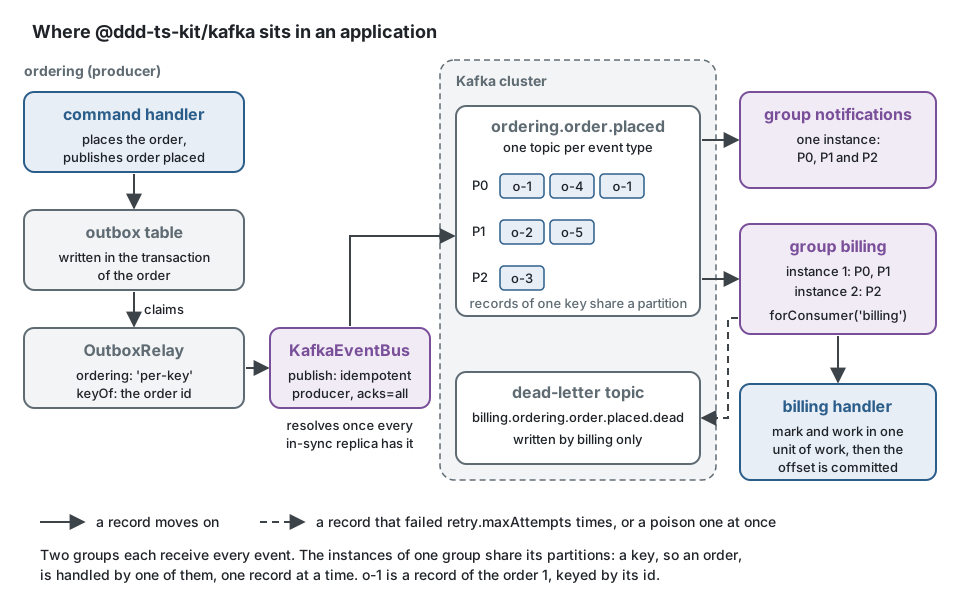
init --broker kafka writes this wiring in the platform of the project: the bus is built by
platform/events/create-event-provider.ts, keyed by platform/events/aggregate-key-of.ts,
platform/platform.module.ts rebinds EventSubscribers on it, and main.ts gives it, traced,
to the outbox relay of platform/events/start-outbox-relay.ts, which runs
ordering: 'per-key' with the same key. By hand, the same thing reads:
import { defineContextModule } from '@ddd-ts-kit/di';import { EventSubscribers, IntegrationEventPublisher, type IntegrationEvent } from '@ddd-ts-kit/kernel';import { OutboxPublisher, OutboxStore, type IntegrationEventDefinition } from '@ddd-ts-kit/events';import { KafkaEventBus } from '@ddd-ts-kit/kafka';
// The ordering key, given to the relay and to the bus: the aggregate id an event is about.export const aggregateOf = (event: IntegrationEvent): string | undefined =>  orderPlaced.is(event) ? event.payload.orderId : undefined;
export const bus = new KafkaEventBus({  brokers: config.kafkaBrokers, // 'kafka-1:9092,kafka-2:9092' or a list  client: { 'security.protocol': 'sasl_ssl', 'sasl.mechanism': 'SCRAM-SHA-512' /* ... */ },  keyOf: aggregateOf, // default: the event id, which orders nothing  publishedTypes: ['billing.invoice.issued'], // their topics are created by assertTopology  topics: { partitions: 6, replicationFactor: 3 }, // default: those of the broker  retry: { maxAttempts: 5, delayMs: 5_000 }, // the defaults  onFailure: (failure) => logger.warn('event bus failure', { ...failure }), // codes only, never an error message  onDelivery: ({ consumer, topic, outcome }) => deliveries.add(1, { consumer, topic, outcome }),});
export const messagingModule = defineContextModule({  name: 'messaging',  register(builder) {    // Publishing side: handlers write to the outbox, in the transaction of the command.    builder.rebind(IntegrationEventPublisher).toClass(OutboxPublisher, [OutboxStore]);    // Consuming side: one subscriber per consuming context, named after it.    builder.rebind(EventSubscribers).toValue({ forContext: (name) => bus.forConsumer(name) });  },});
// What the project has elsewhere, declared so that this sample compiles alone.declare const orderPlaced: IntegrationEventDefinition<{ readonly orderId: string }>;declare const config: { readonly kafkaBrokers: string };declare const logger: { warn(message: string, fields: object): void };declare const deliveries: { add(value: number, attributes: Record<string, string>): void };import type { IntegrationEventDefinition } from '@ddd-ts-kit/events';import { CommandBus, systemActor, type Actor, type Command, type IntegrationEvent } from '@ddd-ts-kit/kernel';import { IntegrationEventHandler } from '@ddd-ts-kit/kernel/declarations';
@IntegrationEventHandler(orderPlaced, { consumer: 'billing.invoice-on-order-placed' })export class InvoiceOnOrderPlacedIntegrationHandler { constructor(private readonly commands: CommandBus) {}
// Nobody is calling: the handler acts as a system actor named after its consumer. readonly actor = systemActor('billing.invoice-on-order-placed');
async handle(event: IntegrationEvent<OrderPlacedPayload>): Promise<void> { await this.commands.execute(new IssueInvoice(this.actor, event.payload.orderId)); }}
// What the project has elsewhere: the published language of ordering, the command of billing.interface OrderPlacedPayload { readonly orderId: string;}declare const orderPlaced: IntegrationEventDefinition<OrderPlacedPayload>;declare const IssueInvoice: new (actor: Actor, orderId: string) => Command;import { contextModule, createApplication, kernelModule } from '@ddd-ts-kit/di';import { Clock } from '@ddd-ts-kit/kernel';import { OutboxRelay, OutboxStore } from '@ddd-ts-kit/events';import { aggregateOf, bus, messagingModule } from '@/platform/messaging.module';
const app = createApplication({ modules: [ kernelModule(), persistenceModule, messagingModule, contextModule('ordering', orderingDeclarations), contextModule('billing', billingDeclarations), ],});
// The relay target is the bus. A record is marked published when every in-sync replica has it.const relay = new OutboxRelay({ store: app.resolve(OutboxStore), publisher: bus, clock: app.resolve(Clock), ordering: 'per-key', // one running relay: the events of an aggregate leave in order keyOf: aggregateOf,});
await app.start(); // subscribes the handler of billing on bus.forConsumer('billing')await bus.assertTopology(); // fail at startup, not at the first recordrelay.start({ intervalMs: 500 });
process.on('SIGTERM', async () => { await relay.stop(); // the tick in progress finishes await app.stop(); // the handlers are unsubscribed await bus.close(); // consumers stop, handlers in progress finish and commit});persistenceModulebindsOutboxStore, and rebindsUnitOfWorkandProcessedEventStoreto the database: see the README of the persistence adapter. A declared integration event handler is subscribed on the subscriber of its own context (forContextreceives the name of its module), and sinceUnitOfWorkandProcessedEventStoreare bound, its idempotency mark and its work commit in one unit of work: a redelivery is deduplicated, a failure leaves nothing behind.- Without an outbox the bus is the event bus of the kernel module, and handlers publish
straight to the broker:
kernelModule({ eventBus: bus, eventSubscribers: () => ({ forContext: (name) => bus.forConsumer(name) }) }). - Without a container the same objects are wired by hand:
bus.forConsumer('billing')is anIntegrationEventSubscriber, to give tosubscribeAllandconsumeof@ddd-ts-kit/events. publish(events)resolves only when every in-sync replica acknowledged every record of the batch and rejects otherwise (PUBLISH_NOT_ACKNOWLEDGEDwith the code of librdkafka inreason,BROKER_UNAVAILABLE,EVENT_BUS_CLOSED). Nothing is buffered for later: the outbox is the buffer.- A consumer name is required to subscribe, and it is the consumer group id, as is:
bus.forConsumer('billing')gives anIntegrationEventSubscriberfor one context on the clients of the bus (a modular monolith has several), and theconsumeroption names the onebus.subscribeworks for. A context extracted to its own service keeps its name, so its group and its offsets: nothing changes on the cluster. - Tracing is put around both sides from outside, as with any provider:
tracedPublisher(bus)as the relay target, and on the consuming side the instrumentation of the kernel module (kernelModule({ instrumentation: traceApplication() })), which gives each declared handler one spanprocess <consumer>per attempt.tracedSubscriber(bus.forConsumer(name))is for a composition withoutkernelModule. The bus carriestraceparentandcorrelationIduntouched, in the envelope and in the record headers. - The correlation makes the round trip. Publish through
scopedPublisher(publisher, scope)of the kernel: a declared handler (orconsume(definition, { ..., scope }, handler)by hand, or a callback wrapped withinEventScope) runs in an execution context whosecorrelationIdis the one of the request that published, whosecausationIdis the event, and a retry runs in the same one. - Change data capture (the Debezium outbox event router) can replace the relay and the publishing side of this bus; give it the same topics, keys and headers. The consuming side stays.
Topology
Section titled “Topology”bus.describeTopology() returns the topics and the groups as data, for a review or a
generated document; bus.assertTopology() creates the topics that do not exist and resolves
once the consumers have their partitions. For forConsumer('billing') subscribed to
ordering.order.placed:
| Object | Name | Properties |
|---|---|---|
| events topic | ordering.order.placed |
topicOf(type), by default the type; partitions and replication of topics, or of the broker |
| consumer group | billing |
subscribed to the events topics of its types; starts at the earliest record |
| dead-letter topic | billing.ordering.order.placed.dead |
<consumer>.<topic>.dead; written by this consumer only |
| replay group | billing.replay |
exists once replayDead ran; its committed offsets on the dead-letter topics say what was replayed |
The same, as the bus describes it:
import { KafkaEventBus, deadTopicOf, replayGroupOf } from '@ddd-ts-kit/kafka';
const bus = new KafkaEventBus({ brokers: 'kafka-1:9092', publishedTypes: ['billing.invoice.issued'] });
bus.forConsumer('billing').subscribe('ordering.order.placed', async () => {});
export const { topics, groups } = bus.describeTopology();// topics: [//   { name: 'billing.invoice.issued', role: 'events', partitions: -1, replicationFactor: -1 },//   { name: 'ordering.order.placed', role: 'events', partitions: -1, replicationFactor: -1 },//   { name: 'billing.ordering.order.placed.dead', role: 'dead', partitions: -1, replicationFactor: -1 },// ]   (-1: the defaults of the broker, since `topics` is not given)// groups: [{ groupId: 'billing', topics: ['ordering.order.placed'] }]
export const dead = deadTopicOf('billing', 'ordering.order.placed'); // 'billing.ordering.order.placed.dead'export const replay = replayGroupOf('billing'); // 'billing.replay'
One topic per event type is the default. topicOf: (type) => type.split('.')[0] gives one
topic per producing context instead: a consumer then reads every type of that context and
skips, by committing them, those it did not subscribe to; this is what keeps the order
between two types of one aggregate.
Topics are created on demand too: the first publication of a type creates its topic, the
first subscription creates the events topic and the dead-letter topic. Automatic creation by
the broker is never relied on (it gives one partition and the default replication, silently).
An existing topic is never altered: topics applies at creation only. With
topics: { create: false } the bus creates nothing and a missing topic fails the
publication.
A record is the envelope as JSON (id, type, version, occurredAt, payload,
traceparent, correlationId, tenantId), its key is keyOf(event), and its headers are
x-event-id, x-event-type, x-event-version, traceparent, x-correlation-id and
x-tenant-id. Any Kafka client can consume it.
Two consumers of one type are two groups and both receive every event. Two instances of one consumer are two members of its group: each partition, so each key, goes to one of them.
Ordering
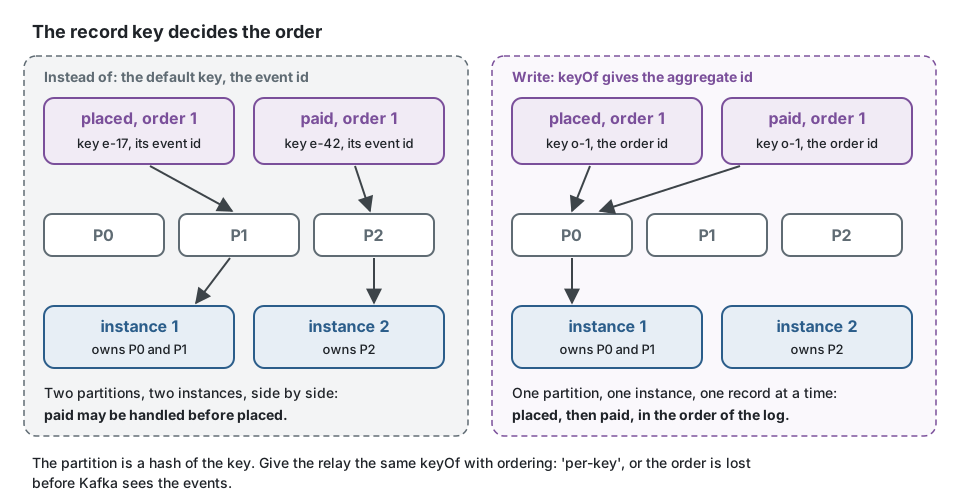
Section titled “Ordering”Kafka orders the records of one partition, and the key chooses the partition. So:
- Give
keyOfthe aggregate id. The default key is the event id: every event is then alone in its order. - Run the relay with
ordering: 'per-key'and the samekeyOf, or the order is lost before Kafka sees the events. - The bus does the rest: one publication writes the records of a topic in the order of the batch (idempotent producer, so a retry of the client cannot reorder or duplicate them), a consumer handles the records of a partition one at a time, and a failed record is retried in place, see below.
import { OutboxRelay, type IntegrationEventDefinition, type OutboxStore } from '@ddd-ts-kit/events';import { KafkaEventBus } from '@ddd-ts-kit/kafka';import type { Clock, IntegrationEvent } from '@ddd-ts-kit/kernel';
declare const orderPlaced: IntegrationEventDefinition<{ readonly orderId: string }>;declare const orderPaid: IntegrationEventDefinition<{ readonly orderId: string; readonly amount: number }>;declare const store: OutboxStore;declare const clock: Clock;
// Instead of: the default key, the event id. Each event is alone in its order, so two events// of one order may sit on two partitions and be handled side by side.export const unordered = new KafkaEventBus({ brokers: 'kafka-1:9092' });
// Write: the aggregate id, one function given to the bus and to the relay alike.const orderIdOf = (event: IntegrationEvent): string | undefined =>  orderPlaced.is(event) || orderPaid.is(event) ? event.payload.orderId : undefined;
export const bus = new KafkaEventBus({ brokers: 'kafka-1:9092', keyOf: orderIdOf });
// One running relay: the records of an order leave in the order they were written.export const relay = new OutboxRelay({ store, publisher: bus, clock, ordering: 'per-key', keyOf: orderIdOf });
An event that keyOf answers undefined for is published without a key: Kafka then spreads
such records over the partitions, and they keep no order between them.
concurrency is the number of partitions a consumer handles at once (default 1); the records
of one partition are never handled concurrently.
Retry and dead-letter behaviour
Section titled “Retry and dead-letter behaviour”- An offset is committed after every handler subscribed to the type of the record resolved,
never before, and never automatically. A declared
@IntegrationEventHandler(orconsumeof@ddd-ts-kit/eventsby hand) commits its work and its idempotency mark in one unit of work: the commit of the offset then follows that commit, and a redelivery is deduplicated. - When a handler throws, the bus pauses the partition of the record for
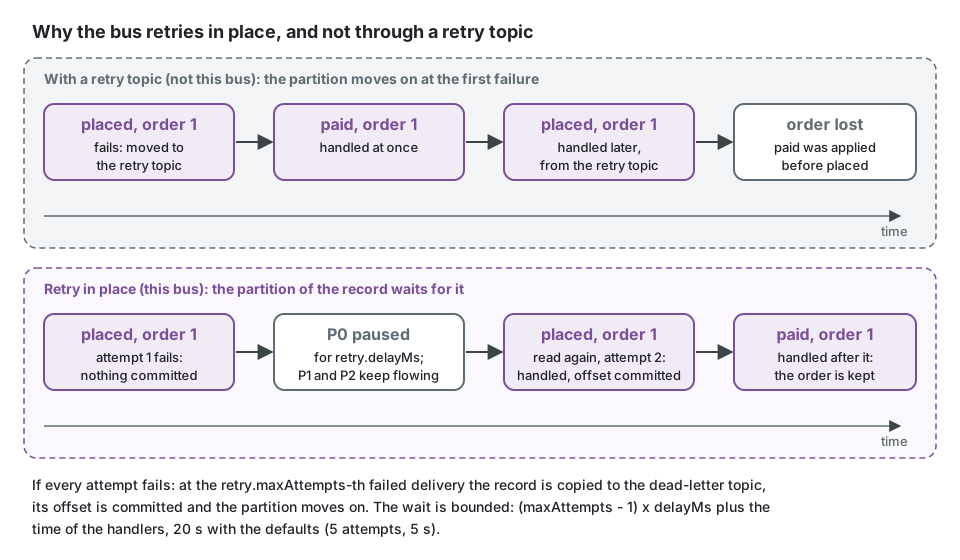
retry.delayMsand reads the same record again: no hot loop, the other partitions keep flowing, and the consumer keeps polling, so the wait neither delays a rebalance nor counts againstmax.poll.interval.ms. - At the
retry.maxAttempts-th failed delivery the record is copied to the dead-letter topic withx-dead-reason: max-attempts,x-error-code,x-attemptandx-source(<topic>/<partition>/<offset>), its offset is committed and the partition moves on. A failing record holds its partition for(maxAttempts - 1) x delayMsplus the time of its handlers (20 s with the defaults), never for ever. - A record whose value is not an envelope (unparseable, or without
id,type,version,occurredAt) is poison: it goes straight to the dead-letter topic withx-dead-reason: poisonandx-error-code: POISON_MESSAGE, and no handler sees it. - Only codes travel:
x-error-codeis thecodeof the error or its class name. The message of an error is never logged, reported or attached, because it may quote payload data. The client logs messages and stacks of what it catches: the bus turns its logger off.
Why retry in place and not through retry topics. A retry topic lets the partition move on at the first failure, and that is exactly the problem: the next event of the same aggregate is handled before the one that failed. A database that was down for two seconds would apply "order paid" before "order placed". Retrying in place keeps the order of a key through any failure that heals within the attempts; the cost is that the other keys of that partition wait too, for a bounded time. The order is given up only at the dead-letter step: the events that follow a dead one are handled without it, and a replay brings it back late. A consumer that cannot tolerate that must stop on the dead letter itself (carry a version in the payload, refuse a gap).
The bus decides from what the handler does, so a handler that hides its failure hides it from the bus too:
import type { KafkaEventBus } from '@ddd-ts-kit/kafka';import type { IntegrationEvent } from '@ddd-ts-kit/kernel';
declare const bus: KafkaEventBus;declare const logger: { warn(message: string, fields: object): void };declare function sendReceipt(event: IntegrationEvent): Promise<void>;
const notifications = bus.forConsumer('notifications');
// Instead of: catching the error. The handler resolves, the offset is committed, and the// event is gone: no retry, no dead letter, nothing to replay.notifications.subscribe('billing.invoice.issued', async (event) => {  try {    await sendReceipt(event);  } catch {    logger.warn('receipt not sent', { eventId: event.id });  }});
// Write: let it throw. The bus pauses the partition, reads the record again after// retry.delayMs, and after retry.maxAttempts copies it to// notifications.billing.invoice.issued.dead, where replayDead can take it back.notifications.subscribe('billing.invoice.issued', async (event) => {  await sendReceipt(event);});
Delivery is at least once. The copy-then-commit order means a crash in between delivers the record twice, never zero times.
Rebalances. Offsets are committed one record at a time, for handled records only, so a partition that moves to another member is resumed exactly after the last handled record. A handler in progress when its partition is taken away finishes; its commit is then refused, and the new owner handles the record again: the processed-event store absorbs it. The count of attempts lives in the memory of the member: a record being retried when its partition moves, or when the process restarts, starts a fresh budget.
Lost connections. librdkafka reconnects by itself, producers and consumers alike, with
its own backoff. While the cluster is away publish rejects after publishTimeoutMs (30 s
by default) with PUBLISH_NOT_ACKNOWLEDGED, so the outbox relay keeps the records and
retries them; a publication that was cut may have been written, and its retry is then a
second record with the same event id, which consumers deduplicate. A consumer that could not
start, commit or write a dead letter reports kind: 'connection' and tries again after the
reconnect backoff (200 ms doubling up to 30 s), without moving past the record.
Credentials. The client properties (SASL password, TLS keys) go to the client library when the bus is built and are kept nowhere else. A KafkaEventBus that is logged, spread or
serialised shows KafkaEventBus [clients concealed] and nothing else: its fields are not enumerable,
and toJSON and util.inspect answer that name. The failures it reports are codes. What the
client library itself shows when one of its own objects is inspected is not in the hands of
this package: do not log those.
What a handler is told. Next to the event, each handler receives the delivery
(EventDelivery of the kernel): { attempt, maxAttempts, system: 'kafka', destination, consumer },
where destination is the topic. Handlers of the application ignore it; @ddd-ts-kit/tracing reads it
to make one CONSUMER span per attempt and to mark the redeliveries and the attempt after which
the event is buried. The bus names itself messagingSystem: 'kafka', and traceparent travels in
the envelope and as a real header, intact across a retry.
Operations
Section titled “Operations”What to watch:
| Signal | Where | Meaning |
|---|---|---|
outbox stats() (pending, failed, dead) |
the outbox store | the publishing side: see @ddd-ts-kit/events |
lag of group <consumer> on its events topics |
cluster (kafka-consumer-groups.sh --describe, an exporter) |
the consumer lags, is stopped, or is retrying a record: a lag that does not move is a partition held by a failing record |
lag of group <consumer>.replay on <consumer>.<topic>.dead, or the end offset of that topic before any replay |
cluster | the dead-letter depth: must be 0, alert on anything else |
onDelivery counted by outcome |
this bus | rate of retried, dead, poison against acknowledged |
onFailure with kind: 'connection' |
this bus | consumers that could not start, commit or dead-letter, with the code of librdkafka |
DeadLetterReports of the kernel on onFailure |
the error tracker | one report per event given up (dead or poison), with the error its handler threw; a retried delivery is not reported |
bus.deliveriesInFlight |
this bus | handlers running now; stuck above 0 means a handler that hangs |
bus.partitionsAssigned |
this bus | 0 on an instance that subscribed means it consumes nothing (more instances than partitions, or not joined) |
under-replicated partitions, min.insync.replicas |
cluster | below 2 in-sync replicas, acks=all protects nothing |
The signals of the bus, wired to a meter and a logger, and the replay of dead letters once the cause is fixed:
import { KafkaEventBus } from '@ddd-ts-kit/kafka';import { DeadLetterReports, type ErrorReporter, type EventSubscribers } from '@ddd-ts-kit/kernel';
declare const deliveries: { add(value: number, attributes: Record<string, string>): void };declare const logger: { warn(message: string, fields: object): void };declare const errorReporter: ErrorReporter;
const deadLetters = new DeadLetterReports(errorReporter);
export const bus = new KafkaEventBus({  brokers: ['kafka-1:9092', 'kafka-2:9092', 'kafka-3:9092'],  // One count per settled record: acknowledged, retried, dead or poison.  onDelivery: ({ consumer, topic, outcome }) => deliveries.add(1, { consumer, topic, outcome }),  // Codes only, never an error message: safe to log as it is.  onFailure: (failure) => {    logger.warn('event bus failure', failure);    deadLetters.onFailure(failure);  },});
// Bound to EventSubscribers: the reports of buried events then carry what the handler threw.export const subscribers: EventSubscribers = { forContext: (name) => deadLetters.observing(bus.forConsumer(name)) };
// For a gauge: handlers running now, and partitions this instance consumes.export const gauges = () => ({ inFlight: bus.deliveriesInFlight, partitions: bus.partitionsAssigned });
// Once the cause is fixed: up to 100 records back to ordering.order.placed, for billing only.export async function replayBillingDeadLetters(): Promise<number> {  return bus.replayDead({ consumer: 'billing', type: 'ordering.order.placed' }, 100);}
It copies up to that many records from the dead-letter topic back to the topic they came
from, with the header x-replay-for: billing, and commits its progress on the dead-letter
topic as the group billing.replay. The consumers of this kit other than billing skip a
record marked for someone else; a consumer written without this kit sees the event a second
time and must deduplicate on x-event-id. The replayed record goes to the end of the topic,
so after the events that followed it. Look at x-dead-reason and x-error-code first:
replaying a poison record only kills it again. Dead-letter topics are ordinary topics: give
them a retention that leaves time to look.
To stop a consumer for good, delete its group, its replay group and its dead-letter topics. Unsubscribing a handler does not move the group: a record whose type has no handler left holds its partition until a handler comes back or the bus closes.
Limits
Section titled “Limits”- A failing record delays its whole partition, for
(maxAttempts - 1) x delayMsplus the time of its handlers. Keep that well under the latency the other aggregates can accept. - One delay. The wait is the same for every attempt, no exponential backoff.
- One commit per record, synchronous: the throughput of a partition is bounded by the handler plus a commit round trip. It is the price of never committing an unhandled record.
- A handler must finish within
maxHandlingMs(max.poll.interval.ms, 5 minutes by default). Beyond it the member is taken for dead, its partitions move, and the record is handled twice, concurrently. - A new group starts at the earliest record of its topics (
startFrom: 'earliest'): a consumer deployed after the producers misses nothing, and a consumer added a year later reads a year of retained events. Chooselatestdeliberately, knowing that what is published between the creation of the group and its first assignment is then skipped. - A retry runs every handler of the type again, those that succeeded included, when several handlers of one consumer subscribe to the same type. Each must be idempotent.
- A batch is not atomic. When
publishrejects, some records may have been written. The relay publishes one by one and retries, consumers deduplicate. Transactions are not used. - The idempotent producer deduplicates the retries of the client, not those of the relay. A record published again by the relay is a second record: the processed-event store is not optional.
- Durability is a cluster setting.
acks=allwaits for the in-sync replicas, whatever their number: use a replication factor of 3 withmin.insync.replicas=2. The defaults of a single-node broker acknowledge with one copy. publishdoes not fail fast while the cluster is away: it waitspublishTimeoutMs. Lower it for a relay that must notice quickly; it is also the bound of a healthy but slow acknowledgement.- Topic and group names are the event type and the consumer name as given: they must fit
the 249 characters and the
[a-zA-Z0-9._-]alphabet of Kafka, dead-letter suffix included. - Partitions of an existing topic are not changed by the bus, and adding partitions by hand moves keys to other partitions: the order of a key is lost across that change.
- The native client is loaded in the process: a crash of librdkafka is a crash of the
process, and
clientis passed to it unchecked.
Not verified by the test suite: a cluster of several brokers (leader election, an in-sync
replica set that shrinks, min.insync.replicas), TLS and SASL, the cooperative assignor and
the next-generation group protocol (group.protocol=consumer), a consumer process killed
mid-handler, a fatal producer error (the bus then opens a new producer; the path is not
exercised), brokers older than 4.3, and Debezium in place of the relay.
Other providers
Section titled “Other providers”@ddd-ts-kit/rabbitmq and @ddd-ts-kit/nats implement the same two ports and pass the same
contract suite. The three share the envelope, the header names (traceparent,
x-correlation-id, x-event-version, x-attempt, x-error-code, x-dead-reason), the
option names (consumer, retry, reconnect, onFailure, onDelivery) and the methods
(forConsumer, assertTopology, describeTopology, replayDead, close).
RedisStreamsEventBus of @ddd-ts-kit/redis is a fourth: same ports, same contract suite,
same option names and methods, on a server you may already run. Kafka is the one to choose
when the order of the events of an aggregate matters.
Testing
Section titled “Testing”The suites need a real broker and are skipped without DDD_TS_KIT_TEST_KAFKA_BROKERS:
docker run -d --rm --name ddd-ts-kit-test-kafka -p 127.0.0.1:9092:9092 -p 127.0.0.1:9094:9094 -e KAFKA_NODE_ID=1 -e KAFKA_PROCESS_ROLES=broker,controller -e KAFKA_LISTENERS=PLAINTEXT://:9092,RELAYED://:9094,CONTROLLER://:9093 -e KAFKA_ADVERTISED_LISTENERS=PLAINTEXT://127.0.0.1:9092,RELAYED://127.0.0.1:9095 -e KAFKA_LISTENER_SECURITY_PROTOCOL_MAP=CONTROLLER:PLAINTEXT,PLAINTEXT:PLAINTEXT,RELAYED:PLAINTEXT -e KAFKA_CONTROLLER_QUORUM_VOTERS=1@localhost:9093 -e KAFKA_CONTROLLER_LISTENER_NAMES=CONTROLLER -e KAFKA_INTER_BROKER_LISTENER_NAME=PLAINTEXT -e KAFKA_OFFSETS_TOPIC_REPLICATION_FACTOR=1 -e KAFKA_TRANSACTION_STATE_LOG_REPLICATION_FACTOR=1 -e KAFKA_TRANSACTION_STATE_LOG_MIN_ISR=1 -e KAFKA_GROUP_INITIAL_REBALANCE_DELAY_MS=0 apache/kafka:4.3.1DDD_TS_KIT_TEST_KAFKA_BROKERS=127.0.0.1:9092 DDD_TS_KIT_TEST_KAFKA_RELAY=127.0.0.1:9095=127.0.0.1:9094 npx vitest run packages/kafkadocker rm -f ddd-ts-kit-test-kafkaA Kafka client connects to the addresses the broker advertises, so a network failure cannot
be produced by pointing the bus at a relay: the broker has a second listener, RELAYED,
that advertises 127.0.0.1:9095, where the tests listen and relay to the port behind it
(9094). DDD_TS_KIT_TEST_KAFKA_RELAY gives both addresses; without it the three network
failure tests are skipped and the rest runs.
They run the contract suite on topics of one and of three partitions, then the behaviours of
this provider, one suite per behaviour (publishing, consuming, correlation, retries
in place, dead-letters, partitions for the order per key through a retry and a second
instance joining, topology, connection-loss with the acknowledged publication cut
mid-flight, closing) and the whole chain from the outbox to an idempotent consumer. Every test works on topics and groups of its own and deletes them.