
Entities and value objects
Summary. The domain model is made of two kinds of objects. An entity has an identity that
persists while its attributes change: an appointment stays the same appointment when it is
rescheduled. A value object has no identity: it is defined entirely by its attributes, it is
immutable, and two of them with the same attributes are interchangeable, like a time slot or a
cancellation reason. Most concepts should be value objects; entities are the few things whose
continuity the business tracks. In this kit both have a private constructor and factories,
entities change only through methods named after a business intention, and value objects never
change at all. A value object is always a class extending ValueObject, never a function that
builds a plain object (domain/value-object-class).
Telling them apart
Section titled “Telling them apart”Ask the domain expert: "if every attribute were the same, would these still be two different things?"
| Entity | Value object | |
|---|---|---|
| Identity | has one, stable over time | none |
| Equality | by identifier | by attributes (equals) |
| Mutability | changes state through intention methods | immutable; an operation returns a new instance |
| Lifecycle | created, changed, sometimes ended; stored and loaded | created when needed, discarded freely |
| Example | Appointment, Calendar, a TimeOff entry inside a calendar |
TimeSlot, CancellationReason, WorkingHours, an email address |
Two appointments for the same client, practitioner and slot would still be two appointments
(and a bug the invariant must prevent): entity. Two TimeSlots from 09:00 to 09:30 on the same
day are the same slot: value object.
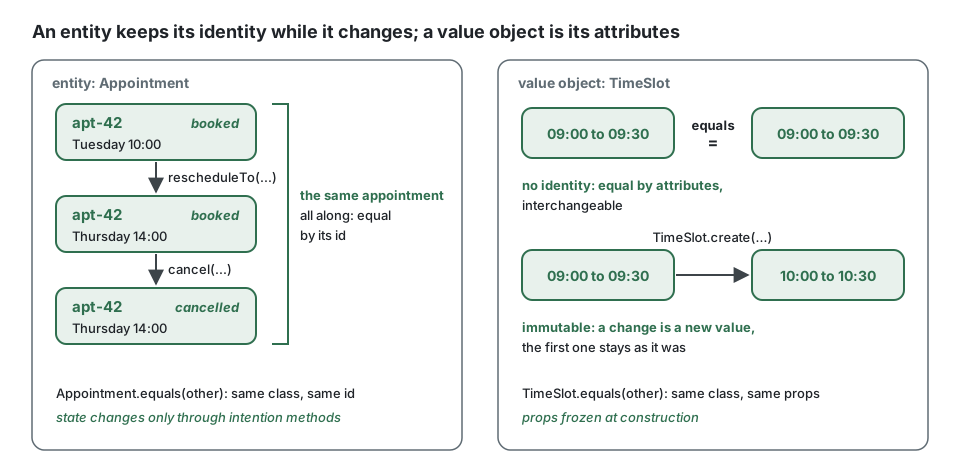
The same concept can be an entity in one context and a value in another. A practitioner is an
entity where profiles are managed; in appointments it is only a practitionerId.
Value objects
Section titled “Value objects”A value object gathers a concept that would otherwise be scattered as primitives, together with the rules that make it valid and the operations that belong to it.
import { ConceptError, ValueObject } from '@ddd-ts-kit/kernel';
export class AppointmentError extends ConceptError {  static invalidTimeSlot(startsAt: Date, endsAt: Date) {    return AppointmentError.refusal(      'INVALID_TIME_SLOT',      `A slot ends after it starts: ${startsAt.toISOString()} to ${endsAt.toISOString()} does not.`,      { startsAt, endsAt },    );  }}
// contexts/appointments/domain/value-objects/time-slot.vo.tsexport type TimeSlotProps = {  readonly startsAt: Date;  readonly endsAt: Date;};
export class TimeSlot extends ValueObject<TimeSlotProps> {  private constructor(props: TimeSlotProps) {    super(props);  }
  static create(startsAt: Date, endsAt: Date): TimeSlot {    if (endsAt.getTime() <= startsAt.getTime()) {      throw AppointmentError.invalidTimeSlot(startsAt, endsAt);    }
    return new TimeSlot({ startsAt, endsAt });  }
  overlaps(other: TimeSlot): boolean {    return this.startsAt < other.endsAt && other.startsAt < this.endsAt;  }
  startsWithin(durationMs: number, now: Date): boolean {    return this.startsAt.getTime() - now.getTime() < durationMs;  }
  get startsAt(): Date {    return this.props.startsAt;  }
  get endsAt(): Date {    return this.props.endsAt;  }}
What the shape gives:
- Valid by construction. The constructor is private and
createchecks the rules, so aTimeSlotthat exists is a valid one. Code that receives aTimeSlotnever re-validates. - Immutable. Properties are readonly and no method assigns to the object
(
domain/value-object-immutability). It can be shared and passed around without defensive copies. - Behaviour next to data.
overlapsis written once, on the type it concerns, instead of being repeated wherever two pairs of dates meet. - No hidden clock.
startsWithinreceivesnow; the domain never reads the system time (purity/no-system-clock). - Equality for free.
ValueObjectfreezes the props at construction and compares them inequals, dates by their instant and arrays item by item: two slots built from the same instants are equal,===is not the question. - Props are a
type, not aninterface.ValueObject<Props>requiresRecord<string, unknown>: an object type alias satisfies it, an interface does not, because TypeScript gives an implicit index signature to the first only.
In a spec, the value is used as the business speaks of it:
import { ValueObject } from '@ddd-ts-kit/kernel';import { describe, expect, it } from 'vitest';
// The TimeSlot above, reduced to what this spec uses.type TimeSlotProps = { readonly startsAt: Date; readonly endsAt: Date };
class TimeSlot extends ValueObject<TimeSlotProps> {  private constructor(props: TimeSlotProps) {    super(props);  }
  static create(startsAt: Date, endsAt: Date): TimeSlot {    return new TimeSlot({ startsAt, endsAt });  }
  overlaps(other: TimeSlot): boolean {    return this.props.startsAt < other.props.endsAt && other.props.startsAt < this.props.endsAt;  }}
const at = (time: string): Date => new Date(`2026-03-03T${time}:00.000Z`);
describe('TimeSlot', () => {  it('is equal to another slot with the same start and end', () => {    expect(TimeSlot.create(at('09:00'), at('09:30')).equals(TimeSlot.create(at('09:00'), at('09:30')))).toBe(true);  });
  it('overlaps a slot that starts before it ends', () => {    expect(TimeSlot.create(at('09:00'), at('09:30')).overlaps(TimeSlot.create(at('09:15'), at('09:45')))).toBe(true);  });
  it('does not overlap the slot that starts when it ends', () => {    expect(TimeSlot.create(at('09:00'), at('09:30')).overlaps(TimeSlot.create(at('09:30'), at('10:00')))).toBe(false);  });});
Why a value object is a class
Section titled “Why a value object is a class”A value can be written two ways in TypeScript: a function that builds a plain object, or a class.
The kit writes, and checks, the class (domain/value-object-class).
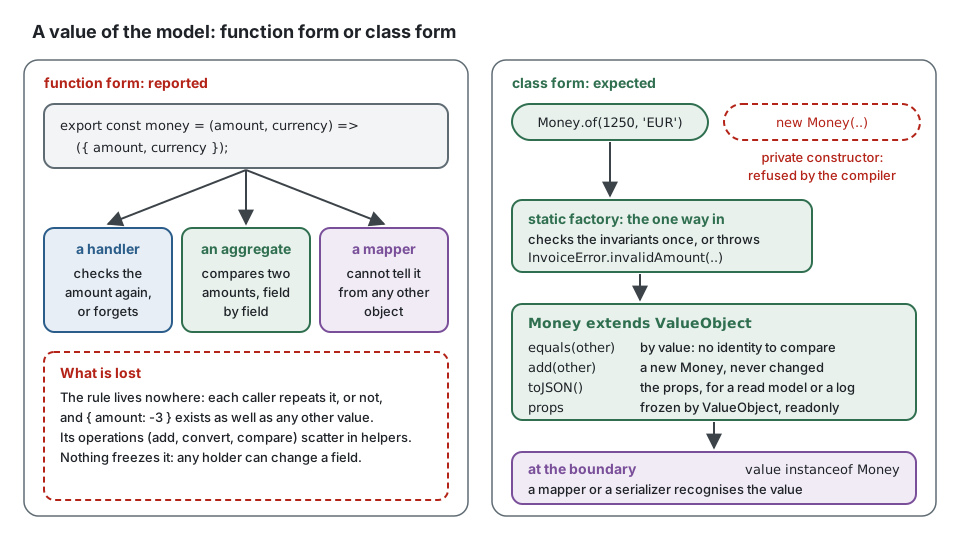
The function form looks lighter:
// domain/value-objects/money.vo.ts: reportedexport type Money = { readonly amount: number; readonly currency: string };
export const money = (amount: number, currency: string): Money => ({ amount, currency });
and costs more at every place that uses it:
// three callers, three copies of the rules, or noneif (!Number.isInteger(price.amount)) { /* ... */ } // a handler validates againconst same = a.amount === b.amount && a.currency === b.currency; // an aggregate compares by handconst total = { amount: a.amount + b.amount, currency: a.currency }; // a helper adds, uncheckedThe class form gathers all of that in one place:
// domain/value-objects/money.vo.ts: npx ddd-ts-kit generate value-object billing Moneyimport { ValueObject } from '@ddd-ts-kit/kernel';import { InvoiceError } from '@/contexts/billing/domain/errors/invoice.error';
export type MoneyProps = {  readonly amount: number;  readonly currency: string;};
export class Money extends ValueObject<MoneyProps> {  private constructor(props: MoneyProps) {    super(props);  }
  static of(amount: number, currency: string): Money {    if (!Number.isInteger(amount)) {      throw InvoiceError.invalidAmount(amount);    }
    return new Money({ amount, currency });  }
  static zero(currency: string): Money {    return Money.of(0, currency);  }
  add(other: Money): Money {    if (other.currency !== this.currency) {      throw InvoiceError.currencyMismatch(this.currency, other.currency);    }
    return Money.of(this.amount + other.amount, this.currency);  }
  get amount(): number {    return this.props.amount;  }
  get currency(): string {    return this.props.currency;  }}
// the same three callersconst price = Money.of(1250, 'EUR'); // valid, or refused with INVALID_AMOUNTconst same = a.equals(b); // by valueconst total = a.add(b); // a new Money, checked again by `of`What the class gives, and the function cannot:
Function answering { amount, currency } |
Class extending ValueObject |
|
|---|---|---|
| Equality without identity | every caller compares field by field, or compares references by mistake | equals compares the props: two equal values are interchangeable |
| Invariants checked once | any object of the right shape passes, { amount: 0.5 } included; each caller re-checks or forgets |
the constructor is private, the static factory is the only way in: a Money that exists is valid |
| Behaviour next to the data | add, convert, isZero become helpers in other files, found by searching |
methods of the type they concern, found by completion |
| Refusals from static factories | an invalid input goes through unnoticed | Money.of throws the refusal of its concept, InvoiceError.invalidAmount(..), which the HTTP mapping, the audit trail and the tests know by its code; or returns it in a Result under "stack.valueObjects": "result" |
| Immutability | a readonly type is a promise of the compiler only: any holder can still spread and change it |
the props are frozen by ValueObject, an operation returns a new instance (domain/value-object-immutability) |
| Recognised at the boundary | a mapper cannot tell a Money from any object with two such fields |
value instanceof Money in a mapper or a serializer; toJSON() gives the props to a read model or a log |
What domain/value-object-class checks
Section titled “What domain/value-object-class checks”The rule holds a project whose config says "stack.values": "classes", which init writes. A
config without the key was written before the rule existed: it reads as free and nothing is
reported; CONFIG.md gives the steps to move.
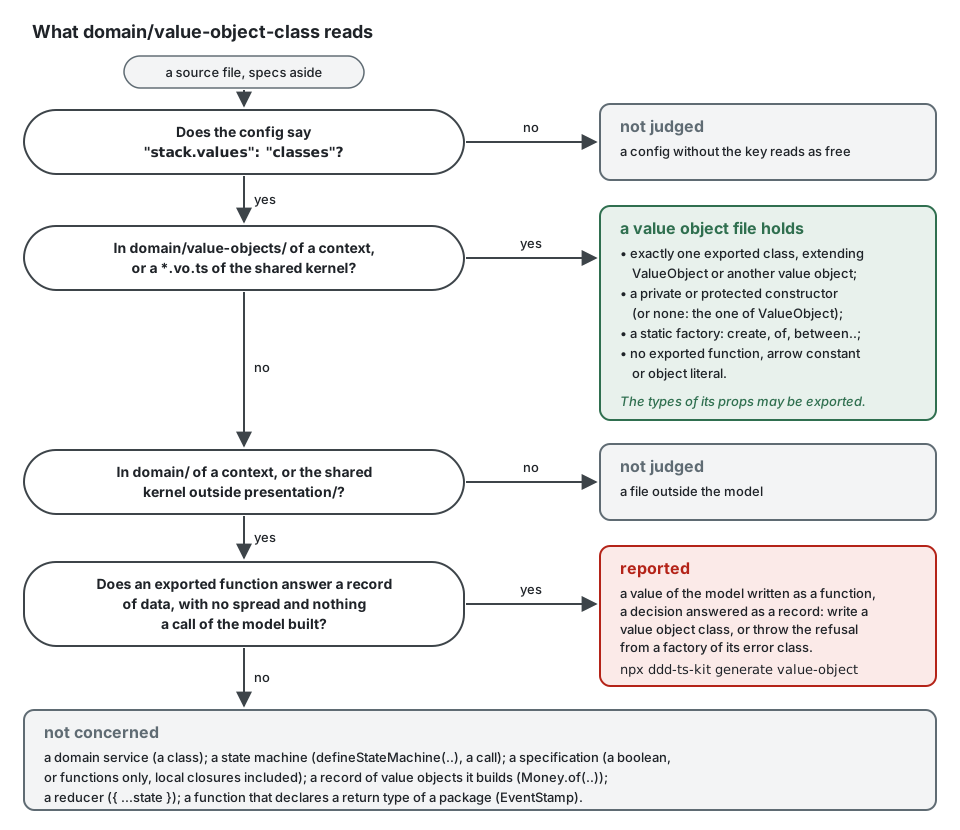
- A value object file (
domain/value-objects/*.vo.tsof a context, a*.vo.tsof the shared kernel outsidepresentation/) exports exactly one class extendingValueObject, directly or through another value object of the project; its constructor is private or protected (a class that declares none inherits the protected one ofValueObject); a concrete class has a static factory; and the file exports no function, no arrow constant and no object literal, inline, by an export list or by default. The types and interfaces of its props may be exported next to it. - In the other files of
domain/and of the shared kernel (outsidepresentation/), an exported function that answers a record of data is a value written as a function, and is reported with the command that writes the class.
Whether an answered object is a record of data is read entry by entry, without the types:
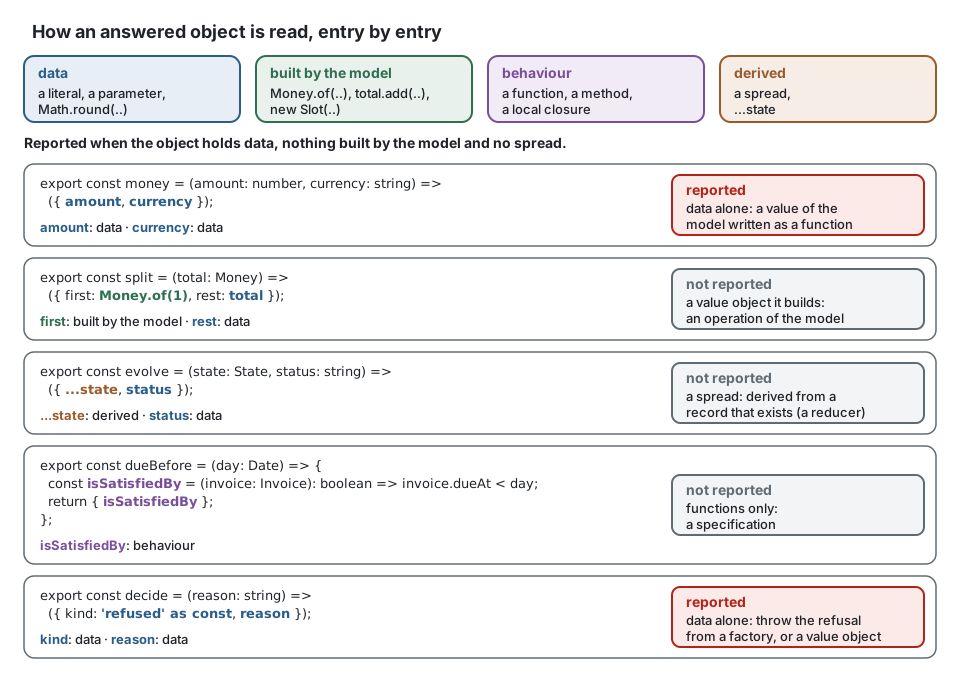
| Entry | Reads as | Examples |
|---|---|---|
| a literal, a parameter, an operation on them, a call of the language | data | amount, 'EUR', cents * 100, Math.round(cents), new Date(at) |
any other call or new, or a name bound to one in the module |
built by the model | Money.of(1), total.add(tax), new Slot(..) |
| a function, a method, or a name bound to one in the module | behaviour | isSatisfiedBy: (x) => .., describe() {}, { isSatisfiedBy } |
...state |
derived | { ...state, status } |
The object is a record of data when it holds data, nothing built by the model and no spread. A
function that declares a return type of a package (): EventStamp of the kernel) is not
judged: the shape belongs to the library, and the project cannot make it a class.
What stays a function, because it is not a value:
// domain/state-machines/invoice.state-machine.ts: a declaration, the result of a callexport const invoiceLifecycle = defineStateMachine({ states: ['draft', 'issued'], /* ... */ });
// domain/services/invoice-total.service.ts: takes and returns value objectsexport function invoiceTotal(lines: readonly Money[], currency: string): Money {  return lines.reduce((sum, line) => sum.add(line), Money.zero(currency));}
// a specification: answers a boolean, or functions only, literal or local closuresexport const isOverdue = (invoice: Invoice, now: Date): boolean => invoice.dueAt < now;export const dueBefore = (day: Date) => {  const isSatisfiedBy = (invoice: Invoice): boolean => invoice.dueAt < day;
  return { isSatisfiedBy };};
// an operation of the model: a record of value objects it buildsexport const split = (total: Money) => ({ first: Money.of(1), rest: total.subtract(Money.of(1)) });
// a reducer: derives a record that exists, with a spreadexport const evolve = (state: InvoiceState, status: string): InvoiceState => ({ ...state, status });
What is reported, by decision, with what to write instead:
// a decision answered as a record: the domain refuses by throwing the refusal of its concept,// `throw InvoiceError.refused(reason)`, or names the decision as a value object,// `Decision.refused(reason)`, whose class says which decisions existexport const decide = (reason: string) => ({ kind: 'refused' as const, reason });
// data with closures: a value with behaviour, which is a class with methodsexport const money = (cents: number) => ({ cents, doubled: (): number => cents * 2 });
// a record that only gathers its parameters, value objects included: a pair that means// something is a value of the glossary, `Period.between(start, end)`export const period = (start: Instant, end: Instant) => ({ start, end });
Not every exported type of domain/ is a value either. A parameter object, which only
groups the arguments of one method or factory and is neither kept, compared nor computed with,
stays a type: CalendarDesk (the practice, the practitioner and the time zone given to
Calendar.create, then spread into the state) and FreedSlot (the slot, the calendar and the
slots still held, given to Waitlist.offer) in the example. A value holds no aggregate:
FreedSlot carries a Calendar, an entity with an identity, which no equality by value can
compare. A value of the glossary that the model computes with is a value object:
MeasuredOutcome and OccupancyFigures of the analytics context, which the occupancy measure
reads and answers. Each checks its rules once, in its factory: MeasuredOutcome.of refuses an
end before the start, OccupancyFigures.of a figure below zero and fewer appointments held than
completed and missed ones, both through a factory of OccupancyError:
static of(state: OutcomeState, startsAt: Date, endsAt: Date): MeasuredOutcome {  if (endsAt.getTime() < startsAt.getTime()) {    throw OccupancyError.outcomeEndsBeforeStart(startsAt.toISOString(), endsAt.toISOString());  }
  return new MeasuredOutcome({ state, startsAt: new Date(startsAt), endsAt: new Date(endsAt) });}
Primitive obsession
Section titled “Primitive obsession”The architecture reference calls it a defect: an email, an amount, a period are types
(ARCHITECTURE.md, section 4). The symptom is a signature such as
book(practitionerId: string, clientId: string, start: Date, end: Date): two strings that can
be swapped unnoticed, two dates whose order nothing guarantees. Candidates for a value object:
- anything with a format or a range (email, phone number, duration, percentage);
- anything that is two values that travel together (start and end, amount and currency);
- anything with a closed set of values (a status, a channel);
- identifiers of other aggregates, when confusing them would be costly.
Instead of:
book(practitionerId: string, clientId: string, startsAt: Date, endsAt: Date): void; // end before start? swapped ids?write:
book(practitionerId: string, clientId: string, slot: TimeSlot): void; // a TimeSlot that exists is validThe generator's own templates remind it: state is declared "with value objects, not primitives".
Entities
Section titled “Entities”An entity is defined by a thread of continuity. Its class protects that thread:
import { ConceptError, Entity, ValueObject } from '@ddd-ts-kit/kernel';
export class CalendarError extends ConceptError {  static timeOffCanOnlyShrink(timeOffId: string) {    return CalendarError.refusal('TIME_OFF_CAN_ONLY_SHRINK', `Time off ${timeOffId} can only be shortened.`, {      timeOffId,    });  }}
// contexts/calendars/domain/value-objects/period.vo.ts, reduced to what the entity usestype PeriodProps = { readonly from: Date; readonly to: Date };
export class Period extends ValueObject<PeriodProps> {  private constructor(props: PeriodProps) {    super(props);  }
  static create(from: Date, to: Date): Period {    return new Period({ from, to });  }
  overlaps(other: Period): boolean {    return this.props.from < other.props.to && other.props.from < this.props.to;  }
  contains(other: Period): boolean {    return this.props.from <= other.props.from && other.props.to <= this.props.to;  }}
// contexts/calendars/domain/entities/time-off.entity.tsexport interface TimeOffState {  readonly period: Period;  readonly reason: string;}
export class TimeOff extends Entity<string> {  private constructor(    id: string,    private state: TimeOffState,  ) {    super(id);  }
  static create(id: string, state: TimeOffState): TimeOff {    return new TimeOff(id, state);  }
  static rehydrate(id: string, state: TimeOffState): TimeOff {    return new TimeOff(id, state);  }
  shortenTo(period: Period): void {    if (!this.state.period.contains(period)) {      throw CalendarError.timeOffCanOnlyShrink(this.id);    }
    this.state = { ...this.state, period };  }
  covers(period: Period): boolean {    return this.state.period.overlaps(period);  }
toState(): TimeOffState { return { ...this.state }; }}- Private constructor, two factories.
createis birth and checks the invariants the entity guards on its own;rehydrateis loading from storage and checks nothing, because the stored state was valid when it was saved. - No setter, no public mutable property (
domain/aggregate-encapsulation). State is replaced by a method whose name the business would recognise:shortenTo, notsetPeriod. - Identity is given, not generated inside. The identifier comes from the
IdGeneratorport through the application layer (purity/no-ambient-randomness), which keeps tests deterministic. - The intention method guards its rule.
shortenTorefuses a period that is not inside the current one: the entity cannot be lengthened through a method named "shorten". - State is made of value objects. The entity carries identity and lifecycle; the values carry validity.
- Equal by identity.
Entity.equalscompares the class and the id, never the state: aTimeOffloaded before and aftershortenTois the same time off.
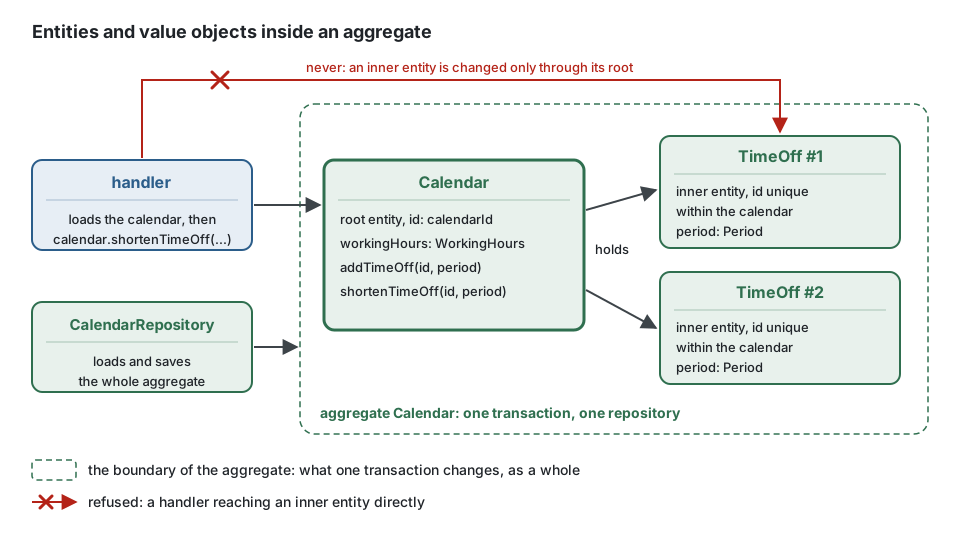
An entity is either the root of an aggregate (Appointment, Calendar) or
lives inside one (TimeOff inside Calendar). An inner entity is reached and changed only
through its root, has no repository of its own, and its identity only needs to be unique
within the aggregate.
npx ddd-ts-kit generate value-object appointments TimeSlotnpx ddd-ts-kit generate entity calendars TimeOffEach command writes the file and its spec, with TODO(domain) markers where a business
decision is expected.
Choosing: prefer values
Section titled “Choosing: prefer values”Model a concept as a value object unless the business needs to track it over time. Values are cheaper in every way: no identity to manage, no lifecycle, no concurrency, trivially testable. A frequent mistake is to give an identity to something because it has a database row. Storage is the mapper's concern; a value object can be stored in columns of its owner's table, or in a table of its own with a technical key the domain never sees.
| Question | If yes |
|---|---|
| Does the business refer to "that one" over time, even after it changed? | entity |
| Could it be replaced by an equal one without anyone noticing? | value object |
| Does it have a lifecycle with states? | entity |
| Is it a measure, a description, a quantity, a range? | value object |
Limits and when not to use it
Section titled “Limits and when not to use it”- Not every string deserves a type. A free-text note with no rule and no operation gains nothing from a wrapper class. Wrap what has validity rules, behaviour, or a real risk of confusion.
- Throw, or
Result. The generated value object throws fromcreate, as an aggregate method does:throw PersonError.invalidEmail(raw), and the caller takes the value with nounwrap. A project that prefers expected failures as values says"stack.valueObjects": "result":createreturnserr(PersonError.invalidEmail(raw))and the caller unwraps it; a config without the key is read that way, andddd-ts-kit value-objectsmoves such a project to throwing factories (CONFIG.md). Either way the refusal is built by a factory of the error class of the concept the value describes, not a class per value object. - Immutability is checked syntactically.
domain/value-object-immutabilitysees readonly properties and writes tothis; it does not see a mutable object held in a readonly field (aDatecan still be mutated through its methods, an array can be pushed to). Hold values that are themselves immutable, or copy on the way in and out. - Encapsulation rules belong to the ESLint plugin, which reads the syntax tree; the
text-level CLI checker has no equivalent for
domain/aggregate-encapsulationanddomain/value-object-immutability(CLI README).domain/value-object-classis read by both. - The function form is detected by what it answers, without the types. The review follows
what the rule does not: an object built in a variable first, then returned
(
const value = { .. }; return value;); an object answered through a condition (cond ? { .. } : { .. }), inside an array or as the argument of a call; a name read by its first declaration in the module, so a parameter named like a function of the module reads as that function; a call read by the name it starts from, soname.trim()on a parameter reads as built by the model; and a return type of a package read by its declared name only. - A relaxed rule is a recorded deviation. The rule defaults to
error; setting it towarnoroffunderrulesis recorded underdeviationswith its ADR (governance/recorded-deviation). A project not ready for it keeps"stack.values": "free". - A thin CRUD context may have entities with few rules. That is acceptable where the subdomain is simple; see Anemic model.
Sources
Section titled “Sources”- Eric Evans, Domain-Driven Design, Addison-Wesley, 2003, chapter 5 "A Model Expressed in Software" (entities, value objects, services).
- Vaughn Vernon, Implementing Domain-Driven Design, Addison-Wesley, 2013, chapter 5 "Entities" and chapter 6 "Value Objects".
- Vlad Khononov, Learning Domain-Driven Design, O'Reilly, 2021, chapter 6 "Tackling Complex Business Logic".
- Martin Fowler, Patterns of Enterprise Application Architecture, Addison-Wesley, 2002, "Value Object"; and "ValueObject", martinfowler.com/bliki/ValueObject.html.