
Domain events and integration events
Summary. An event states that something happened, in the past tense. This kit distinguishes two kinds that are easy to confuse. A domain event is a fact inside one bounded context, recorded by an aggregate and handled in the same context. An integration event is a contract between contexts, declared once in the producer's published language with a version and a schema, delivered at least once. A publisher of the application layer translates the first into the second. Keeping them apart is what lets a model change without breaking its consumers.
Two kinds, side by side
Section titled “Two kinds, side by side”| Domain event | Integration event | |
|---|---|---|
| Audience | the context that raised it | other contexts, possibly other services |
| Declared in | domain/events/, a class |
published-language/, with defineIntegrationEvent({ type, version, payload }) |
| Shape | whatever the model finds convenient; may hold value objects | plain JSON in a versioned envelope, validated by a schema |
| Stability | changes freely with the model | a contract: additive inside a version, otherwise a new version |
| Raised by | the aggregate, when its state changes | a publisher reacting to a domain event |
| Delivery | in process, at the end of the unit of work of the command: before its commit by default, after it for a handler declared after-commit |
at least once, through the outbox when there is a database, never for a command that rolled back |
| Handled by | application/event-handlers/ |
application/integration/handlers/ of the consuming context |
| Consumers must be | ordinary handlers | idempotent, registered under a stable consumer name |
| Documented in | the code | the generated event catalog and AsyncAPI document |
Both follow the name format <context>.<aggregate>.<fact> (events/name-format), which is why
the same string, scheduling.appointment.booked, can name the domain event and the
integration event made from it. They are still two declarations with two lifecycles.
Side by side, in the scheduling context of the example application. The domain event is a
class of the domain, free to hold a Date or a value object:
// contexts/scheduling/domain/events/appointment-booked.event.ts (simplified)export class AppointmentBooked implements DomainEvent {  static readonly eventName = 'scheduling.appointment.booked';
  readonly name = AppointmentBooked.eventName;
  constructor(    readonly aggregateId: string,    readonly occurredAt: Date,    readonly slot: Slot, // a type of the model, which consumers never see  ) {}}
The integration event is a declaration of the published language: a type, a version and a schema of plain JSON, which validates what is published and what is consumed:
// contexts/scheduling/published-language/appointment-booked.v1.integration-event.ts (simplified)export const appointmentBookedV1 = defineIntegrationEvent({ type: 'scheduling.appointment.booked', version: 1, payload: zodSchema(z.object({ appointmentId: z.string(), startsAt: z.string().datetime() /* ... */ })),});The full declaration is in Designing the payload.
The path of one fact
Section titled “The path of one fact”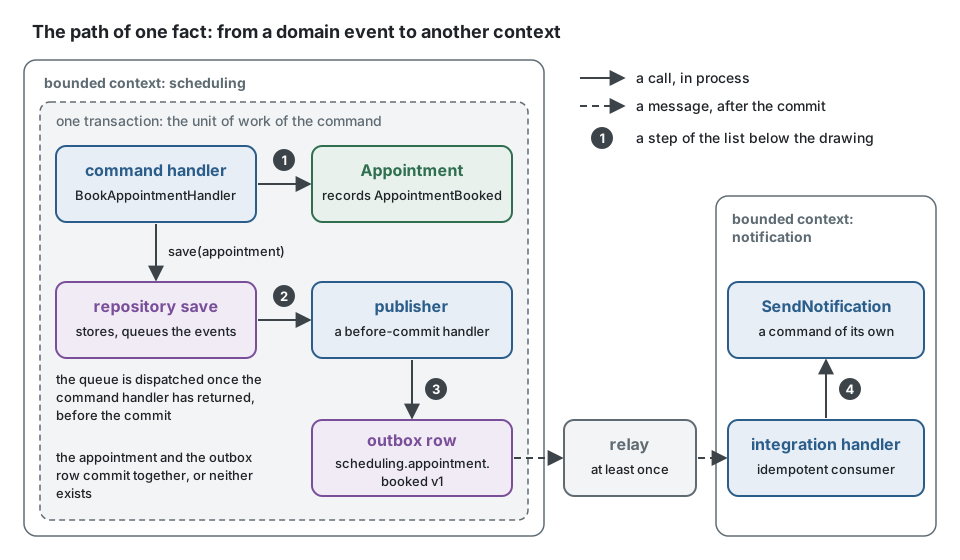
-
The aggregate records.
Appointment.book(...)checks the invariants and records the domain event. An aggregate never publishes anything itself and knows no bus.// contexts/scheduling/domain/aggregates/appointment.aggregate.ts (simplified)import { AggregateRoot, ConceptError, type DomainEvent } from '@ddd-ts-kit/kernel';interface Slot {readonly calendarId: string;readonly practitionerId: string;readonly patientId: string;readonly startsAt: Date;readonly endsAt: Date;}export class AppointmentBooked implements DomainEvent {static readonly eventName = 'scheduling.appointment.booked';readonly name = AppointmentBooked.eventName;constructor(readonly aggregateId: string,readonly occurredAt: Date,readonly slot: Slot,) {}}export class AppointmentError extends ConceptError {static emptySlot(startsAt: Date) {return AppointmentError.refusal('EMPTY_SLOT', 'A slot ends after it starts.', { startsAt });}}export class Appointment extends AggregateRoot {private constructor(id: string,readonly slot: Slot,) {super(id);}static book(id: string, slot: Slot, now: Date): Appointment {if (slot.endsAt <= slot.startsAt) {throw AppointmentError.emptySlot(slot.startsAt); // the invariant first}const appointment = new Appointment(id, slot);appointment.record(new AppointmentBooked(id, now, slot)); // recorded, not publishedreturn appointment;}} -
The save hands the events over, the unit of work dispatches them.
saveonly queues the recorded events. Once the command handler has returned, they are dispatched to the handlers of the same context, inside the transaction of the command, before its commit. The command handler writesawait this.appointments.save(appointment)and nothing else: nopullEvents(), no dispatcher (domain-events/dispatched-on-save, ARCHITECTURE.md section 4, "Domain events").Instead of handing the events over by hand:
await this.appointments.save(appointment);await this.dispatcher.dispatch(appointment.pullEvents()); // refused: domain-events/dispatched-on-savewrite the save alone:
// contexts/scheduling/application/commands/book-appointment/book-appointment.handler.ts (simplified)import { AggregateRoot, Clock, Command, IdGenerator, Repository } from '@ddd-ts-kit/kernel';import { CommandHandler } from '@ddd-ts-kit/kernel/declarations';interface Slot {readonly calendarId: string;readonly practitionerId: string;readonly patientId: string;readonly startsAt: Date;readonly endsAt: Date;}declare class Appointment extends AggregateRoot {static book(id: string, slot: Slot, now: Date): Appointment;}export abstract class AppointmentRepository extends Repository<Appointment> {}export class BookAppointmentCommand extends Command<string> {constructor(readonly slot: Slot) {super();}}@CommandHandler(BookAppointmentCommand)export class BookAppointmentHandler implements CommandHandler<BookAppointmentCommand> {constructor(private readonly appointments: AppointmentRepository,private readonly ids: IdGenerator,private readonly clock: Clock,) {}async execute(command: BookAppointmentCommand): Promise<string> {const appointment = Appointment.book(this.ids.next(), command.slot, this.clock.now());await this.appointments.save(appointment); // the recorded events leave with the savereturn appointment.id;}} -
A publisher translates. One of those handlers is the publisher: it builds the integration event from the domain event and hands it to the
IntegrationEventPublisherport. With a database that port is the outbox, so the event is stored in the transaction of the command (events/outbox-required, see Transactional outbox). The relay publishes it after the commit, never for a command that rolled back.// contexts/scheduling/application/integration/publishers/appointment-booked.publisher.ts (simplified)import { IdGenerator, IntegrationEventPublisher, type DomainEvent } from '@ddd-ts-kit/kernel';import { DomainEventHandler } from '@ddd-ts-kit/kernel/declarations';import type { IntegrationEventDefinition } from '@ddd-ts-kit/events';interface Slot {readonly calendarId: string;readonly practitionerId: string;readonly patientId: string;readonly startsAt: Date;readonly endsAt: Date;}class AppointmentBooked implements DomainEvent {static readonly eventName = 'scheduling.appointment.booked';readonly name = AppointmentBooked.eventName;constructor(readonly aggregateId: string,readonly occurredAt: Date,readonly slot: Slot,) {}}interface AppointmentBookedV1Payload {readonly appointmentId: string;readonly practitionerId: string;readonly patientId: string;readonly startsAt: string;readonly endsAt: string;}// the declaration of the published language, shown in "Designing the payload"declare const appointmentBookedV1: IntegrationEventDefinition<AppointmentBookedV1Payload>;@DomainEventHandler(AppointmentBooked)export class AppointmentBookedPublisher implements DomainEventHandler<AppointmentBooked> {constructor(private readonly publisher: IntegrationEventPublisher,private readonly ids: IdGenerator,) {}async handle(event: AppointmentBooked): Promise<void> {// the model is translated field by field: a Date becomes an ISO 8601 textconst published = appointmentBookedV1.create({appointmentId: event.aggregateId,practitionerId: event.slot.practitionerId,patientId: event.slot.patientId,startsAt: event.slot.startsAt.toISOString(),endsAt: event.slot.endsAt.toISOString(),},{ id: this.ids.next(), occurredAt: event.occurredAt },);await this.publisher.publish([published]); // the outbox, in the transaction of the command}} -
The consumer reacts. In
notification, an integration event handler translates the event into a command of its own context and sends it on the command bus. It contains no business logic and imports only the upstream's published language. Its consumer name is stable: it scopes the idempotency of the handler, and names the system actor it runs as.// contexts/notification/application/integration/handlers/scheduling-appointment-booked.integration-handler.ts (simplified)import { AuthorizedCommand, CommandBus, systemActor, type Actor, type IntegrationEvent } from '@ddd-ts-kit/kernel';import { IntegrationEventHandler } from '@ddd-ts-kit/kernel/declarations';import type { IntegrationEventDefinition } from '@ddd-ts-kit/events';interface AppointmentBookedV1Payload {readonly appointmentId: string;readonly patientId: string;readonly startsAt: string;}// imported from the published language of scheduling, the only thing notification knows of itdeclare const appointmentBookedV1: IntegrationEventDefinition<AppointmentBookedV1Payload>;export class SendNotificationCommand extends AuthorizedCommand {constructor(actor: Actor,readonly notice: { readonly recipientId: string; readonly appointmentId: string; readonly startsAt: Date },) {super(actor);}}@IntegrationEventHandler(appointmentBookedV1, { consumer: 'notification.scheduling-appointment-booked' })export class SchedulingAppointmentBookedIntegrationHandler {readonly actor = systemActor('notification.scheduling-appointment-booked');constructor(private readonly commands: CommandBus) {}async handle(event: IntegrationEvent<AppointmentBookedV1Payload>): Promise<void> {const { patientId, appointmentId, startsAt } = event.payload;await this.commands.execute(new SendNotificationCommand(this.actor, { recipientId: patientId, appointmentId, startsAt: new Date(startsAt) }),);}}
The publisher is the anti-leak valve: the domain event can gain a field, be split or be renamed, and the integration event stays what it was until the team decides to version it.
When a domain event is handled
Section titled “When a domain event is handled”An effect of a domain event exists only if the state change that recorded it is committed.
A before-commit handler commits with it, an after-commit handler runs only after it, an
integration event is published only after it.
One command, two saves:
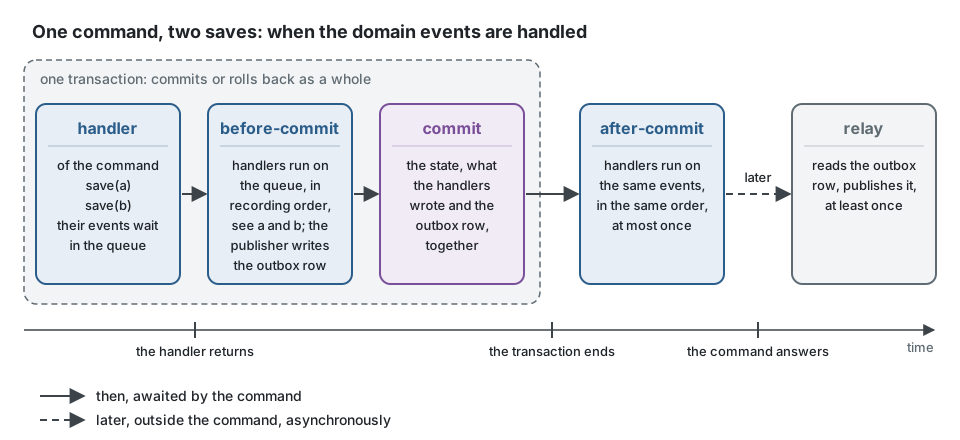
Inside a unit of work a save only queues the events its aggregates recorded, in recording
order across all the saves. When the command handler has returned, still inside the
transaction, the queue is dispatched. A handler may save an aggregate: its events join the
queue behind those waiting, under the same order rule, without recursion. A handler may append
to the outbox. Then the transaction commits, and the handlers of the after-commit phase run.
| Guarantees | When it fails | Delivery | |
|---|---|---|---|
before-commit handler (default) |
runs once every save of the command is done (when the command handler has returned), in its transaction; what it writes commits or rolls back with the state change | the command fails and everything rolls back | in the transaction: exactly with the commit |
after-commit handler |
runs once the transaction has committed, never when it rolled back, in dispatch order, awaited before the command answers | the command still succeeds; the failure is logged and reported, the other handlers still run | at most once |
| integration event | appended to the outbox by a before-commit publisher, published by the relay after the commit, never for a rolled back command |
the relay retries; consumers are idempotent | at least once |
The two phases
Section titled “The two phases”before-commit is the default. after-commit is declared on the handler:
// an after-commit handler, for illustrationimport type { DomainEvent } from '@ddd-ts-kit/kernel';import { DomainEventHandler } from '@ddd-ts-kit/kernel/declarations';
class AppointmentBooked implements DomainEvent {  static readonly eventName = 'scheduling.appointment.booked';
  readonly name = AppointmentBooked.eventName;
  constructor(    readonly aggregateId: string,    readonly occurredAt: Date,  ) {}}
/** A board of free slots kept in a cache: refreshing it may fail without harm. */export abstract class AvailabilityBoard {  abstract refresh(appointmentId: string): Promise<void>;}
@DomainEventHandler(AppointmentBooked, { phase: 'after-commit' })export class AppointmentBookedEventHandler implements DomainEventHandler<AppointmentBooked> {  constructor(private readonly board: AvailabilityBoard) {}
  async handle(event: AppointmentBooked): Promise<void> {    await this.board.refresh(event.aggregateId);  }}
In the explicit style the phase is given at registration:
dispatcher.on(AppointmentBooked.eventName, callback, { phase: 'after-commit' }).
The generator writes either: npx ddd-ts-kit generate event-handler scheduling Appointment Booked --phase after-commit.
See the order for yourself. The in-memory parts of the kernel follow the same rules as the
ORM adapters, so a few lines show when each phase runs. unitOfWorkStage() tells a handler
where it stands:
import {  AggregateRoot,  InMemoryDomainEventDispatcher,  InMemoryUnitOfWork,  Repository,  dispatchingOnSave,  unitOfWorkStage,  type DomainEvent,} from '@ddd-ts-kit/kernel';
class SlotHeld implements DomainEvent {  static readonly eventName = 'scheduling.slot.held';
  readonly name = SlotHeld.eventName;
  constructor(    readonly aggregateId: string,    readonly occurredAt: Date,  ) {}}
class Slot extends AggregateRoot {  static hold(id: string, now: Date): Slot {    const slot = new Slot(id);    slot.record(new SlotHeld(id, now));
    return slot;  }}
class InMemorySlotRepository implements Repository<Slot> {  private readonly rows = new Map<string, Slot>();
  async findById(id: string): Promise<Slot | undefined> {    return this.rows.get(id);  }
  async save(slot: Slot): Promise<void> {    this.rows.set(slot.id, slot); // persists only: no dispatch code in an adapter  }}
const dispatcher = new InMemoryDomainEventDispatcher();const slots = dispatchingOnSave(new InMemorySlotRepository(), () => dispatcher); // what the container doesconst unitOfWork = new InMemoryUnitOfWork();const seen: string[] = [];
dispatcher.on(SlotHeld.eventName, async (event) => {  seen.push(`before-commit ${event.aggregateId} (${unitOfWorkStage()})`);});dispatcher.on(  SlotHeld.eventName,  async (event) => {    seen.push(`after-commit ${event.aggregateId} (${unitOfWorkStage()})`);  },  { phase: 'after-commit' },);
const now = new Date('2026-03-09T10:00:00Z');
await unitOfWork.run(async () => {  await slots.save(Slot.hold('a', now));  await slots.save(Slot.hold('b', now));  seen.push(`the command handler returns (${unitOfWorkStage()})`);});
// seen is now://   the command handler returns (open)//   before-commit a (before-commit)//   before-commit b (before-commit)//   after-commit a (after-commit)//   after-commit b (after-commit)
Nothing reaches a handler while the work runs: both saves are done before the first
before-commit handler hears of either.
What is at most once. The after-commit phase, and only it. A crash between the commit and
the run loses the effect, and a failing handler is not retried. Its failure cannot fail the
command: it is logged (Logger.error, "A domain event handler failed after the commit", with
domainEvent, errorType, errorCode) and handed to the ErrorReporter under the operation
after-commit <event name>. Anything that must be reliable goes through the outbox as an
integration event.
An after-commit handler never saves. Handing an aggregate to a repository there (save,
saveAll, remove(aggregate)) is refused before the write with SaveAfterCommitError: the
unit of work is over, so nothing would dispatch the events of that aggregate nor roll the write
back. Such a handler sends a command through the CommandBus, which opens a unit of work of
its own. unitOfWorkStage() of the kernel answers 'outside', 'open', 'before-commit' or
'after-commit'.
Instead of saving in the handler:
// an after-commit handler of AppointmentCancelledconst waitlist = await this.waitlists.findById(event.calendarId);waitlist.offer(event.slot, this.clock.now());await this.waitlists.save(waitlist); // SaveAfterCommitError: the unit of work is oversend a command, whose own unit of work saves, dispatches and commits:
const freed = { startsAt: event.slot.startsAt, endsAt: event.slot.endsAt, heldUntil: event.slot.heldUntil };await this.commands.execute(new OfferFreedSlotCommand(this.actor, event.calendarId, freed));Why a before-commit handler has transactional effects only
Section titled “Why a before-commit handler has transactional effects only”The commit itself can fail after the before-commit handlers ran: a deferred constraint, a
serialization failure, a lost connection. Everything they wrote in the transaction disappears
with it, the outbox row included. An effect outside the database would stay. The guarantee is
therefore safe only because a before-commit handler can have transactional effects alone,
which is what domain-events/transactional-before-commit holds. Such a handler may depend on:
- repository ports and the domain layer of its context;
- kernel ports other than
Cache,CachePurger,Lock,RateLimiter,JobSchedulerandEventBus(CacheInvalidationis one: the purge it asks for commits with the work, see HTTP caching); - ports of
application/ports/whose adapters are all underinfrastructure/persistence/.
A gateway, an external port or an adapter of infrastructure/external/ asks for a choice:
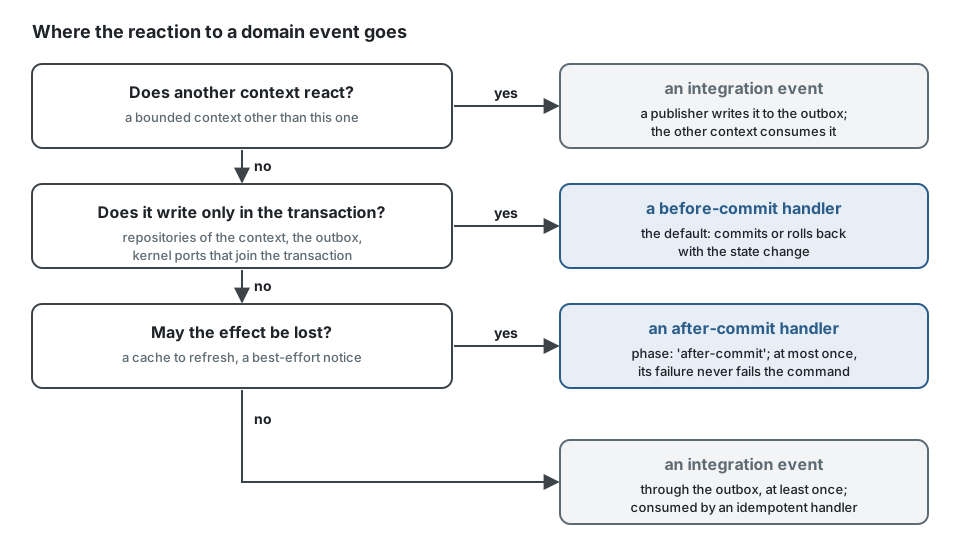
| The effect | Goes |
|---|---|
| may be lost (a cache to refresh, a best-effort notice) | in a handler with phase: 'after-commit' |
| must not be lost | behind an integration event: outbox, at least once |
An after-commit handler does not depend on IntegrationEventPublisher: the transaction that
would hold the outbox row is over.
What a failure leaves behind
Section titled “What a failure leaves behind”| What fails | Result |
|---|---|
| a save | it pulls nothing: its events stay on the aggregate and reach no handler; the unit of work rolls back, the events of the earlier saves are dropped |
| the command handler, after a save | the queued events are dropped: no handler of either phase runs |
a before-commit handler |
the command fails with what it threw; rollback; the events still waiting are dropped; no after-commit handler runs |
| the commit | rollback; no after-commit handler runs, no outbox row exists |
an after-commit handler |
nothing is undone: the state is committed and the command succeeds |
Events pulled by a save of a unit of work that rolled back are dropped and never put back on the aggregate instance. A retry runs the command again on reloaded aggregates, which record their events again; they are dispatched once. An aggregate instance of a failed command is not reused.
Where the queue lives
Section titled “Where the queue lives”The queue belongs to a scope opened by withinUnitOfWork(work, transaction) of the kernel, in
an AsyncLocalStorage. Every UnitOfWork.run of the kit is built on it (InMemoryUnitOfWork,
drizzle, knex, prisma, typeorm), so a run called directly by a consumer or a script has the
timing of a command. unitOfWorkMiddleware calls it too: a command is covered even with a
project's own UnitOfWork that does not.
- A nested
run, or a command sent from inside a unit of work by a handler, joins the scope in progress: one dispatch, at the end of the outermost, and theafter-commitphase after the outermost commit. - Two concurrent commands never share a scope.
- A project that writes its own
UnitOfWorkbuildsrunon it, and runsunitOfWorkContractof@ddd-ts-kit/testing/contracts, which fails an adapter that forgot:
import { AsyncLocalStorage } from 'node:async_hooks';import { withinUnitOfWork, type UnitOfWork } from '@ddd-ts-kit/kernel';
/** The driver of the project: begins, calls, commits when the work resolved, rolls back when it rejected. */interface Ledger {  transaction<T>(work: (transaction: LedgerTransaction) => Promise<T>): Promise<T>;}
interface LedgerTransaction {  readonly id: string;}
export class LedgerUnitOfWork implements UnitOfWork {  private readonly current = new AsyncLocalStorage<LedgerTransaction>();
  constructor(private readonly ledger: Ledger) {}
  run<T>(work: () => Promise<T>): Promise<T> {    return withinUnitOfWork(work, (scoped) => {      if (this.current.getStore() !== undefined) {        return scoped(); // a nested run joins the transaction in progress      }
      return this.ledger.transaction((transaction) => this.current.run(transaction, scoped));    });  }}
transaction begins, calls what it is given, commits when it resolved and rolls back when it
rejected. withinUnitOfWork does the rest.
The contract is run by the four ORM packages on PGlite, in process. The knex, prisma and
typeorm packages also run it on a real PostgreSQL when DDD_TS_KIT_TEST_DATABASE_URL is set,
where it also proves that the rows of a before-commit handler are invisible from another
connection and visible to the after-commit handlers. The failing commit is a deferred
constraint.
Outside any unit of work
Section titled “Outside any unit of work”In a domain test, with a repository used alone, in a script, there is nothing to wait for: the
save dispatches before it resolves, before-commit handlers then after-commit ones. Nothing
is atomic then: a handler that fails rejects the save without undoing it.
Changed
Section titled “Changed”Before, the events of an aggregate were dispatched right after each save, inside the transaction. What to check when upgrading:
| If the project has | Do |
|---|---|
| a handler that relied on running between two saves of one command | it now runs after both: read the state it needs from what is saved, or split the command |
| a handler with an effect outside the database (a gateway, a cache, a remote call) | declare it phase: 'after-commit', or move the work behind an integration event when it must not be lost; domain-events/transactional-before-commit reports it |
its own UnitOfWork |
build run on withinUnitOfWork and run unitOfWorkContract |
its own DomainEventDispatcher |
dispatch(events, phase?) and on(name, handler, { phase }?): honour the phase, and never reject in the after-commit phase |
| a domain event handler that sends a command | sent before the commit, the command joins the unit of work in progress: its events are dispatched with the others, not before it returns. Sent after the commit, it opens a unit of work of its own |
a call to apartFromDomainEventFlow |
removed from @ddd-ts-kit/kernel, without replacement: see the row above |
a spec built on createTestBuses() |
commandBus runs commands in its unit of work: handlers are heard once the command handler has returned |
| assertions or dashboards on span trees | domain-event spans are no longer under repository X.save: see the README of @ddd-ts-kit/tracing |
Why not publish the domain event directly
Section titled “Why not publish the domain event directly”It is tempting to hand AppointmentBooked to every interested context. Three things go wrong:
- The model becomes a public API. Renaming a value object of
schedulingbreaksanalytics. The upstream can no longer refactor. - Internal facts leak.
schedulingmay record fine-grained events useful to itself (a slot was held, a hold expired). Consumers do not need them and should not build on them. - The delivery contract differs. A domain event is handled in process, at the end of the unit of work of the command. An integration event may cross a broker, arrive twice, arrive late. Mixing the two hides which guarantees a handler can count on.
Not every domain event becomes an integration event. Publish what another context has a reason to react to, when one asks for it.
Designing the payload
Section titled “Designing the payload”The payload is what consumers need in order to act without calling back, and nothing internal
(the integration-event skill gives the same rule).
// contexts/scheduling/published-language/appointment-booked.v1.integration-event.ts (simplified)import { defineIntegrationEvent, type PayloadOf } from '@ddd-ts-kit/events';import { zodSchema } from '@ddd-ts-kit/validation/zod';import { z } from 'zod';
export const appointmentBookedV1 = defineIntegrationEvent({  type: 'scheduling.appointment.booked',  version: 1,  description: 'A patient booked an appointment with a practitioner.',  payload: zodSchema(    z.object({      appointmentId: z.string().describe('Identifier of the appointment.'),      practitionerId: z.string(),      patientId: z.string(),      startsAt: z.string().datetime().describe('Start of the slot, ISO 8601, UTC.'),      endsAt: z.string().datetime(),    }),  ),});
/** What a consumer reads, derived from the schema: no second type to keep in step. */export type AppointmentBookedV1Payload = PayloadOf<typeof appointmentBookedV1>;
The example application declares the same event with class-validator
(classSchema(AppointmentBookedV1Payload)); any schema of @ddd-ts-kit/validation fits.
| Question | Guidance |
|---|---|
| Identifiers or data? | Identifiers plus the facts that define the event (the slot). notification can schedule a reminder from startsAt without asking scheduling |
| The whole aggregate? | No. A dump of the aggregate couples consumers to the model and grows with it |
| Personal data? | Only when a consumer needs it. A broker keeps messages; the envelope carries no actor by default for the same reason (events README) |
| A fact or an instruction? | A fact. scheduling.appointment.booked, not "send-reminder": the producer does not know what consumers do |
| Order-sensitive consumers? | Carry a version or a sequence of the aggregate in the payload: ordering is not guaranteed by default (see Delivery and idempotency) |
| Field descriptions | Written in the schema: they flow into the catalog and the AsyncAPI document |
There is a real trade-off between thin events (identifiers only, consumers call back) and fat events (enough state to act). Thin events keep the contract small but turn every consumer into a synchronous client of the producer. The kit's rule leans towards "enough to act", because calling back defeats the autonomy the event was meant to give.
What the kit provides
Section titled “What the kit provides”defineIntegrationEventgives the payload type, validates what is published and what is consumed, and feeds the generated catalog and AsyncAPI document (events/defined-in-published-language).- The envelope is standard: id, type, version, time of occurrence, payload, trace context, correlation id, and the tenant the fact belongs to when there is one.
- The provider is behind two kernel ports, a publisher and a subscriber; the in-memory bus is the default, and brokers are adapters held to one contract suite (see Message brokers).
- Generators write the declaration, the publisher, the handler, their specs and their registration.
Limits and when not to use it
Section titled “Limits and when not to use it”- Two declarations for one fact is duplication on purpose. In a context with one consumer and a stable model it feels heavy. It is still the boundary that lets the two evolve apart.
- Events are the wrong tool for a question. A context that cannot decide without an answer now needs a gateway port, not a request disguised as an event and a reply event.
- Events are the wrong tool inside one aggregate's transaction. Two things that must change together belong to one aggregate; an event makes them eventually consistent (see Eventual consistency).
- A domain event handler runs inside the transaction of the command by default. If it
fails, the command fails and the state change is rolled back. A local effect that must not
block the command is an
after-commithandler, and may be lost; a reaction that must not be lost goes through the outbox as an integration event. - The kit does not store the domain events of a state-persisted aggregate. They are dispatched with the save and gone. An aggregate chosen to be event-sourced keeps its events as its stream: see Event sourcing, per aggregate.
- Event-driven designs are harder to follow. No single place shows the whole flow. The
generated catalog, the context map and a sequence diagram per cross-context flow in
docs/integration/README.mdare how the kit compensates.
Sources
Section titled “Sources”- Eric Evans, Domain-Driven Design Reference, 2015 (Domain Events), https://www.domainlanguage.com/ddd/reference/
- Vaughn Vernon, Implementing Domain-Driven Design, Addison-Wesley, 2013, chapter 8 ("Domain Events") and chapter 13 ("Integrating Bounded Contexts").
- Vlad Khononov, Learning Domain-Driven Design, O'Reilly, 2021, chapter 15 ("Event-Driven Architecture": event notification, event-carried state transfer, domain events).
- Martin Fowler, "What do you mean by Event-Driven?", 2017, https://martinfowler.com/articles/201701-event-driven.html
- Gregor Hohpe and Bobby Woolf, Enterprise Integration Patterns, Addison-Wesley, 2003 (Event Message, Published Language via Canonical Data Model).
- README of
@ddd-ts-kit/events.