
A worked example: the context map of the scheduling application
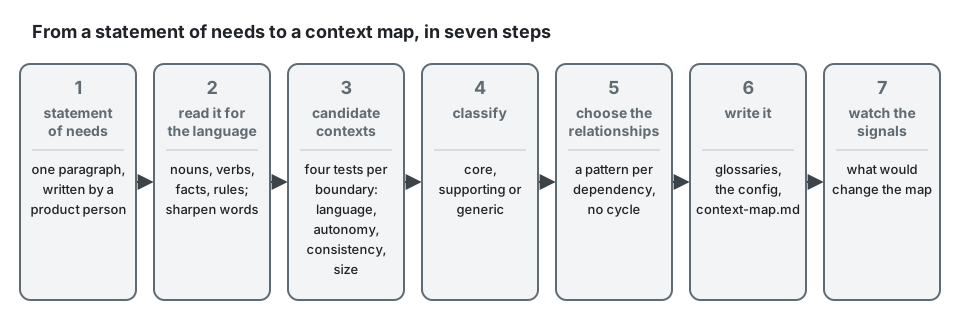
Summary. This page walks from a plain statement of needs to a context map, step by step:
read the statement for nouns, verbs and facts, propose candidate contexts, test each boundary
(language, autonomy, consistency, size), classify, choose a relationship pattern for every
dependency, and write the result where the kit expects it. The outcome is five contexts in the
code (appointments, availability, calendars, notifications, analytics) and one bought
capability (identity) that gets no context at all.
1. The statement of needs
Section titled “1. The statement of needs”As a product person would write it:
Practitioners (physiotherapists, for a start) publish the hours they work and the days they are off. Clients see the free times of a practitioner and book one. A practitioner must never have two clients at the same time. A client can move an appointment to another free time, or cancel it; cancelling is free until 24 hours before, after that it counts as a late cancellation. Clients get a confirmation when they book and a reminder the day before, by email or SMS as they prefer. The practice manager wants to see how full each practitioner is and how many clients do not show up. Everyone signs in; practitioners and managers through the company's single sign-on.
2. Read it for the language
Section titled “2. Read it for the language”| Kind | Words found |
|---|---|
| Nouns | practitioner, client, working hours, day off, free time, appointment, confirmation, reminder, practice manager, occupancy, no-show |
| Verbs | publish hours, book, move, cancel, remind, sign in |
| Facts | appointment booked, appointment moved, appointment cancelled, hours changed, time off added, reminder sent |
| Rules | never two clients at once; free cancellation until 24 hours before |
Two words need sharpening with the domain expert before anything else. "Free time" becomes slot. "Move" becomes reschedule, and the expert confirms that a rescheduled appointment is the same appointment, not a cancellation followed by a booking.
3. Candidate contexts
Section titled “3. Candidate contexts”A first cut by subject: calendars, availability, appointments, notifications, analytics, identity. Each is then put through the four tests of Bounded context.
| Candidate | Language | Autonomy | Consistency | Verdict |
|---|---|---|---|---|
| calendars | working hours, time off; no notion of client | changes when practitioners' contracts change | a calendar is consistent on its own | a context |
| appointments | appointment, slot as "the booked interval", cancellation reason | the booking rules are the product | no double booking must hold at every instant | a context, and the centre |
| availability | slot as "an interval still on offer" | the way slots are proposed can change without touching booking | derived from two other contexts: always slightly late, and that is acceptable | a context, advisory |
| notifications | reminder, channel, recipient | reminder policy is decided by support, changes often | a late reminder is tolerable | a context |
| analytics | occupancy, no-show rate | reports change with management's questions | hours late is fine | a context |
| identity | user, credential, session | a solved problem | not ours | bought: no context |
The debated boundary: availability or appointments?
Section titled “The debated boundary: availability or appointments?”The word "slot" means two things, which the language test reads as two contexts. The harder question is where "never two clients at once" lives.
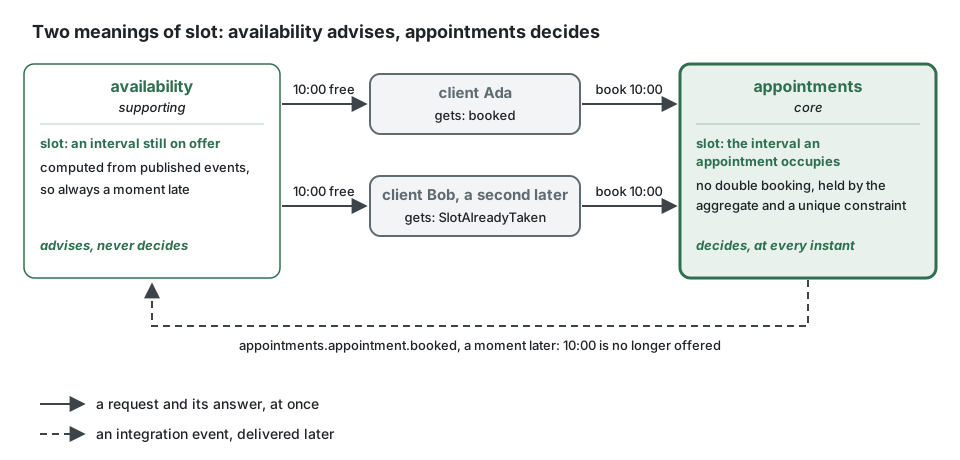
- If
availabilityguarded it, booking would depend on data computed from events, which lag. Two clients looking at the same open slot would both be allowed. - The consistency test settles it: a rule that must hold at every instant lives in one
aggregate boundary, hence in
appointments, backed by a database constraint (Aggregates). availabilitytherefore only advises. A client who picks a slot taken a second ago gets the domain errorSlotAlreadyTaken, and the product decides how to say it kindly (Eventual consistency).
Could availability simply be queries inside appointments? It could, and for a first release
that is a defensible choice. It is kept separate here because it needs calendars' data as much
as appointments', its vocabulary differs, and its rules (buffers between appointments, how far
ahead slots are offered) change for other reasons than booking rules. The doubt goes into the
"Known tensions" of the map.
Does appointments need calendars at booking time?
Section titled “Does appointments need calendars at booking time?”Booking outside working hours should be refused. appointments could call calendars
synchronously, but then booking fails whenever calendars is unavailable. Instead appointments
keeps a local projection of working hours and time off, fed by
calendars.calendar.working-hours-changed and calendars.calendar.time-off-added. It decides
alone, on data that may be a moment old, which the business accepts: a practitioner who adds
time off after a booking was made handles the conflict by hand anyway.
4. Classify
Section titled “4. Classify”| Context | Classification | Reason |
|---|---|---|
appointments |
core | the rules clients and practitioners choose the product for |
availability |
supporting | a computation over other contexts' facts |
calendars |
supporting | specific and simple |
notifications |
supporting | the policy is ours, the sending is bought |
analytics |
supporting | follows from the events of appointments |
| identity | generic | an OIDC provider; the platform maps its tokens to an Actor |
See Domain and subdomains for the criteria.
5. Choose the relationships
Section titled “5. Choose the relationships”| Downstream | Upstream | Pattern | Reasoning |
|---|---|---|---|
appointments |
calendars |
published-language | same product; calendars publishes events made for consumers |
availability |
calendars |
published-language | same |
availability |
appointments |
published-language | same |
notifications |
appointments |
published-language | notifications translates "booked" into "schedule a reminder" in its own handler |
analytics |
appointments |
conformist | analytics has no model to protect: it stores the facts as published |
notifications |
email and SMS provider (external) | anticorruption layer | the provider's vocabulary stays in infrastructure/anti-corruption/ |
| every context | identity provider (external) | open host service on its side | OpenID Connect; the mapping to Actor happens once, in the platform |
No cycle: calendars depends on nobody, appointments on calendars, and the three others
only consume. notifications and analytics have no relationship with each other: separate
ways, expressed by declaring nothing.
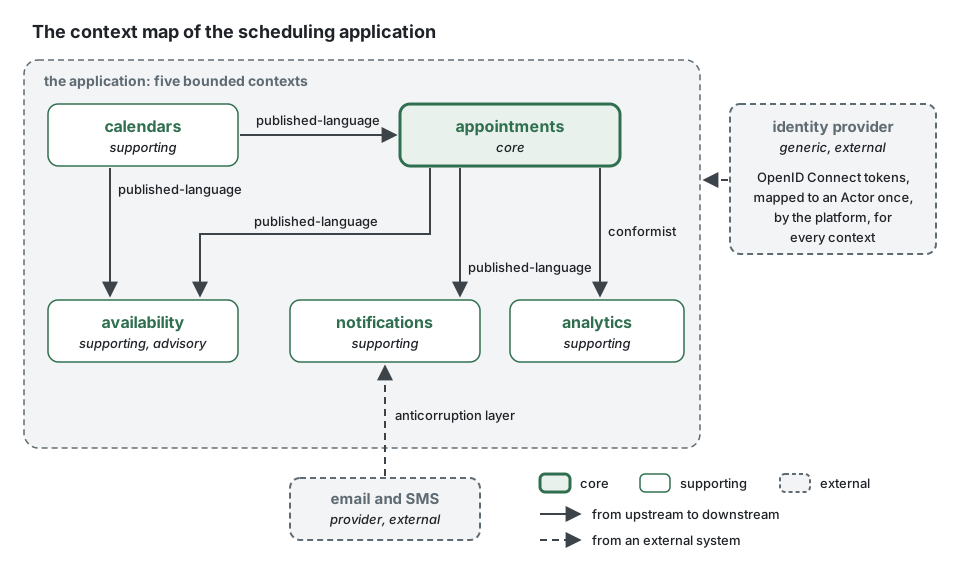
Arrows run from upstream to downstream, as in the generated map. The two external systems are
drawn here for the reader; the generated diagram, a Mermaid block between the markers of
docs/context-map.md, shows the contexts of the config only.
6. Write it where the kit expects it
Section titled “6. Write it where the kit expects it”Glossaries first. Each generate context command takes the first terms with it:
npx ddd-ts-kit generate context calendars --classification supporting \  --purpose "Practitioners state when they work and when they are off. Other contexts learn it from published events." \  --term "Calendar=The working hours and time off of one practitioner" \  --term "Working hours=The weekly intervals during which a practitioner takes appointments" \  --term "Time off=A period during which a practitioner takes no appointment"
npx ddd-ts-kit generate context appointments --classification core \  --upstream calendars:published-language \  --purpose "Clients book, reschedule and cancel appointments with practitioners. A practitioner is never booked twice for the same time." \  --term "Appointment=A commitment of a practitioner to see a client during a slot" \  --term "Slot=The interval, start and end, an appointment occupies"
npx ddd-ts-kit generate context availability --classification supporting \  --upstream calendars:published-language --upstream appointments:published-language \  --purpose "Answers which slots a practitioner can still offer. It advises and never decides a booking." \  --term "Slot=An interval a practitioner can still offer to a client"
npx ddd-ts-kit generate context notifications --classification supporting \  --upstream appointments:published-language \  --purpose "Sends confirmations and reminders about appointments. It chooses the channel the client prefers." \  --term "Reminder=A message announcing a coming appointment to its client"
npx ddd-ts-kit generate context analytics --classification supporting \  --upstream appointments:conformist \  --purpose "Measures occupancy and no-shows per practitioner. It records the facts of appointments as published." \  --term "Occupancy=The share of a practitioner's working hours covered by appointments"
The resulting excerpt of ddd-ts-kit.config.json:
{ "contexts": { "calendars": { "classification": "supporting", "upstreams": [] }, "appointments": { "classification": "core", "upstreams": [{ "context": "calendars", "relationship": "published-language" }] }, "availability": { "classification": "supporting", "upstreams": [ { "context": "calendars", "relationship": "published-language" }, { "context": "appointments", "relationship": "published-language" } ] }, "notifications": { "classification": "supporting", "upstreams": [{ "context": "appointments", "relationship": "published-language" }] }, "analytics": { "classification": "supporting", "upstreams": [{ "context": "appointments", "relationship": "conformist" }] } }}Then:
npx ddd-ts-kit docs # writes docs/context-map.md: the diagram and the tablenpx ddd-ts-kit check --rule tree/context-doc --rule context/no-cycle --rule context/declared-relationshipAnd by hand, outside the generated markers of docs/context-map.md: the reading guide (book,
then availability and notifications react), why "no double booking" is in appointments, why
analytics is conformist, and the known tension about availability. The generated file leaves a
TODO(domain) under each of these headings; filled in for this map, they read:
<!-- ddd-ts-kit:context-map -->(generated: the diagram and the table of the contexts)<!-- /ddd-ts-kit:context-map -->
## Reading guide
A client books in `appointments`, which holds the slot and announces it. `availability` stopsoffering the slot, `notifications` confirms and plans the reminder, `analytics` counts it.`calendars` only publishes working hours and time off.
## Why these boundaries
"Never two clients at once" must hold at every instant, so it lives in the `Appointment`aggregate, backed by a unique constraint. `availability` is derived from events and advises.
## Relationship notes
`analytics` is conformist: it stores the events of `appointments` as published and has nomodel to protect. Its cost: a breaking change of those events breaks its reports.
## Known tensions
`availability` may be queries of `appointments` in disguise. If its rules stay trivial for ayear, merge it.
7. What would change the map
Section titled “7. What would change the map”| Signal | Likely move |
|---|---|
| availability's rules stay trivial for a year | merge it into appointments as queries |
| slot suggestion becomes the selling point | reclassify availability as core |
| booking needs to charge a deposit | a new payments context, generic, behind an anticorruption layer |
appointments keeps asking calendars for more fields |
the projection is too thin, or the boundary is wrong |
| analytics breaks at each event change | conformist no longer fits: version the events strictly or add a translator |
Limits and when not to use it
Section titled “Limits and when not to use it”- This is one defensible map, not the map. Another team could keep availability inside appointments, or split notifications by channel. What matters is that each boundary has a stated reason and a stated doubt.
- The exercise was done in writing, from one paragraph. A real project should confront the candidates with domain experts, for example in an event storming session (Methodology).
- Do not copy the number of contexts. For a first version with one developer,
appointmentsandcalendarsalone, with availability as queries and notifications as an event handler, would be a reasonable start. - The example application of the repository (
examples/scheduling) made another cut of the same domain, which shows the point: one core context,scheduling, holds calendars, availability and appointments together;identityis a supporting context of its own, because practices and the delegations between practitioners and assistants are rules of the product, not a bought login, andschedulingis its customer (customer-supplier);notificationconsumes the events ofschedulingandidentity, andanalyticsconforms to those ofscheduling. Its map is inexamples/scheduling/docs/context-map.md.
Sources
Section titled “Sources”- Eric Evans, Domain-Driven Design, Addison-Wesley, 2003, chapter 14.
- Vaughn Vernon, Implementing Domain-Driven Design, Addison-Wesley, 2013, chapters 2 and 3.
- Vlad Khononov, Learning Domain-Driven Design, O'Reilly, 2021, chapters 3 and 4.
- Alberto Brandolini, Introducing EventStorming, Leanpub (reading a domain as commands, events and policies).