
Test runners: Vitest and Jest
Summary. The testing approach of the kit (fakes instead of mocks, builders, contract suites, four test levels) does not depend on a runner: the helpers import none, and the contract suites take the runner's functions as an argument. A runner still has to be chosen. Vitest is the default and the one the kit's own pipeline, coverage thresholds and end-to-end proofs are built on. Jest is supported by the generator with a narrower setup. This page compares the two for this kind of project and states exactly what each choice gives you.
What the runner has to do here
Section titled “What the runner has to do here”A context of the scheduling application has specs at several levels (see the testing strategy and section 7 of the architecture reference):
Appointmentrefuses a second cancellation: a pure domain spec, milliseconds;CancelAppointmentthrough the in-memory command bus with fakes: milliseconds;- the appointment repository against PostgreSQL, held to the repository contract: seconds;
POST /appointmentsend to end over HTTP and the event bus: seconds.
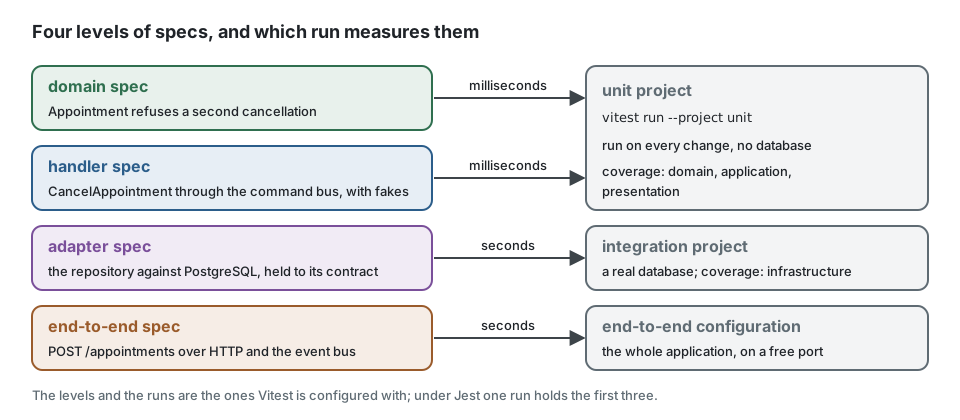
So the runner must run TypeScript written as ES modules, handle decorators (the declared style
puts one on handlers and adapters), split fast and slow specs, and measure coverage per layer.
It does not need a mocking system: test/no-mocks discourages one. Instead of a mock that
asserts a call:
// contexts/notification/test/unit/send-reminder.handler.spec.ts: reported by test/no-mocksconst mailer = { deliver: vi.fn() };await new SendReminderHandler(mailer).execute(reminder);expect(mailer.deliver).toHaveBeenCalledWith('ada@example.test', expect.anything()); // ties the spec to the callwrite a fake that implements the port, and assert the outcome. Nothing in it belongs to a
runner but it and expect:
import { expect, it } from 'vitest';
// application/ports/mailer.port.ts and the handler under test, reduced to what the spec usesabstract class Mailer {  abstract deliver(address: string, subject: string): Promise<void>;}class SendReminderHandler {  constructor(private readonly mailer: Mailer) {}
  async execute({ address, startsAt }: { address: string; startsAt: Date }): Promise<void> {    await this.mailer.deliver(address, `Reminder: your appointment at ${startsAt.toISOString()}`);  }}
// test/fakes/in-memory-mailer.ts: a fake implements the port and keeps what it was givenclass InMemoryMailer implements Mailer {  readonly sent: { address: string; subject: string }[] = [];
  async deliver(address: string, subject: string): Promise<void> {    this.sent.push({ address, subject });  }}
it('reminds the client of the appointment', async () => {  const mailer = new InMemoryMailer();
  await new SendReminderHandler(mailer).execute({ address: 'ada@example.test', startsAt: new Date('2026-03-02T09:00:00Z') });
  expect(mailer.sent).toEqual([{ address: 'ada@example.test', subject: 'Reminder: your appointment at 2026-03-02T09:00:00.000Z' }]);});
Under Jest, the same spec imports expect and it from @jest/globals; the rest is unchanged.
Comparison
Section titled “Comparison”Versions and licences were read from npm on 2026-10-10.
| Vitest | Jest | |
|---|---|---|
| Version, licence | 5.0.3, MIT | 30.5.2, MIT |
| TypeScript | supported out of the box, through Vite's transformers | needs a transformer (babel-jest with your Babel configuration by default): the kit's template uses @swc/jest |
| ES modules | "ESM first" in its own words | experimental in Jest's own words, through Node's --experimental-vm-modules flag, which the generated scripts pass |
| Decorators | lowers legacy decorators itself and not standard (TC39) ones, which need the kit's plugin (as the testing README states and the kit's suites exercise; not found on vitest.dev) | whatever the transformer does: the kit's template sets @swc/jest to the mode of the project, legacy with metadata (class-validator, NestJS) or standard (decoratorVersion: '2022-03') |
| Projects (unit and integration apart) | yes, used by the kit | yes as a Jest feature (projects); not used by the kit's template |
| Coverage | v8, istanbul or a custom provider; thresholds per glob pattern, used by the kit |
babel (default) or v8 provider; coverageThreshold global, per glob or per path; the kit's template sets it through governedJestCoverage() from ddd-ts-kit.config.json, per context and layer, in a single run |
| Watch mode | reruns the tests related to a change by searching the module graph | --watch reruns the tests related to changed files, which needs a git or hg repository and a static dependency graph; --watchAll reruns everything |
| Globals | imported from vitest |
imported from @jest/globals in generated specs |
| Ecosystem (a judgement, not a measured fact) | newer, aligned with Vite | older, many existing suites |
The feature rows were read on 2026-10-10 from the documentation of Vitest 5.0.3 (https://vitest.dev/guide/features , https://vitest.dev/config/coverage) and of Jest 30.5 (https://jestjs.io/docs/configuration , https://jestjs.io/docs/ecmascript-modules , https://jestjs.io/docs/cli). The decorator row for Vitest and the ecosystem row are not from those pages and are marked as such.
Type checking is done by neither: both strip types. The compiler does it in its own gate.
Speed comparisons between the two depend on the project and were not measured for this page.
Selection criteria
Section titled “Selection criteria”- What the kit proves. The stacks the CLI generates, runs and lints end to end in its own test suite are Vitest projects. With Jest you leave that verified path (details below).
- Existing suites. An organisation with thousands of Jest specs, shared presets and trained people has a real reason to stay on Jest.
- Decorator mode of the project. With class-validator or NestJS the project is in the
legacy decorator mode and both runners handle it. In the standard mode, Vitest needs one
plugin line, which the generated config has; the Jest template sets the standard mode in the
options of
@swc/jest. - Coverage gates per layer. Both configs read the thresholds from
ddd-ts-kit.config.json(governedCoverage,governedJestCoverage). The Vitest gate is run on generated projects by the end-to-end suite of the CLI; the Jest one is written and not run there, the workspace does not install Jest. - Framework habits. NestJS documentation and generators assume Jest; that is a habit, not a constraint, since handlers and aggregates of the kit are tested without the framework.
What this kit supports and verified
Section titled “What this kit supports and verified”Runner-agnostic parts (@ddd-ts-kit/testing):
- builders, given/when/then scenarios,
createTestBusesandInMemoryRepositoryimport no runner and no library; - the contract suites of
@ddd-ts-kit/testing/contracts(repositoryContract,unitOfWorkContract,eventBusContract,outboxStoreContract,processedEventStoreContract,cacheContract,lockContract,rateLimiterContract,jobSchedulerContract,loggerContractand the others its README lists) take{ describe, it, expect, beforeEach }, andafterEachwhen given, from the caller and use onlytoBeandtoEqual, "which the globals of vitest and jest both provide", in the README's words; - the rule against mocks names the
vi.*and thejest.*functions alike.
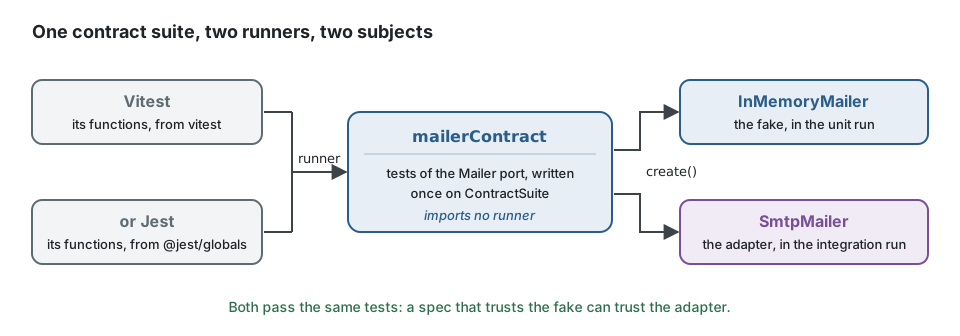
A port of your own gets a contract the same way, on the base class ContractSuite, and the
fake and the real adapter are both held to it, under whichever runner the project uses:
import { ContractSuite, type Awaitable, type ContractRunner } from '@ddd-ts-kit/testing/contracts';import { afterEach, beforeEach, describe, expect, it } from 'vitest';
export abstract class Mailer {  abstract deliver(address: string, subject: string): Promise<void>;  abstract deliveredTo(address: string): Promise<readonly string[]>;}
// test/contracts/mailer.contract.ts: what any Mailer must do, with no runner importedexport function mailerContract(runner: ContractRunner, options: { name: string; create(): Awaitable<Mailer> }): void {  new MailerSuite(runner, () => options.create()).describe(`${options.name} (mailer contract)`);}
class MailerSuite extends ContractSuite<Mailer> {  protected tests(): void {    this.it('keeps what it delivered, per address', async () => {      await this.subject.deliver('ada@example.test', 'Reminder');
      this.expect(await this.subject.deliveredTo('ada@example.test')).toEqual(['Reminder']);      this.expect(await this.subject.deliveredTo('bob@example.test')).toEqual([]);    });  }}
// test/fakes/in-memory-mailer.tsclass InMemoryMailer implements Mailer {  private readonly sent = new Map<string, string[]>();
  async deliver(address: string, subject: string): Promise<void> {    this.sent.set(address, [...(this.sent.get(address) ?? []), subject]);  }
  async deliveredTo(address: string): Promise<readonly string[]> {    return this.sent.get(address) ?? [];  }}
// test/unit/in-memory-mailer.contract.spec.ts: the runner hands its functions overmailerContract({ describe, it, expect, beforeEach, afterEach }, { name: 'InMemoryMailer', create: () => new InMemoryMailer() });
The adapter's spec, under test/integration/, calls the same mailerContract with a create
that builds the real adapter. Under Jest the first line imports the five functions from
@jest/globals instead; ContractRunner asks nothing more of them.
With Vitest (the default):
vitest.config.tswithunitandintegrationprojects and the coverage thresholds of the config file, per context and layer (domain highest, infrastructure lowest, the latter measured by the integration run of the pipeline), and the specs of the contexts a pull request does not reach left to the default branch (unaffectedContexts()). Reduced to its parts, for a project in the standard decorator mode:
import { governedCoverage } from '@ddd-ts-kit/testing/coverage';import { decorators } from '@ddd-ts-kit/testing/vitest';import { defineConfig } from 'vitest/config';
const INTEGRATION_SPECS = 'src/contexts/*/test/integration/**/*.spec.ts';
export default defineConfig(({ mode }) => ({ // standard decorators, compiled by the compiler of the project; legacy ones need no plugin plugins: [decorators({ compiler: '@typescript/native' })], resolve: { tsconfigPaths: true }, test: { projects: [ { extends: true, test: { name: 'unit', include: ['src/**/*.spec.ts'], exclude: [INTEGRATION_SPECS] } }, { extends: true, test: { name: 'integration', include: [INTEGRATION_SPECS] } }, ], // what is measured and the floor of each layer: read from ddd-ts-kit.config.json coverage: { provider: 'v8', reporter: ['text', 'cobertura', 'lcov'], ...governedCoverage(mode) }, },}));- a separate end-to-end configuration that starts the whole application on a free port, on an in-process PostgreSQL unless a database URL is given;
- JUnit and Cobertura reports for GitLab, the Actions reporter for GitHub;
decorators()of@ddd-ts-kit/testing/vitestfor projects in the standard decorator mode: Vitest 5 does not lower standard decorators, and a spec importing a decorated file would stop on a syntax error. The plugin compiles only the files holding a decorator with the compiler of the project (the native TypeScript 7 included, since it runs the binary), caches the result (about 60 ms per file the first time with TypeScript 7, 220 ms with TypeScript 6, nothing after, as measured in the README), keeps source maps, and steps aside in the legacy mode. It does not type-check and does not touch.tsx;- the generated projects that the CLI proves in full (specs, end-to-end specs, build, documentation checks, lint, import graph, dead code) are listed in the CLI README; none of them is described there as a Jest project.
With Jest (init --tests jest). What follows was read in a project generated on
2026-10-10:
- a
jest.config.jsusing@swc/jest, with decorators compiled in the mode of the project (legacy with metadata, or standard), ES module handling, the import alias mapped and the contexts a pull request does not reach left out:
// jest.config.js, as generated for a project in the standard decorator mode (reduced)import { governedJestCoverage, unaffectedContexts } from '@ddd-ts-kit/testing/coverage';
export default { testEnvironment: 'node', moduleNameMapper: { '^@/(.*)$': '<rootDir>/src/$1.ts' }, // the "paths" of tsconfig.json, repeated testPathIgnorePatterns: ['/node_modules/', ...unaffectedContexts().map((directory) => `/${directory}`)], extensionsToTreatAsEsm: ['.ts'], transform: { '^.+\\.ts$': ['@swc/jest', { jsc: { parser: { syntax: 'typescript', decorators: true }, transform: { decoratorVersion: '2022-03' }, target: 'es2022' } }], }, coverageProvider: 'v8', ...governedJestCoverage(),};- a
jest.e2e.config.jsextending it, with a longer timeout and one worker; jest,@jest/globals,@swc/coreand@swc/jestas development dependencies; generated specs import their globals from@jest/globals;- one test script for unit and adapter specs together, run with
node --experimental-vm-modules: the integration script of the pipeline only prints that adapter specs run with the unit specs; jest.config.jswith thev8coverage provider and the thresholds of the config file, per context and layer, in the one run Jest makes (npm run test:coverage);- unit tests of the CLI check that these files and the recorded stack are produced. No evidence was found that a generated Jest project is installed and run by the kit's own end-to-end suite.
Limits and when not to use it
Section titled “Limits and when not to use it”Vitest
- Standard decorators need the plugin; forgetting it gives a syntax error at the first decorated import, not a helpful message.
- The plugin calls the project's compiler once per decorated file on a cold cache: a first run in CI without a cache pays it for every such file.
- Tooling around a new major version can lag: the pipeline README reports that the mutation testing tool it tried did not work with Vitest 5.
Jest
- ES modules rely on
--experimental-vm-modules. The Node.js documentation (v26.11.1, read on 2026-10-10, https://nodejs.org/api/vm.html) labelsvm.Module,vm.SourceTextModuleandvm.SyntheticModule"Stability: 1 - Experimental", and Jest's own page calls its ESM support experimental; mocking a module in ESM goes throughjest.unstable_mockModule. @swc/jestwas last published in September 2025 (0.2.39 on npm); it works with current Jest as far as the template assumes, which was not run for this page.- The template writes the decorator mode of the project into
jest.config.jswhen the project is generated: Jest does not readtsconfig.json, so a project that later changes its mode there changes thetransformoptions ofjest.config.jstoo. - No unit and integration split, no in-repository proof of a full run: those are yours to add and to keep working.
Either one
- A runner does not make a test good. A spec that asserts calls instead of outcomes is as brittle under Vitest as under Jest.
- Do not mix both runners in one project: two configurations, two transform pipelines and two sets of globals for no gain.
Recommendation by situation
Section titled “Recommendation by situation”| Situation | Choice |
|---|---|
| New project | Vitest: the default, the verified path, thresholds and reports included |
| Declared style in the standard decorator mode | Vitest with the decorators() plugin |
| NestJS or class-validator project (legacy decorators) | Vitest works without the plugin; Jest if the team's NestJS tooling is built on it |
| Existing codebase with a large Jest suite adopting the kit | Jest, adding the project split and thresholds by hand; plan a migration only if it pays |
| A library or adapter published for others | write its contract with ContractSuite, so consumers run it under either runner |
| Wanting mutation testing | not available in the kit today, with either runner |
Sources
Section titled “Sources”- This repository:
packages/testing/README.md(contract suites, "Standard decorators under Vitest"),packages/cli/README.md(init, "Development"),pipeline/README.md(coverage thresholds, reports, mutation testing),docs/ARCHITECTURE.mdsections 5 and 7; templatespackages/cli/templates/init/jest.config.js.tplandpackages/cli/templates/init/e2e/jest.e2e.config.js.tpl. - Vitest: https://vitest.dev/guide/features and https://vitest.dev/config/coverage (v5.0.3, read on 2026-10-10); npm: https://www.npmjs.com/package/vitest
- Jest 30.5: https://jestjs.io/docs/configuration , https://jestjs.io/docs/ecmascript-modules and https://jestjs.io/docs/cli (read on 2026-10-10); npm: https://www.npmjs.com/package/jest
- Node.js,
vmmodule (stability of VM modules): https://nodejs.org/api/vm.html @swc/jest: https://www.npmjs.com/package/@swc/jest- TC39 decorators proposal: https://github.com/tc39/proposal-decorators
- Martin Fowler, "Mocks Aren't Stubs", martinfowler.com.
- Steve Freeman and Nat Pryce, Growing Object-Oriented Software, Guided by Tests, Addison-Wesley, 2009.
See also
Section titled “See also”- Testing strategy
- Static analysis and pipeline
- Ports and composition: decorator modes
- Dependency injection
- Configuration:
stack.tests