
Client SDK: a typed client from the OpenAPI contract
Summary. A project of the kit writes its OpenAPI contract from its routes
(openapi/openapi.yaml, or one file per document of openapi.documents). The callers of the API
(a front end, another team, a partner, the end-to-end specs of the project itself) want a typed
client of that contract, current with it, that refuses what the API refuses in the words of its
error codes. Three maintained generators were measured on the contract of the example
application. None of them reads the error codes the contract declares per status, two of them
add an install of 35 to 73 MB to the project, and one of them refuses the TypeScript version the
projects of the kit use. The kit therefore writes the client itself: ddd-ts-kit sdk, with no
dependency to install and none for the consumer. This page gives the measures, the decision, and
how the generated client is used, checked and published.
What a client of a kit contract has to do
Section titled “What a client of a kit contract has to do”The contract of the example (examples/scheduling/openapi/openapi.yaml, 32 operations) shows
what a client must carry:
-
Refusals as data. Every refusal is a problem document (RFC 9457,
application/problem+json) with a stablecode. Each response lists the codes it may carry inx-error-codes:POST /practicesanswers404withPERSON_NOT_REGISTERED,422withUNKNOWN_TIME_ZONEorVALIDATION_FAILED. A caller branches on the code, so the client should typeproblem.codeas exactly those codes, per status.# openapi/openapi.yaml: the 422 answer of POST /practices, as docs:generate writes it'422':description: 'Unprocessable Content. Error codes: UNKNOWN_TIME_ZONE, VALIDATION_FAILED.'content:application/problem+json:schema:$ref: '#/components/schemas/Problem'x-error-codes:- UNKNOWN_TIME_ZONE- VALIDATION_FAILED -
Security per operation. Most operations require the
bearerscheme, a few are public. -
Split documents. With
openapi.documents, a contract is several self-contained files: a public API and a back office get one client each. -
Query parameters as written. Filters are named
filter[status], lists are repeated. -
Many consumers. A browser bundle, a Node service, the end-to-end specs: no runtime dependency, and what a bundle does not call should not be in it.
Comparison
Section titled “Comparison”Measured on 2026-10-12 on the example contract as it was then (25 operations, version 0.6.0 of
the kit; it has 32 operations today, and its client 82 kB of sources), versions read from npm the
same day, every
generator with its documented defaults (openapi-fetch for openapi-typescript, the fetch client
for orval). Sizes are minified with esbuild 0.28; "one operation" bundles getAppointment and
what it needs. Install sizes include TypeScript 6 (24 MB), which every project of the kit
already installs.
| openapi-typescript + openapi-fetch | @hey-api/openapi-ts | orval | ddd-ts-kit sdk |
|
|---|---|---|---|---|
| Version, licence | 7.13.0 and 0.17.0, MIT | 0.99.0, MIT | 8.41.0, MIT | the CLI, MIT |
| Installed to generate | 35 packages, 45 MB | 46 packages, 35 MB | 60 packages, 73 MB | nothing: the CLI the project has |
| Installs next to TypeScript 6 | no: its peer range is typescript@^5.x, npm install stops on ERESOLVE |
yes | yes | yes |
| Output on the example | one .d.ts of 80 kB, types only |
16 files, 110 kB, half of it a copied runtime | one file of 68 kB | 6 files, 66 kB, and a README |
| Runtime dependency of the consumer | openapi-fetch and its helper package |
none (runtime copied) | none | none |
| Whole client, minified (gzip) | 6.6 kB (2.6 kB): the runtime, the paths are types | 13.6 kB (4.5 kB) | 13.9 kB (2.2 kB) | 10.1 kB (2.8 kB) |
| One operation, minified | the whole runtime, 6.6 kB | 9.6 kB | 0.2 kB | 2.4 kB |
Error codes of x-error-codes |
lost: code: string |
lost: code: string |
lost: code: string |
typed per status: Failure<422, 'UNKNOWN_TIME_ZONE' | 'VALIDATION_FAILED', Problem> |
| Outcome discriminated by status | yes, { data, error, response } |
yes with throwOnError: false |
yes, { data, status } |
yes, { ok, status, data | problem } |
| Security of the contract | not read: a middleware sets the header | per operation, an auth callback |
not read: no credential is attached | per operation and scheme, a value or a function per scheme |
| Split documents | one run per file | one run per file | one target per file | one client per document, from openapi.documents |
| Base URL | an option | an option | none: relative URLs, a mutator to add one | an option |
| Maintenance | active, stable major | active, still 0.x: breaking changes between minors | active, frequent releases | released with the kit, held by its specs |
None of the three reads x-error-codes: a vendor extension, which they leave in comments
(openapi-typescript and hey-api copy the description "Error codes: ..." into JSDoc). Getting the
codes into the types would mean a second generator over theirs, plus their install, plus, for
openapi-typescript, an override of its peer range in every project. The contracts the kit
writes use a known subset of OpenAPI 3.1 (JSON request bodies, JSON and problem responses,
component schemas, HTTP and API key schemes), because the kit writes them: a generator of that
subset is a few hundred lines that the CLI, which has no runtime dependency, can carry.
The decision
Section titled “The decision”ddd-ts-kit sdk generates the clients. It reads the committed contract (YAML or JSON, as
openapi.format says), so it needs no build and no network, and the same command answers
--check for the pipeline.
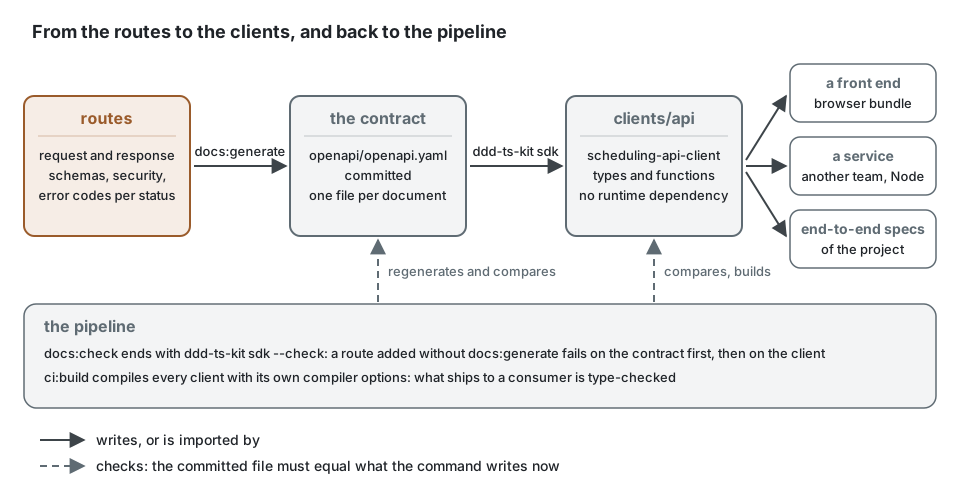
The loop, in commands:
npx ddd-ts-kit sdk # once: records "sdk" in the config and writes clients/<document>npm install # npm lists the new workspace package in package-lock.jsonnpm run docs:generate # after a route changes: the contract, then the clientsnpm run docs:check # what the pipeline runs: fails on a stale contract or clientnpm run sdk:build # compiles every client, as ci:build doesWhen the contract comes from somewhere else, or when the team wants React Query hooks, Zod
schemas or mocks generated with the client, orval and hey-api are the better tools: they cover
OpenAPI broadly and have plugins for those. Run them on openapi/*.yaml like any other
contract; the kit does not stand in the way.
What is generated
Section titled “What is generated”init --sdk asks for the clients in a new project; npx ddd-ts-kit sdk asks for them in an
existing one (it records "sdk" in ddd-ts-kit.config.json, see CONFIG, appends
to AGENTS.md (CLAUDE.md in a project written before it) the instruction init --sdk writes for
the agents, never to edit a client, and says to add clients/** to the paths of
.claude/rules/presentation.md and of .github/instructions/presentation.instructions.md).
For each document of the contract, a workspace package:
clients/ tsconfig.json builds every client: tsc -b clients api/ the whole contract; a split contract gives clients/<document> package.json name from "sdk.name"; the version is the team's README.md use, operations, error codes, how to publish tsconfig.json ES modules, declarations, DOM types: a browser and Node alike src/ index.ts what the package exports client.ts createClient(), connect(), the security schemes operations.ts per operation: its input type, its outcome type, its function errors.ts ERROR_CODES, ErrorCode, isErrorCode(), isProblem() schemas.ts one type per component schema runtime.ts the same for every contract: request, credentials, answerA split contract (openapi.documents) gives clients/<name> for each document, a document
named openapi included; two contract files that would write one client (openapi.yaml and a
stray api.yaml in a contract that is not split) are refused with both names.
Every file but package.json is rewritten by each run; package.json keeps its version and every
key the team adds, and only the name, the entry points, the build script and
publishConfig.access follow the config.
The command also wires the project, and running it again changes nothing:
- the clients are workspace packages (
"workspaces"in package.json,pnpm-workspace.yamlunder pnpm). npm lists each one inpackage-lock.json, andnpm cirefuses a lock that misses one: while the lock of an npm project does not list a client (the first run, a new document of a split contract, a newsdk.name), the command says to runnpm installand commit the lock, andsdk --checkfails. pnpm accepts a new workspace package in a frozen install; - the name of each client resolves to its sources in the
pathsoftsconfig.json, which the type check, Vitest, tsx and knip read: a spec imports the client by its package name, as a consumer would, without a build first; - their sources are left out of Biome and knip, which would read generated code as code written
by hand, and of the ESLint preset, which does so when the config has
"sdk": a project without the key keeps linting and formatting whatever it has underclients/; - knip.json names the root as a workspace of its own (
workspaces["."]), which knip asks for once package.json has workspaces; what knip.json said of the project moves there, and the generators enter a new context or entry point there from then on; - the scripts:
sdk:generate,sdk:build;docs:generateregenerates the clients after the contract,docs:checkandci:docscompare them,ci:buildbuilds them.
What the client changes, on one call. Written by hand, nothing ties the request or the code of the refusal to the contract:
// Instead of: a request written by handconst response = await fetch('https://api.example.com/practices', {  method: 'POST',  headers: { 'content-type': 'application/json', authorization: `Bearer ${session.token()}` },  body: JSON.stringify({ name: 'Riverside', timeZone: 'Europe/Paris', manager: 'ada' }), // the field is managerId});const problem = (await response.json()) as { code?: string };
if (response.status === 422 && problem.code === 'UNKNOWN_TIMEZONE') {  // never true: the code is UNKNOWN_TIME_ZONE, and nothing says so before production}
Through the client, the same two mistakes do not compile:
// Write: the client of the contractconst result = await api.openPractice({ body: { name: 'Riverside', timeZone: 'Europe/Paris', manager: 'ada' } });// error TS2561: Object literal may only specify known properties, but 'manager' does not exist// in type '{ name: string; timeZone: string; managerId: string; }'. Did you mean to write 'managerId'?
if (!result.ok && result.status === 422 && result.problem.code === 'UNKNOWN_TIMEZONE') {  // error TS2367: This comparison appears to be unintentional because the types  // '"UNKNOWN_TIME_ZONE" | "VALIDATION_FAILED"' and '"UNKNOWN_TIMEZONE"' have no overlap.}
The whole use:
import { createClient, isProblem, unwrap } from 'scheduling-api-client';
const api = createClient({ baseUrl: 'https://api.example.com', credentials: { bearer: () => session.token() } });
const result = await api.openPractice({ body: { name: 'Riverside', timeZone: 'Europe/Paris', managerId: 'ada' } });
if (result.ok) {  console.log(result.data.id);} else if (result.status === 422 && result.problem.code === 'UNKNOWN_TIME_ZONE') {  // result.problem.code is 'UNKNOWN_TIME_ZONE' | 'VALIDATION_FAILED' here, and nothing else.}
try {  const page = await unwrap(api.searchAppointments({ query: { 'filter[status]': 'booked' } }));  console.log(page.items.length);} catch (error) {  if (isProblem(error, 'INVALID_CRITERIA')) {    // error.code is 'INVALID_CRITERIA'.  }}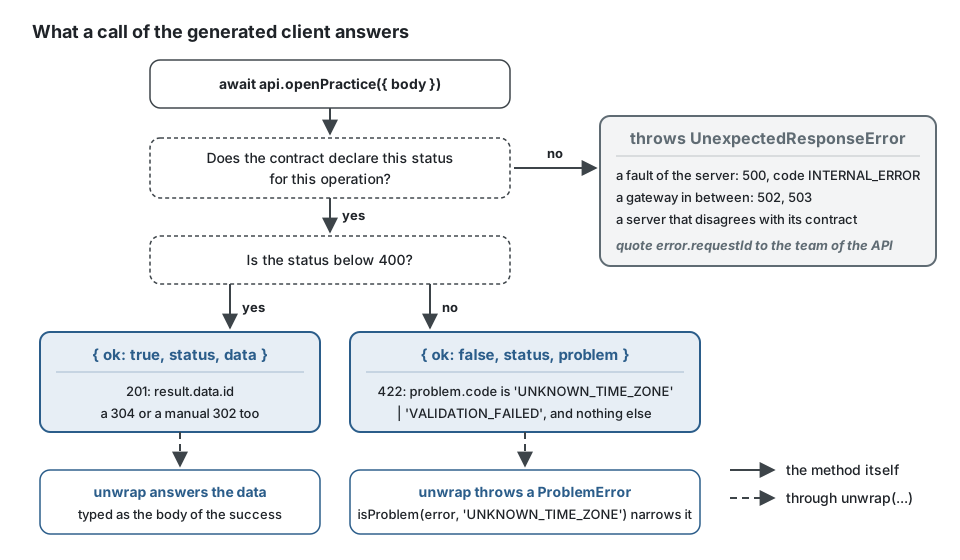
- A method never throws for a status its contract declares: the outcome is a union keyed by
okandstatus.unwrapturns a refusal into a thrownProblemError. - A status the contract does not declare throws
UnexpectedResponseError. The common one is a fault of the server: the kit answers any unexpected error with a 500 problem document (codeINTERNAL_ERROR,requestId) that no operation declares, and the error reads it:error.code,error.requestId(the reference to quote to the team of the API, which finds the request in its logs) anderror.problem. A gateway in between (502, 503) and a server that disagrees with its contract end there too; the drift check keeps the contract equal to the routes, not to every answer of the server. - A declared status below 400 is a success (
ok: true), a 304 or a 302 underredirect: 'manual'included; 400 and above a refusal. - A credential is given per security scheme, as a value or as a function asked before each request. An operation sends the credentials of the first alternative of its security that has all of them, nothing when it allows anonymous calls and none is given.
headersadds headers to every request, and a header of the call replaces the one of the client whatever the case of its name;fetchreplaces the global one (a test, a retry).- Each operation is also a function,
getAppointment(connect(options), input), so that a bundle holds only the operations it calls. - The body is not validated against its schema: the client trusts the contract, and
docs:checkkeeps the contract equal to the routes.
In a browser bundle, import the functions of the operations it calls, not createClient,
which holds them all. Same origin, the cookies of the browser as the credential:
import { connect, getAppointment } from 'scheduling-api-client';
const connection = connect({ baseUrl: '/api', fetch: (request) => fetch(request, { credentials: 'include' }) });
const appointment = await getAppointment(connection, { path: { appointmentId: 'appointment-42' } });
When the server fails, the error to report carries what the team of the API needs to find the request in its logs:
import { createClient, UnexpectedResponseError, unwrap } from 'scheduling-api-client';
const api = createClient({ baseUrl: 'https://api.example.com', credentials: { bearer: 'token' } });
try {  await unwrap(api.getAppointment({ path: { appointmentId: 'appointment-42' } }));} catch (error) {  if (error instanceof UnexpectedResponseError) {    console.error(`${error.status} ${error.code ?? ''}: quote ${error.requestId ?? 'the time of the call'} to the team of the API`);  }
  throw error;}
In the tests of a consumer, fetch is the seam: give one that answers what the test needs
and records what was sent, with no server and no mocking library:
import { createClient } from 'scheduling-api-client';
const requests: Request[] = [];
const api = createClient({  baseUrl: 'https://api.test',  credentials: { bearer: 'token-of-ada' },  fetch: async (request) => {    requests.push(request);    return Response.json({ id: 'practice-1' }, { status: 201 });  },});
const opened = await api.openPractice({ body: { name: 'Riverside', timeZone: 'Europe/Paris', managerId: 'ada' } });
console.log(opened.ok && opened.data.id); // practice-1console.log(requests[0]?.headers.get('authorization')); // Bearer token-of-ada
These samples import the client of the example by its package name, which resolves in a
project that generated it, not in the repository of the kit, so the checked samples of this
documentation skip them. They were compiled by hand against examples/scheduling/clients/api,
and the compiler messages quoted above are its own; no gate keeps them so.
Limits
Section titled “Limits”- Request bodies are JSON. A route of another media type (an upload) is generated without its
body type; send it with
fetch. - A
defaultresponse or a range (4XX) is not typed: the kit writes neither. - Cookie parameters are not generated; a cookie scheme is, sent as a
Cookieheader, which only a caller outside a browser can set. A browser drops it and sends its own cookies: there, give afetchthat calls the global one withcredentials: 'include', and no credential for that scheme. - A component schema named like a type the generated files use (
Array,Record) or like an export of the client (ErrorCode,Client,unwrap...) gets a trailing_. - An operation is named after its
operationId. A reserved word is followed byOperation(deleteOperation); a name another operation already holds (listItemsandListItems), a name of the client (send,createClient), or one whose types (<Name>Input,<Name>Result) a schema holds, is followed by a number (createClient2).
Checked by the pipeline
Section titled “Checked by the pipeline”The clients are committed, so a fresh clone builds without generating anything. The documents
job runs docs:check, which ends with ddd-ts-kit sdk --check: a route added without
docs:generate fails it on openapi/openapi.yaml first, then on the client. The build job runs
ci:build, which compiles every client with its own compiler options (npm run sdk:build):
what ships to a consumer is type-checked in GitHub Actions and in GitLab CI alike. The end-to-end
specs that import a client type-check it with the project in ci:typecheck.
Publish
Section titled “Publish”Publishing is a decision of the team and never a step the generated pipeline takes. To publish a client:
- choose its name (
"sdk.name", a scope for a private registry) and its access ("sdk.access":restrictedfor a private scope,public), thennpx ddd-ts-kit sdk; - raise
versioninclients/<document>/package.json(the contract version is a good source:info.version); - for a registry other than npm, write its URL in an
.npmrcnext to that package.json, its token in the environment, never in the repository; npm publish --workspace clients/<document>(pnpm publish --filter <name>): itsprepublishOnlybuilds it first.
A team that wants it automated adds a job of its own on a tag, with the registry token as a
secret of the pipeline, and npm publish --provenance from GitHub Actions.
In the example
Section titled “In the example”The scheduling example generates clients/api (scheduling-api-client). Inside the kit's
repository the example is itself a workspace of the root, and npm ignores a workspace's own
"workspaces": there the client is reached through the paths entry of tsconfig.json alone,
which is what the specs and the type check use. Its workspace entry takes effect in a standalone
copy of the example, the layout a generated project has, where npm publish --workspace clients/api works. Its end-to-end specs
of registering a person and opening a practice, and the helpers every journey sets its practice
up with (registerPeople, openStaffedPractice), call the API through it
(application.apiAs(actor) in test/e2e/support/start-application.ts, with expectAnswer and
expectRefusal, which the compiler holds to the statuses and codes of each operation):
// adapted from test/e2e/identity-open-practice.e2e.spec.ts: the comment after 'UNKNOWN_TIME_ZONE' is addedit('answers the documented problem for each business refusal', async () => {  await registerPeople(application, 'ada');  const root = application.apiAs({ id: 'root', roles: ['network-admin'] });
  expectRefusal(    await root.openPractice({ body: { ...opening, timeZone: 'Europe/Atlantis' } }),    422,    'UNKNOWN_TIME_ZONE', // 'UNKNOWN_TIMEZONE', or 'PERSON_NOT_REGISTERED' with 422, would not compile  );
  expectRefusal(await root.openPractice({ body: { ...opening, managerId: 'nobody' } }), 404, 'PERSON_NOT_REGISTERED');});
apiAs gives the token of the actor as the credential of the bearer scheme, a function asked
before each request: the authentication of the client is proven against the real server. The other
specs keep the HTTP helpers, which remain the tool for a request the contract does not describe:
a body the client would refuse to compile is sent with them to prove VALIDATION_FAILED. The
end-to-end spec packages/cli/test/e2e/client-sdk.spec.ts proves the loop on a fresh project:
init --sdk, a route added, the contract and the client regenerated, a consumer type-checked.