
Representations, field access and forms described by the server
Summary. A route answers a typed value that its response schema checks; how that value
becomes bytes is a presentation concern of its own. The same agenda is wanted as JSON by the
web application, as XML by a partner and as CSV by a spreadsheet; the same booking body is
filled by a patient, by an assistant and by a practitioner, who may not see or set the same
fields. This page explains the three ideas the kit builds on: one schema, several
representations chosen by content negotiation; the fields of a schema reserved to some callers,
decided by the same authorization as the use cases; and forms described by the server from what
a route already declares. The how-to is in the README of @ddd-ts-kit/http;
the libraries and renderers are compared in tools/representations-and-forms.md.
One value, several representations
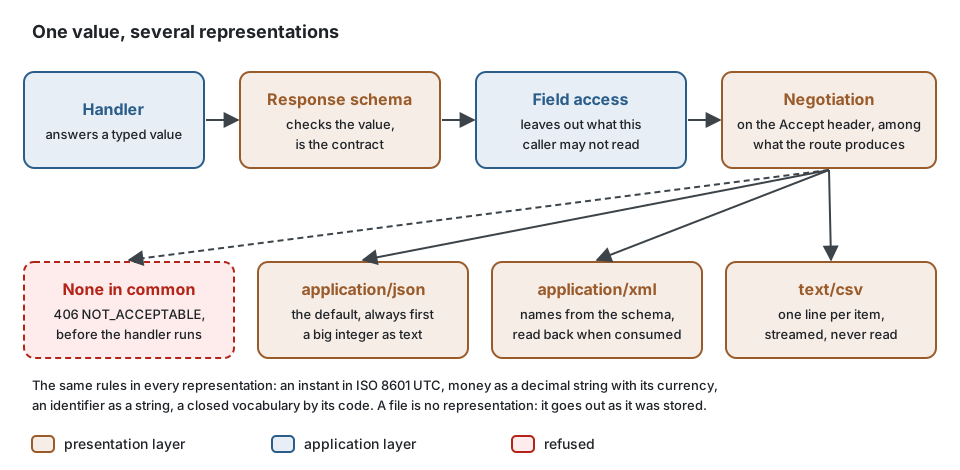
Section titled “One value, several representations”The schema of a response is the contract: the server checks what it answers against it, and the OpenAPI document is generated from it. A representation is a function of that value and that schema, nothing else:
Four consequences:
- No second model. There is no "XML DTO" next to the JSON one: element names and attributes come from the schema (the XML object of OpenAPI), columns of a CSV from the properties of an item. A partner format with a vocabulary of its own (namespaces, mixed content, an XML Schema the partner owns) is not a representation: it is an anti-corruption layer with its own mapper.
- Negotiation is a contract. The route says what it produces; the request says what it
accepts (RFC 9110); none in common is
406. A body sent as XML is read into the value the JSON path would have produced and validated by the same schema: one set of rules, whatever the wire. A file is no representation: a route that answers bytes or a stream of its own declares no body schema, and noAcceptheader refuses it. - A long list is read through the bus, page by page. An export streams page after page, each page a query sent through the bus, so each one is authorized, run in its transaction and tenant session, timed and traced. A query that answers a lazy list would be read after the bus has returned, outside all of that.
- Serialization rules are standard. An instant is ISO 8601 in UTC, money a decimal string with its currency, an identifier a string, a closed vocabulary its code, a list a page envelope or a stream. A project does not decide them again for each format.
Aggregates are never serialized. A representation sees the presentation type a controller answers, which a serializer built from a read model.
Fields reserved to some callers
Section titled “Fields reserved to some callers”"The patient does not see the internal note" is a right, so it belongs to authorization, not to
an if (actor.roles.includes('practitioner')) in a serializer: that test is forgotten in the
CSV export, in the XML for the partner and in the form, and no contract says the field may be
missing.
The kit marks the field on the schema instead: a field requires a permission or a policy to be
read, and possibly another one to be set. The permission is decided by the same Access as a use
case, about the element the field belongs to (the calendar of the appointment), so roles,
attribute policies and relationships all work. Setting a field is an act, and its decision is
recorded like any other; showing or hiding one only shapes an answer, and is not recorded, so a
page of a thousand rows does not write a thousand lines in the audit trail.
| Where | A field the caller may not read | A field the caller may read but not set |
|---|---|---|
| An answer, in every representation | absent | present |
| A request body | refused, 403 | refused, 403 |
| A form described by the server | absent | read-only |
| The contract | marked x-field-access, not required |
the same |
Two things stay elsewhere. Which rows an actor may read is the access scope of the query,
applied in the statement; field access never filters rows. What a field may hold is
validation, and a business rule about it stays an invariant of the domain. The use case still
checks the write permission itself (Access.authorize in the handler), because a job or another
transport sends the same command without passing through HTTP.
An answer that hides fields differs per caller, even on a route anybody may call: a shared
cache that kept the answer of a member of staff under its URL would hand the note to the next
anonymous caller. A public cache policy on such a route is refused when the routes are mounted
unless its vary names Authorization or Cookie; private is the usual answer
(HTTP caching).
Forms described by the server
Section titled “Forms described by the server”A front end usually rebuilds, for every command, a form the server already describes: the fields, their types, their lengths, the values of a closed vocabulary. Describing it from the route keeps one source:
- From what the route declares. The request schema gives the fields, their constraints and their options; a few presentation hints add what a schema cannot say: groups and order, the widget of a field, the route a field takes its options from, when a field shows or is required. Labels are translation keys, never text.
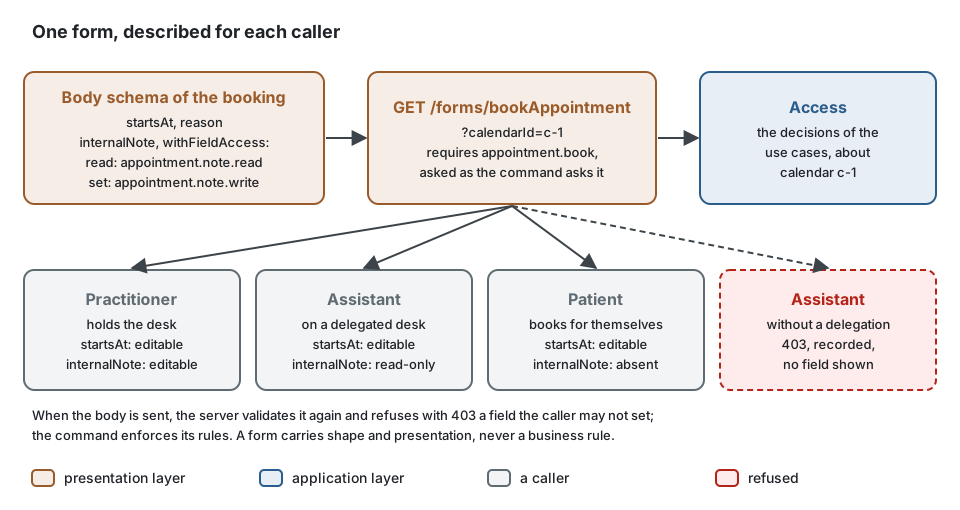
- For the caller. The form is given only to who may run its use case, the permission asked
as the command asks it, from the values of the request (the calendar in
?calendarId=, who books for whom); anybody else gets a 403 and learns nothing of its fields. Hidden and read-only fields then come from the same field access as the answers, about the same element; an object the caller may not set is read-only down to its last field. - Two formats from one tree. A neutral tree of groups and fields is the model of the kit; JSON Forms (a JSON Schema, a UI schema and the data) is produced from it, because maintained renderers exist for React, Angular and Vue.
A form carries shape and presentation, never a business rule. "An appointment cannot overlap another" is answered by the command when the form is sent; the form only tells the user early what the schema would refuse anyway. And the server validates again: a form is a convenience for the client, never a check.
Limits
Section titled “Limits”- XML here renders the JSON model; it is not a design tool for XML vocabularies.
- CSV is written, never read, and holds flat rows: an import is a use case with a body schema of its own.
- A streamed list cannot be refused once its first item is written: a failure later cuts the response short, and is reported as a fault.
- Field access judges the fields of the schema it is declared on; a nested object is restricted
through its own schema. A shared schema keeps the marks whichever wraps the other
(
sharedSchema(name, withFieldAccess(...))orwithFieldAccess(sharedSchema(...), ...)); a schema built from a marked one by another means (a part picked from it, a library's own composition) is a new shape and is marked again. Each requirement is one decision per distinct element of the answer, remembered for the last few hundred elements: a long export with an element per row costs one decision per row. - A form names the permission of its use case (
requires); one that does not is given to whoever may call its route. - A form describes scalars, nested objects and lists of a closed vocabulary; layout beyond groups and order, and the behaviour of a lookup, are the front end's.
See also
Section titled “See also”- The presentation layer: controllers, mappers, serializers, guards.
- Authentication and authorization: the models a field requirement is decided by.
- Invariants, permissions, validation: why a form never holds a business rule.
- The read side, parts 2 and 3.
- Rule
authz/fields-by-schemain the architecture reference.