
@ddd-ts-kit/di
Context modules on top of tsyringe, for projects that want dependency injection without a heavy framework.
A port is an abstract class, and the class is what you inject by. A class says what it is, and the context is assembled from what its classes say: there is no file listing bindings to keep in step with the code, and no constant standing for a port. The explicit module, where every binding is written by hand, stays supported and mixes with the declared style in one application.
npm i @ddd-ts-kit/di tsyringe reflect-metadatareflect-metadata is imported by this package before tsyringe loads (tsyringe refuses to load
without it), so you do not import it yourself. No decorator of the kit needs it: dependencies
are named, never reflected.
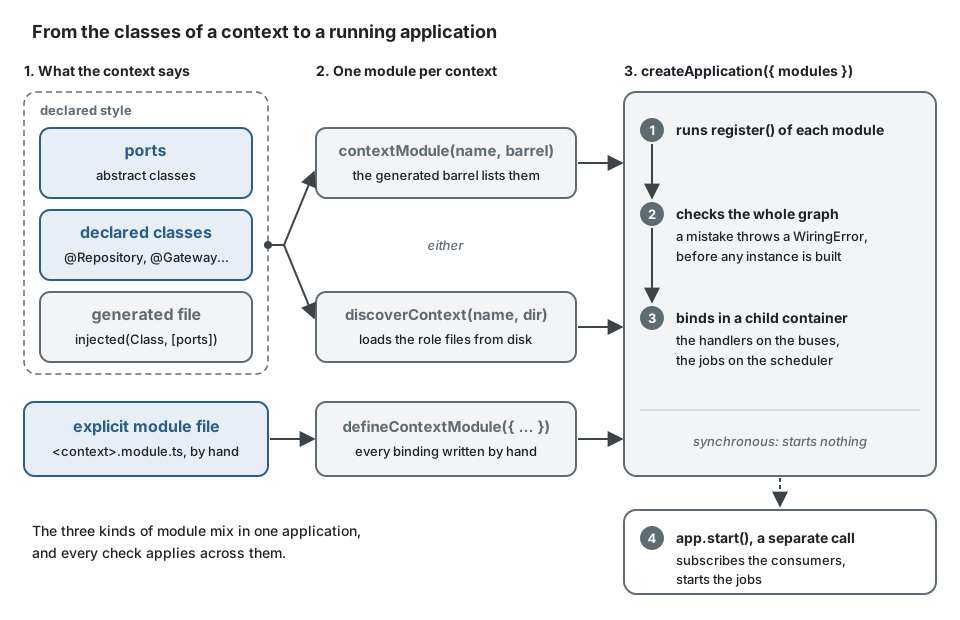
Whatever the style, the path is the same: the classes of a context say what they are, a module
gathers them, and createApplication checks the whole graph before it builds a single instance.
A first application
Section titled “A first application”The smallest application, in one file: one port, its adapter, one command and its handler, the module that ties them, and the composition root. It is written in the explicit style, so that every binding is visible; the declared style below writes the same thing with no module file.
// src/main.ts: a whole application in one file, read from top to bottom.import { Clock, Command, CommandBus, IdGenerator, type CommandHandler } from '@ddd-ts-kit/kernel';import { createApplication, defineContextModule, kernelModule } from '@ddd-ts-kit/di';
// A port: an abstract class. It types the parameter and keys the container.export abstract class StockGateway {  abstract reserve(sku: string): Promise<void>;}
// An adapter implements its port; it never extends it.export class InMemoryStock implements StockGateway {  readonly reserved: string[] = [];
  async reserve(sku: string): Promise<void> {    this.reserved.push(sku);  }}
export class PlaceOrder extends Command<string> {  constructor(readonly sku: string) {    super();  }}
// The handler states what it needs in its constructor, and nothing else.export class PlaceOrderHandler implements CommandHandler<PlaceOrder> {  constructor(    private readonly stock: StockGateway,    private readonly ids: IdGenerator,    private readonly clock: Clock,  ) {}
  async execute(command: PlaceOrder): Promise<string> {    await this.stock.reserve(command.sku);
    return `${this.ids.next()}@${this.clock.now().toISOString()}`;  }}
// The module says which adapter answers a port, and which handler runs a command.export const orderingModule = defineContextModule({  name: 'ordering',  register(builder) {    builder.bind(StockGateway).toClass(InMemoryStock).as('gateway');    builder.command(PlaceOrder).handledBy(PlaceOrderHandler, [StockGateway, IdGenerator, Clock]);  },});
// The composition root. kernelModule() binds Clock, IdGenerator, the buses, the unit of work...const app = createApplication({ modules: [kernelModule(), orderingModule] });
await app.start();
const orderId: string = await app.resolve(CommandBus).execute(new PlaceOrder('sku-1'));
console.log(orderId);
await app.stop();
The list [StockGateway, IdGenerator, Clock] is checked by the compiler against the
constructor of PlaceOrderHandler: a missing, extra or misplaced port does not compile (see
"What the compiler checks"). The spec of the handler swaps the adapter for a fake and runs on
a deterministic kernel, a frozen clock and identifiers id-1, id-2...:
import { expect, it } from 'vitest';import { Command } from '@ddd-ts-kit/kernel';import { createTestApplication, fake, type ContextModule } from '@ddd-ts-kit/di';
// What the spec imports from the context, declared here so that the sample compiles alone.declare abstract class StockGateway {  abstract reserve(sku: string): Promise<void>;}declare class PlaceOrder extends Command<string> {  readonly sku: string;  constructor(sku: string);}declare const orderingModule: ContextModule;
it('reserves the stock of the order it places', async () => {  const reserved: string[] = [];
  const app = createTestApplication({    modules: [orderingModule],    fakes: [fake(StockGateway, { reserve: async (sku) => void reserved.push(sku) })],  });
  const orderId = await app.commandBus.execute(new PlaceOrder('sku-1'));
  expect(reserved).toEqual(['sku-1']);  expect(orderId).toBe('id-1@2026-01-01T00:00:00.000Z');});
The module is the unit under test: no new PlaceOrderHandler(...) by hand, no vi.mock. The
fake is an object literal, since a port is only a shape.
A context that declares itself
Section titled “A context that declares itself”The decorators come from @ddd-ts-kit/kernel/declarations, which holds no container: the
application layer imports the kernel and nothing else. This package turns the declarations
into bindings; nothing else does. The domain carries no decorator.
A port lives where the layer that owns it lives: a repository port in
domain/repositories/, any other port in application/ports/, one abstract class per file.
import { Repository } from '@ddd-ts-kit/kernel';
export abstract class InvoiceRepository extends Repository<Invoice> { abstract findUnpaidOf(customerId: string): Promise<readonly Invoice[]>;}export abstract class PaymentGateway { abstract capture(invoiceId: string, amount: Money): Promise<PaymentReceipt>;}import { AuthorizedCommand, type Actor } from '@ddd-ts-kit/kernel';import { Requires } from '@ddd-ts-kit/kernel/declarations';
@Requires(permissions['invoice.issue'], { resource: (command: IssueInvoice) => ({ type: 'customer', id: command.customerId }),})export class IssueInvoice extends AuthorizedCommand<string> { constructor(actor: Actor, readonly customerId: string) { super(actor); }}import type { Clock, IdGenerator } from '@ddd-ts-kit/kernel';import { CommandHandler } from '@ddd-ts-kit/kernel/declarations';
@CommandHandler(IssueInvoice)export class IssueInvoiceHandler implements CommandHandler<IssueInvoice> { constructor( private readonly invoices: InvoiceRepository, private readonly payments: PaymentGateway, private readonly ids: IdGenerator, private readonly clock: Clock, ) {}
async execute(command: IssueInvoice): Promise<string> { const invoice = Invoice.issue({ id: this.ids.next(), customerId: command.customerId, issuedAt: this.clock.now() });
await this.invoices.save(invoice);
return invoice.id; }}The handler only saves. The save hands over the domain events the aggregate recorded, and the unit of work of the command dispatches them once the handler has returned, before the commit: see "Domain events and the unit of work".
// contexts/billing/application/queries/get-invoice/get-invoice.query.ts and .handler.ts@Public()export class GetInvoice extends Query<InvoiceView | undefined> {  constructor(readonly invoiceId: string) {    super();  }}
@QueryHandler(GetInvoice)export class GetInvoiceHandler implements QueryHandler<GetInvoice> { /* ... */ }import { CommandBus, systemActor, type IntegrationEvent } from '@ddd-ts-kit/kernel';import { IntegrationEventHandler } from '@ddd-ts-kit/kernel/declarations';import { OrderPlaced, type OrderPlacedPayload } from '@/contexts/ordering/published-language/index';
@IntegrationEventHandler(OrderPlaced, { consumer: 'billing.invoice-on-order-placed' })export class InvoiceOnOrderPlaced implements IntegrationEventHandler<OrderPlacedPayload> { constructor(private readonly commands: CommandBus) {}
async handle(event: IntegrationEvent<OrderPlacedPayload>): Promise<void> { await this.commands.execute(new IssueInvoice(systemActor('billing.invoice-on-order-placed'), event.payload.customerId)); }}import { IdGenerator, IntegrationEventPublisher } from '@ddd-ts-kit/kernel';import { DomainEventHandler } from '@ddd-ts-kit/kernel/declarations';
@DomainEventHandler(InvoiceIssued)export class InvoiceIssuedPublisher implements DomainEventHandler<InvoiceIssued> { constructor( private readonly publisher: IntegrationEventPublisher, private readonly ids: IdGenerator, ) {}
async handle(event: InvoiceIssued): Promise<void> { /* publishes billing.invoice.issued */ }}import { Clock, ExecutionScope } from '@ddd-ts-kit/kernel';import { Repository } from '@ddd-ts-kit/kernel/declarations';
@Repository(InvoiceRepository)export class KnexInvoiceRepository implements InvoiceRepository { /* ... */ }import { Gateway } from '@ddd-ts-kit/kernel/declarations';import { retry, timeout } from '@ddd-ts-kit/aspects';
@Gateway(PaymentGateway, { aspects: [retry({ attempts: 3 }), timeout(2000)] })export class HttpPaymentGateway implements PaymentGateway { /* ... */ }That is the whole context. It is assembled in one line, in one of two ways.
// main.ts, discovered: no file of the context names its classesimport { CommandBus } from '@ddd-ts-kit/kernel';import { createApplication, kernelModule } from '@ddd-ts-kit/di';import { discoverContext } from '@ddd-ts-kit/di/discovery';
const billing = await discoverContext('billing', new URL('./contexts/billing/', import.meta.url));const app = createApplication({ modules: [kernelModule(), platformModule, billing], authorization: 'required' });await app.start();const invoiceId = await app.resolve(CommandBus).execute(new IssueInvoice(actor, 'customer-1')); // typed string
// main.ts, listed: one generated barrel per context and nothing elseimport { contextModule, createApplication, kernelModule } from '@ddd-ts-kit/di';import * as billing from '@/contexts/billing/billing.declarations';
const app = createApplication({ modules: [kernelModule(), platformModule, contextModule('billing', billing)] });The same mechanism, in one file
Section titled “The same mechanism, in one file”In a project these classes live in their own files and the injected(...) line is written by
ddd-ts-kit docs in the generated file of the context. Squeezed into one file that compiles,
the whole mechanism reads at once: decorators that say what each class is, one line that says
what a constructor takes, and a module made from the classes.
import { Command, CommandBus, IdGenerator } from '@ddd-ts-kit/kernel';import { CommandHandler, Gateway, Public, injected } from '@ddd-ts-kit/kernel/declarations';import { contextModule, createApplication, kernelModule } from '@ddd-ts-kit/di';
// application/ports/stock.port.ts: a port is never decorated.export abstract class StockGateway {  abstract reserve(sku: string): Promise<void>;}
// application/commands/place-order/place-order.command.ts@Public()export class PlaceOrder extends Command<string> {  constructor(readonly sku: string) {    super();  }}
// application/commands/place-order/place-order.handler.ts: the decorator lists nothing.@CommandHandler(PlaceOrder)export class PlaceOrderHandler implements CommandHandler<PlaceOrder> {  constructor(    private readonly stock: StockGateway,    private readonly ids: IdGenerator,  ) {}
  async execute(command: PlaceOrder): Promise<string> {    await this.stock.reserve(command.sku);
    return this.ids.next();  }}
// infrastructure/external/in-memory-stock.gateway.ts: bound to its port by its decorator.@Gateway(StockGateway)export class InMemoryStockGateway implements StockGateway {  readonly reserved: string[] = [];
  async reserve(sku: string): Promise<void> {    this.reserved.push(sku);  }}
// ordering.declarations.ts, generated by `ddd-ts-kit docs` from the constructor above.injected(PlaceOrderHandler, [StockGateway, IdGenerator]);
// main.tsconst ordering = contextModule('ordering', [PlaceOrder, PlaceOrderHandler, InMemoryStockGateway]);const app = createApplication({ modules: [kernelModule(), ordering] });
const orderId: string = await app.resolve(CommandBus).execute(new PlaceOrder('sku-1'));
Compare with "A first application": the bind(...).toClass(...) and command(...).handledBy(...)
statements are gone, each class carries its own, and the list of the handler moved out of the
composition root into a generated line nobody writes by hand.
Ports and values
Section titled “Ports and values”A port is an abstract class
Section titled “A port is an abstract class”The class names the dependency and carries its type: a constructor parameter typed by it
names what is injected, app.resolve(Clock) answers a Clock, and nothing else stands for
the port. The
ports of the kernel (Clock, IdGenerator, UnitOfWork, CommandBus, QueryBus,
IntegrationEventPublisher, ExecutionScope...) are abstract classes imported from
@ddd-ts-kit/kernel; yours are written the same way.
Instead of the usual tsyringe pair, an interface for the type and a constant for the token, kept in step by hand:
export interface PaymentGateway {  capture(invoiceId: string): Promise<string>;}export const PAYMENT_GATEWAY = Symbol('PaymentGateway');
@injectable()export class CaptureInvoiceHandler {  constructor(@inject(PAYMENT_GATEWAY) private readonly payments: PaymentGateway) {}}
write one abstract class, which is both:
import { Clock } from '@ddd-ts-kit/kernel';
export abstract class PaymentGateway {  abstract capture(invoiceId: string): Promise<string>;}
export class CaptureInvoiceHandler {  constructor(    private readonly payments: PaymentGateway, // the type of the parameter names the port    private readonly clock: Clock, // a port of the kernel, written the same way  ) {}}
No parameter decorator, no @injectable(), no constant to import next to the type: the class
that types the parameter is also the token its list names (written in a statement or generated
by ddd-ts-kit docs), so nothing else has to be kept in step.
The rule, checked when a binding is registered (INVALID_PORT for toClass, a
DeclarationError for a decorator):
- a port has abstract members only: no body, no constructor parameter, no private or protected
member. One exception,
static readonly tokenKey(see "Identity"); - a port may extend another port, and is then another port;
- an adapter
implementsits port and neverextendsit; - a class bound to itself (
bind(Settings).toClass(Settings, [...]), a handler, a job, a policy) is no port and keeps its methods.
Because a port holds nothing but a shape, a fake and a plain object stand for it:
fake(Clock, { now: () => new Date(0) }).
A value is typed by an abstract class too
Section titled “A value is typed by an abstract class too”A configuration object, a database handle, a list, a primitive: an abstract class with
abstract readonly properties, bound with toValue to a plain object. That is the one way.
export abstract class Database {  abstract readonly client: Knex;}
// contexts/billing/application/ports/payment-settings.port.tsexport abstract class PaymentSettings {  abstract readonly apiUrl: string;  abstract readonly apiKey: string;}
// platform/platform.module.tsbuilder.bind(Database).toValue({ client: knex(config.database) });builder.bind(PaymentSettings).toValue({ apiUrl: config.payments.url, apiKey: config.payments.key });
A primitive is wrapped: abstract class TaxRate { abstract readonly value: number }, then
builder.bind(TaxRate).toValue({ value: 0.2 }).
A value and a port together, in one module that compiles: the adapter takes the value by its
constructor like any other dependency, and resolve answers each typed by its class.
import { createApplication, defineContextModule, kernelModule } from '@ddd-ts-kit/di';
// A value: an abstract class with abstract readonly properties.export abstract class PaymentSettings {  abstract readonly apiUrl: string;}
// A port.export abstract class PaymentGateway {  abstract capture(invoiceId: string): Promise<string>;}
// The adapter takes the value by its constructor, like any other dependency.export class HttpPaymentGateway implements PaymentGateway {  constructor(private readonly settings: PaymentSettings) {}
  async capture(invoiceId: string): Promise<string> {    return `${this.settings.apiUrl}/captures/${invoiceId}`;  }}
const paymentsModule = defineContextModule({  name: 'payments',  register(builder) {    builder.bind(PaymentSettings).toValue({ apiUrl: 'https://payments.example' });    builder.bind(PaymentGateway).toClass(HttpPaymentGateway, [PaymentSettings]).as('gateway');  },});
const app = createApplication({ modules: [kernelModule(), paymentsModule] });
const gateway: PaymentGateway = app.resolve(PaymentGateway); // typed by the port, no castconst settings: PaymentSettings = app.resolve(PaymentSettings);
console.log(await gateway.capture('inv-1'), settings.apiUrl);
What the compiler checks
Section titled “What the compiler checks”Where the declaration or the statement is written, with no run:
| Mistake | Example |
|---|---|
| the class does not implement the port | bind(Mailer).toClass(SmsSender), @Repository(InvoiceRepository) on a class missing findById |
| the value does not have the shape of the port | bind(Clock).toValue('noon'), fake(OrderRepository, { save }), override(Clock, 12) |
| a list names a port of another type | handledBy(GetOrderHandler, [Clock]) for a constructor taking an OrderRepository |
| a list is in another order than the constructor | [IdGenerator, Clock] for (clock: Clock, ids: IdGenerator) |
| a list is one short or one too many, or a statement of an explicit module has none | toClass(ReserveStock) for a constructor with parameters |
| a list names a concrete class where its port is expected | [InMemoryOrderRepository] for a parameter typed OrderRepository |
| the handler does not handle that message or answers another result | command(PlaceOrder).handledBy(CancelOrderHandler, ...) |
| the event handler handles another payload | on(ParcelShipped, ...).handledBy(InvoiceOnOrderPlaced, ...) |
.requires(...) on a message that carries no actor |
query(GetCatalog).requires(permission) |
A list is the one of a statement of an explicit module (toClass, handledBy), of a
generated injected(Class, [..]), or of a decorator that still writes one. A decorator
without a list accepts any constructor: the signature is then the statement, and what the
generated file registers from it is checked the same way (see "Constructor injection").
Two limits of a structural type system. A concrete class is told apart from its port by what it adds: a class with no member of its own, private ones included, is the port for the compiler. And a constructor whose parameters are all optional still has parameters: a statement of an explicit module gives it a list.
Identity
Section titled “Identity”tokenIdentity(port) is the symbol a container keys a port by; describeToken(port) is its
class name, which is what error messages and describe() print.
- A port of your project is identified by the class itself. Two classes of the same name are two ports, and a class that extends a port is another port.
- A port that declares
static readonly tokenKey = '<package>.<Port>'is identified by that key, the same in every copy of its package a process loads. The ports of the kernel all declare one (kernel.Clock...), and so doUseCaseGuard,UseCaseDeclarationsandDeclaredPoliciesof this package: a handler compiled against one copy of the kernel is wired by a container built on another. - The key is not inherited:
abstract class BusinessClock extends Clockis another port, bound separately.
The limit: a port of your own without a tokenKey, loaded twice (the same file imported as
source and as compiled output, or a package installed in two versions), is two ports. The
binding made for one does not answer the other, which the application reports as unbound.
Load each port once, or give a port that a published package exposes a tokenKey.
What a class may declare
Section titled “What a class may declare”The full list, with the options of each, is in the README of @ddd-ts-kit/kernel
("Declarations"). What this package does with each:
| Declaration | Becomes |
|---|---|
@Requires(permission, options?) / @Public() on a command or a query |
the access of the use case: what .requires(...) and .public() say in an explicit module, read by authorization: 'required' and by the authorization module |
@CommandHandler(Message), @QueryHandler(Message) |
a singleton of kind use-case, registered on CommandBus or QueryBus |
@IntegrationEventHandler(contract, { consumer }) |
a singleton of kind consumer, subscribed by start() on the subscriber of its context, idempotent per consumer name, run in the execution context of the event, its mark and its work in one unit of work |
@DomainEventHandler(Event, { phase? }) |
a singleton of kind domain-event-handler, attached to DomainEventDispatcher under the eventName its event class declares when the application is created, in its phase: before-commit (default), at the end of the unit of work and inside its transaction, or after-commit, once it has committed; an event dispatched under the name and built from another class is left alone |
@Projection(name), with @On(definition) or @On(Event) on its methods |
a singleton of kind consumer. Each integration event it applies is subscribed by start() under the name of the projection, exactly as a handler of integration events is: its own execution context, idempotent per name, its mark and its write in one unit of work. Each domain event of its own context is attached to DomainEventDispatcher and applied inside the save. See "Projections" |
@Scheduled(name, schedule and options) |
a singleton of kind job, registered on JobScheduler when the application is created, started by start() after the consumers and stopped first by stop(); see "Scheduled jobs" |
@Repository(Port, options?) |
the binding of the port, kind repository: its save hands the domain events of the aggregate to the unit of work, which dispatches them at its end |
@Gateway(Port, options?) |
the binding of the port, kind gateway |
@Adapter(Port, { kind? }) |
the binding of the port, kind external (default) or publisher |
@Policy(permission, { name }) |
a singleton listed in DeclaredPolicies, which the authorization module evaluates |
A handler, a job, a policy and an event handler are bound under themselves: the class is what
builds them, and app.resolve(IssueInvoiceHandler) answers the instance the bus runs. One
class is therefore one binding: listing a declared class in two modules is refused.
The options of a repository, a gateway and an adapter are the ones of an explicit binding:
transient: true for .transient(), aspects: [...] for .with(...), the first outermost,
and replaces: true for rebind, which a platform adapter uses to take the place of a default
of the kernel module (@Adapter(UnitOfWork, { replaces: true })). The kind
reaches the decorate hook, so tracing and global aspects see declared adapters as they see
explicit ones. A handler is built on the first message it handles; nothing is built when a
class is declared or when a module is created.
contextModule(name, declared)
Section titled “contextModule(name, declared)”declared is a class, a list (lists may nest) or the namespace import of a barrel. Of a
namespace only the declared classes are kept, so the barrel may also export ports and types.
A class named directly in a list must carry a declaration (UNDECLARED_CLASS): a forgotten
decorator is not skipped in silence. A class met twice is taken once. The module is static:
a bundler follows every class, and so does a dead-code analysis.
discoverContext(name, directory, options?)
Section titled “discoverContext(name, directory, options?)”From @ddd-ts-kit/di/discovery, the one entry of this package that reads the disk. It loads,
in the order of their paths, every file under application/ and infrastructure/ of the
context whose name ends with a role suffix, and keeps the exported classes that declare
themselves; then <name>.dependencies of the same directory when it exists, the generated
file that registers what their constructors take (see "Constructor injection"):
| Suffix | Folder | Declares |
|---|---|---|
*.command, *.query |
application/commands/, application/queries/ |
@Requires or @Public |
*.handler |
application/commands/, application/queries/ |
@CommandHandler or @QueryHandler |
*.integration-handler |
application/integration/handlers/ |
@IntegrationEventHandler |
*.publisher |
application/integration/publishers/ |
@DomainEventHandler |
*.event-handler |
application/event-handlers/ |
@DomainEventHandler |
*.policy |
application/authorization/ |
@Policy |
*.job |
application/scheduling/ |
@Scheduled |
*.projection |
application/projections/ |
@Projection |
*.repository |
infrastructure/persistence/ |
@Repository |
*.gateway, *.adapter |
infrastructure/ |
@Gateway, @Adapter |
A publisher is a domain event handler whose work is to announce the event to the other contexts: the same declaration as an event handler, under a suffix and a folder that say what it is for.
domain/, presentation/, published-language/ and test/ are never read, and neither are
the *.port files of application/ports/: ports and fakes are left alone. It fails with a
WiringError naming the file:
DISCOVERY_FAILED: a file that throws while loading (the failure is kept ascause), or a directory with neitherapplication/norinfrastructure/;NOTHING_DECLARED: a file of a role suffix that exports no declared class;MISPLACED_DECLARATION: a file of a role suffix outside its folder (refused before it is loaded), or a class that declares another role than the one of its file.
Options: ignore: (file) => boolean leaves files out (a policy written with definePolicy, an
adapter bound explicitly); extensions (default .js, .mjs, .ts, .mts, the first that
exists wins, .d.ts never) says what is loaded; load: (url) => Promise<module> replaces
import().
What it costs, to weigh against one generated barrel:
- it reads directories and imports at startup, sequentially, before the application exists;
- a bundler cannot follow it: a bundled application lists its classes with
contextModule; - the files it loads are imported by nothing, so knip and dependency-cruiser must be told that they are entries (see "Limits");
- it runs what runs the process: compiled
.jsin production,.tsonly under a loader or a test runner that transforms them; - under Vitest this package must be inlined, so that the
import()of discovery goes through the runner, which compiles the.tsrole files and lowers their decorators:test: { server: { deps: { inline: ['@ddd-ts-kit/di'] } } }. A project initialised with--assembly discoveryhas that line in itsvitest.config.ts.
Prefer contextModule with a barrel for anything bundled, for a serverless cold start, and
whenever the tooling should see the classes; prefer discovery when adding a file must be all
it takes.
Constructor injection
Section titled “Constructor injection”A declared class states what it depends on once, in its constructor, and its decorator lists nothing:
@CommandHandler(IssueInvoice)export class IssueInvoiceHandler implements CommandHandler<IssueInvoice> { constructor( private readonly invoices: InvoiceRepository, private readonly ids: IdGenerator, private readonly clock: Clock, ) {}}The container does not ask the compiler for those types: design:paramtypes exists only with
legacy decorators compiled by tsc or swc, so it is absent with standard decorators and under
tsx or esbuild, and it is Object for a port imported with import type. Instead
ddd-ts-kit docs (and every generate, and every start of the dev script) reads the
constructor signatures from the sources and writes, in the generated file of the context, what
each class is given:
// contexts/billing/billing.declarations.ts (generated)import { injected } from '@ddd-ts-kit/kernel/declarations';// ... one import per class and per token
export * from '@/contexts/billing/application/commands/issue-invoice/issue-invoice.handler';// ... one export per role file
injected(IssueInvoiceHandler, [InvoiceRepository, IdGenerator, Clock]);
injected registers the list in a registry of the kernel, shared by every copy of the kernel
a process loads, and is typed like the list of a statement: the compiler refuses a generated
list that does not match the constructor. When a module is recorded, each declared class is
given, in this order:
- the list of its decorator, when it wrote one (
@CommandHandler(IssueInvoice, [InvoiceRepository, IdGenerator, Clock]): the form 0.1 projects wrote, still supported, and it wins); - the list
injectedregistered for it; - nothing, when its constructor takes no parameter.
Anything else stops createApplication before a single instance is built:
| Code | When | The message says |
|---|---|---|
MISSING_DEPENDENCIES |
the constructor takes parameters, the decorator lists nothing and no generated file that was loaded registered a list | the class, its file when discovery loaded it, the module, and to run ddd-ts-kit docs and assemble the context from the generated file |
DEPENDENCY_ARITY |
the registered list has another length than the constructor (the file is stale), or the list of a decorator is shorter than the constructor (a cast, plain JavaScript) | both lengths, the tokens of the list, and the same command |
So nothing is ever injected as undefined. Where the lists come from, per assembly:
| The lists are in | Loaded by | |
|---|---|---|
contextModule('billing', billing) with the barrel |
billing.declarations.ts, after the exports |
the import * as billing of the composition root, or of a test |
discoverContext('billing', directory) |
billing.dependencies.ts (.js once compiled), next to the layers of the context |
the scan, with the role files, under the preferred extension; a context whose classes take nothing has none |
an explicit module, bind(..).toClass(C, [..]), handledBy(H, [..]) |
the statement: explicit stays explicit, nothing is read from a signature | the module file |
builder.include(SomeDeclaredClass) in an explicit module |
the list of its decorator, or the generated file of its context when that file is imported | the module file |
A test assembles a context from its generated file, as the composition root does. To build
one class alone, take it from that file:
contextModule('billing', { IssueInvoiceHandler: billing.IssueInvoiceHandler }). A class
imported from its own file and handed over alone has no list, and is refused by name.
declaredTokens(declared) answers the token each declared class of a source is bound under
(its port for an adapter, the class itself for a handler, a job, a policy or a projection):
declaredTokens(billing).map((token) => app.resolve(token)) builds every class of a
context, which is how a test proves that none is left without what it takes.
What keeps a generated list current is outside this package: declarations/barrel-current
of ddd-ts-kit check and ddd-ts-kit docs --check fail, naming the class, when a constructor
changed without regeneration, and declarations/constructor-injection refuses a parameter
that names no single class.
Decorator modes
Section titled “Decorator modes”The declarations work under both decorator modes of TypeScript, with the same source line:
| Stack | tsconfig.json |
Why |
|---|---|---|
| class-validator, NestJS, TypeORM entities, any library with legacy decorators | "experimentalDecorators": true |
those libraries only have legacy decorators, and one program has one mode |
| anything else | nothing: leave experimentalDecorators unset |
standard (TC39) decorators need no flag |
A declaration decorator is a function of the class alone. The legacy call hands it the class,
the standard call hands it the class and a context that it does not read, so the same
function serves both and stores the declaration in a registry of the kernel, never in
Symbol.metadata. Neither mode needs emitDecoratorMetadata, and no parameter decorator
exists in either: what a constructor takes is read from the source and registered by a
generated file, the one mechanism in both modes. Vitest lowers legacy decorators by
itself; for standard ones add decorators() of @ddd-ts-kit/testing/vitest to the Vitest
config.
An explicit module
Section titled “An explicit module”The alternative: every binding written by hand in <context>.module.ts. It needs no
decorator at all, and suits a context whose wiring is unusual (factories, values, conditional
bindings) or a team that wants the wiring in one file. The ports are the same abstract classes,
in the same files.
import { Clock, CommandBus, IdGenerator, IntegrationEventPublisher } from '@ddd-ts-kit/kernel';import { defineContextModule } from '@ddd-ts-kit/di';import { PaymentCaptured } from '@/contexts/billing/published-language/index';
export const orderingModule = defineContextModule({  name: 'ordering',  register(builder) {    builder.bind(OrderRepository).toClass(DrizzleOrderRepository, [Database]).as('repository');    builder.bind(OrderReads).toClass(DrizzleOrderReads, [Database]).as('repository');    builder.bind(StockGateway).toClass(HttpStockGateway, [StockSettings]).as('gateway');
    builder      .command(PlaceOrder)      .handledBy(PlaceOrderHandler, [OrderRepository, StockGateway, IntegrationEventPublisher, IdGenerator, Clock]);    builder.command(MarkOrderPaid).handledBy(MarkOrderPaidHandler, [OrderRepository, Clock]);    builder.query(GetOrder).handledBy(GetOrderHandler, [OrderReads]);
    builder      .on(PaymentCaptured, { consumer: 'ordering.mark-order-paid' })      .handledBy(MarkOrderPaidOnPaymentCaptured, [CommandBus]);  },});
Nothing else is needed: no manual registration on a bus, no subscription code.
import { CommandBus } from '@ddd-ts-kit/kernel';import { createApplication, kernelModule } from '@ddd-ts-kit/di';
const app = createApplication({ modules: [kernelModule(), platformModule, orderingModule, billingModule] });await app.start();const orderId = await app.resolve(CommandBus).execute(new PlaceOrder('sku-1')); // typed stringprocess.on('SIGTERM', () => void app.stop());import { createTestApplication, fake } from '@ddd-ts-kit/di';
it('places an order and announces it', async () => { const orders = new InMemoryOrderRepository(); const app = createTestApplication({ modules: [orderingModule], fakes: [fake(OrderRepository, orders), fake(StockGateway, new InMemoryStock({ 'sku-1': 3 }))], });
const orderId = await app.commandBus.execute(new PlaceOrder('sku-1'));
expect(orders.count()).toBe(1); expect(app.eventBus.published).toMatchObject([{ type: 'ordering.order.placed', payload: { orderId } }]);});Mixing the two styles
Section titled “Mixing the two styles”-
In one application: declared and explicit modules are listed together; every check below applies across them.
-
In one module:
builder.include(declared)adds declared classes next to explicit statements, for the value or the factory a decorator cannot express.export const billingModule = defineContextModule({name: 'billing',register(builder) {builder.include(billing);builder.bind(TaxRate).toValue({ value: config.taxRate });},}); -
A decorated message in an explicit module:
builder.command(IssueInvoice).handledBy(...)reads the@Requiresor@Publicof the message;.requires(...)and.public()written on the builder win. -
Replacing a declared adapter: a later module calls
builder.rebind(Port), and a test givesfake(Port, ...), exactly as for an explicit binding.
Statements of an explicit module
Section titled “Statements of an explicit module”| Call | Meaning |
|---|---|
bind(Port).toClass(Class, [ports]) |
new Class(...) with the ports resolved in order; the list is omitted for a constructor without parameters. The class implements the port (INVALID_PORT when the port has a body or the class extends it) |
bind(Port).toFactory((resolve) => instance) |
anything a constructor cannot express |
bind(Port).toValue(value) |
an existing object, a fake, or the plain object a value class types |
.singleton() / .transient() |
one instance per application (default) or one per resolution |
.as(kind) |
role of the binding, handed to the decorate hook: repository, gateway, external, use-case, publisher, consumer, domain-event-handler, job. A port extending the kernel Repository is of kind repository without it |
rebind(Port).to... |
replaces the binding of a module listed earlier, such as a default of kernelModule() |
command(Type).handledBy(Handler, [ports]) |
binds the handler under itself (singleton, kind use-case) and registers it on CommandBus |
query(Type).handledBy(Handler, [ports]) |
the same on QueryBus |
on(contract, { consumer }).handledBy(Handler, [ports]) |
binds the integration event handler under itself (kind consumer) and subscribes its handle(event) on the subscriber of the module |
job(name, schedule and options).handledBy(Job, [ports]) |
binds the job under itself (singleton, kind job) and registers its run(execution) on JobScheduler |
backgroundJob(name, options?).handledBy(Job, [ports]) |
binds the background job under itself (singleton, kind job) and registers it on QueueWorker; name is the static jobName of the class (see "Background jobs") |
.handledByFactory((resolve) => handler) |
the factory form of the five lines above, bound under a class made for the statement, which reads command(PlaceOrder) handler in a description |
include(declared) |
adds classes that declare themselves: what contextModule does |
around(kinds, (resolve) => aspect) |
puts an aspect around every binding of these kinds, whichever module declares it (see "Domain events and the unit of work") |
One class is one binding. handledBy(Handler) binds the class under itself, so the same
handler class cannot be given to two statements: the second is refused with
DUPLICATE_BINDING. One handler per message is the rule the kit follows everywhere; where one
object really serves two statements, give each handledByFactory(() => shared).
Handlers are registered when the application is created, which resolves the two buses; a
handler itself is built on the first message it handles, then reused. Consumers are subscribed
by start() and unsubscribed by stop(), since a subscription is a side effect.
The life of an application
Section titled “The life of an application”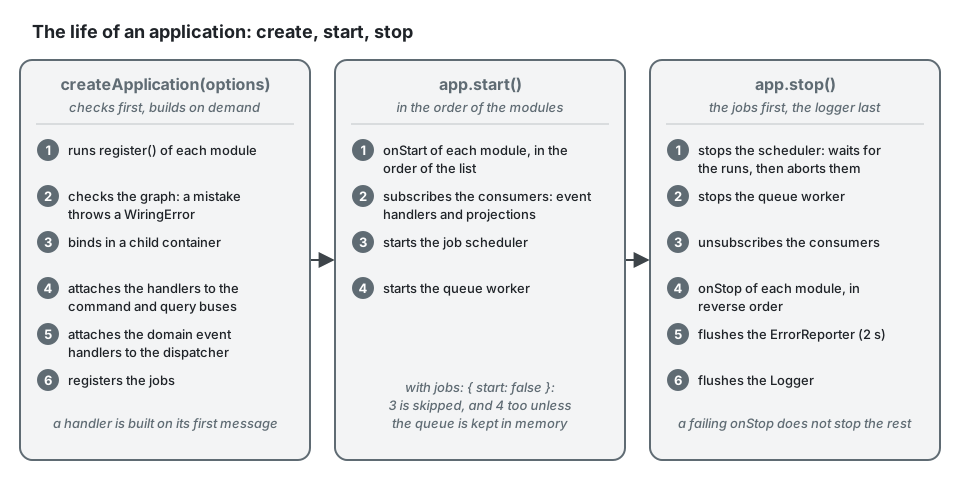
Whatever the style of its modules, an application goes through the same three calls:
createApplication(options)is synchronous: it runsregisterof every module, checks the graph (a mistake throws aWiringError, see "Checks"), binds everything in a child container and attaches the handlers to the buses, the jobs to the scheduler and the background jobs to the queue worker. It builds what it attaches to (a bus when a handler goes on it, the dispatcher when a domain event handler exists, the scheduler and the queue worker when a job exists) and nothing else: a handler or an adapter is built when it is first resolved.app.start()callsonStartof each module in the order of the list, then subscribes the consumers, then starts the scheduler and the queue worker. Withjobs: { start: false }the scheduler stays stopped, and so does the worker of a shared queue; a queue kept in memory (InMemoryJobStore, the default) is still consumed, since no other process sees it. A secondstart()calls noonStartagain and subscribes nothing twice.app.stop()undoes it in reverse: the jobs first, while everything they use is still up, then the consumers, thenonStopof each started module in reverse order, then theErrorReporterand theLogger. A module whoseonStopfails does not keep the others from stopping; the failures are thrown together at the end, as anAggregateError.
A module that owns a resource opens it in onStart and closes it in onStop:
import { createApplication, defineContextModule, kernelModule } from '@ddd-ts-kit/di';
interface Pool {  query(sql: string): Promise<unknown>;  end(): Promise<void>;}
declare function createPool(url: string): Pool;declare const config: { readonly databaseUrl: string };
export abstract class Database {  abstract readonly pool: Pool;}
export const platformModule = defineContextModule({  name: 'platform',  register(builder) {    builder.bind(Database).toValue({ pool: createPool(config.databaseUrl) });  },  // Called by app.start(), in the order of the modules, before any consumer is subscribed.  async onStart({ resolve }) {    await resolve(Database).pool.query('select 1');  },  // Called by app.stop(), in reverse order, once the jobs and the consumers have stopped.  async onStop({ resolve }) {    await resolve(Database).pool.end();  },});
const app = createApplication({ modules: [kernelModule(), platformModule] });
await app.start();process.once('SIGTERM', () => void app.stop());
Integration event handlers
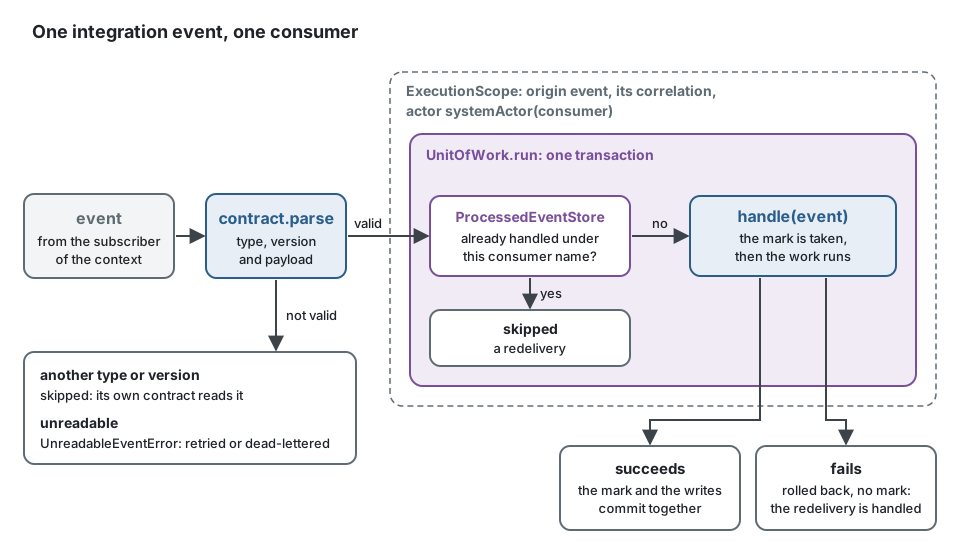
Section titled “Integration event handlers”contract is anything with type, version and parse(event): a declaration made by
defineIntegrationEvent of @ddd-ts-kit/events fits as it is. An event of another version is
skipped, an event the contract cannot read throws UnreadableEventError so that the provider
retries or dead-letters it, and a redelivered event is handled once per consumer name when
ProcessedEventStore is bound. The name is required: it is the idempotency key, and it must
survive the renaming of a class.
The execution context of the event
Section titled “The execution context of the event”Every consumer handles its events inside ExecutionScope, in a context of its own: origin
event, the correlation of the event (its id when it names none), the event as causationId,
and systemActor(consumer) as actor, which is therefore what ActorContext answers to the
repositories of the consuming context. Nothing to wire. A project whose envelopes name an
actor adds on(contract, { consumer, actorOf: (event) => actor }). For the correlation to
start at the request, publish through a scoped publisher:
kernelModule({ eventPublisher: (resolve) => scopedPublisher(new OutboxPublisher(store), resolve(ExecutionScope)),});One unit of work per event
Section titled “One unit of work per event”When UnitOfWork and ProcessedEventStore are both bound, which kernelModule() does, the
idempotency mark and the work of the handler run inside one unitOfWork.run, opened inside
the execution context of the event:
- a handler that fails leaves no mark: the transaction that held it is rolled back, and the redelivery is handled;
- a handler that succeeds commits its mark with its writes: the redelivery is skipped, and there is no window where one is kept without the other;
- a command the handler sends runs its own
unitOfWork.runinside that one, so theUnitOfWorkadapter must join the transaction that is open, as the adapters of the kit do; - the unit of work is resolved at each event, as the command bus resolves it at each command.
This holds for a store whose mark is written in the database of the unit of work. Without a
UnitOfWork bound, the mark is taken first and given back with release when the handler
fails, for a store that has one; a store without release keeps the mark of a failed handler.
The subscriber of each context
Section titled “The subscriber of each context”A handler of a context is subscribed on EventSubscribers.forContext(<module name>). By
default every context gets the single IntegrationEventSubscriber, which is the in-memory
event bus: one process, one bus, nothing to say.
A broker gives each consuming context its own subscriber, so that the context keeps its queues when it is extracted. Say it once, in the kernel module or from a later module:
kernelModule({ eventBus: bus, eventSubscribers: { forContext: (name) => bus.forConsumer(name) } });
builder.rebind(EventSubscribers).toValue({ forContext: (name) => bus.forConsumer(name) });
The name handed to forContext is the name of the module: the first argument of
contextModule and discoverContext, the name of defineContextModule. An application
without the kernel module needs one of the two bound, IntegrationEventSubscriber or
EventSubscribers; EventSubscribers wins when both are.
Projections
Section titled “Projections”A projection is a class of application/projections/, in a *.projection.ts file, declared
with @Projection('<context>.<name>'); the README of @ddd-ts-kit/kernel
("Projections") says what it may do and why its writes are idempotent and ordered. Here it is
wired: contextModule and discoverContext find it like any declared class, and an explicit
module takes it with builder.include(AppointmentListProjection).
The CLI knows the role: application/projections/ is a directory of the canonical tree,
ddd-ts-kit generate projection <context> <Name> <event-type> writes one with its spec, the
generated barrel exports it and registers what its constructor takes, and describe and the
reference of CONTEXT.md list it with the events it applies.
const app = createTestApplication({ modules: [contextModule('reporting', reporting)] });
await app.start();await app.eventBus.publish([orderPlaced('evt-1'), orderPlaced('evt-1'), orderPlaced('evt-2')]);
expect(await app.get(CustomerOrders).get('customer-1')).toMatchObject({ orders: 2 });
A spec feeds a projection through the in-memory bus and reads the model through its port:
there is nothing else to learn. The fake of a read model port is InMemoryReadModelStore of
the kernel, bound by its adapter or given with fake(Port, store).
- One consumer. The name of the projection is the consumer name of every event it applies:
the idempotency scope in
ProcessedEventStore, the system actor it runs as, theprocess <projection>span and, behind a broker, its queue or its group. Two projections of the same name are refused (DUPLICATE_PROJECTION), and so are two methods of one projection applying the same event (DUPLICATE_CONSUMER). - One unit of work per event. With
UnitOfWorkandProcessedEventStorebound to the same database as the read model, the mark and the row commit or roll back together. Without them, the stamp each row carries still makes a redelivery a no-op. - Measured. With
Metricsbound,projection_events_totalcounts each event bycontext,projection,eventandresult(applied,stale,ignored,failed), andprojection_last_event_age_msholds the age of the last event applied when it was. - Described.
describe().projectionslists each projection with the events it applies and the method of each; they do not appear amongintegrationEventHandlersanddomainEventHandlers.
Behind a broker
Section titled “Behind a broker”Discovery, a broker and a database, with no helper of your own. The complete composition root:
import { EventSubscribers, ProcessedEventStore, UnitOfWork } from '@ddd-ts-kit/kernel';import { createApplication, defineContextModule, kernelModule } from '@ddd-ts-kit/di';import { discoverContext } from '@ddd-ts-kit/di/discovery';import { RabbitMqEventBus } from '@ddd-ts-kit/rabbitmq';
const bus = new RabbitMqEventBus({ connection: config.amqpUrl });
const platformModule = defineContextModule({  name: 'platform',  register(builder) {    builder.bind(Database).toValue({ client: knex(config.database) });    builder.rebind(UnitOfWork).toClass(DatabaseUnitOfWork, [Database]);    builder.rebind(ProcessedEventStore).toClass(DatabaseProcessedEvents, [Database]);    builder.rebind(EventSubscribers).toValue({ forContext: (name) => bus.forConsumer(name) });  },  onStop: () => bus.close(),});
const app = createApplication({  modules: [    kernelModule({ eventBus: bus }),    platformModule,    await discoverContext('ordering', new URL('./contexts/ordering/', import.meta.url)),    await discoverContext('billing', new URL('./contexts/billing/', import.meta.url)),  ],  authorization: 'required',});
await app.start();process.on('SIGTERM', () => void app.stop());
That is all: discoverContext('billing', ...) names the module billing, so its integration
event handlers are subscribed on bus.forConsumer('billing'), each event handled in the
execution context of the event, its mark and its work in one database transaction. With a
barrel instead of discovery the two lines become contextModule('ordering', ordering) and
contextModule('billing', billing), and nothing else changes. DatabaseUnitOfWork and
DatabaseProcessedEvents stand for the adapters of your persistence package; any bus with a
forConsumer(name) fits where RabbitMqEventBus is.
The kernel module
Section titled “The kernel module”kernelModule(options?) binds the ports every context depends on.
| Port | Default | Option |
|---|---|---|
Clock |
SystemClock |
clock |
IdGenerator |
UuidGenerator |
ids |
UnitOfWork |
InMemoryUnitOfWork |
unitOfWork |
CommandBus |
InMemoryCommandBus running each command in the unit of work: the domain events its saves announce are dispatched once the handler has returned, before the commit, then the after-commit handlers run |
commandBus |
QueryBus |
InMemoryQueryBus |
queryBus |
EventBus |
InMemoryEventBus |
eventBus |
IntegrationEventPublisher |
the event bus | eventPublisher |
IntegrationEventSubscriber |
the event bus | eventSubscriber |
EventSubscribers |
the single IntegrationEventSubscriber, for every context |
eventSubscribers |
ProcessedEventStore |
InMemoryProcessedEventStore |
processedEvents |
ExecutionScope |
AsyncLocalStorageExecutionScope |
executionScope |
ActorContext |
ScopedActorContext: the actor of the execution scope |
actorContext |
DomainEventDispatcher |
InMemoryDomainEventDispatcher, which hears what the save of every repository announced; a failure of an after-commit handler goes to the Logger and the ErrorReporter (reportAfterCommitFailures) |
domainEvents |
Logger |
NoopLogger. app.stop() flushes it last, after the error reporter, and stops all the same when the flush fails |
logger |
Metrics |
NoopMetrics |
metrics |
ErrorReporter |
NoopErrorReporter. The default buses and the default scheduler hand it their unexpected failures (never a DomainError), and app.stop() gives it two seconds to flush |
errorReporter |
Cache |
InMemoryCache on Clock |
cache |
CacheInvalidation |
PublishedCacheInvalidation: purge requests published on IntegrationEventPublisher (the outbox, when there is one); a multi-tenant application passes its own with perTenant: true |
cacheInvalidation |
Lock |
InMemoryLock on Clock: this process only |
lock |
RateLimiter |
InMemoryRateLimiter on Clock: this process only |
rateLimiter |
JobScheduler |
InProcessJobScheduler of @ddd-ts-kit/scheduling on Clock, Lock, ExecutionScope, IdGenerator, Logger, Metrics and ErrorReporter |
jobScheduler |
TenantDirectory |
none: a job declared tenancy: 'per-tenant' is refused when it is registered. Given, the default scheduler runs such a job once per tenant it lists, in that tenant's scope; the test application takes tenants (by default the tenant of its execution context) |
tenants |
The ports are the abstract classes of @ddd-ts-kit/kernel: a handler types a constructor
parameter by Clock without importing this package.
An option is an instance or a (resolve) => instance factory. An adapter with dependencies of
its own reads better in the module that owns them:
export const persistenceModule = defineContextModule({ name: 'persistence', register(builder) { builder.bind(Database).toFactory(() => ({ client: connect(config.databaseUrl) })); builder.rebind(UnitOfWork).toClass(DrizzleUnitOfWork, [Database]); builder.rebind(IntegrationEventPublisher).toClass(OutboxPublisher, [OutboxStore]).as('publisher'); },});Use cases publish through IntegrationEventPublisher and never through EventBus, so moving
to an outbox touches no context. A bus given for CommandBus or QueryBus needs a
register(type, handler) method for the declared handlers to be attached to it.
Scheduled jobs
Section titled “Scheduled jobs”A class of application/scheduling/ that carries @Scheduled is a job of its context: nothing
else registers it.
import { CommandBus, systemActor } from '@ddd-ts-kit/kernel';import { Scheduled, type JobExecution, type ScheduledJob } from '@ddd-ts-kit/kernel/declarations';
@Scheduled('billing.send-reminders', { cron: '0 7 * * 1-5', timeZone: 'Europe/Paris' })export class SendRemindersJob implements ScheduledJob {  constructor(private readonly commands: CommandBus) {}
async run(execution: JobExecution): Promise<void> { await this.commands.execute(new SendReminders(systemActor('billing.send-reminders'), execution.scheduledAt)); }}- Registered when the application is created, on
JobScheduler, with the defaults of its options filled in. The class is built on its first run, so a job that cannot be built fails that run and nothing else. - Started by
start(), after the modules and once the consumers are subscribed: a job sends commands whose events must find their handlers. Stopped first bystop(), which waits for the runs in progress, then aborts them, while everything they use is still up. - Each run happens in
ExecutionScope, in a context of originschedule, assystemActor('<job name>'), with a correlation of its own. The scheduler does it, not the job. - The default scheduler is the in-process one of
@ddd-ts-kit/scheduling, on the boundClockandLock. With the default lock, which excludes inside one process only, several instances each run every job: bind a lock between processes (RedisLock) before scaling out. What one instance among several guarantees, and what it does not, is in that README. - An application without job never resolves the scheduler.
createApplication({ jobs }) says whether this process runs the jobs and what configuration
changes of each:
createApplication({ modules, jobs: { start: config.runJobs, // default true settings: { 'billing.send-reminders': { enabled: config.reminders.enabled }, 'billing.export-ledger': { schedule: { every: '6h' }, timeoutMs: 300_000 }, }, },});| Option | |
|---|---|
start: false |
the jobs are registered and described, runNow runs one, and start() never starts the scheduler, nor the worker of a shared queue (a queue in the memory of the process is still consumed): the process that serves requests next to a worker process that runs the jobs |
settings['<job name>'] |
enabled, schedule and any option of the declaration (overlap, missed, timeoutMs, jitterMs, singleInstance), which win over what the class wrote. A key left undefined changes nothing |
app.resolve(JobScheduler) is the port: runNow(name) for an operations endpoint,
describe() for the next run and the last outcome of each job. A context extracted as its own
service takes its jobs with it: they belong to its module, and nothing is global.
Background jobs
Section titled “Background jobs”A class of application/background/ that carries @Background is a background job of its
context, named by its static jobName:
@Background({ maxAttempts: 3, timeout: '10m' })export class CompileStatementsBackgroundJob implements BackgroundJob<CompileStatementsPayload> {  static readonly jobName = 'billing.compile-statements';
  constructor(private readonly commands: CommandBus) {}
  async run(payload: CompileStatementsPayload, execution: BackgroundJobExecution): Promise<void> {    await this.commands.execute(new CompileStatements(execution.jobId, payload.month));  }}
An explicit module writes builder.backgroundJob('billing.compile-statements', { maxAttempts: 3 }) .handledBy(CompileStatementsBackgroundJob, [CommandBus]); a name other than the jobName of the class is
refused (INVALID_JOB_SETTINGS), a name declared twice too (DUPLICATE_JOB).
- Registered when the application is created on the
QueueWorkerof@ddd-ts-kit/scheduling, which then consumes the queue of the context. The class is built on its first attempt. - Consumed while the process runs the jobs:
start()starts the worker after the scheduler whenjobs.startis notfalse,stop()stops it with the scheduler, waiting for the attempts in progress, then aborting them. A process started withjobs: { start: false }enqueues and leaves the shared queue to the worker; a queue kept in its own memory (InMemoryJobStore, the default) is still consumed, since no other process sees it. kernelModule()bindsJobStore(in memory by default: bindKnexJobStore,DrizzleJobStoreorRedisJobStorewithjobStore, or no job reaches a worker of another process),JobQueue(aStoredJobQueueon it, which stores thetraceparentgiven by the instrumentation) andQueueWorker(tuned byqueues: { concurrency, pollIntervalMs, graceMs }, failures to theErrorReporter).describe().backgroundJobslists each job, its queue and its options, defaults filled in.
kernelModule() also binds ProcessStore (in memory by default: bind KnexProcessStore or
DrizzleProcessStore with processStore) and ProcessRunner, the runner of
@ddd-ts-kit/scheduling on it, the JobQueue, the CommandBus and the UnitOfWork: the
handlers that drive a process manager depend on ProcessRunner, and its timeout job is a
background job of the context. In a test application, app.processes.list() shows the instances.
In a test application, app.jobQueue is the queue the use cases enqueue on, in memory, and
app.backgroundJobs.runDue() runs what is due on app.clock and throws what an attempt threw;
app.backgroundJobs.store.list() shows what was enqueued. What the jobs guarantee:
Background jobs.
A declared context is tested like an explicit one: the module is the unit, the fakes replace its adapters.
const app = createTestApplication({ modules: [contextModule('billing', billing)], fakes: [fake(PaymentGateway, new InMemoryPayments())],});fake(Port, value) is checked: the value implements the port. An in-memory class, an object
literal and a class written in the spec all fit, since a port is a shape.
createTestApplication({ modules, fakes, now?, idPrefix?, actor?, session?, executionContext?, authorization?, jobs? }) puts the modules on a deterministic
kernel, whether or not they list kernelModule(), and returns the application plus what a
spec touches:
| Member | Is |
|---|---|
commandBus, queryBus |
the in-memory buses, with every declared handler |
eventBus |
InMemoryEventBus; eventBus.published lists what the use cases announced. Every context listens on it, whatever EventSubscribers the modules bind |
domainEvents |
InMemoryDomainEventDispatcher: the save of every repository, adapter or fake, announces to it, with the timing of the application (at the end of the command, then after it for after-commit handlers); a spec may dispatch a domain event itself to see the declared handlers react, and domainEvents.afterCommitFailures holds what after-commit handlers threw |
clock |
FixedClock at now (default 2026-01-01T00:00:00.000Z); clock.advance(ms) |
ids |
SequentialIdGenerator: id-1, id-2... |
actorContext |
FixedActorContext; actAs(actor) changes who infrastructure sees |
executionScope |
FixedExecutionScope (correlation test-correlation, origin test), following actorContext |
logger, metrics |
InMemoryLogger and InMemoryMetrics: assert logger.entries, metrics.samples |
errors |
InMemoryErrorReporter: errors.reports lists the unexpected failures of the commands, queries and jobs, as data |
cache |
InMemoryCache on clock |
cacheInvalidation |
InMemoryCacheInvalidation: cacheInvalidation.invalidated lists the tags the use cases asked to purge |
lock, rateLimiter |
InMemoryLock and InMemoryRateLimiter on clock |
jobs |
runNow(name) runs a declared job as the scheduler would and throws what it threw; scheduler is a ManualJobScheduler on clock, not started |
jobQueue, backgroundJobs |
the queue the use cases enqueue on, in memory, and what runs it: backgroundJobs.runDue() (see "Background jobs") |
processes |
InMemoryProcessStore: processes.list() shows the instances of the process managers |
get(Port) |
resolve, typed by the port |
as(actorOrSession, work) |
runs a block as someone else, then comes back |
actor, session and executionContext say who infrastructure sees by default: an actor, a
whole session (its actor becomes the current actor), or the complete execution context for a
spec about a tenant, a correlation or a deadline. app.as switches for one block and hands the
actor to it, which is what a spec about authorization wants to read:
const app = createTestApplication({ modules: [billingModule, authorization], actor: accountant });
await app.as(accountant, (actor) => app.commandBus.execute(new IssueInvoice(actor, 'customer-1')));await expect(  app.as(clerk, (actor) => app.commandBus.execute(new VoidInvoice(actor, 'inv-1'))),).rejects.toMatchObject({ code: 'FORBIDDEN' });
app.as(aSession().of(accountant).impersonatedBy('support-7').build(), () => {  // infrastructure sees the session: audit records the impersonation});
Use cases still receive the actor in the command or query; as only decides what the
repositories, the audit columns and the tenant scoping see while the block runs.
Jobs are never started by time in a test application: start() subscribes the consumers
and leaves the scheduler alone, whatever the clock does. A spec runs a job by name and asserts
the fakes, as it would for a command:
await app.jobs.runNow('billing.send-reminders');
expect(mailer.sent).toHaveLength(2);
For a spec about the schedule itself, await app.jobs.scheduler.start() then
await app.jobs.scheduler.advance(ms) move app.clock and run what becomes due, and
app.jobs.scheduler.runs lists what happened. The jobs option takes per-job settings, as
createApplication({ jobs: { settings } }) does. Runs take their correlation ids from a
generator of their own (job-run-1...), so a job leaves the identifiers a spec predicts alone.
A fake must stand for a port that a module binds or that a class depends on, otherwise
UNKNOWN_FAKE is raised: a fake for the wrong port would silently leave the real adapter in
place. Consumers receive events once await app.start() ran.
createApplication({ overrides: [override(Port, value)] }) is the same pair without that
check, and overrideForTests(app, Port, value) swaps a binding on an existing application;
call it before the first resolve, since a singleton already built keeps what it was given. An
override replaces the binding, may stand in for a module that is not loaded, and is not
decorated. Every application owns a tsyringe child container (app.container), so two tests
never share instances.
Checks
Section titled “Checks”createApplication throws a WiringError (with a code) before anything is instantiated:
DUPLICATE_BINDING: a port bound twice, or a class given to two statements or listed in two modules, both modules named;NOTHING_TO_REBIND: arebindof a port that no earlier module binds;INVALID_PORT: a class bound to a port that carries a body, or that it extends;UNBOUND_DEPENDENCY: a class dependency that no module binds, or handlers, consumers and jobs declared without the bus, the subscriber or the scheduler they go on;DEPENDENCY_CYCLE: a cycle between class bindings, the path printed;INCOMPLETE_BINDING: abind,command,query,onorjobleft without its target;DUPLICATE_HANDLER: a command or a query with two handlers, both modules named;DUPLICATE_CONSUMER: two consumers of the same event sharing a name;DUPLICATE_PROJECTION: two projections sharing a name;BUS_WITHOUT_REGISTER: handlers declared for a bus that cannot receive them;UNKNOWN_FAKE: see above;UNDECLARED_CLASS: a class listed incontextModuleorincludewithout a declaration;MISSING_DEPENDENCIES: a declared class whose constructor takes parameters and that no list covers: its decorator names none and no generated file that was loaded registered one;DEPENDENCY_ARITY: a list of another length than the constructor it is for;DUPLICATE_JOB: two jobs sharing a name, both modules named: the name is the lock, the actor and the label of a job;UNKNOWN_JOB: settings given for a job that no module declares;INVALID_JOB_SETTINGS: a schedule or an option of the settings that cannot be read (a cron, a time zone, a zero interval), or a job of an explicit module whose name or schedule cannot.
DUPLICATE_HANDLER, DUPLICATE_CONSUMER and DUPLICATE_JOB are reported before the
DUPLICATE_BINDING of the class they share, so the message says what the mistake is.
The checks do not tell the two styles apart. For a declared class the message names the class and, when discovery loaded it, the file:
Token "InvoiceRepository" is bound twice: by module "billing" (declared by classKnexInvoiceRepository in /app/dist/contexts/billing/infrastructure/persistence/knex-invoice.repository.js)and by module "invoicing" (declared by class InMemoryInvoiceRepository).Factories do not declare what they resolve, so a cycle or a missing port going through a
factory is reported when it is resolved (DEPENDENCY_CYCLE, UNBOUND_TOKEN).
Diagnostics
Section titled “Diagnostics”app.describe() returns the wiring as plain, serializable data: ports and classes by name.
{ modules: ['kernel', 'ordering'], bindings: [{ token: 'PlaceOrderHandler', module: 'ordering', kind: 'use-case', lifetime: 'singleton', source: 'class', implementation: 'PlaceOrderHandler', dependencies: ['OrderRepository', 'Clock'], overridden: false }], commands: [{ message: 'PlaceOrder', handler: 'PlaceOrderHandler', module: 'ordering' }], queries: [{ message: 'GetOrder', handler: 'GetOrderHandler', module: 'ordering' }], integrationEventHandlers: [{ event: 'billing.payment.captured', version: 1, consumer: 'ordering.mark-order-paid', handler: 'MarkOrderPaidOnPaymentCaptured', module: 'ordering' }], domainEventHandlers: [], policies: [], jobs: [{ name: 'ordering.expire-carts', schedule: 'every 15m', overlap: 'skip', missed: 'skip', jitterMs: 0, enabled: true, singleInstance: true, job: 'ExpireCartsJob', module: 'ordering' }], projections: [{ name: 'ordering.order-list', projection: 'OrderListProjection', module: 'ordering', applies: [{ kind: 'integration', event: 'billing.payment.captured', version: 1, method: 'paid' }] }], overrides: [],}An entry that comes from a declaration also carries origin: 'declared', declaredBy (the
class) and, when discovery loaded it, file. An entry written in a module is explicit and
carries none of the three:
{ token: 'InvoiceRepository', module: 'billing', kind: 'repository', lifetime: 'singleton', source: 'class', implementation: 'KnexInvoiceRepository', dependencies: ['Database'], overridden: false, origin: 'declared', declaredBy: 'KnexInvoiceRepository', file: '/app/dist/contexts/billing/infrastructure/persistence/knex-invoice.repository.js' }domainEventHandlers lists the declared handlers of domain events, publishers included, each
with its phase (before-commit or after-commit),
policies the declared policy classes, jobs the jobs with the settings they run with, those
of the application applied. What a job did last and when it runs next is not wiring: ask
app.resolve(JobScheduler).describe().
Domain events and the unit of work
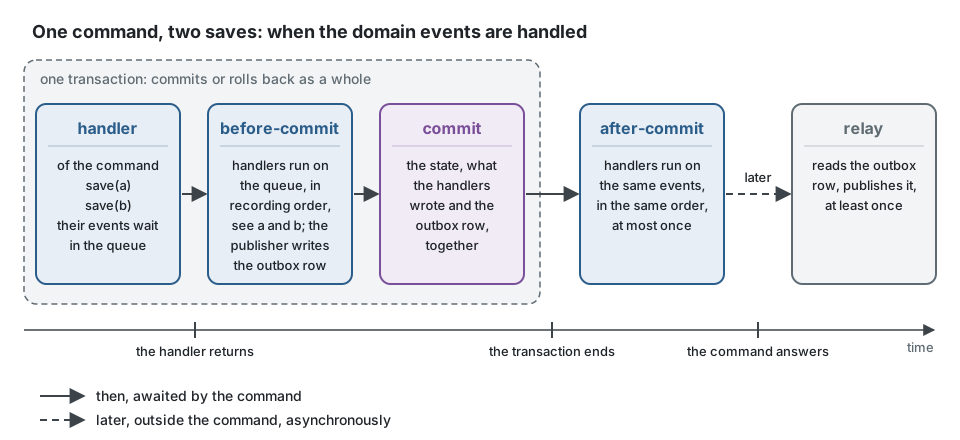
Section titled “Domain events and the unit of work”An effect of a domain event exists only if the state change that recorded it is committed.
Instead of dispatching the events in the handler (behind kernelModule() the save has already
taken them, so this line dispatches nothing; without it, the reactions would run outside the
timing of the unit of work):
await this.invoices.save(invoice);await this.dispatcher.dispatch(invoice.pullEvents());return invoice.id;save the aggregate, and stop there:
import { AggregateRoot, Clock, Command, Repository, type CommandHandler, type DomainEvent } from '@ddd-ts-kit/kernel';
export class InvoiceIssued implements DomainEvent {  static readonly eventName = 'billing.invoice.issued';
  readonly name = InvoiceIssued.eventName;
  constructor(    readonly aggregateId: string,    readonly occurredAt: Date,  ) {}}
export class Invoice extends AggregateRoot {  private constructor(id: string) {    super(id);  }
  static issue(id: string, issuedAt: Date): Invoice {    const invoice = new Invoice(id);
    invoice.record(new InvoiceIssued(id, issuedAt));
    return invoice;  }}
export abstract class InvoiceRepository extends Repository<Invoice> {}
export class IssueInvoice extends Command<string> {  constructor(readonly invoiceId: string) {    super();  }}
export class IssueInvoiceHandler implements CommandHandler<IssueInvoice> {  constructor(    private readonly invoices: InvoiceRepository,    private readonly clock: Clock,  ) {}
  async execute(command: IssueInvoice): Promise<string> {    const invoice = Invoice.issue(command.invoiceId, this.clock.now());
    // The save hands InvoiceIssued to the unit of work of the command, which dispatches it    // once this method has returned, before the commit.    await this.invoices.save(invoice);
    return invoice.id;  }}
A handler writes await this.orders.save(order); return order.id; and nothing else: no
pullEvents(), no DomainEventDispatcher in a use case. kernelModule() puts
dispatchingOnSave of the kernel around every binding of kind repository, in every module:
declared with @Repository, bound .as('repository'), or bound under a port that extends the
kernel Repository (which is a repository whether the module says so or not). A repository
adapter contains no dispatch code. The save only hands the events over; the unit of work of the
command dispatches them at its end.
| Question | Answer |
|---|---|
| Which methods | Every method of the repository that is handed an aggregate, or an array of them, and resolves: save(order), saveAll([a, b]), remove(order). A method that is handed no aggregate (findById, remove(id)) announces nothing: a removal that announces an event takes the aggregate |
| Which events, in which order | Those the aggregates of the call recorded, pulled once the call resolved: in the order of the arguments, then of recording, and across the saves of the command in the order of the saves |
| When | Once the command handler has returned, inside the transaction, before the commit: the default command bus runs the handler in UnitOfWork.run, and a save only queues. Every handler sees every save of the command. What the domain event handlers write, the outbox included, commits or rolls back with the state |
| After the commit | Handlers declared phase: 'after-commit' run once the transaction has committed, never when it rolled back, in the order the events were dispatched, awaited before the command answers. At most once: a crash between the commit and the run loses them |
A before-commit handler fails |
The command fails with what it threw and the unit of work rolls back. The events still waiting are dropped, no after-commit handler runs, and the aggregate instances have given their events: do not save them again, a retry reloads them |
An after-commit handler fails |
The command still succeeds. The failure is logged (Logger.error, "A domain event handler failed after the commit", with domainEvent, errorType, errorCode) and handed to the ErrorReporter under the operation after-commit <event name>; the other handlers still run |
| The save fails | Nothing is pulled: the events stay on the aggregate. The command fails, and the events queued by earlier saves are dropped |
| The command handler throws after a save, or the commit fails | The queued events are dropped: no handler of either phase for a handler that threw, no after-commit handler for a commit that failed; nothing stored, no outbox row |
| A handler saves another aggregate | Before the commit: its events wait behind the ones already queued and are dispatched in recording order, without recursion. After the commit: refused before the write with SaveAfterCommitError; send a command through the CommandBus instead |
| A handler sends a command | Before the commit, that command joins the unit of work in progress: one dispatch, at the end of the outermost, one commit. After the commit, it is a unit of work of its own |
| The same aggregate saved twice | The second save announces what was recorded since the first, which may be nothing |
| A save outside of any unit of work | Dispatches before it resolves, before-commit handlers then after-commit ones. Nothing is atomic then: the state is written, the handlers run, and a handler that fails rejects the save without undoing it |
| An adapter that pulls the events itself | Leaves nothing to dispatch: no double dispatch, and no dispatch at all unless the adapter does it. An adapter never calls pullEvents() |
| Order of the wrappers | Outermost first: the decorate hook, the instrumentation (the span of the save), the hand-over of the events, the aspects other modules put around the kind (builder.around), the aspects of the binding (.with(retry(...))). A retried save announces once |
A before-commit handler may only have effects the transaction covers, because the commit can
still fail after it ran: domain-events/transactional-before-commit holds it. An effect outside
the database is an after-commit handler when it may be lost, an integration event through the
outbox when it must not:
@DomainEventHandler(InvoiceIssued, { phase: 'after-commit' })export class InvoiceIssuedEventHandler implements DomainEventHandler<InvoiceIssued> {  constructor(private readonly cache: Cache) {}
  async handle(event: InvoiceIssued): Promise<void> {    await this.cache.delete(cacheKey<InvoiceSummary>('invoice-summary', event.aggregateId));  }}
A UnitOfWork given through kernelModule({ unitOfWork }) gets this timing for commands
whatever it is made of: the default command bus puts withinUnitOfWork of the kernel around
it. Built on withinUnitOfWork itself, as the ORM packages are, it gives the same timing to a
run called directly, the one of a consumer included.
In a test application, the adapter of a module and the fake given for a repository port both
announce to app.domainEvents, whether kernelModule() is listed or not. Without a container,
dispatchingOnSave(repository, () => dispatcher) of the kernel is the same wrapper, and
createTestBuses().dispatching(fake) of @ddd-ts-kit/testing applies it to a fake.
A module puts an aspect of its own around every binding of some kinds with
builder.around(kinds, (resolve) => aspect): outside the aspects of each binding, inside the
decorate hook, the first declared outermost.
Observing the application
Section titled “Observing the application”kernelModule({ instrumentation }) takes what observes the application from outside: an object
whose members are wrappers, each optional, applied where the thing is built.
| Member | Wraps |
|---|---|
binding |
every instance of a binding declared with a kind, outside the dispatch of domain events |
useCase |
a bus middleware, on both default buses, after the use case guard and outside the unit of work; it reads info.context, the module of the handler |
publisher |
the IntegrationEventPublisher |
consumer |
what each declared consumer is subscribed with, told its consumer name, its module and its event type |
domainEvents |
the DomainEventDispatcher |
job |
each run of a declared job, inside its execution scope, told the job name and its module |
errorReporter |
the ErrorReporter |
executionScope |
told the ExecutionScope once it is built |
traceApplication() of @ddd-ts-kit/tracing is such an object, and makes one readable trace
per action; this package depends on no tracing library. A port given through an option of
kernelModule is wrapped too; one rebound by a later module is not.
The decorate hook
Section titled “The decorate hook”createApplication({ decorate }) receives every instance a binding creates, handlers and
consumers included, with { token, context, kind? } where token is the port class, and
returns the instance to hand out. It is the place for cross-cutting wrappers of a project.
Tracing comes through kernelModule({ instrumentation }) instead, see "Observing the
application".
One binding takes its own wrappers with .with(...), the first outermost:
builder.bind(PaymentGateway).toClass(HttpPaymentGateway, [PaymentSettings]).as('external').with(retry({ attempts: 3 }), timeout(2000));A BindingAspect is (instance, { kind?, className, context, token }) => instance, where
token is the name of the port; the aspects of @ddd-ts-kit/aspects fit as they are, and its
aspects(...) builds a decorate hook. The decorate hook comes around the aspects of a
binding.
The tsyringe container
Section titled “The tsyringe container”app.container is the tsyringe child container of the application, for interoperability. A
port is registered there under tokenIdentity(port), a symbol, never under the class: tsyringe
would try to build a class it is asked for, and an abstract class is not one of its tokens.
import { tokenIdentity } from '@ddd-ts-kit/di';
app.container.isRegistered(tokenIdentity(Clock));          // trueapp.container.resolve<Clock>(tokenIdentity(Clock));        // what app.resolve(Clock) answersapp.container.isRegistered(PlaceOrderHandler);             // false: bound under its identity too
app.resolve(Port) is the typed way in, and the one that reports a cycle or an unbound port
with the names of who asked.
Access control
Section titled “Access control”A use case says what it requires, or says it is public: on the message itself with
@Requires(permission) or @Public(), or where it is registered:
builder.command(IssueInvoice).requires(permissions['invoice.issue']).handledBy(IssueInvoiceHandler, [InvoiceRepository, Clock]);builder.query(GetCatalog).public().handledBy(GetCatalogHandler, [Catalog]);.requires exists only for messages that carry an actor (AuthorizedCommand,
AuthorizedQuery of the kernel). With createApplication({ modules, authorization: 'required' })
an application whose command or query declares neither, in either way, does not start
(UNDECLARED_AUTHORIZATION), and one that declares them without a module enforcing them does
not either (AUTHORIZATION_NOT_ENFORCED).
Three classes of this package carry it:
| Class | Is |
|---|---|
UseCaseGuard |
the port both buses ask before anything else, the unit of work included: check(message, next, info). Unbound, every message passes; an authorization module binds it |
UseCaseDeclarations |
a value, { list }: what every command and query declared, for whoever enforces it |
DeclaredPolicies |
a value, { list }: the @Policy classes of the contexts, each resolved by its class |
The enforcement itself and the authorizers live in @ddd-ts-kit/auth (authorizationModule
from @ddd-ts-kit/auth/di). ActorContext is bound by kernelModule(); the test application
takes an actor option, and lets every message through unless a listed module binds
UseCaseGuard.
Limits
Section titled “Limits”-
A class plays one role: one declaration per class, and an adapter that implements two ports is bound explicitly, once per port.
-
A class is one binding: a handler class serves one statement, a declared class one module.
-
A class decorator of another library that replaces the class (answers a new one) must be written below the declaration, so that the declaration lands on the class that is exported. A decorator that only annotates, as
@Injectable()does, composes in either order. -
A declaration is not inherited: a subclass declares itself or is bound explicitly.
-
What a constructor takes reaches the container through a generated file, never through compiler metadata: a declared class edited where nothing regenerates that file (
docs,generate, thedevscript) is refused at composition time until it is. -
A class that inherits its constructor has a
lengthof zero, so a missing list for it cannot be seen at run time:declarations/constructor-injectionofddd-ts-kit checkreads the base class of the project, and refuses one it cannot read. -
A consumer name, a policy name, a job name and the name of a domain event are written in the declaration; they are not derived from the class, which a refactoring renames.
-
A port of your own is identified by its class: see "Identity" for a port loaded twice.
-
Discovered files are imported by nothing. In a project using discovery, tell knip that they are entries and dependency-cruiser that they are not orphans:
knip.json { "entry": ["src/main.ts", "src/contexts/*/{application,infrastructure}/**/*.{command,query,handler,integration-handler,publisher,event-handler,policy,job,projection,repository,gateway,adapter}.ts", "src/contexts/*/*.dependencies.ts"] }// .dependency-cruiser.cjs, in the pathNot of the no-orphans rule'\\.(command|query|handler|integration-handler|publisher|event-handler|policy|job|projection|repository|gateway|adapter|dependencies)\\.ts$'With a barrel and
contextModuleneither setting is needed.