
@ddd-ts-kit/redis
Adapters of kernel ports on the Redis protocol: the Cache, Lock and RateLimiter ports,
the wake-up signal of the outbox relay, a store of background jobs, and an integration event
provider on Redis Streams.
They use a common subset of the protocol, so the same code runs on Redis, Dragonfly and
Valkey: the choice of server is an operational one, made in the composition root by a
connection URL.
npm i @ddd-ts-kit/redis ioredis| Entry | Holds | Imports |
|---|---|---|
@ddd-ts-kit/redis |
connectRedis, closeRedis, FAIL_FAST, redisHealth, RedisCache, jsonCodec, RedisLock, RedisRateLimiter, RedisRelaySignal, relayWakeUpMiddleware, RedisJobStore, reportLostJobs; re-exported from the kernel: the Lock and RateLimiter ports, InMemoryLock, InMemoryRateLimiter |
the kernel, @ddd-ts-kit/scheduling, ioredis (peer) |
@ddd-ts-kit/redis/event-bus |
RedisStreamsEventBus, its options, topology and error types, streamNamesOf, DEFAULT_PREFIX, the codes ATTEMPTS_EXHAUSTED and POISON_ENTRY, the names of the entry fields |
the kernel, ioredis (peer) |
@ddd-ts-kit/redis/testing |
cacheContract, lockContract, rateLimiterContract, re-exported from @ddd-ts-kit/testing/contracts |
@ddd-ts-kit/testing (optional peer), the runner you pass |
Where it sits in an application
Section titled “Where it sits in an application”Nothing here is imported from domain/ or application/. A use case depends on the port
(Cache, Lock, RateLimiter of the kernel); the adapter is chosen in platform/ and bound
in the composition root.
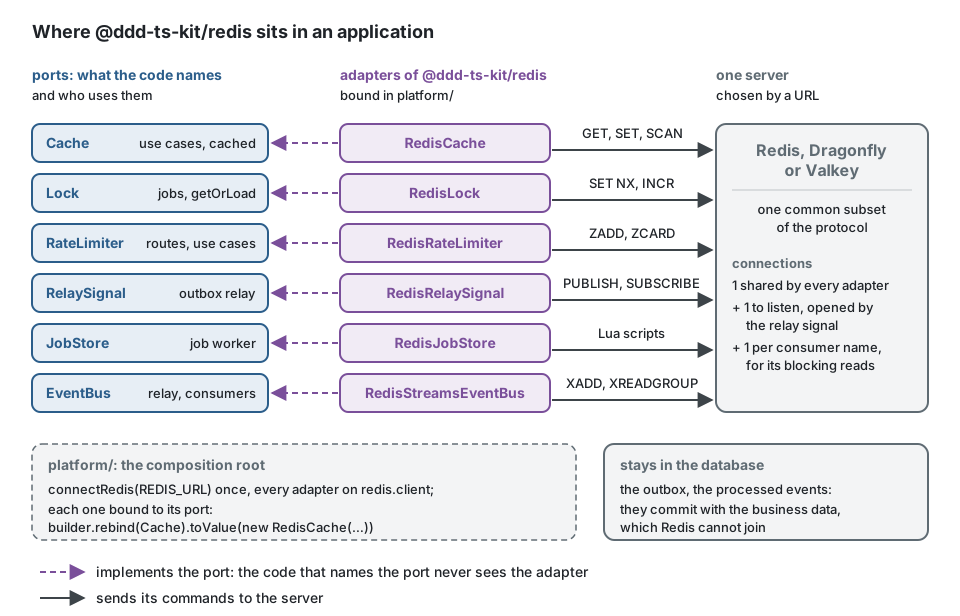
The same use case then runs against Redis in production and against the in-memory adapters of
the kernel in its tests. Instead of naming the adapter, which ties the use case to one server
and which layer/application-inward
reports in application/, name the port:
import { Cache, FixedClock, InMemoryCache, cacheKey, type CacheKey } from '@ddd-ts-kit/kernel';
interface Quote {  readonly pair: string;  readonly rate: number;}
interface ExchangeRates {  quoteOf(pair: string): Promise<Quote>;}
const quoteKey = (pair: string): CacheKey<Quote> => cacheKey<Quote>('quote', pair);
// Instead of `constructor(private readonly cache: RedisCache)`: the port of the kernel.export class QuoteReader {  constructor(    private readonly cache: Cache,    private readonly rates: ExchangeRates,  ) {}
  async quoteOf(pair: string): Promise<Quote> {    const cached = await this.cache.get(quoteKey(pair));
    if (cached !== undefined) {      return cached;    }
    const quote = await this.rates.quoteOf(pair);    await this.cache.set(quoteKey(pair), quote, { ttlMs: 30_000 });
    return quote;  }}
// In a test, the in-memory cache of the kernel; in production, RedisCache, bound in platform/.const clock = new FixedClock(new Date('2026-10-13T09:00:00Z'));export const reader = new QuoteReader(new InMemoryCache(clock), { quoteOf: async (pair) => ({ pair, rate: 1.08 }) });
With the CLI, init --cache redis writes platform/redis/open-redis.ts (one connection, the
cache, the lock, the rate limiter, the relay signal when events go through an outbox, the
readiness probe), init --broker redis writes platform/events/create-event-provider.ts
around RedisStreamsEventBus, and init --queue redis (which needs --cache redis) adds the
job store to the same connection. What follows is each piece, wired by hand.
Connection
Section titled “Connection”import { connectRedis, redisHealth } from '@ddd-ts-kit/redis';
declare const config: { readonly redisUrl: string };
export const redis = connectRedis(config.redisUrl); // or ioredis options, or a client you already have
export const ready = () => redisHealth(redis.client); // { status: 'up', latencyMs } | { status: 'down', reason }export const shutdown = () => redis.close();connectRedis(url | options | client)answers{ client, close() }. A connection it opened is closed byclose(); a client it was handed is used as it is and left open, since its owner closes it.- A connection opened here adds two settings to the defaults of ioredis (
FAIL_FAST), which your options override:commandTimeout: 2000andmaxRetriesPerRequest: 1. With the plain defaults, a command sent while the server is away waits for twenty reconnections before failing, and every request of the application waits with it. redisHealth(client, { timeoutMs? })sends onePING, never throws, and answers within the timeout (1 s by default): use it in a readiness probe. A cache being down is rarely a reason to stop receiving traffic; a lock or a rate limiter being down may be.- Every adapter takes the ioredis client, so several share one connection. The relay signal opens a second one, to listen, and the event bus one per consumer name, to block on its reads.
Local development, with Dragonfly:
services: dragonfly: image: docker.dragonflydb.io/dragonflydb/dragonfly:v2.0.2 ulimits: memlock: -1 command: ['--maxmemory=512mb', '--proactor_threads=2'] ports: - '127.0.0.1:6379:6379' volumes: - dragonfly:/datavolumes: dragonfly:REDIS_URL=redis://127.0.0.1:6379 then suits the three servers alike.
Credentials. A client of ioredis keeps its options, password included, and shows them to
whoever inspects it: that cannot be changed from here, so never log a client. The adapters of
this package (RedisCache, RedisLock, RedisRateLimiter, RedisRelaySignal,
RedisJobStore, RedisStreamsEventBus) hold their client in a field that is not enumerable,
and answer their name to JSON.stringify and util.inspect: logging, spreading or serialising
an adapter does not lead to the client. The object connectRedis answers gives its client by
name (redis.client, const { client } = redis) and leaves it out of a spread or a log.
import type { Logger } from '@ddd-ts-kit/kernel';import { redisHealth, type RedisConnection } from '@ddd-ts-kit/redis';
declare const redis: RedisConnection;declare const logger: Logger;
export async function logStartup(): Promise<void> { // Instead of: logger.info('redis connected', { client: redis.client }), the password with it. // Write what an operator needs, which holds no secret: const health = await redisHealth(redis.client); logger.info('redis connected', { status: health.status });}RedisCache implements the kernel Cache port with its typed CacheKey.
import { Cache, Lock, Metrics, RateLimiter } from '@ddd-ts-kit/kernel';import { contextModule, createApplication, defineContextModule, kernelModule, type DeclaredSource } from '@ddd-ts-kit/di';import { RedisCache, RedisLock, RedisRateLimiter, type RedisConnection } from '@ddd-ts-kit/redis';
declare const redis: RedisConnection; // connectRedis(config.redisUrl), abovedeclare const catalogDeclarations: DeclaredSource;
const platformModule = defineContextModule({  name: 'platform',  register(builder) {    builder.rebind(Cache).toFactory((resolve) => new RedisCache(redis.client, { namespace: 'app', metrics: resolve(Metrics) }));    builder.rebind(Lock).toValue(new RedisLock(redis.client, { namespace: 'app:lock' }));    builder.rebind(RateLimiter).toValue(new RedisRateLimiter(redis.client, { namespace: 'app:rate' }));  },});
export const app = createApplication({ modules: [kernelModule(), platformModule, contextModule('catalog', catalogDeclarations)] });
A port of the kernel is an abstract class, and the class is what a binding is keyed by: the
three adapters implements theirs, and a use case that names Cache, Lock or RateLimiter
in its dependencies receives them. kernelModule({ cache: (resolve) => new RedisCache(...), lock: ..., rateLimiter: ... })
does the same through its options. cached of @ddd-ts-kit/aspects and everything that
resolves Cache then use it without knowing. A context that wants its keys apart builds its
own instance with its own namespace. Give each adapter a namespace of its own, as above:
without one, the lock writes under lock: and the rate limiter under rate:, which two
applications sharing a server would share too.
| Option | Default | Effect |
|---|---|---|
namespace |
none | every key is <namespace>:<name>: one per bounded context, or per application sharing a server |
codec |
jsonCodec |
how a value becomes text and back. With JSON, a Date comes back as a string and a class instance as a plain object: cache data, not objects |
onError |
miss |
a failing server costs a miss on read and a dropped write, never an exception. throw lets the failure through |
metrics |
none | counts failures as cache_errors_total, labels operation (get, set, delete) and context (the namespace) |
lock |
none | a Lock that getOrLoad uses across processes |
set(key, value, { ttlMs })stores withPX, in milliseconds. WithoutttlMsthe entry stays until deleted or evicted by the server;ttlMs: 0or less deletes it.deleteByPrefix('price:')deletes every entry of the namespace whose name starts with the prefix and answers how many. It walks the keys withSCAN(200 at a time), neverKEYS, and reads the prefix literally (*,?,[are escaped). It is not atomic: an entry written during the walk may survive. It is an administrative tool, not something to call per request; prefer short time to live values to invalidation.- An entry that cannot be decoded is a miss and is counted.
The type a CacheKey carries is a promise the codec has to keep. JSON keeps it for plain data
only, so cache the shape the value really has after the round trip:
import { cacheKey, type Cache } from '@ddd-ts-kit/kernel';
declare const cache: Cache;
interface Slot {  readonly id: string;  readonly startsAt: Date;}
// Instead of: the key promises a Date, and the cache answers a string.export async function cacheSlot(slot: Slot): Promise<void> {  await cache.set(cacheKey<Slot>('slot', slot.id), slot, { ttlMs: 60_000 });}
// Write: plain data, in the shape it has once read back.interface SlotView {  readonly id: string;  readonly startsAt: string;}
export async function cacheSlotView(slot: Slot): Promise<void> {  const view: SlotView = { id: slot.id, startsAt: slot.startsAt.toISOString() };
  await cache.set(cacheKey<SlotView>('slot', slot.id), view, { ttlMs: 60_000 });}
Or give a codec ({ encode(value): string; decode(text): unknown }) that knows your types.
A cache must not take the application down. With the default onError: 'miss', a server
that is away, slow beyond the command timeout or answering errors makes the application run
as if it had no cache. Watch cache_errors_total: a cache that silently stopped working is a
latency incident waiting for load.
Stampede protection
Section titled “Stampede protection”When a popular entry expires, every request that misses it computes it again at the same time.
- Inside one process,
cachedof@ddd-ts-kit/aspectsalready shares one underlying call among concurrent identical calls (single flight). Give it aRedisCacheand that part is done. - Across processes, use
getOrLoadwith alock:
import { cacheKey, type CacheKey } from '@ddd-ts-kit/kernel';import { RedisCache, RedisLock, type RedisConnection } from '@ddd-ts-kit/redis';
declare const redis: RedisConnection;
interface Quote {  readonly pair: string;  readonly rate: number;}
declare const rates: { quoteOf(pair: string): Promise<Quote> };
const quoteKey = (pair: string): CacheKey<Quote> => cacheKey<Quote>('quote', pair);
const cache = new RedisCache(redis.client, {  namespace: 'catalog',  lock: new RedisLock(redis.client, { namespace: 'catalog:lock' }),});
export function quoteOf(pair: string): Promise<Quote> {  return cache.getOrLoad(quoteKey(pair), () => rates.quoteOf(pair), { ttlMs: 30_000 });}
getOrLoad reads the entry; on a miss the callers of this process share one computation, and
with a lock only one process computes: the others wait for its value up to waitMs (default
2 s), then compute it themselves. The process that computes holds the lock for lockTtlMs at
most (default 10 s): past it, another one may start. It never fails because of the lock or the
server: the worst case is the unprotected one. A failed computation is not cached. The
cache and coordination guide
draws these steps.
RedisLock implements the kernel Lock port:
abstract class Lock { abstract acquire(key: string, options: { ttlMs: number; waitMs?: number }): Promise<LockHandle | undefined>;}interface LockHandle { readonly key: string; readonly fencingToken: number; release(): Promise<void> }import type { Lock } from '@ddd-ts-kit/kernel';
declare const lock: Lock;declare function exportEverything(): Promise<void>;
export async function nightlyExport(): Promise<void> { const handle = await lock.acquire('nightly-export', { ttlMs: 60_000 });
if (handle === undefined) { return; // another instance is already doing it }
try { await exportEverything(); } finally { await handle.release(); }}RedisLock is the single-instance algorithm of the Redis documentation: SET key <random owner> NX PX ttl, and a release that deletes the key only if it still holds that owner
(compare-and-delete), so a holder whose lock expired cannot free the lock of the next one.
waitMs polls every retryDelayMs (default 25 ms). InMemoryLock of the kernel is the same
contract inside one process, for tests and single instances; it is what kernelModule() of
@ddd-ts-kit/di binds Lock to until the platform rebinds it (builder.rebind(Lock), shown
under Cache).
What it guarantees, and what it does not. At most one holder at a time, provided the
server keeps its data and the holder finishes within ttlMs. It is not a consensus lock.
Two holders are possible when:
- the holder is paused (garbage collection, a stalled disk, a suspended container) for longer than the time to live, and keeps working after the lock went to somebody else;
- the server fails over to a replica that had not received the key yet;
- the server restarts without persistence, or evicts the key under memory pressure;
- clocks, on the server side, jump.
So use it to avoid doing work twice (a scheduled job on several instances, the recomputation of a cache entry, an import): cases where a rare double run costs some waste and nothing else. Do not use it where two holders would break an invariant. Preventing a double booking, a double payment or a duplicated invoice number belongs to a database constraint (a unique index, an exclusion constraint, the optimistic version of the aggregate), which holds whatever any process believes about a lock.
// Instead of: a lock as the guard of an invariant.const handle = await lock.acquire(`slot:${slotId}`, { ttlMs: 5_000 });if (handle !== undefined && !(await bookings.existsForSlot(slotId))) {  await bookings.save(booking); // two holders (a pause, a failover) both get here: booked twice}
// Write: the database refuses the second booking, whatever any process believes.//   CREATE UNIQUE INDEX bookings_one_per_slot ON bookings (slot_id);await bookings.save(booking); // the second insert fails on the index: the handler answers a refusal
The fencing token grows with each acquisition of a key (INCR, in the same script as the
SET). A resource that stores the highest token it has seen can refuse a write from a stale
holder. It narrows the gap, for resources able to compare; its counter lives in the same
server and starts again if that server loses its data, so it is not a proof either.
import type { Lock } from '@ddd-ts-kit/kernel';
declare const lock: Lock;declare function buildReport(): Promise<string>;
/** In practice a column of the row being written: here, the highest token the store accepted. */export class ReportStore {  private highestToken = 0;
  private readonly reports: string[] = [];
  write(report: string, fencingToken: number): void {    if (fencingToken < this.highestToken) {      throw new Error(`Stale holder: token ${String(fencingToken)} after ${String(this.highestToken)}`);    }
    this.highestToken = fencingToken;    this.reports.push(report);  }}
export async function nightlyReport(store: ReportStore): Promise<void> {  const handle = await lock.acquire('nightly-report', { ttlMs: 60_000 });
  if (handle === undefined) {    return;  }
  try {    store.write(await buildReport(), handle.fencingToken);  } finally {    await handle.release();  }}
The cache and coordination guide draws two holders of one key and how the token tells them apart.
A server that is away makes acquire reject: whether somebody holds the key cannot be known,
and the caller decides.
Rate limiter
Section titled “Rate limiter”RedisRateLimiter implements the kernel RateLimiter port:
abstract class RateLimiter { abstract consume(key: string, limit: { limit: number; windowMs: number }): Promise<{ allowed: boolean; remaining: number; retryAfterMs: number }>;}A sliding window: at any instant, at most limit allowed calls during the windowMs before
it. A refused call is not counted. RedisRateLimiter keeps one sorted set per key, one member
per allowed call, and decides in a single script, so concurrent calls from several instances
cannot both take the last place.
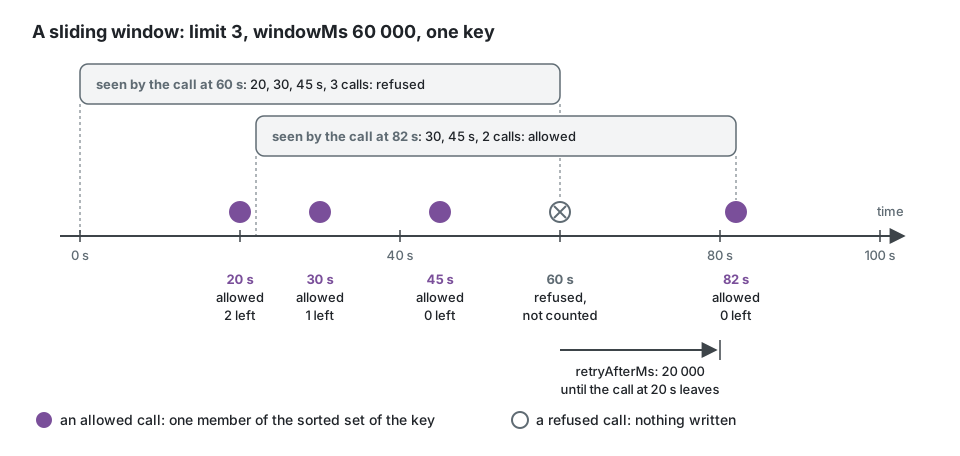
remaining counts the places left once this call is counted; retryAfterMs is 0 for an
allowed call, and for a refused one the time until the oldest call of the window leaves it.
In front of the HTTP layer, before authentication cost anything (Fastify shown; the same three lines fit an Express middleware):
import Fastify from 'fastify';import { RedisRateLimiter, type RedisConnection } from '@ddd-ts-kit/redis';
declare const redis: RedisConnection;
export const server = Fastify();const limiter = new RedisRateLimiter(redis.client, { namespace: 'api', onError: 'allow' });
server.addHook('onRequest', async (request, reply) => {  const decision = await limiter.consume(`ip:${request.ip}`, { limit: 120, windowMs: 60_000 });  reply.header('RateLimit-Remaining', decision.remaining);
  if (decision.allowed) {    return;  }
  reply.header('Retry-After', Math.ceil(decision.retryAfterMs / 1000));  return reply.code(429).send({ type: 'about:blank', title: 'Too Many Requests', status: 429, code: 'RATE_LIMITED' });});
A use case that must be limited for a business reason (three password resets per hour)
depends on the RateLimiter port of the kernel and receives the adapter by injection
(builder.rebind(RateLimiter), shown under Cache); InMemoryRateLimiter on a
FixedClock is its fake. The refusal is a business answer, with its code, not an HTTP status
written in the use case:
import { Command, ConceptError, FixedClock, InMemoryRateLimiter, RateLimiter, type CommandHandler } from '@ddd-ts-kit/kernel';
export class RequestPasswordReset extends Command {  constructor(readonly accountId: string) {    super();  }}
export class PasswordResetError extends ConceptError {  static tooMany(retryAfterMs: number) {    return PasswordResetError.refusal('PASSWORD_RESETS_EXHAUSTED', 'Three password resets per hour at most.', { retryAfterMs });  }}
export class RequestPasswordResetHandler implements CommandHandler<RequestPasswordReset> {  constructor(private readonly limiter: RateLimiter) {}
  async execute({ accountId }: RequestPasswordReset): Promise<void> {    const decision = await this.limiter.consume(`password-reset:${accountId}`, { limit: 3, windowMs: 3_600_000 });
    if (!decision.allowed) {      throw PasswordResetError.tooMany(decision.retryAfterMs);    }
    // send the link  }}
// In a test: the in-memory limiter on a fixed clock, and time moves when the test says so.const clock = new FixedClock(new Date('2026-10-13T09:00:00Z'));export const handler = new RequestPasswordResetHandler(new InMemoryRateLimiter(clock));- Exact, at a memory cost. One member per allowed call: a key costs memory in proportion to its limit. Fine up to thousands per window; for tens of thousands, limit a coarser key or a shorter window.
- The clock is the caller's. Instants come from the
Clockgiven to the limiter (itsclockoption, the system clock by default), not from the server, so every instance must be synchronized (NTP): a skew between two instances shifts the window by as much. In exchange the limiter is tested on a fixed clock, and the script holds no arithmetic that differs between Lua versions. onError:throw(default) lets the caller decide;allowkeeps serving without a limit while the server is away (the usual choice in front of an API);denyrefuses everything (for the few limits that are a security control, such as login attempts).- The key expires by itself one window after its last allowed call.
Relay signal
Section titled “Relay signal”An outbox relay polls. RedisRelaySignal lets it poll rarely and still publish at once, across
processes: the process that committed a command notifies, a relay in any other process wakes.
import { InMemoryCommandBus, SystemClock, unitOfWorkMiddleware, type IntegrationEventPublisher, type UnitOfWork } from '@ddd-ts-kit/kernel';import { OutboxRelay, type OutboxStore } from '@ddd-ts-kit/events';import { RedisRelaySignal, relayWakeUpMiddleware, type RedisConnection } from '@ddd-ts-kit/redis';
declare const redis: RedisConnection;declare const store: OutboxStore;declare const publisher: IntegrationEventPublisher;declare const unitOfWork: UnitOfWork;
const signal = new RedisRelaySignal(redis.client, { channel: 'app:outbox' });
// The worker that relays: it wakes on a notification, and still polls every 5 s.export const relay = new OutboxRelay({ store, publisher, clock: new SystemClock(), wakeOn: signal });relay.start({ intervalMs: 5_000 });
// The API process. Instead of `.use(unitOfWorkMiddleware(unitOfWork)).use(relayWakeUpMiddleware(signal))`,// which notifies inside the transaction, before the record is visible, put the wake-up first:// it is then the outer middleware, and notifies once the unit of work committed.export const commandBus = new InMemoryCommandBus().use(relayWakeUpMiddleware(signal)).use(unitOfWorkMiddleware(unitOfWork));
It satisfies the RelaySignal port of @ddd-ts-kit/events structurally: this package does not
depend on @ddd-ts-kit/events, so the class does not name the port, and it is accepted wherever
a RelaySignal is expected, builder.bind(RelaySignal).toValue(signal) included. It has
the semantics of the in-memory signal: a hint, never a delivery. Publish/subscribe keeps
nothing for a subscriber that is away; a notification sent while the relay reconnects, or
before it subscribed, is lost, and the event goes out at the next poll. Keep a real
intervalMs. notify() never throws. close() closes the listening connection the signal
opened.
relayWakeUpMiddleware notifies after every command that succeeded, whether it published or
not: a spurious wake-up costs the relay one empty claim. With PostgreSQL, LISTEN/NOTIFY from
the outbox table does the same without another server.
Event bus on Redis Streams
Section titled “Event bus on Redis Streams”RedisStreamsEventBus is an integration event provider: an EventBus of the kernel that
publishes with XADD and resolves only when the server acknowledged every entry, so the
outbox relay can mark a record published, and consumes through one consumer group per
consumer with a blocking read on a dedicated connection, acknowledgement after the handler, a
bounded number of delayed redeliveries and a dead stream. It sits next to the RabbitMQ, Kafka
and NATS providers, passes eventBusContract of @ddd-ts-kit/testing, and runs unchanged on
Redis, Dragonfly and Valkey.
npm i @ddd-ts-kit/redis @ddd-ts-kit/events ioredisWhen to choose this. You already run and operate Redis, Dragonfly or Valkey, the volume is moderate (handlers of a stream run one at a time per instance), and one more server to run is worth avoiding. You get consumer groups, redelivery, dead letters and a readable log with one dependency. Choose RabbitMQ when you want a broker that owns delivery (publisher confirms written to disk, quorum queues replicated before the confirmation, per-message routing), and Kafka when you want a durable, replicated log with partitions, per-key ordering and long retention. Here durability is what the server is configured for, and retention is bounded by memory: see Guarantees and limits.
Composition root
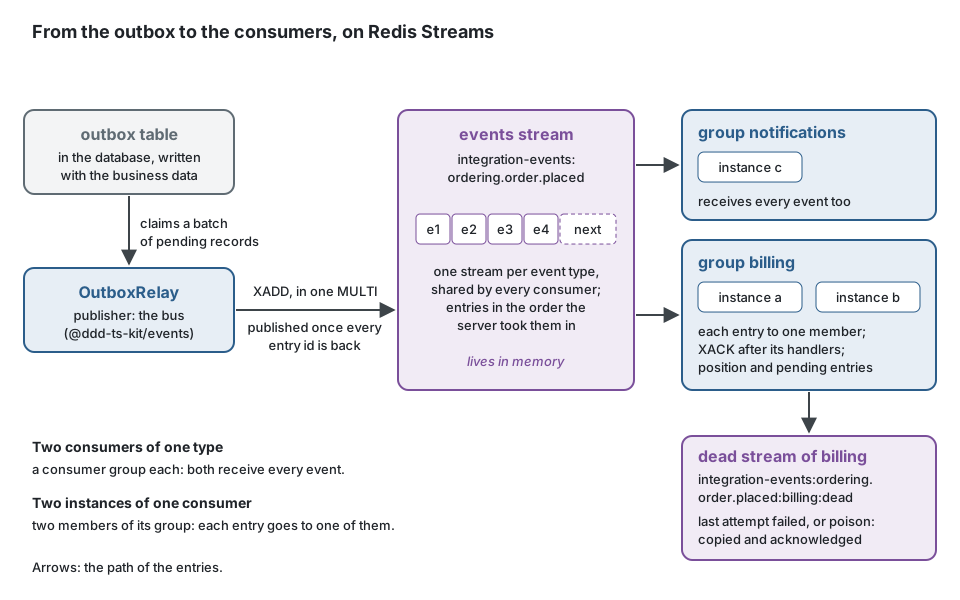
Section titled “Composition root”Handlers never see this package. They publish to the outbox; the relay publishes to the streams; each consuming context subscribes through the bus under its own name.
import { Command, SystemClock, type CommandBus, type Logger, type Metrics, type ProcessedEventStore, type UnitOfWork } from '@ddd-ts-kit/kernel';import {  OutboxPublisher,  OutboxRelay,  consume,  subscribeAll,  validatingPublisher,  type EventRegistry,  type IntegrationEventDefinition,  type OutboxStore,} from '@ddd-ts-kit/events';import { RedisStreamsEventBus } from '@ddd-ts-kit/redis/event-bus';import { tracedPublisher, tracedSubscriber } from '@ddd-ts-kit/tracing';
declare const config: { readonly redisUrl: string };declare const logger: Logger;declare const metrics: Metrics;declare const outboxStore: OutboxStore;declare const registry: EventRegistry;declare const processed: ProcessedEventStore;declare const unitOfWork: UnitOfWork;declare const commandBus: CommandBus;declare const orderPlaced: IntegrationEventDefinition<{ readonly orderId: string }>;declare class IssueInvoice extends Command {  constructor(orderId: string);}
const deliveries = metrics.counter('event_deliveries_total');
const bus = new RedisStreamsEventBus({  connection: config.redisUrl, // or ioredis options, or a client you already have (redis.client)  prefix: 'integration-events', // the default: one stream per type, `<prefix>:<type>`  retry: { maxAttempts: 5, delayMs: 5_000 }, // the defaults  visibilityTimeoutMs: 60_000, // the default: above the worst case of a batch of handlers  batchSize: 10, // the default  onFailure: (failure) => logger.warn('event bus failure', { ...failure }), // codes only, never an error message  onDelivery: ({ stream, consumer, outcome }) => deliveries.increment({ stream, consumer, result: outcome }),});
// Publishing side: handlers write to the outbox, in the transaction of the command.export const publisher = validatingPublisher(new OutboxPublisher(outboxStore), registry);
// The relay target is the bus. A record is marked published when the server answered its entry id.const relay = new OutboxRelay({ store: outboxStore, publisher: tracedPublisher(bus), clock: new SystemClock() });relay.start({ intervalMs: 500 });
// Consuming side: one subscriber per consuming context, named after it.const billingEvents = tracedSubscriber(bus.forConsumer('billing'));subscribeAll(billingEvents, [  consume(orderPlaced, { consumer: 'billing.ordering-order-placed', processed, unitOfWork }, async (event) => {    await commandBus.execute(new IssueInvoice(event.payload.orderId));  }),]);
await bus.assertTopology(); // fail at startup, not at the first event
process.on('SIGTERM', async () => { await relay.stop(); // the tick in progress finishes await bus.close(); // readers stop, the batch in progress finishes and acknowledges});-
publish(events)sends the batch as oneMULTIofXADDand resolves only when the server answered an entry id for every event. It rejects otherwise (PUBLISH_NOT_CONFIRMEDwith theeventIdand areasoncode,BROKER_UNAVAILABLE,EVENT_BUS_CLOSED). Nothing is buffered for later: the outbox is the buffer. -
A consumer name is required to subscribe:
bus.forConsumer('billing')gives anIntegrationEventSubscriberfor one context (a modular monolith has several, each with a reading connection of its own), and theconsumeroption names the onebus.subscribeworks for (a service that is a single context). -
With
@ddd-ts-kit/di, the declared integration event handlers of a context are subscribed onEventSubscribers.forContext(<module name>). Give it the bus, and each context reads under its own name:import { EventSubscribers } from '@ddd-ts-kit/kernel';const app = createApplication({modules: [kernelModule({ eventSubscribers: () => ({ forContext: (name) => bus.forConsumer(name) }) }),contextModule('billing', billingDeclarations),],});// or, from a later modulebuilder.rebind(EventSubscribers).toValue({ forContext: (name) => bus.forConsumer(name) }); -
The tracing wrappers work as with any provider (with
@ddd-ts-kit/di, the consuming side is traced bykernelModule({ instrumentation: traceApplication() })andtracedSubscriberis left out): the bus carriestraceparentandcorrelationIduntouched, in the envelope and as fields of the entry, across a retry too. Next to the event, each handler receives the delivery (EventDeliveryof the kernel):{ attempt, maxAttempts, system: 'redis', destination, consumer }, wheredestinationis the stream.@ddd-ts-kit/tracingreads it to make one CONSUMER span per attempt; the bus names itselfmessagingSystem: 'redis'. -
The correlation makes the round trip. Publish through
scopedPublisher(publisher, scope)of the kernel and consume withconsume(definition, { ..., scope }, handler): the consumer runs in an execution context whosecorrelationIdis the one of the request that published, whosecausationIdis the event, and a redelivery runs in the same one. Or give the bus thescopeoption: every handler then runs inside it, under the name of its consumer. -
A context extracted to its own service keeps its consumer name and so its groups: nothing changes on the server.
-
The publishing connection is the one you give, shared with the other adapters of this package if you hand over
redis.client. Every consumer name reads on a duplicate of it (client.duplicate()), because a blocking read holds its connection.close()closes what the bus opened and leaves a client it was handed open.
| Option | Default | Effect |
|---|---|---|
connection |
required | URL, ioredis options or client. A connection opened here takes FAIL_FAST and a reconnection delay from reconnect |
prefix, streamOf |
integration-events |
the stream of a type is <prefix>:<type>, or what streamOf(type) answers |
consumer |
none | the consumer bus.subscribe reads for |
instance |
host, process id, random suffix | the name of this process inside its groups; unique per process |
batchSize |
10 | entries read at once per stream (COUNT), then handled in order, one at a time |
blockMs |
1000 | how long a read waits (BLOCK): it bounds close() and the precision of the retry delay |
retry |
5 attempts, 5000 ms | deliveries before the dead stream, and the wait after a failure |
visibilityTimeoutMs |
60000 | idle time after which the pending entries of another instance are taken over; never less than retry.delayMs |
startFrom |
new |
where a group this bus creates starts: what is published from then on, or beginning for the whole stream |
retention |
none | { maxLength } or { maxAgeMs }: trimming applied by each publication. See the limits |
deduplication |
none | { windowMs }: the publish-side guard below |
scope |
none | an ExecutionScope every handler runs inside |
reconnect |
200 ms doubling up to 30 s | delay between reconnections, and between the attempts of a reader that fails |
Topology
Section titled “Topology”bus.describeTopology() returns the streams and the groups as data, for a review or a
generated document; bus.assertTopology() creates them, idempotently. The bus also creates
its groups before it reads or publishes, and again after any failure of a reader (a server
that came back without its data has lost them). For forConsumer('billing') subscribed to
ordering.order.placed:
| Object | Name | Properties |
|---|---|---|
| events stream | integration-events:ordering.order.placed |
one per event type, shared by every consumer; created empty by the first group (MKSTREAM) or by the first publication |
| consumer group | billing, on that stream |
one per consumer name; holds its position and its pending entries; created at $ (or 0 with startFrom: 'beginning') |
| group member | the instance name |
one per process; removed at close() when it leaves nothing pending |
| dead stream | integration-events:ordering.order.placed:billing:dead |
one per consumer and type, created by the first dead letter; no group reads it |
An entry holds the envelope as JSON in the field envelope (id, type, version,
occurredAt, payload, traceparent, correlationId, tenantId) and, beside it, the fields
id, type, version, traceparent, correlation-id and tenant-id: an operator reads them with XRANGE
without parsing the body, and any client of the protocol can consume the stream.
Two consumers of one type have a group each and both receive every event. Two instances of one consumer are two members of its group: each event goes to one of them.
Ordering. One instance receives the events of a type in the order of the stream, which is the order the server took them in. That order is broken by a redelivery (the failed event comes back after later ones were handled) and by competing instances (two members of a group progress independently). There is no order across types, and none per aggregate: carry a version in the payload when it matters.
Retry and dead-letter behaviour
Section titled “Retry and dead-letter behaviour”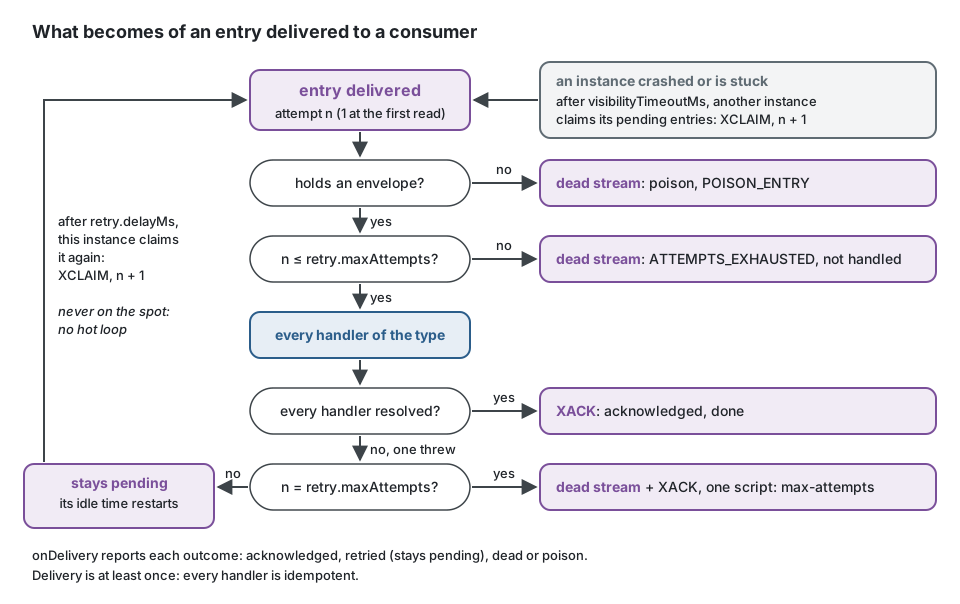
- An entry is acknowledged (
XACK) after every handler subscribed to its type resolved. Useconsumeof@ddd-ts-kit/events: the acknowledgement then follows the commit of the unit of work, and a redelivery is deduplicated. - When a handler throws, the entry is not acknowledged: it stays in the pending entry list of
the group, owned by this instance, and its idle time restarts at the failure. Once it has
been idle for
retry.delayMs, the instance claims it again (XPENDINGwithIDLE, thenXCLAIM). A failed entry is never handled again on the spot: no hot loop. - The attempt number is the delivery counter the server keeps in the pending entry list: 1
for the first read, incremented by each claim. At the
retry.maxAttempts-th failed delivery the entry is copied to the dead stream withdead-reason: max-attempts,error-code,attempt,consumerandentry-id(its id in the events stream), and acknowledged, in one script: never one without the other. - The pending entries of an instance that died, or that is stuck, are taken over by another
instance of the consumer once they have been idle for
visibilityTimeoutMs. That delivery counts as an attempt. An entry that used all its attempts this way, never answered by a handler, goes to the dead stream witherror-code: ATTEMPTS_EXHAUSTEDwithout being handled again: an event that kills its consumers does not kill them forever. - An entry that does not hold an envelope (no
envelopefield, unparseable, or withoutid,type,version,occurredAt) is poison: it goes straight to the dead stream withdead-reason: poisonanderror-code: POISON_ENTRY, and no handler sees it. - Only codes travel:
error-codeis thecodeof the error or its class name. The message of an error is never logged, reported or attached, because it may quote payload data.
Delivery is at least once. An acknowledgement lost to a disconnection, a claim racing a slow handler, a relay retry: each delivers an event twice, never zero times.
On a lost connection ioredis reconnects with the delay of reconnect; publish rejects at
once between two attempts (BROKER_UNAVAILABLE), so the outbox relay keeps the records and
retries them, and the readers resume where their groups are. Entries that were being handled
stay pending and are claimed again.
Publishing twice
Section titled “Publishing twice”Redis Streams have no publish-side deduplication: an XADD that succeeded but whose
answer was lost is appended again by the retry of the relay, and both entries are delivered.
The answer is the same as for every provider: the consumer deduplicates, with a
processed-event store in the transaction of its handler (consume).
A cheap guard narrows the window, as an option:
new RedisStreamsEventBus({ connection, deduplication: { windowMs: 3_600_000 } });Each event is then appended by a script that first looks for the key
<stream>:<event id>:published, appends only if it is absent, and writes it with the window
as its time to live. A relay retry within the window appends nothing and is acknowledged. It
is a guard, not a guarantee: the mark is one more key, evicted or lost with the server like
any other, and it costs one key per event for the duration of the window. Consumers still
deduplicate. Verified on Dragonfly v2.0.2, Valkey 9.1.2 and Redis 8.10.2. (Redis 8.10.2
reports a server-side idempotent append in XINFO STREAM; it is not used, the two other
servers do not have it.)
Operations
Section titled “Operations”What to watch, with the commands of any client (<stream> is <prefix>:<type>):
| Signal | Command | Meaning |
|---|---|---|
outbox stats() (pending, failed, dead) |
the outbox store | the publishing side: see @ddd-ts-kit/events |
| lag of a consumer | XINFO GROUPS <stream>: lag, last-delivered-id |
entries not read yet: the consumer is late or stopped |
| pending entries | XINFO GROUPS <stream>: pending; detail with XPENDING <stream> <consumer> - + 10 (owner, idle time, deliveries) |
being handled, or waiting for a redelivery; a plateau means a handler that keeps failing, an idle time above the visibility timeout means nobody reads |
| depth of the dead stream | XLEN <stream>:<consumer>:dead |
must be 0: alert on anything else |
| what died and why | XRANGE <stream>:<consumer>:dead - + COUNT 10: error-code, dead-reason, attempt |
the code to look for in the logs of the consumer |
| members of a group | XINFO CONSUMERS <stream> <consumer> |
instances; one that crashed stays listed until removed |
| memory of a stream | XLEN <stream>, MEMORY USAGE <stream> |
streams only grow unless trimmed |
onDelivery counted by outcome |
this bus | rate of retried, dead, poison against acknowledged |
onFailure with kind: 'connection' |
this bus | reconnections (CONNECTION_LOST, ECONNREFUSED) and what the server refused to a reader (REDIS_NOGROUP) |
bus.deliveriesInFlight |
this bus | entries read and not settled; stuck above 0 means a handler that hangs |
onFailure says codes only. To report an event the bus gives up with the error its handler
really threw, as the example application does, hand the hook to DeadLetterReports of the
kernel and subscribe through it: a delivery that fails and is retried is not reported, a dead
or poison entry is.
import { DeadLetterReports, type ErrorReporter } from '@ddd-ts-kit/kernel';import { RedisStreamsEventBus } from '@ddd-ts-kit/redis/event-bus';
declare const config: { readonly redisUrl: string };declare const errors: ErrorReporter;
const deadLetters = new DeadLetterReports(errors);
export const bus = new RedisStreamsEventBus({  connection: config.redisUrl,  onFailure: (failure) => deadLetters.onFailure(failure),});
// Remembers what each handler threw, until onFailure says whether the event was given up.export const billingEvents = deadLetters.observing(bus.forConsumer('billing'));
Replaying dead entries, once the cause is fixed:
import { streamNamesOf, type RedisStreamsEventBus } from '@ddd-ts-kit/redis/event-bus';
declare const bus: RedisStreamsEventBus;
const billing = { consumer: 'billing', type: 'ordering.order.placed' };
// The keys to read first, with XLEN and XRANGE: the events stream and the dead stream of billing.export const { events, dead } = streamNamesOf(billing); // with the default prefix; pass `streamOf` otherwise
// Up to 100 entries back to the events stream, oldest first, for billing only.export const replayed = await bus.replayDead(billing, 100);
It moves up to that many entries, oldest first, from the dead stream back to the events
stream, each in one script (appended, then deleted from the dead stream). The new entry has a
fresh attempt budget and carries replay-for: billing: the other consumers of the type
acknowledge it without handling it. A client of your own that reads the stream should skip an
entry whose replay-for names somebody else. Look at dead-reason and error-code first:
replaying a poison entry only kills it again.
Housekeeping:
- A consumer stopped for good:
XGROUP DESTROY <stream> <consumer>and delete its dead stream. Unsubscribing only stops reading; the group keeps its position and its lag grows. - An instance that crashed stays a member of its groups. Its pending entries are taken over
after the visibility timeout; remove the name with
XGROUP DELCONSUMER <stream> <consumer> <instance>onceXINFO CONSUMERSshows it with 0 pending (deleting a member drops its pending entries). - Trimming by hand, when no
retentionis configured:XTRIM <stream> MINID ~ <id>with an id every group has passed (last-delivered-idofXINFO GROUPS) and nothing pending below.
Guarantees and limits
Section titled “Guarantees and limits”- Durability is the server's, and it is a setting. An entry is acknowledged when the
server holds it in memory. What survives a crash depends on persistence: with Redis or
Valkey and
appendonly yes,appendfsync everysec(the usual setting) can lose about the last second of acknowledged entries andalwaysnone, at a cost on every write; with snapshots only (RDB, and Dragonfly, which persists by snapshots), everything since the last snapshot is lost; without persistence a restart starts empty. Replication is asynchronous: a failover can lose what the replica had not received. For an event log this means an event the relay marked published can vanish, and no consumer will ever see it. A broker that confirms after writing to a replicated log does not have that window. Decide whether your events tolerate it, set persistence accordingly, and do not purge published outbox records before your backup horizon. - The positions are in the same server. Groups, pending entries and delivery counters are lost or rewound with the data. A server restored from an older snapshot delivers again what was handled since (consumers deduplicate); a server that lost everything gets its groups created again at the end of empty streams.
- No publish-side deduplication, as said above.
- Retention is bounded by memory. A stream lives in memory, entirely. By default nothing
is trimmed.
retention: { maxLength }(MAXLEN ~) andretention: { maxAgeMs }(MINID ~, by the clock of the publisher) trim at each publication, approximately, and without regard for the groups: an entry no consumer has read yet, or one waiting for its redelivery, is dropped with the rest and silently leaves the pending list at its next claim. Size the cap far above the worst lag you accept, or trim by hand. Dead streams are never trimmed. - Eviction applies to everything. Under
allkeys-*a whole stream can be evicted. Run the event bus on a server withnoeviction(a publication then fails when memory is full, and the relay retries), not on the one that is your cache. - One at a time per stream and instance. Throughput is that of your handlers in sequence; scale with instances, at the price of ordering. Types are handled in parallel inside a batch, but a turn ends when its slowest stream does.
- The visibility timeout must exceed the worst case of a batch (
batchSizetimes the slowest handler): beyond it another instance takes the entries over while the first is still working, and they are handled twice. With slow handlers, lowerbatchSize. - One delay. The same wait before every retry, no exponential backoff, precise to
blockMs. A failed entry whose instance stops is retried by another one after the visibility timeout, not after the retry delay. - A redelivery runs every handler of the type again, those that succeeded included, when several handlers of one consumer subscribe to the same type. Each must be idempotent.
- A batch is one transaction on one server: all its entries are appended, or the publication rejects. A rejection does not prove nothing was appended (the answer may have been lost); the relay retries and consumers deduplicate.
- A new group starts at the end of the stream by default: what was published before a
consumer first subscribed is not delivered to it.
startFrom: 'beginning'reads what the stream still holds. - A subscription added while the consumer is reading is read from the next turn, up to
blockMslater. Nothing is missed: its group exists before the bus publishes. - One server or a primary with replicas. A read covers the streams of a consumer in one
command and a dead letter touches two keys in one script: on a Redis Cluster the keys must
share a slot, which a
prefixin braces gives ({events}). Not tested on a cluster. - A crashed process leaves its name in its groups, and a deduplication mark per event for the window, when the guard is on: housekeeping above.
What is not here: a processed-event store
Section titled “What is not here: a processed-event store”There is deliberately no RedisProcessedEventStore. The idempotency of a consumer only holds
if "this event was processed" commits with the state change it stands for
(events/consumer-idempotent). A mark in Redis and a change in PostgreSQL are two systems: a
crash between the two either loses the event (mark kept, change rolled back) or processes it
twice. Use the store of your database adapter (KnexProcessedEventStore,
DrizzleProcessedEventStore), in the unit of work of the consumer.
The same reasoning applies to the outbox itself and to anything that must be atomic with business data: it lives in the database.
Compatibility: the commands used
Section titled “Compatibility: the commands used”| Adapter | Commands |
|---|---|
RedisCache |
GET, SET (with PX), DEL, SCAN (with MATCH, COUNT) |
RedisLock |
EVAL of two scripts calling SET (with NX, PX), INCR, GET, DEL |
RedisRateLimiter |
EVAL of one script calling ZREMRANGEBYSCORE, ZCARD, ZADD, PEXPIRE, ZRANGE (with WITHSCORES) |
RedisRelaySignal |
PUBLISH, SUBSCRIBE |
RedisStreamsEventBus, publishing |
MULTI, EXEC, XADD (with MAXLEN ~ or MINID ~ under retention); under deduplication, EVAL of one script calling GET, XADD, SET (with PX) |
RedisStreamsEventBus, consuming |
XGROUP CREATE (with MKSTREAM), XREADGROUP (with GROUP, COUNT, BLOCK, several streams), XACK, XPENDING (extended form, with IDLE and with a consumer), XCLAIM (with a minimum idle time, and with JUSTID), XGROUP DELCONSUMER, EVAL of one script calling XADD, XACK |
RedisStreamsEventBus, replayDead |
XRANGE (with COUNT), EVAL of one script calling XRANGE, XADD, XDEL |
redisHealth, close |
PING, QUIT |
| ioredis itself, at connection | HELLO 3 (ioredis 6; replies are mapped to their classic shape), INFO, CLIENT SETINFO, and AUTH, SELECT when the URL asks |
Choices made for portability:
- Scripts are sent with
EVAL, notEVALSHA: no script cache to warm or to lose behind a proxy or after a failover. They are a few lines each. - Every key a script touches is declared in
KEYS: Dragonfly refuses a script that reaches an undeclared key (Valkey runs it), and a cluster needs the keys for routing. The two keys of the lock share a hash tag ({key}). - Lua is kept to commands and comparisons. No arithmetic on scores, no
redis.call('TIME'), nocjson, noredis.setresp: Redis and Valkey embed Lua 5.1, Dragonfly Lua 5.4, and they differ on numbers. Measured on the two servers above: a script returning10/4answers2on Valkey and2.5on Dragonfly, andtostring(10/2)is5on one and5.0on the other. - No
KEYS, noUNLINK, no keyspace notifications, no modules, no functions. Streams are used by the event bus only. - The scripts of the event bus pass a variable number of fields with
unpack(ARGV, n)and test an empty reply with#: both behave the same on Lua 5.1 and 5.4, checked on the three servers. A dead letter is a script, not aMULTI: a transaction would acknowledge the entry even if its copy to the dead stream had failed. - Redeliveries use
XPENDINGthenXCLAIM, notXAUTOCLAIM.XAUTOCLAIMworks on the three servers, but answers no delivery counter, and the bounded retries need it. - The blocking read goes through the named command of ioredis (
client.xreadgroup), neverclient.call('XREADGROUP'): under RESP3, which ioredis 6 speaks, only the commands it knows have their reply mapped back to the classic shape. deleteByPrefixdeletes one key perDEL, since a cluster refuses aDELwhose keys live in different slots.
What differs between the servers, as far as the event bus is concerned, and is absorbed:
XREADGROUPon several streams answers every stream on Dragonfly, those without a new entry with an empty list; Redis and Valkey leave them out.- A command on a stream that no longer exists is refused as
NOGROUPby Redis and Valkey; Dragonfly answersERR no such keytoXPENDING. Both make the reader create its groups again; the code reported isREDIS_NOGROUPorREDIS_ERR. - An empty blocking read lasted its
BLOCKtime on Dragonfly and Redis, and was measured at about 100 ms more on Valkey.
Tested against Dragonfly v2.0.2, Valkey 9.1.2 and Redis 8.10.2 with ioredis 6, same suite,
same results. The suite needs a server and is skipped without DDD_TS_KIT_TEST_REDIS_URL:
docker run -d --rm --name ddd-ts-kit-test-redis -p 127.0.0.1:6390:6379 docker.dragonflydb.io/dragonflydb/dragonfly:v2.0.2DDD_TS_KIT_TEST_REDIS_URL=redis://127.0.0.1:6390 npx vitest run packages/redisThe specs write under a random namespace per test and never flush the server. Those of the event bus run the contract suite (with its defaults, then with the publication guard and capped streams), the behaviours of the provider (acknowledged publication cut mid-flight, redelivery, dead-lettering, replay, poison, competing and separate consumers, takeover after the visibility timeout, groups lost and created again, reconnection through a TCP relay the test cuts, graceful close) and the whole chain from the outbox to an idempotent consumer. Each test works under a prefix of its own and deletes its keys.
Background job store
Section titled “Background job store”RedisJobStore is the JobStore of @ddd-ts-kit/scheduling on Redis, Dragonfly or Valkey,
for a project without a database or a queue it wants out of it: a few Lua scripts on the
client of the package, every key under {<namespace>} so that a cluster keeps them in one slot
and Dragonfly sees every key a script touches declared.
import type { ErrorReporter, Logger } from '@ddd-ts-kit/kernel';import { kernelModule } from '@ddd-ts-kit/di';import { RedisJobStore, reportLostJobs, type RedisConnection } from '@ddd-ts-kit/redis';
declare const redis: RedisConnection;declare const logger: Logger;declare const errors: ErrorReporter;
const jobStore = new RedisJobStore(redis.client, { namespace: 'jobs', onLostJob: reportLostJobs(logger, errors) });
export const kernel = kernelModule({ jobStore });
reportLostJobs(logger, errors?) logs a write lost after its unit of work committed (the id of
the job, the class and code of the error) and hands the error to the ErrorReporter, origin
queue; a project initialised with --queue redis has it bound by its platform module.
Redis cannot join the transaction of a database. Inside a unit of work, add, cancel and
retryDead answer from what Redis holds and write once it committed (whenCommitted of the
kernel): a command that rolls back leaves no job and cancels none, but a process that dies
between the commit and the write loses that write, and onLostJob is told when it fails. With
a database, prefer the jobs table of the ORM package. The idempotency key, scoped by the tenant
of the job, is checked before the job is staged and again when it is written: two jobs of one
key staged before either committed both answer their own id, and only the first is kept.
Not BullMQ: it would bring a second worker model that the store contract (claim, lease,
heartbeat, reports by attempt) does not map onto, and emulated cluster mode on Dragonfly. The
store passes jobStoreContract on Dragonfly in the integration job of CI; it was also run by
hand on Redis 8 (last run: Dragonfly 2.0.2, Redis 8.2, 2026-10-13). What the jobs guarantee: Background jobs.
Contract suites
Section titled “Contract suites”Each port has a suite that its in-memory implementation and its adapter both pass. An adapter of your own (another client library, another store) is held to the same:
import { beforeEach, describe, expect, it } from 'vitest';import { FixedClock, type Cache, type Clock, type Lock, type RateLimiter } from '@ddd-ts-kit/kernel';import { cacheContract, lockContract, rateLimiterContract } from '@ddd-ts-kit/testing/contracts';
// Your adapters, under test: each call answers a fresh one.declare function createMyCache(): Cache;declare function createMyLock(): Lock;declare function createMyLimiter(clock: Clock): RateLimiter;
const sleep = (ms: number) => new Promise<void>((resolve) => setTimeout(resolve, ms));const clock = new FixedClock(new Date('2026-10-13T09:00:00Z'));
const runner = { describe, it, expect, beforeEach };cacheContract(runner, { name: 'MyCache', createCache: () => createMyCache(), elapse: (ms) => sleep(ms) });lockContract(runner, { name: 'MyLock', createLock: () => createMyLock(), elapse: (ms) => sleep(ms) });rateLimiterContract(runner, { name: 'MyLimiter', createLimiter: () => createMyLimiter(clock), elapse: (ms) => clock.advance(ms) });
elapse makes time pass for the subject: advance the clock it reads, or really wait when the
time is the server's. The suites live in @ddd-ts-kit/testing/contracts, with those of the
other kernel ports, where the in-memory implementations of the kernel are run against them;
@ddd-ts-kit/redis/testing re-exports them.
Limits
Section titled “Limits”- One server or a primary with replicas. A Redis Cluster works for the cache (one key per
command) and the lock (hash tag);
deleteByPrefixwould have to scan every node, which it does not. Not tested on a cluster. - Eviction applies to everything. A server configured to evict (
allkeys-lru) may evict a lock or a rate-limit key as well as a cache entry. Use avolatile-*policy, or a second server for what is not a cache. - No client-side caching, no pipelining of
get: each read is a round trip. - Values are JSON by default:
undefined,Date,Map,bigintand class instances do not survive. Give a codec, or cache plain data. - The lock is not re-entrant and is not renewed: choose
ttlMsabove the worst case of the work, or split the work. - ioredis 5 is accepted as a peer; the suites were only run with ioredis 6.