
ddd-ts-kit
Bootstrap, scaffold, document and verify Domain-Driven Design and Clean Architecture projects
in TypeScript. One binary: init creates the project, generate writes every piece of
boilerplate at its canonical place, docs keeps the architecture documentation current,
describe, status and todo read the project back as facts, check proves that the code
still follows docs/ARCHITECTURE.md.
init also installs the quality pipeline: ESLint with @ddd-ts-kit/eslint-plugin,
dependency-cruiser, knip, coverage thresholds, git hooks and the CI of GitHub or GitLab.
The generator and the checker share one definition of the canonical tree, and a test generates every kind for every stack and requires zero violation: they cannot disagree.
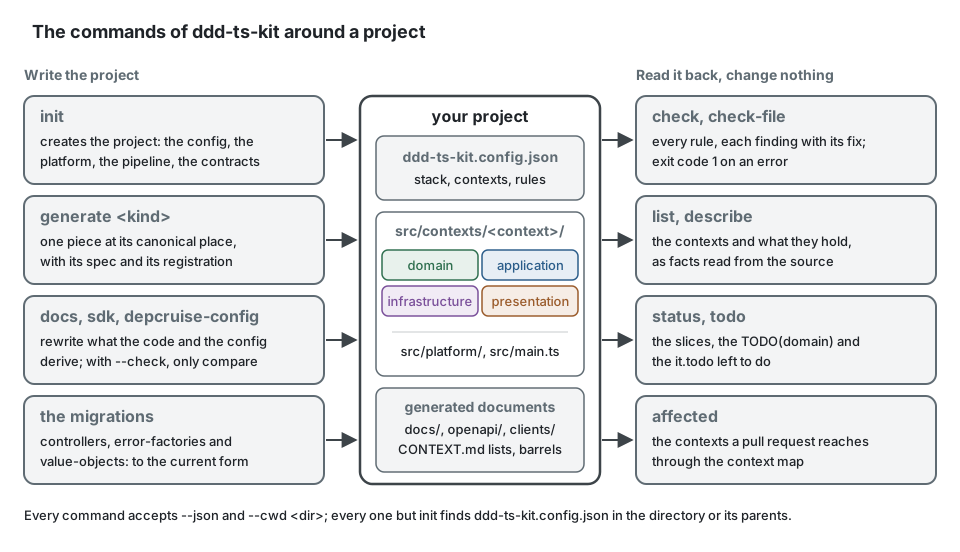
The main commands fall into two families. The first writes the project: init once, generate for
each piece, docs, sdk and depcruise-config for what is derived from the code and the
config, and three migrations that move a project from an older form to the current one. The
second reads the project back without changing it: check judges it, list and describe state
what it holds, status and todo say what is left to do, affected says what a pull request has
to run.
No runtime dependency. Node 22.12 or later.
npx ddd-ts-kit initnpx ddd-ts-kit generate context billing --classification core --term "Invoice=A request for payment"npx ddd-ts-kit generate aggregate billing Invoicenpx ddd-ts-kit generate command billing IssueInvoice --aggregate Invoice --permission invoice.issue --grant accountant --term "Issue=To make an invoice final"npx ddd-ts-kit generate route billing IssueInvoice --method POST --path /invoicesnpx ddd-ts-kit checkinit ends by saying what to run next: pnpm install, then pnpm run verify (npm install,
then npm run verify with --package-manager npm), then the recommended steps of the method, in
order (methodology); which command, when
gives the command of each moment of a project and the reference of every flag. A new project passes that whole gate before
anything is generated, with no context, with one and with several: the end-to-end suite installs
it for real and runs it, on both package managers and on every proven stack. After the install the
CLI is the one the project pins: pnpm exec ddd-ts-kit <command>, or npx ddd-ts-kit <command>.
Every command accepts --json (machine-readable output, errors included) and --cwd <dir>.
Commands other than init look for ddd-ts-kit.config.json in the directory and its parents.
Exit codes: 0 success, 1 violations, stale documentation or, under --strict, a commit over
its limits, 2 wrong usage (the message says what to do).
ddd-ts-kit init [--http express|fastify|hono|nest|none] [--validation zod|class-validator|typebox|standard-schema|none] [--di tsyringe|nest|manual] [--tests vitest|jest] [--orm drizzle|knex|prisma|typeorm|custom|none] [--database postgres|mysql|sqlite|none] [--events in-memory|outbox] [--docs-ui swagger|scalar|redoc|none] [--ci github|gitlab|both|none] [--ci-extras <extra>,...|none] [--authn jwt|keycloak|none] [--authz rbac|abac|rebac|custom] [--broker none|rabbitmq|kafka|nats|redis|custom] [--cache none|redis] [--http-cache none|varnish] [--storage local|s3|none] [--audit on|off] [--errors none|sentry] [--logger stdout|pino|winston] [--style declared|explicit] [--assembly barrel|discovery] [--dependencies signature|listed] [--refusals factories|classes] [--routes controllers|functions] [--value-objects throwing|result] [--literals named|free] [--values classes|free] [--tenancy none|shared-table] [--queue database|redis|memory] [--schemas shared|per-route] [--package-manager npm|pnpm] [--allow-no-outbox "<reason>"] [--import-alias '$<name>/'] [--import-extension none|js] [--sdk] [--context <name>:<core|supporting|generic>]... [--preset identity]... [--dry-run] [--force]Works in an empty directory or an existing project. An existing file is never replaced without
--force; it is reported as skipped. init also writes the generated contracts as the scripts
of the project write them for a project without a route or an integration event of its own
(openapi/openapi.yaml, docs/integration/asyncapi.yaml and event-catalog.md; JSON under
"openapi": { "format": "json" } of the config), so that the first commit holds them and
docs:check passes at once; a contract that is already there is
left alone, --force included. An existing package.json is merged: missing scripts and
dependencies are added, yours are kept and mentioned in the notes. Run again later, init keeps
the stack recorded in the config.
init --force on a project that is already initialised rewrites the files init owns and keeps
the config: the contexts and their upstreams, the rules, the limits, the deviations and every
other key stay as written, and the stack changes only where a flag names a choice
(init --force --logger pino changes the logger; a combination the recorded stack cannot take
is refused as for a new project). The composition root, the proof that each context wires alone
and the registry of permissions are rewritten from their templates, then the declared contexts
are wired into them again; what another generator had added to a file of the platform (the
value of a gateway, the settings of a job) is not, and a note says so. A config that cannot be
read is replaced.
The pipeline uses free tools only. --ci-extras adds jobs that need a paid plan on a private
repository, or report into a merge request only in a paid tier: codeql, dependency-review
(GitHub), gitlab-sast, gitlab-secret-detection, gitlab-dependency-scanning (GitLab). The
list is recorded as ci.extras in the config; an unknown name, or a job of a platform --ci does
not cover, is refused. The table of every tool and its conditions:
pipeline/README.md.
An import of a file of the project is written without an extension
(@/contexts/billing/domain/aggregates/invoice.aggregate): init records
"importExtension": "none", and --import-extension js asks for the .js of the emitted file
instead. A config without the key is read as js, so a project generated before the key
existed keeps its spelling. See docs/CONFIG.md.
Defaults: express, zod, tsyringe (nest with --http nest, and only then), vitest,
drizzle on postgres, outbox when there is an ORM, swagger, github, jwt, rbac, no broker,
the cache in the process, files in a local directory (--storage local), the audit trail on when there is an ORM, unexpected failures reported
nowhere (--errors none), JSON lines on the standard output (--logger stdout), and the
declared style with a barrel wherever the declarations are read: with --di tsyringe.
Package manager. pnpm unless --package-manager npm: every script, pipeline, hook, the
Dockerfile, the guidance and the agent permissions are written in the dialect of the one chosen,
recorded under stack.packageManager. pnpm is pinned in package.json and provided by corepack;
pnpm-workspace.yaml says that no dependency runs a build script unless allowed by name. Both are
proven by a real install of a generated project, its build and its verify. The kit is installed
from the registry either way.
Pipelines. A pull or merge request runs the unit specs, the integration specs and the lint of
the contexts its change reaches through the context map (ddd-ts-kit affected); types,
architecture, import graph, dead code, end to end, build and documents always run on the whole
project, and the default branch and the nightly schedule run everything.
Two styles. In the declared style each class says what it is with a decorator of
@ddd-ts-kit/kernel/declarations (@Requires or @Public on a command or a query,
@CommandHandler, @QueryHandler, @IntegrationEventHandler, @DomainEventHandler, @Scheduled,
@Policy, @Repository, @Gateway, @Adapter), a context has no <context>.module.ts, and the
composition root assembles it in one line. In the explicit style every binding is written in the
module file of the context: builder.bind(Port).toClass(Adapter, [Ports]),
builder.command(Message).requires(...).handledBy(Handler, [Ports]), builder.job(name, schedule).
--style declared is refused with --di manual and --di nest: the declarations are plain
metadata, and only @ddd-ts-kit/di (on tsyringe) turns them into bindings.
--assembly says how a declared context reaches the composition root: barrel (the default) is one
generated file per context, <context>.declarations.ts, static, followed by a bundler, by knip and
by dependency-cruiser; discovery writes await discoverContext(...) instead, with the knip entry
and the dependency-cruiser exception the discovered files need (publishers and jobs included: they
are discovered like the rest), and inlines @ddd-ts-kit/di in the two vitest configs, so that the
files it imports itself are compiled by the runner. Discovery is accepted behind a broker: a
context listens on the subscriber EventSubscribers.forContext(name) hands it, in either assembly.
A config written before stack.style existed is explicit.
The same use case in both styles. In the declared style, the command and its handler carry their
decorator, and the handler's constructor says what it needs. The body of the handler is the one
generate command billing IssueInvoice --aggregate Invoice --permission invoice.issue writes,
before its TODO(domain) is answered; the input of the command is filled in:
import { definePermissions } from '@ddd-ts-kit/auth';import { type Actor, AggregateRoot, AuthorizedCommand, type Clock, type IdGenerator, Repository } from '@ddd-ts-kit/kernel';import { CommandHandler, Requires } from '@ddd-ts-kit/kernel/declarations';
declare class Invoice extends AggregateRoot {  static create(id: string, now: Date): Invoice;}
// domain/repositories/invoice.repository.tsexport abstract class InvoiceRepository extends Repository<Invoice> {}
// application/authorization/billing.permissions.tsexport const billingPermissions = definePermissions('billing', {  'invoice.issue': { description: 'Issue invoice' },});
// application/commands/issue-invoice/issue-invoice.command.ts@Requires(billingPermissions['invoice.issue'])export class IssueInvoiceCommand extends AuthorizedCommand<string> {  constructor(    actor: Actor,    readonly customerId: string,  ) {    super(actor);  }}
// application/commands/issue-invoice/issue-invoice.handler.ts@CommandHandler(IssueInvoiceCommand)export class IssueInvoiceHandler implements CommandHandler<IssueInvoiceCommand> {  // each parameter is typed by one class, which is also its injection token  constructor(    private readonly invoiceRepository: InvoiceRepository,    private readonly ids: IdGenerator,    private readonly clock: Clock,  ) {}
  async execute(command: IssueInvoiceCommand): Promise<string> {    const invoice = Invoice.create(this.ids.next(), this.clock.now());
    await this.invoiceRepository.save(invoice);
    return invoice.id;  }}
In the explicit style, the same classes carry no decorator, and the module file of the context binds each of them, with its permission and the ports it is given:
import { definePermissions } from '@ddd-ts-kit/auth';import { defineContextModule } from '@ddd-ts-kit/di';import { AggregateRoot, AuthorizedCommand, Clock, type CommandHandler, IdGenerator, Repository } from '@ddd-ts-kit/kernel';
// the classes of the declared sample, without their decoratorsdeclare class Invoice extends AggregateRoot {}declare class IssueInvoiceCommand extends AuthorizedCommand<string> {}declare class IssueInvoiceHandler implements CommandHandler<IssueInvoiceCommand> {  constructor(invoiceRepository: InvoiceRepository, ids: IdGenerator, clock: Clock);  execute(command: IssueInvoiceCommand): Promise<string>;}declare class InMemoryInvoiceRepository implements InvoiceRepository {  findById(id: string): Promise<Invoice | undefined>;  save(invoice: Invoice): Promise<void>;}
export abstract class InvoiceRepository extends Repository<Invoice> {}
export const billingPermissions = definePermissions('billing', {  'invoice.issue': { description: 'Issue invoice' },});
// billing.module.ts: every binding of the context, one line eachexport const billingModule = defineContextModule({  name: 'billing',  register(builder) {    builder.bind(InvoiceRepository).toClass(InMemoryInvoiceRepository).as('repository');    builder      .command(IssueInvoiceCommand)      .requires(billingPermissions['invoice.issue'])      .handledBy(IssueInvoiceHandler, [InvoiceRepository, IdGenerator, Clock]);  },});
check holds both forms: authz/declared reports a command that says neither who may send it
nor that it is public, declarations/role-declared a role file of the declared style without its
decorator.
A port is an abstract class and its own injection token. application/ports/<name>.port.ts
and domain/repositories/<name>.repository.ts hold one abstract class each. Generated code holds
no token(), no UPPER_SNAKE injection constant, no <context>.ports.ts and no
platform/tokens.ts: a constructor parameter typed by a port class names what is injected
(private readonly clock: Clock), kernel ports are value imports wherever they are named in a
list or a binding and type imports where they only type a parameter, an adapter implements
its port.
Instead of an interface, a token constant and an injection by name:
export interface IPaymentGateway {  charge(invoiceId: string, amountInCents: number): Promise<void>;}
export const PAYMENT_GATEWAY = Symbol('PaymentGateway'); // ports/no-token-constant
constructor(@inject(PAYMENT_GATEWAY) private readonly payments: IPaymentGateway) {}
write one abstract class, which is both the contract and the token:
import { Adapter } from '@ddd-ts-kit/kernel/declarations';
export abstract class PaymentGateway {  abstract charge(invoiceId: string, amountInCents: number): Promise<void>;}
// infrastructure/external/remote-payment-gateway.adapter.ts: implements the port, never extends it@Adapter(PaymentGateway, { kind: 'external' })export class RemotePaymentGateway implements PaymentGateway {  async charge(invoiceId: string, amountInCents: number): Promise<void> {    // TODO(platform): call the payment provider with invoiceId and amountInCents  }}
// a handler names the port by the type of its parameter: nothing else says what is injectedexport class SettleInvoiceHandler {  constructor(private readonly payments: PaymentGateway) {}
async settle(invoiceId: string, amountInCents: number): Promise<void> { await this.payments.charge(invoiceId, amountInCents); }}ports/abstract-class, ports/implements-never-extends, ports/no-token-constant and
ports/value-import hold this form, in check and in ESLint.
The constructor states the dependencies. In the declared style a generated class lists
nothing in its decorator (@CommandHandler(IssueInvoiceCommand)): each constructor parameter
is typed by one class, its token (declarations/constructor-injection). generate, docs and
the dev script read the signatures, with the zero-dependency scanner of the checker and no
compiler, and write injected(Class, [Tokens]) statements in the generated file of each
context: the barrel <context>.declarations.ts, or <context>.dependencies.ts under
discovery. @ddd-ts-kit/di injects from there. emitDecoratorMetadata is never relied on: it
is absent with standard decorators and under tsx. init writes
"stack.dependencies": "signature"; a config without the key is listed, the 0.1 form
(@CommandHandler(M, [Ports])), which keeps working untouched, and
--dependencies listed asks for it. The explicit style stays explicit: its module file lists
what each class is given. Every generated file exports one class, interface or function and is named
after it.
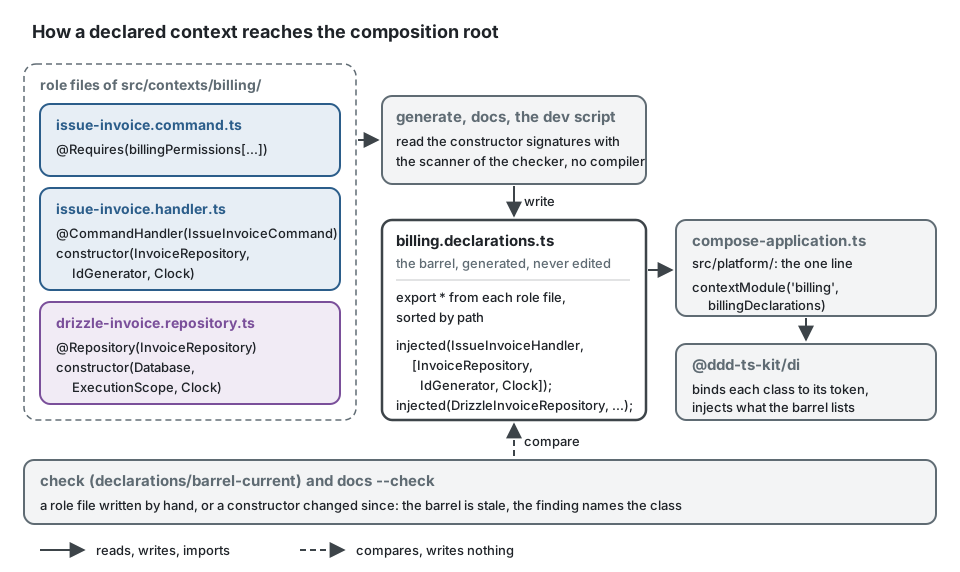
An excerpt of the barrel of the notification context of the example application, as the CLI
writes it (never by hand):
import { injected } from '@ddd-ts-kit/kernel/declarations';import { WithdrawReminderHandler } from '@/contexts/notification/application/commands/withdraw-reminder/withdraw-reminder.handler';import { ReminderRepository } from '@/contexts/notification/domain/repositories/reminder.repository';import { KnexReminderRepository } from '@/contexts/notification/infrastructure/persistence/knex-reminder.repository';import { Clock, ExecutionScope } from '@ddd-ts-kit/kernel';import { KnexContext } from '@ddd-ts-kit/knex';
export * from '@/contexts/notification/application/commands/withdraw-reminder/withdraw-reminder.command';export * from '@/contexts/notification/application/commands/withdraw-reminder/withdraw-reminder.handler';export * from '@/contexts/notification/infrastructure/persistence/knex-reminder.repository';
injected(WithdrawReminderHandler, [ReminderRepository]);injected(KnexReminderRepository, [KnexContext, ExecutionScope, Clock]);
and the one line of the composition root that adds the whole context:
contextModule('notification', notificationDeclarations) in src/platform/compose-application.ts.
Domain errors are built by factories. init writes "stack.refusals": "factories": a
context has one error class per concept, extending ConceptError of the kernel, and
generate error <context> <Concept> <refusal> adds a static factory to it. The errors/*
rules hold that form. --refusals classes, or a config without the key, keeps one class per
error built with new, as 0.1 and 0.2 wrote them; error-factories moves a project from one
to the other.
The older form, under "stack.refusals": "classes": one class per error.
import { DomainError } from '@ddd-ts-kit/kernel';
export class SlotTakenError extends DomainError {  readonly code = 'SLOT_TAKEN';
  constructor(readonly calendarId: string) {    super(`The slot of calendar ${calendarId} is already held.`);  }}
const refusal = new SlotTakenError('calendar-1');
The form init writes: one class per concept of the glossary, one factory per refusal, which
generate error scheduling Appointment slotTaken adds.
import { ConceptError } from '@ddd-ts-kit/kernel';
export class AppointmentError extends ConceptError {  static slotTaken(calendarId: string) {    return AppointmentError.refusal('SLOT_TAKEN', `The slot of calendar ${calendarId} is already held.`, { calendarId });  }}
const refusal = AppointmentError.slotTaken('calendar-1');
// what catches it tells the refusal by its class and its code, and reads its factsif (AppointmentError.is(refusal, 'SLOT_TAKEN')) {  console.log(refusal.facts.calendarId);}
A route is a controller class. init writes "stack.routes": "controllers": each route is
one class with one method, in a folder of its own, behind the guards of its route group, and a
declared context lists no route: its controllers reach the application through its generated
file. --routes functions, or a config without the key, keeps one defineRoute function per
route, listed in <context>.routes.ts, as 0.1 to 0.3 wrote them; controllers moves a
project from one to the other, a context at a time.
A shape is declared once. init writes "stack.schemas": "shared": a command route answers
its identifier with acceptedSchema of @ddd-ts-kit/http, one Accepted component in the
contract, and generate schema <context> <Name> (or schema shared-kernel <Name>) writes a
shape several routes use, which the contract documents once and every route refers to. The
schema/* rules hold that form. --schemas per-route, or a config without the key, keeps one
schema per route, an identifier answer included, as 0.1 to 0.5 wrote them.
A value object throws its refusals. init writes "stack.valueObjects": "throwing":
generate value-object writes a create that returns the value object or throws the refusal of
its concept, and a spec that asserts it with expectRefusal(() => ..). --value-objects result,
or a config without the key, keeps a create returning a Result that the caller unwraps, as 0.1
to 0.5 wrote it; value-objects moves a project from one to the other.
Domain events leave with the save. A generated command handler builds or loads its aggregate,
calls one intention method, await repository.save(aggregate) and returns: no pullEvents(), and
no DomainEventDispatcher in a handler or in a repository adapter, which only persists. The events
the aggregate recorded are dispatched once the save resolves, inside the unit of work of the
command: by the kernel module on tsyringe, by dispatchingOnSave around each repository in
platform/create-platform.ts with hand wiring (domain-events/dispatched-on-save).
Instead of pulling the events and dispatching them in the handler:
async execute(command: IssueInvoiceCommand): Promise<void> {  const invoice = await this.invoiceRepository.findById(command.invoiceId);
  invoice.issue(this.clock.now());  await this.invoiceRepository.save(invoice);  await this.dispatcher.dispatch(invoice.pullEvents()); // domain-events/dispatched-on-save}
write the save, and nothing after it:
import { type Actor, AggregateRoot, AuthorizedCommand, type Clock, type CommandHandler, ConceptError, Repository } from '@ddd-ts-kit/kernel';
declare class Invoice extends AggregateRoot {  /** Makes the invoice final and records InvoiceIssued, which waits in the aggregate. */  issue(now: Date): void;}
declare class InvoiceError extends ConceptError {  static notFound(invoiceId: string): InvoiceError;}
export abstract class InvoiceRepository extends Repository<Invoice> {}
export class IssueInvoiceCommand extends AuthorizedCommand<void> {  constructor(    actor: Actor,    readonly invoiceId: string,  ) {    super(actor);  }}
export class IssueInvoiceHandler implements CommandHandler<IssueInvoiceCommand> {  constructor(    private readonly invoiceRepository: InvoiceRepository,    private readonly clock: Clock,  ) {}
  async execute(command: IssueInvoiceCommand): Promise<void> {    const invoice = await this.invoiceRepository.findById(command.invoiceId);
    if (invoice === undefined) {      throw InvoiceError.notFound(command.invoiceId);    }
    invoice.issue(this.clock.now());
    // InvoiceIssued is dispatched once this save resolves, inside the unit of work of the command    await this.invoiceRepository.save(invoice);  }}
--events in-memory together with an ORM is refused unless --allow-no-outbox "<reason>" is given:
it records a deviations entry (stack.events) and writes the decision record it points to. The generated
persistence of the four ORMs is written for PostgreSQL; custom starts on in-memory adapters
held to the contract suites, for you to replace. The choices are recorded under stack in the
config, docsUi, ci and logger included.
| Written | Content |
|---|---|
ddd-ts-kit.config.json |
stack, contexts, rule severities (docs/CONFIG.md) |
package.json |
scripts and dependencies of the stack (below); build is the compiler, then ddd-ts-kit build-aliases |
tsconfig.json, tsconfig.build.json |
strict, NodeNext, rootDir . and outDir dist, and paths: the one declaration of the import alias (@/* to ./src/*, $test/*, $scripts/*, and $generated/* with Prisma), derived from importAlias (--import-alias '$<name>/', @/ by default; #<name>/ and @<name>/ are refused with the reason); the build config extends the other and declares no paths; experimentalDecorators (and emitDecoratorMetadata) only for nest or class-validator, whose decorators are legacy ones: the declarations and the aspects serve both modes |
src/main.ts |
composition root: tracing first (error reporting second with --errors sentry), config, persistence, application (log, traceConsumers: config.tracing.consumers, resilience, jobs: { start: config.runJobs, settings: jobSettings(process.env) }), outbox relay, HTTP server; on SIGTERM or SIGINT it closes the server, stops the relay, stops the application, closes the persistence and shuts the tracing down |
src/platform/ |
one export per file, each named after it, in one folder per concern. At its root: tracing.ts, compose-application.ts and job-settings.ts (jobSettings(environment, context?): one line per job, JOB_<CONTEXT>_<JOB>_ENABLED=false switches one off). config/ (app-config.ts, load-config.ts, config-error.ts, read-tracing.ts: fail-fast on DATABASE_URL, LOG_LEVEL, LOG_FORMAT, LOG_SCRUB_MESSAGES, the OUTBOUND_* policy, RUN_JOBS and the tracing variables below); observability/ (create-logger.ts, see --logger; create-metrics.ts: a NoopMetrics behind a TODO(platform)); resilience/ (resilience-settings.ts, default-resilience.ts, adapter-aspects.ts: retry with backoff and a timeout for external and gateway, own-policy.ts for an adapter that states its own, self-governed.ts); events/, database/, auth/, audit/, redis/ (below); http/ (start-http-server.ts, with-documentation.ts: /docs and /openapi.json, or /openapi/<name>.json per document of a split contract, off in production unless API_DOCS=true; openapi-documents.ts, the split written by ddd-ts-kit docs from openapi.documents). With --di tsyringe: compose-application.ts (composeApplication(persistence, options, contexts?): kernelModule({...}), the platform module, the authorization module, the contexts; installs the aspect runtime), lay-foundations.ts (one execution scope, clock, id generator, logger, metrics, instrumentation and audit, built before any module), platform.module.ts (what replaces the in-process defaults of the kernel: unit of work, processed-event store, the storage class, OutboxStore, EventSubscribers behind a broker, ErrorMapper, and builder.around(['external', 'gateway'], ...), the resilience of every adapter that leaves the process), platform-test.module.ts (what a handler spec lists next to its context: the storage class bound to a factory that throws), buses/create-command-bus.ts and create-query-bus.ts (outermost first: errorReportingMiddleware, loggingMiddleware, metricsMiddleware, the permission, the span of the use case, the audit entry, then the unit of work of a command). With --di manual or nest: compose-application.ts, platform.ts (interface Platform, with jobs: JobScheduler and adapter, which wraps what a module file instantiates), create-platform.ts, jobs/configured-job-scheduler.ts (applies job-settings.ts to what a module registers) |
| tracing | wired once, by the platform (tracing/platform-only): no decorate hook, no decorate-bindings.ts. tracing.ts starts initTracing of @ddd-ts-kit/tracing/node before any other module, on what config/read-tracing.ts validates: OTEL_EXPORTER_OTLP_ENDPOINT (a URL; left out, no span leaves the process), TRACE_SAMPLE_RATIO (0 to 1) and TRACE_CONSUMERS (continue, the default: a consumed event stays in the trace of its publication; link: each delivery starts a trace linked to it). With --di tsyringe: lay-foundations.ts builds traceApplication({ consumers }), compose-application.ts hands it to kernelModule({ instrumentation }) (one span per use case, repository call, domain event, publication, consumer and job) and gives the outbox relay tracedPublisher(bus). With hand wiring: create-platform.ts applies the members of traceApplication() itself (useCase on both buses, domainEvents, publisher, binding around every adapter, job, executionScope, errorReporter), with tracedSubscriber and tracedPublisher around the provider. With an HTTP stack, in both families, auth/http-boundary.ts sets around: tracedRoutes(): one SERVER span per request, named by its route |
--logger |
src/platform/observability/create-logger.ts, one per choice: stdout (the default) is the StdoutLogger of @ddd-ts-kit/aspects, JSON lines, credentials not redacted; pino is createPinoLogger of @ddd-ts-kit/pino (dependencies pino and pino-pretty); winston is createWinstonLogger of @ddd-ts-kit/winston; these two redact the credential keys of the kernel. Every entry carries traceLogFields(scope): the correlation id, origin, actor and tenant of the work in progress and the ids of the active trace. LOG_LEVEL, LOG_FORMAT (json, the default, or pretty; with stdout, which has no pretty format, pretty is refused when the configuration is loaded) and LOG_SCRUB_MESSAGES ([message removed] in place of the message of a logged error that is not a DomainError) are validated in config/load-config.ts. Stopping the application flushes the error reporter, then the logger, last: container.stop() does it on tsyringe, compose-application.ts flushes explicitly with hand wiring. The tools and the tests compose the application without log and write nothing |
src/platform/auth/ |
create-authenticator.ts (--authn jwt: JwtAuthenticator on AUTH_ISSUER, AUTH_AUDIENCE, AUTH_JWKS_URI; --authn keycloak: keycloakAuthenticator on KEYCLOAK_URL, KEYCLOAK_REALM, KEYCLOAK_AUDIENCE and the optional KEYCLOAK_CLIENT_ID; --authn none: development-header-authenticator.ts, which reads x-development-actor and throws in production), principal-of.ts, security-schemes.ts, offline-authenticator.ts, http-boundary.ts (resolvePrincipal answering a Session, executionScope, errorMapper and onError, spread into the mount options: every request runs inside the execution scope, with its correlation id), create-authorizer.ts and the files of the model (roles.ts, with the role system every system actor holds; attribute-policies.ts; relationship-schema.ts, create-tuple-store.ts and its contract spec, relation-tuples.ts, relate-system-actors.ts, permission-mapping.ts and permissions.ts; custom-authorizer.ts, its authorizerContract spec and permissions.ts), authorization.ts (authorizationModule with tsyringe) or use-case-protection.ts (the guard of the hand-wired buses), access-policies.ts, and with --audit off log-decisions.ts (one log entry per decision, ids and codes only). Without an HTTP stack there is no authenticator and no boundary |
--representations negotiated, --forms on |
src/platform/http/presentation-of.ts (Representations.standard() with negotiated, and fieldDeciderOf over the Access of the application), spread into the HTTP boundary and given to the contract script; with --forms on, src/platform/http/with-forms.ts adds formRoutes to the routes and scripts/openapi.ts writes openapi/forms/<operationId>.json. Both are the default with an HTTP stack; json and off leave them out (docs/CONFIG.md) |
--audit on |
src/platform/audit/: create-audit.ts (the trail, the onDecision of the authorization, the refusals of the guards at the edge given to the HTTP boundary as onGuardRefusal, the middleware before the unit of work, the integration events subscribed under the consumer name audit), audited-events.ts (the registry generate integration-event adds to), audit.module.ts, and with an HTTP stack the read side: audit.permissions.ts (audit:trail.read), search-audit-entries.query.ts, its handler, search-audit-entries.route.ts (GET /audit/entries: cursor pages, filters actorId, action, outcome, correlationId). It is a capability of the platform, not a bounded context: no model, one protected query over the AuditReader port, bounded by the tenant of the actor (with --tenancy shared-table, by the tenant of the work through TenantAuditReader: platform staff read across tenants only inside acrossTenants). The refusals of a caller without a credential are not recorded. A scheduled job is audited like a request: origin schedule, actor system:<context>.<job>. With knex the two tables and their append-only triggers are created by the first migration; with drizzle the tables are in schema.ts and npm run db:audit-guard prints the trigger statements for a custom migration; with prisma, typeorm, custom or no ORM the trail is an InMemoryAuditTrail behind a TODO(platform). The test databases leave the audit schema out of reset() |
--tenancy shared-table |
recorded as stack.tenancy; Knex or Drizzle only. Every generate repository is tenant-scoped (as --tenant-scoped), through tenantTable and ownTenantTable or tenantCondition and ownTenantCondition; the outbox keeps the tenant of each event (createOutboxTables(knex, { tenant: true }) and KnexOutboxStore's tenant: true, or tenantOutboxTable), so consumers run in it; tenancy/scoped-statement judges the adapters. Row-level security, schema per tenant and database per tenant are refused, with what to wire by hand (Multitenancy) |
--queue database|redis|memory |
recorded as stack.queue. database (the default on Knex or Drizzle with tsyringe): createJobTable and createProcessTable, or jobsTable and processesTable, in the messaging schema, Persistence gains jobs and processes, and the platform module rebinds JobStore and ProcessStore to them, so a job enqueued by a command is written in its transaction; redis (with --cache redis): RedisJobStore on the connection of the cache, the processes in the database; memory (the default otherwise): nothing is written, the kernel module keeps both in the process. Refused off tsyringe, database with another ORM, redis without the cache |
--cache redis |
src/platform/redis/open-redis.ts (RedisServices: the cache bound to the kernel Cache, the limiter to RateLimiter, the lock to Lock, which keeps a scheduled job to one instance, the relay signal as the wakeOn of the outbox relay with relayWakeUpMiddleware on the command bus), http/refusal-for.ts (one sliding window per caller address, 429 application/problem+json with retry-after; RATE_LIMIT_MAX, RATE_LIMIT_WINDOW_MS), GET /health/ready on the HTTP server, REDIS_URL validated, a compose service cache running Dragonfly with a healthcheck. Without a server (tools, tests without REDIS_URL) the same ports stay in the memory of the process |
--http-cache varnish |
a compose service varnish (Varnish 9.1.0, reaching the API on host.docker.internal) with its VCL in docker/varnish/default.vcl (only answers whose Cache-Control allows them by max-age or s-maxage are kept, filed under their xkey tags, purged by PURGE from the machine of Varnish or with VARNISH_PURGE_KEY, x-cache: HIT|MISS), VARNISH_URL and VARNISH_PURGE_KEY validated, cacheTags: { header: CacheTagHeader.xkey } in the HTTP boundary, and the outbox relay of main.ts and of every generate service entry point publishing through PurgingPublisher with VarnishCachePurger (the end-to-end application records the purges in purges); on --di manual and nest the platform gains cacheInvalidation; with --tenancy, the tags of the answers and the purges are filed under the tenant (perTenant) and the tenant of a request is read from x-tenant-id. Needs an HTTP framework and --events outbox: a purge is a row of the outbox |
--errors sentry |
unexpected failures reported to Sentry or GlitchTip (one protocol, only the DSN differs) through the kernel ErrorReporter, bound to @ddd-ts-kit/sentry. src/platform/errors.ts (initSentry on the validated configuration, then reportProcessFailures), the second import of main.ts, of apps/<context>/main.ts and of apps/worker/main.ts, right after tracing.ts; errors handed to composeApplication, which gives it to the kernel module on tsyringe (errorReporter, flushed by container.stop() before the logger, errorReportingMiddleware first on both buses, the default scheduler observing with reportFailedRuns) or to createPlatform by hand (the same middleware, onRun: reportFailedRuns(errors), platform.errors, flushed two seconds at most when the application stops); reportHttpErrors in auth/http-boundary.ts for every request answered 5xx; DeadLetterReports on the onFailure hook of a provided broker (createEventProvider(config, errors), with observing around each consumer) and of the outbox relay. SENTRY_DSN, SENTRY_ENVIRONMENT (default: NODE_ENV), SENTRY_RELEASE and SENTRY_SCRUB_MESSAGES validated in config/load-config.ts as errorReporting: without a DSN the application starts and reports nothing; a DSN that is not a URL refuses the start. Dependencies @ddd-ts-kit/sentry and @sentry/node. A compose profile errors running GlitchTip 6.2.6 with its own PostgreSQL and Valkey (GLITCHTIP_PORT, loopback only, development bootstrap), and a section of the generated README saying how to read its DSN. The tools and the tests compose the application without a reporter. It goes with every other choice of the stack; with --errors none nothing of this is written |
--authn keycloak |
a compose service keycloak (Keycloak 26.8.0, start-dev --import-realm, profile identity) and docker/keycloak/<project>-realm.json: the API client, a public client <project>-local with the direct grant, its audience and tenant_id mappers, the realm role admin, and the demo users demo-admin and demo-user, for local development only |
--storage local|s3 |
recorded as stack.storage: where the content of files lives, never in the database. src/platform/config/read-files.ts and src/platform/files/open-files.ts, one per choice: local, a directory in development (FILES_DIRECTORY, .data/files) and the signed links answered by the application under /files (FILES_PUBLIC_URL and FILES_SIGNING_SECRET required in production); s3, a bucket of any provider of the S3 protocol through @ddd-ts-kit/s3 (the S3_* variables, MinIO in the compose stack); the memory of the process in the tests and the tools, either way. With --di tsyringe: files/bind-files.ts, files/files.module.ts and files/staging-uploads.ts; with hand wiring files/create-files.ts; with an HTTP stack files/file-routes.ts. They bind FileStorage, FileKeys, FileScanner and FileStaging, register the hourly purge of staged files and stage the file a command carries before its transaction; generate file-upload needs them. --storage none writes none of this (File storage) |
src/platform/events/ |
event-provider.ts (bus, forConsumer(name), start(), close()), in-process-events.ts, and for --broker create-event-provider.ts: RabbitMqEventBus (AMQP_URL), KafkaEventBus (KAFKA_BROKERS, with aggregate-key-of.ts for per-aggregate order), NatsEventBus (NATS_URL) or RedisStreamsEventBus of @ddd-ts-kit/redis/event-bus (REDIS_URL: Redis, Dragonfly or Valkey), each with one subscriber per consuming context (forConsumer), assertTopology at start, its address validated and a compose service with a healthcheck; or custom-event-bus.ts with its eventBusContract spec. start-outbox-relay.ts with the outbox. --broker redis with --cache redis is one server and one compose service, cache; alone, the service is streams |
src/platform/database/ |
persistence.ts (interface Persistence: unit of work, outbox and processed-event stores of the ORM package, the storage handle), open-persistence.ts, persistence-over.ts, inert-persistence.ts, the connection (connect-to-database.ts, create-client.ts or create-data-source.ts), schema.ts, open-test-database.ts (PostgreSQL in process, or the server named by a URL). The storage class a repository adapter names in its dependency list: database.ts with drizzle and prisma (abstract class Database extends the context type of the ORM package), KnexContext of @ddd-ts-kit/knex, TypeOrmContext of @ddd-ts-kit/typeorm |
| migration tooling | drizzle.config.ts, knexfile.js and migrations/00000000000000_initial.js, prisma/schema.prisma and prisma.config.ts, or data-source.ts |
scripts/openapi.ts, scripts/events.ts |
write openapi/openapi.yaml (one file per document of openapi.documents), docs/integration/asyncapi.yaml and docs/integration/event-catalog.md, in JSON under openapi.format: json; --check fails on a difference |
docker-compose.yml, .env.example, Dockerfile, .dockerignore |
the database with a healthcheck and a named volume, jaegertracing/jaeger:2.22.0 behind the observability profile (its UI and its OTLP port bound to 127.0.0.1), ports from .env; a multi-stage, non-root image with production dependencies only |
vitest.e2e.config.ts, test/e2e/support/ |
start-application.ts (the whole application on a free port, on an in-process database unless DATABASE_URL is set, no job run by time), create-credentials.ts, auth-environment.ts, test-environment.ts, story-of.ts (storyOf(trace): a trace without the calls an adapter makes on itself, the form expectSpanTree asserts) |
docs/context-map.md, docs/integration/README.md |
see docs |
test/architecture/extractable.spec.ts |
written with the first context: boots each context alone on the kernel and the platform, its jobs included |
eslint.config.mjs |
the dddTsKit preset of @ddd-ts-kit/eslint-plugin, typed linting on the project's tsconfig |
.dependency-cruiser.cjs |
the import graph rules, generated from the config (see depcruise-config) |
biome.json |
the formatter: Biome with its linter and its import organiser off, line width 120; npm run format writes, npm run format:check checks, and what the CLI generates is already formatted |
knip.json |
dead code: entry points are main.ts and apps/*/main.ts, the scripts, the specs and the fakes, the module files in the explicit style, the role files under discovery (jobs and publishers included) |
vitest.config.ts |
unit and integration projects, the coverage thresholds read from ddd-ts-kit.config.json (governedCoverage), per context and layer, in the standard decorator mode decorators() of @ddd-ts-kit/testing/vitest, which compiles the files holding a decorator with the compiler of the project (Vitest does not lower standard decorators; it lowers legacy ones itself, so a project with experimentalDecorators gets no plugin), and under --assembly discovery server.deps.inline: ['@ddd-ts-kit/di'] |
lefthook.yml, commitlint.config.mjs |
pre-commit (ESLint, the format check and check on the staged files, check --commit-size --staged, which never blocks), pre-push (types, unit tests) and commit-msg hooks (npm run hooks:install), conventional commits |
--ci github |
.github/workflows/ci.yml, pr-title.yml, copilot-setup-steps.yml (Node and the dependencies, installed before the Copilot cloud agent starts), .github/dependabot.yml, .github/branch-protection.md, renovate.json; codeql.yml with --ci-extras codeql |
--ci gitlab |
.gitlab-ci.yml (architecture findings as a Code Quality report through check --format gitlab), .gitlab/merge-request-settings.md, renovate.json |
README.md, AGENTS.md, CLAUDE.md, .claude/rules/*.md, .github/instructions/*.instructions.md |
how to run it; a slim guide in AGENTS.md, which Codex, Copilot and most coding agents read and CLAUDE.md imports (commands, how to read less, the map of the rules, generated files, compiler note, the skills of the plugin: /ddd-ts-kit:start, glossary, use-case, document, quality-gate) and the invariants in seven rule files, domain.md, application.md, published-language.md, infrastructure.md, presentation.md, platform.md and tests.md, each scoped by a paths frontmatter, and the same seven for GitHub Copilot, each scoped by applyTo |
.github/copilot/settings.json |
the plugin of the kit, declared for GitHub Copilot (extraKnownMarketplaces, enabledPlugins): its cloud agent installs it, the Copilot CLI and VS Code recommend it; an existing file keeps what it holds and gains the two entries |
.claude/settings.json |
permissions only: the checks and generators run without asking, .env files are unreadable (.env.example stays readable), the three generated documents are not edited by hand, git push, npm publish and any edit of the files that hold the rules and the pipeline (ddd-ts-kit.config.json, eslint.config.mjs, biome.json, .dependency-cruiser.cjs, knip.json, lefthook.yml, .gitlab-ci.yml, .github/workflows/**, .claude/settings.json, .github/copilot/settings.json) ask first |
.gitignore |
node_modules, dist, coverage, .env, *.tsbuildinfo and .ddd-ts-kit/, where worker-scope writes |
--ci both writes the two pipelines, --ci none neither (and no renovate.json). The pipeline
files are copies of the assets of the repository's pipeline/ directory, shipped in
templates/pipeline/; a test fails when a copy differs from its source by more than its
documented placeholders.
An existing .claude/settings.json is never overwritten: the missing permissions are appended
to its lists, everything else is kept, and the notes of the command list what was added. The
.env rule relies on the gitignore semantics of permission patterns: Read(./.env.*) is
denied and Read(!./.env.example), a negation placed after it in the same list, takes the
example file back out.
Every .ts file init and generate write imports by the alias (@/platform/errors),
never by a relative path; the barrel and a published-language index re-export by it too.
Scripts: dev (tsx watch, which resolves an alias from the paths of tsconfig.json,
with .env loaded by --env-file-if-exists and tracing preloaded),
build (the compiler, then ddd-ts-kit build-aliases), start (plain node on dist/), typecheck, lint, lint:fix, test, test:e2e, check:arch, depcruise,
deadcode, quality, openapi:generate|check, events:generate|check, docs:generate|check,
db:generate, db:migrate, infra:up, infra:down, hooks:install, start:<context> and
start:worker once generate service and generate worker wrote their entry, the ci:* scripts the
pipelines call, test:coverage (every spec once, each context and layer held to the thresholds of
ddd-ts-kit.config.json) and verify, which chains the whole baseline: typecheck, lint,
format:check, test:coverage, end-to-end tests, check:arch, depcruise, deadcode,
docs:check.
package.json carries two compilers: typescript ~6.0.3, which the tools load as a library,
and @typescript/native (npm:typescript@~7.0.2), which build and typecheck call by path
(node node_modules/@typescript/native/bin/tsc). npx tsc would run the older one.
init and generate context start with the language: the first entry of next is the glossary
of the context to fill in.
Presets
Section titled “Presets”--preset identity (on init, or on generate context; once per project) writes a whole bounded
context instead of an empty one: who the people of the application are, the organisations they
belong to and in which role. Accounts are provisioned from the identity provider at the first
sign-in (no password is kept), organisations (the tenants under --tenancy shared-table),
members with roles of a declared vocabulary, invitations by token with an expiry, delegations of
rights for a period; permissions, policies, the published language (member joined, role changed,
account deactivated...), a search, controllers, specs with builders and fakes, the adapters of
the ORM, and the port to the administration API of the identity provider, kept in line at least
once by the consumers of the published facts, with a Keycloak adapter given as a recipe (proven
against a server that answers as Keycloak does, not against Keycloak in the pipeline). Nobody
changes their own role or acts above it, whatever a delegation lends; a deactivated account
leaves its organisations; an address the provider did not verify provisions no account. On init without a --context of its name, the context identity is declared
generic. Every signed-in person holds the permissions of the context whatever --authz says:
the grant 'identity:*' of platform/auth/signed-in-grants.ts, answered by
SignedInGrantsAuthorizer before the model in createAuthorizer. With tenants, the tables of
the context belong to none, under a decision record the preset writes, and with --authn keycloak the authenticator reads the organization claim as the tenants of the person
(another authenticator gets a next step saying what to map). The preset is written for
declared with signature dependencies, factories, throwing value objects, controllers,
Knex or Drizzle on PostgreSQL, Zod or class-validator, Express or Fastify, and a token verifier
(jwt or keycloak); another stack is refused with what to change, and so is a second context
written from the same preset. Why, and which other contexts deserve one:
Bootstrap with well-designed contexts.
generate (alias g)
Section titled “generate (alias g)”ddd-ts-kit generate <kind> ... [--term "<Term>=<meaning>"]... [--allow-name] [--local-only] [--dry-run] [--force]ddd-ts-kit generate --help --jsonOne run of generate does five things, in this order, and writes nothing when the first one
refuses:
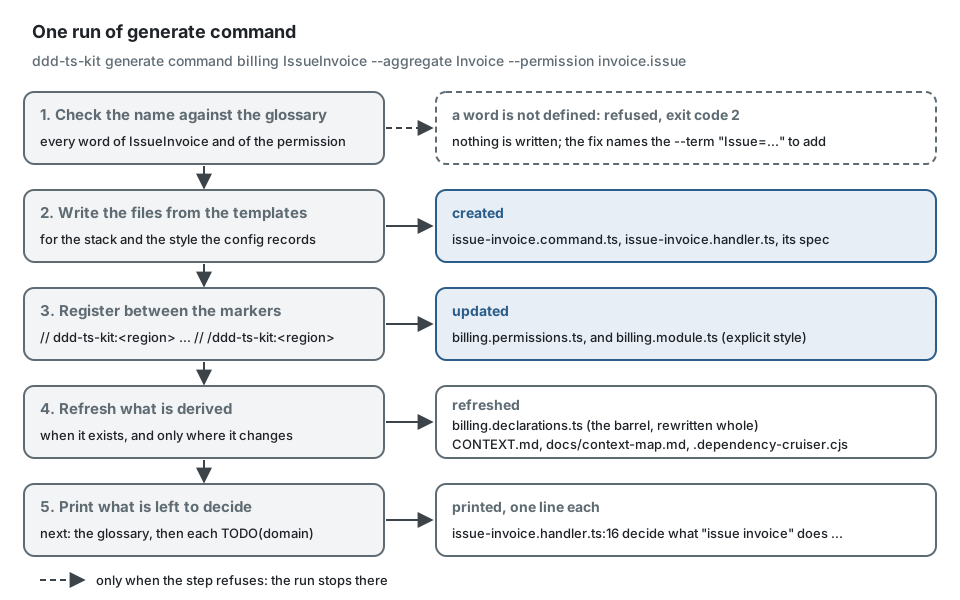
In the example application, a use case named with a word its glossary does not define is refused, and the message says how to go on:
$ npx ddd-ts-kit generate command notification ArchiveNotification --permission notification.archive --aggregate Notificationerror: "ArchiveNotification" uses "archive", which the glossary of src/contexts/notification/CONTEXT.md does not define. fix: Either use an existing term (Notification, Send, Recipient, Contact, Confirmation, Reminder, Plan, Due, Withdraw, Mailer, Kind, Request, Rescheduling, Cancellation, Read, Search), or add the term in the same command: --term "Archive=<what it means for the business>". The glossary is written before the code (rule language/glossary-term).With the term given in the same command (and --dry-run, which says what it would write):
$ npx ddd-ts-kit generate command notification ArchiveNotification --permission notification.archive --aggregate Notification \    --term "Archive=To set a sent notification aside, out of the default search" --dry-runwould create src/contexts/notification/application/commands/archive-notification/archive-notification.command.tswould create src/contexts/notification/application/commands/archive-notification/archive-notification.handler.tswould create src/contexts/notification/test/unit/archive-notification.handler.spec.tswould update src/contexts/notification/CONTEXT.mdwould update src/contexts/notification/application/authorization/notification.permissions.tswould update src/contexts/notification/notification.declarations.ts
Next, in this order: the language of the context first, then the business decisions only you can make src/contexts/notification/application/commands/archive-notification/archive-notification.command.ts:9 declare the input of "archive notification" as a constructor with the actor first, ... src/contexts/notification/application/commands/archive-notification/archive-notification.handler.ts:16 decide what "archive notification" does to a Notification: ... src/contexts/notification/test/unit/archive-notification.handler.spec.ts:38 replace each entry below by a test named after the business behaviour of "archive notification": ...| Kind | Arguments | Writes |
|---|---|---|
context |
<name> --classification <c> [--purpose "<two sentences>"] [--term ...]... [--upstream <ctx>[:relationship]]... [--preset identity] |
CONTEXT.md with its glossary, published-language/index.ts, config entry, registration in platform/compose-application.ts and in test/architecture/extractable.spec.ts; on tsyringe, with HTTP, presentation/http/<name>.routes.ts (a function of the two buses, in both styles); declared: the barrel <name>.declarations.ts; explicit and hand wiring: <name>.module.ts. application/authorization/<name>.permissions.ts is born with the first permission, or at once when platform/auth/permissions.ts lists the permission sets (rebac, custom). With --preset, the context is then written whole from that preset, its classification and purpose those of the preset unless the flags say otherwise (Presets) |
aggregate |
<context> <Name> [--event-sourced] |
aggregate, builder, spec in given / when / then; with --event-sourced, an aggregate on EventSourcedAggregate whose state is the replay of its events, born with its Created domain event, the codec of its stored events in infrastructure/persistence/<name>-events.mapper.ts, a builder that replays a history and a spec given events, and a note naming the EventSourcedRepository its repository adapter delegates to |
builder |
<context> <Aggregate> |
test/builders/<name>.builder.ts, a class extending Builder |
entity |
<context> <Name> |
entity, spec |
value-object (vo) |
<context> <Name> |
value object, spec |
vocabulary |
<context> <Name> --value <value> [--value <value>]... |
domain/vocabularies/<name>.vocabulary.ts: an object as const of the values, keyed by each value in PascalCase, and the union type of the same name; run again, adds the values the file does not hold |
domain-event |
<context> <Aggregate> <Fact> |
event named <context>.<aggregate>.<fact>, spec |
error (refusal) |
<context> <Concept> <refusal> [--code CODE] [--term ...]... |
a static factory <refusal> on domain/errors/<concept>.error.ts, the class of the errors of that concept (created when absent, extending ConceptError), and its case in test/unit/<concept>.error.spec.ts. The factory is added after the last one; run again, the command changes nothing. <Concept> is a term of the glossary (--term adds it). The code is the name of the refusal in constant case, with the concept before it when the name is one word or a code of the kit (Appointment notFound sets APPOINTMENT_NOT_FOUND); --code takes one of the forms errors/factory-name accepts. Refused: a name such as create or error1, and a code already set in the context |
domain-error |
<context> <Name> [--code CODE] |
one class per error with a stable code, spec: the form of a project whose config says "stack.refusals": "classes" or nothing. Refused under factories, with the generate error command to run instead |
domain-service |
<context> <Name> |
service, spec |
state-machine |
<context> <Aggregate> [--value <state>]... [--transition "<intention>:<from>[,<from>]...[><to>]"]... |
the vocabulary <Aggregate>Status (created from --value, two states at least, or given the values it misses), domain/state-machines/<aggregate>.state-machine.ts (<aggregate>Lifecycle: every value a state, the first one initial, the transitions asked, a TODO(domain) for the refusal of the concept error) and test/unit/<aggregate>.state-machine.spec.ts (each transition where it leads, a refusal from a state it does not leave); the aggregate is left to use it |
repository |
<context> <Aggregate> [--tenant-scoped] |
the port domain/repositories/<name>.repository.ts (abstract class <Name>Repository extends Repository<<Name>>), the adapter of the project's ORM (implements the port) with its mapper and table (or model), a fake, one repositoryContract spec run on both, registration |
command |
<context> <UseCaseName> (--permission <aggregate>.<action> [--grant <role>] | --public) [--aggregate <Name>] |
<use-case>.command.ts on AuthorizedCommand (plain Command when public), <use-case>.handler.ts (it builds the aggregate, saves it and answers: the events leave with the save), spec through the bus with the refusal of an actor who lacks the permission, registration with .requires(...) or .public() (and the repository when missing). A generated command answers void or the identifier of its aggregate, so no <use-case>.result.ts is written |
query |
<context> <UseCaseName> (--permission <aggregate>.<action> [--grant <role>] | --public) [--search] |
<use-case>.query.ts on AuthorizedQuery (plain Query when public), <use-case>.result.ts, <use-case>.handler.ts, the read port application/ports/<use-case>-reader.port.ts (an abstract class), its in-memory adapter, fake, spec, registration on the query bus. With --search (needs --permission): a kernel PageRequest in the query, the item, the sort and Page<Item> in the result file, a handler that asks Access.scope and hands the scope to the read port, an in-memory reader paging by offset or cursor |
port |
<context> <Name> |
application/ports/<name>.port.ts, one abstract class, and its fake |
route |
<context> <UseCaseName> --method <GET|POST|PUT|PATCH|DELETE> --path <p> [--command|--query] [--group <Name>] [--mapper] [--serializer] [--cache public|private|no-store] |
under "stack.routes": "controllers": a controller class in presentation/http/<resource>/<use-case>/ (the resource is the first segment of the path), depending on CommandBus or QueryBus, behind the route group of its resource, written with it when it is new (<resource>.routes.ts: prefix, tag, Authenticated); a public use case stands in no group and says guards: [Public]; with class-validator one class per file (<use-case>.params.ts, .body.ts, .answer.ts, .accepted.ts, .line.ts); --mapper and --serializer add a request mapper and a serializer the controller is given; a spec; no registration in a declared project, a controller built by hand in <context>.routes.ts (the module file with hand wiring) in an explicit one. Under "functions": a defineRoute function, its spec, its registration in <context>.routes.ts, and <use-case>-<role>.dto.ts classes |
controller |
the same arguments as route |
the controller class, whatever stack.routes says: for a project of function routes that writes its next route as a class. --cache writes its cache policy: private (a GET of a caller, max-age=0, must-revalidate, strong ETag), public (a GET of a public use case, max-age 1m, s-maxage 5m, tagged with the resources of its path), no-store; refused on a write, and public behind a route group |
file-upload |
<context> <UseCaseName> --path <p> (--permission <aggregate>.<action> [--grant <role>] | --public) [--method POST|PUT] [--group <Name>] |
an upload: a controller that declares the file it receives (its size and media types in the contract, checked as it streams), the command that carries it as a FileUpload, staged by the command bus before the transaction, the handler that records it and promotes it with the commit, and their specs. Refused without stack.storage or without an HTTP stack, with the init --force --storage local to run |
route-group (group) |
<context> <Name> [--prefix <path>] [--group <ParentName>] [--public | --role <role>] |
presentation/http/<name>.routes.ts: an empty class carrying @RouteGroup, behind Authenticated unless --public or --role says otherwise (HasRole(Role.Admin), the role read from the vocabulary of the platform, <platformDir>/auth/role.ts, which gets it when it does not hold it); with --group it refines that group and inherits from it |
guard |
<context> <Name> |
presentation/http/guards/<name>.guard.ts: a declared guard class to fill, and its spec |
representation |
<context> <UseCase> <xml|csv|media/type>[,...] |
adds produces to the @Controller of the use case, and consumes: ['application/xml'] to one that receives a body when XML is asked; says when CSV needs a page or a streamed list, and when stack.representations is not negotiated |
form |
<context> <UseCase> |
adds const form = defineForm<Infer<typeof body>>({ ... }) before the @Controller of a use case that receives a body, and form to its options: the hints of its form at GET /forms/<operationId> |
schema |
<context|shared-kernel> <Name> |
presentation/http/shared/<name>.schema.ts of the context, or presentation/<name>.schema.ts of the shared kernel: one shape of the contract declared once (a zod schema with .meta({ id }), a class-validator class, or a schema wrapped by sharedSchema), to fill; the routes use it whole, nested or in part |
integration-event |
<context> <Aggregate> <Fact> [--version n] |
defineIntegrationEvent declaration in the published language (its payload in <event>.v<n>.payload.ts with class-validator or a schema of your own), index export, the publisher application/integration/publishers/<event>.publisher.ts, spec, registration, a line of platform/audit/audited-events.ts |
integration-handler (consumer) |
<context> <upstreamContext> <eventType> |
application/integration/handlers/<name>.integration-handler.ts, a class <Name>IntegrationHandler depending on CommandBus, its spec, its idempotent subscription under the consumer name <context>.<name>; refused unless the upstream is declared |
event-handler |
<context> <Aggregate> <Fact> [--phase before-commit|after-commit] |
reaction to a domain event of the context, spec, subscription; before the commit of the unit of work by default, after it with --phase after-commit (an effect no transaction covers, at most once), and the spec runs the reaction in that phase |
projection (projector) |
<context> <Name> <event-type> |
a projector in application/projections/<name>.projection.ts, declared with @Projection('<context>.<name>') and one @On(definition) method for the integration event, which the context itself or a declared upstream publishes, and its spec; declared style only. It keeps one read model: its port is received in the constructor |
job |
<context> <Name> (--every <duration> | --cron "<expression>" [--time-zone <zone>]) --command <UseCaseName> |
application/scheduling/<name>.job.ts, a class <Name>Job implements ScheduledJob that sends the command, as systemActor('<context>.<name>') when it is protected, with execution.scheduledAt when the command takes it; test/unit/<name>.job.spec.ts, which runs the job (by name on tsyringe, application.jobs.runNow; job.run(occurrence) with hand wiring) and asserts the command it sent; its registration; its switch in platform/job-settings.ts; the grant of its system actor (below) |
background-job |
<context> <Name> --command <UseCaseName> |
application/background/<name>.background-job.ts, a class <Name>BackgroundJob implements BackgroundJob<<Name>Payload> named by its static jobName <context>.<name>, that sends the command as execution.actor when it is protected, followed by one field of <Name>Payload per other parameter of the constructor of the command (strings, numbers, booleans, literals and lists of them as written, a Date as its ISO text; anything else is refused); test/unit/<name>.background-job.spec.ts, which enqueues it with a payload of every field as a user holding the permission and runs what is due; its registration (@Background(), or builder.backgroundJob(..) in the module file). --di tsyringe only |
process (process-manager) |
<context> <Name> |
application/processes/<name>.process.ts (its state, processName, timeoutJob, isState, a first step that arms a deadline, a step that ends it in time, the step of the deadline), application/background/<name>-timeout.background-job.ts, which delivers its timeouts through ProcessRunner, and the specs of both (givenProcess, the queue of the test application). --di tsyringe only |
acl |
<context> <upstreamOrSystemName> |
translator in infrastructure/anti-corruption/, spec |
e2e |
<context> <UseCaseName> |
test/e2e/<use-case>.e2e.spec.ts driving the route of the use case: 401 without a credential, 403 without the permission, the documented status with it; for a command, one more test asserts the trace of the request, exact on names and structure, with installTestTracing() and expectSpanTree(storyOf(trace), [...]) of @ddd-ts-kit/tracing/testing (POST /invoices, then command IssueInvoiceCommand, then repository InvoiceRepository.save); needs the route |
policy |
<context> <Name> --permission <aggregate>.<action> |
application/authorization/<name>.policy.ts, spec; declared: the class carries @Policy(permission, { name }) and nothing else is written; explicit: registration in platform/auth/access-policies.ts |
gateway |
<context> <upstreamContext> <Name> |
the read contract in the upstream's published language (<name>.contract.ts, an abstract class and the token of the upstream value), the port application/ports/<name>-gateway.port.ts, an in-process adapter in infrastructure/external/ bound .as('gateway'), a fake, one contract suite; refused unless the upstream is declared |
adapter |
<context> <Port> [--kind external|gateway] [--decorators] |
infrastructure/external/remote-<port>.adapter.ts for an existing port, its spec, and on tsyringe its binding builder.bind(<Port>).toClass(Remote<Port>).as(<kind>).with(ownPolicy(retry(...), timeout(...))); with --decorators, on every stack, the class carries @Retry and @Timeout of @ddd-ts-kit/aspects/decorators on its one outbound method and is bound .with(ownPolicy()). Explicit: a port that is already bound, or hand wiring, gets a note instead of a binding. Declared: the class carries @Adapter(<Port>, { kind, aspects }), or @Gateway(<Port>, { aspects }) in remote-<port>.gateway.ts with --kind gateway, and a port that already has a declared adapter is refused |
service |
<context> |
src/apps/<context>/main.ts (kernel, platform, that context only, with its jobs: jobSettings(process.env, '<context>')), script start:<context>, a compose service behind the services profile, the knip entry, deployable: true in the config. The Dockerfile takes the entry as build argument ENTRY |
worker |
none | src/apps/worker/main.ts: the modules of main.ts, no HTTP server, no outbox relay, the jobs started whatever RUN_JOBS says, a graceful stop; script start:worker, a compose service worker behind the services profile, the knip entry, "worker": true in the config, and RUN_JOBS defaulting to false from then on, so the API stops running the jobs the worker runs. With several instances the lock has to be a real one: --cache redis binds the Redis lock, without it the generated README says the limit. A context named worker is refused |
adr |
"<title>" [--deviation <what>] [--reason "<why>"] |
docs/adr/NNNN-<slug>.md; with --deviation, the deviations entry of the config that points to it |
- The declared style, kind by kind. No token anywhere: a list names port classes.
commandandqueryput@Requires(<permissions>[...])or@Public()on the message and@CommandHandler(Message)or@QueryHandler(Message, [<UseCase>Reader])on the handler;repositorywrites@Repository(InvoiceRepository, [<storage>, ExecutionScope, Clock]), the storage beingDatabaseof the platform (drizzle, prisma),KnexContextorTypeOrmContext; the in-memory adapter of a read port isin-memory-<name>-reader.repository.ts, a role file with@Repository(<UseCase>Reader);integration-handlerwrites@IntegrationEventHandler(definition, { consumer })and is refused when the upstream does not declare the event;event-handlerand the publisher ofintegration-eventwrite@DomainEventHandler(Event), attached under theeventNamethe event class declares (the publisher with[IntegrationEventPublisher, IdGenerator]), and both are found like any role file: the composition root lists no publisher;jobwrites@Scheduled('<context>.<name>', schedule);policywrites a class with@Policy(permission, { name })and registers nothing;gatewaywrites@Gateway(<Name>Gateway, [<Name>Contract])and binds the upstream value in the marker regions ofplatform/platform.module.tsandplatform/platform-test.module.ts: a value or a factory is what a decorator cannot say;routeadds its function topresentation/http/<context>.routes.ts. A handler spec builds its test application fromplatformTestModule,contextModule('<context>', <context>Declarations), an authorization module and fakes (fake(InvoiceRepository, new FakeInvoiceRepository())). - The explicit style, kind by kind. The same files without decorators, and one line of the
module file each:
builder.bind(InvoiceRepository).toClass(DrizzleInvoiceRepository, [Database, ExecutionScope, Clock]).as('repository'),builder.command(IssueInvoiceCommand).requires(...).handledBy(IssueInvoiceHandler, [InvoiceRepository, IdGenerator, Clock]),builder.on(definition, { consumer }).handledBy(Handler, [CommandBus]),builder.job('<context>.<name>', schedule).handledBy(<Name>Job, [CommandBus]); a publisher and a domain event handler are bound under themselves and subscribed in thestartregion. With hand wiring (--di manual,--di nest) the module file is a function of thePlatform:platform.adapter(new DrizzleInvoiceRepository(...), { kind: 'repository', context, token }), which gives the repository its span and the dispatch of what it saves,platform.commands.register(Message, new Handler(...), { context }),platform.jobs.register({ name, schedule, run }). - Jobs. The schedule is validated when the job is generated, by the rules of the scheduler
(
parseJobScheduleof the kernel, pinned by a test): a duration (15m,2s, digits alone are milliseconds) or a five-field cron expression, with an IANA time zone;--time-zonewithout--cronis refused, and so is a job without--command, a command that does not exist (with the command that creates it) and a command whose constructor needs more than the actor and the instant the work is for: a job only says that the time has come, the handler finds what to act on. Parameters that are optional or have a default are left out of the call. - The grant of a job. A job whose command is protected sends it as
system:<context>.<name>, which has no right unless the model gives it one.generate jobwrites the grant where the model makes it one line, in asystem-grantsmarker region, andnextpoints at that line:--authz rbac, the id of the permission under the rolesystemofplatform/auth/roles.ts, the rolecreateAuthorizergives every system actor (systemRole);--authz abac, apermit('system-<job>', [permission], ({ actor }) => actor.id === 'system:<job>')rule inplatform/auth/attribute-policies.ts;--authz rebac, the tuplecontext:<context>#operator@system:system:<job>inplatform/auth/relate-system-actors.ts, written to the tuple store when the application starts, as long as the schema still lets asystemsubject operate a context. With--authz custom, a removed region, a remodelled relationship schema or a permission the generator cannot read, nothing is written and the job file carries theTODO(domain)naming the actor and the permission. - The barrel is derived.
<context>.declarations.tsholds oneexport *per role file, sorted by path, then oneinjected(Class, [Tokens])per class whose constructor takes something, read from its signature, with the imports they need. Everygenerate, anddocs, rewrite it;docs --checkandcheck(declarations/barrel-current) report one that a role file written by hand left behind or whose constructor changed since, naming the class (stale src/contexts/billing/billing.declarations.ts: the dependency list of IssueInvoiceHandler is stale: ...). Thedevscript loadsddd-ts-kit/dist/refresh-declarations.jsbefore the application, on every start and reload oftsx watch: a port added to a constructor is injected on the reload that follows the save. The same module is the binaryddd-ts-kit-refresh-declarations. It is laid out as Biome lays it out at a line width of 120; a project that formats at another width leaves**/*.declarations.tsand**/*.dependencies.tsout of its formatter. - Deny by default.
commandandqueryare refused without--permissionor--public. A new permission joins<context>.permissions.ts; its words are checked against the glossary like any other name. With--authz rebacthe requirement names the context as its resource, a starting point to replace by the element the right bears on. With--authz rbac,--grant <role>gives the permission to the role inplatform/auth/roles.ts(the role joinsrole.tswhen it is new); without it, anextstep says the grant is left to do (authz/granted). routehandsactorOf(context.principal)to a protected use case and setssecurity(the scheme of--authn, orfalsefor a public one).integration-handlercarriessystemActor('<context>.<name>')for the command it builds; behind a broker it listens on the subscriber of its context (EventSubscribers.forContext), its mark and its work in one unit of work.- A generated repository adapter only persists: it takes
ExecutionScopeandClock, neverActorContextnor a dispatcher, and stampscreated_at,created_by,updated_at,updated_bywithstampCreationandstampUpdate; the table usesauditColumnsof the ORM package (the five fields are written out for Prisma). The sample fact of an aggregate isregisteredAt, sincecreated_atis the audit column.repository --tenant-scoped(drizzle and knex), and every repository of a project whosestack.tenancyisshared-table, addstenantColumn, names the tenant on the insert and reaches the table through the helpers of the ORM package (tenantTableandownTenantTableon Knex,tenantConditionandownTenantConditionon Drizzle), with a spec that one tenant does not see another's rows. With another ORM the regular adapter is written and a note says what to add. adapter --decoratorsis accepted on every stack: the aspects decorators serve the standard mode and the legacy one atsconfig.jsonwithexperimentalDecoratorsimposes.routeof a--searchquery reads the page withpageQuerySchemaand answerspageSchemaOfandpageResponse. A subscription of an integration event handler that is not abuilder.onis written in thestartregion withidempotent(...)aroundinEventScope(...).- The language first. The name of an aggregate, entity, value object, domain service, domain
event, command or query is refused when one of its words is not covered by a term of the
## Ubiquitous languagetable of the context (plural, past participle and -ing forms are recognised).--term "<Term>=<meaning>", repeatable, adds the rows in the same command. Technical words (Manager,Helper,Data,Impl,Model...) and an event fact that does not read as past tense are refused too.--allow-nameoverrides the three checks;checkwill still report what the glossary does not define. - Generated code compiles as is and passes
check, the ESLint preset, dependency-cruiser and knip at the default severities: one export per file, files far under 350 lines,privatemembers, the blank-line layout. Every place that needs business knowledge carries a// TODO(domain): ...comment saying which decision is expected, and a place where an adapter is to be replaced a// TODO(platform): ...one; the only other comments say what the code cannot. - Specs hold one real passing test where it can be written generically, and
it.todoentries naming the behaviours to cover. No mock: fakes, builders, and the test application. On tsyringe a handler spec goes throughcreateTestApplicationof@ddd-ts-kit/diand observes the facts announced with the save withapplication.domainEvents.on('<name>', ...); with hand wiring it goes throughcreateTestBuses()of@ddd-ts-kit/testing, whosedispatching(fake)makes the save of a fake announce its events todomainEvents. --jsonprints{ dryRun, created, updated, skipped, next, todos, notes }.nextlists theTODO(domain)places asfile:line, the glossary first, then the lines a command wrote for the team to check (the grant of a job);todosadds their text.- A kind that needs something else to compile either creates it (a missing repository or domain event) or stops with the command that creates it (a missing aggregate, use case or route).
- Registration goes between marker comments (
// ddd-ts-kit:<region>...// /ddd-ts-kit:<region>, HTML comments in Markdown). Remove a marker and the generator prints what to add by hand. - Every
generaterefreshes the generated documentation and.dependency-cruiser.cjswhen they exist; generating twice changes nothing. --local-onlyrefuses, naming the files and writing nothing, when the run would write outside<contextsDir>/<context>/andtest/e2e/*.e2e.spec.ts.generate --help --jsonprints every kind with itsusage,aliases,summaryandwritesShared, plussharedandsharedWhen: what it writes outside its context, and when. Both serve a build split between workers (seeworker-scope).- A fake is an entry point for knip and may have no importer for dependency-cruiser: a port and its fake generated before a use case needs them fail neither analyzer. A domain service is kept alive by the spec generated with it.
Templates are plain files in templates/<kind>/, with {{name.pascal}}, {{name.camel}},
{{name.kebab}}, {{name.constant}}, {{context.kebab}} placeholders and
{{#if x}} / {{#unless x}} blocks. An unknown placeholder is an error.
ddd-ts-kit docs [--check] [--stored-events]Regenerates what is derived from the config and the code, and nothing else:
docs/context-map.md, between<!-- ddd-ts-kit:context-map -->markers: a Mermaid diagram (one node per context styled by classification, one arrow per relationship from upstream to downstream labelled with the pattern) and the table of contexts with the first sentence of their purpose, upstreams, downstreams, published events and whether they are deployable alone. The text outside the markers is kept; on first creation the four written sections are laid out with hints.- the generated lists of every
CONTEXT.md(aggregates, published events, permissions, scheduled jobs as a table of name, schedule and command, relationships); - the generated file of every declared context: the barrel
<context>.declarations.ts, with what each constructor is injected, read from its signature, or under discovery<context>.dependencies.ts, which holds that alone; - the reference of every
CONTEXT.md: the facts ofdescribe, as tables under## Reference, betweenddd-ts-kit:referencemarkers; aCONTEXT.mdthat has no such section gets it after its last generated list; docs/integration/README.md, created once and never rewritten; its Provider section starts with the strategy of the chosen broker.
--stored-events also records in stored-events.lock.json the shape of each version of a stored
event declared in the codecs of infrastructure/persistence/, never rewriting a recorded version:
run it once the shape of a version is final.
--check writes nothing, names each stale file and each declared stored-event version not
recorded in stored-events.lock.json, and exits 1. The event catalog and the
AsyncAPI document need the code of the project to run, so they are produced by
scripts/events.ts (npm run events:generate, part of npm run docs:generate).
ddd-ts-kit sdk [--check] [--dry-run]Generates the typed client of each document of the OpenAPI contract, read from the committed
openapi/*.yaml (or .json): a workspace package under clients/<document> (clients/api for
the whole contract), with no runtime dependency. Each operation is a method of createClient()
and a function of its own; its outcome is typed by status, a refusal by the error codes the
contract lists for it (x-error-codes); a credential is given per security scheme. The first
run records "sdk" in the config (init --sdk does it for a new project) and wires the
project: the workspace, the paths entry of each client in tsconfig.json, the exclusions of
Biome and knip, the scripts sdk:generate and sdk:build, and docs:generate, docs:check,
ci:docs, ci:build extended. The package.json of a client keeps its version and the keys a
team adds. Under npm, while package-lock.json does not list a client yet, it says to run
npm install and commit the lock, which npm ci would refuse. --check writes nothing, names
each stale file (and a client the lock misses) and exits 1. The comparison with
openapi-typescript, hey-api and orval, and how to publish a client:
docs/tools/client-sdk.md.
depcruise-config
Section titled “depcruise-config”ddd-ts-kit depcruise-config [--check | --write]Prints the dependency-cruiser configuration derived from ddd-ts-kit.config.json: layers,
published languages, declared upstreams, allowed packages, cycles and orphans. --write saves
it as .dependency-cruiser.cjs; --check exits 1 when the file is missing or stale, which is
what npm run depcruise runs first. Edit the config, not the file.
value-objects
Section titled “value-objects”ddd-ts-kit value-objects [--dry-run]Moves the value objects of a project from a Result to factories that return the value or
throw ("stack.valueObjects": "throwing"). What it rewrites, and what it leaves to a person, is
in CONFIG.md.
controllers
Section titled “controllers”ddd-ts-kit controllers [<context>] [--dry-run]Moves the function routes of a project, or of one context, to controller classes
("stack.routes": "controllers"). For each presentation/http/<name>.route.ts:
- the controller is written to
presentation/http/<resource>/<name>/<name>.controller.ts, the resource being the first segment of its path: the declaration keeps the method, the summary, the schemas, the one response with its description and the error codes; the handler becomeshandle, with the actor read from the request and the answer returned without its status; - one route group per resource is written (
<resource>.routes.ts: its prefix, the tags of its routes,Authenticated, andFORBIDDENwhen every route declared it); a route withsecurity: falsestands in no group and saysguards: [Public]; - the schema files named after the route follow it (
<name>-body.dto.tsbecomes<name>.body.ts), the others go toshared/under their name, and every import of a moved file is rewritten; - the spec becomes
<name>.controller.spec.tsand runs the controller without its guards; - in a declared project the list
<context>.routes.ts, its spec and its line in the composition root are removed; in an explicit one the list builds each controller by hand; - the config says
controllersonce no function route is left in the contexts.
A context is turned whole or not at all. A route that is not written as
export function <name>Route(<bus>): Route { return defineRoute(spec, async (input) => { .. }); },
that declares several responses, or whose handler answers anything else than
{ status, body } is named with the reason and its context is left as it is: function routes
keep running next to controllers. The command ends with what is left to a person: run the
formatter and ddd-ts-kit docs, move the helpers a controller kept to a request mapper or a
serializer, give the groups their guards, hold the guards in the specs.
error-factories
Section titled “error-factories”ddd-ts-kit error-factories --planddd-ts-kit error-factories --apply [--dry-run]Moves a project from one class per error (new SlotTakenError(..)) to static factories on one
error class per concept (AppointmentError.slotTaken(..)), in two steps, because which concept
a refusal is about is a decision of the model.
--plan writes error-factories.plan.json: per context, one entry per class of
domain/errors/ that extends DomainError, with its code, the concept proposed for it (the
aggregate its name starts or ends with, empty when none does) and the factory name that says
its code (APPOINTMENT_NOT_FOUND on Appointment gives notFound). Edit it: every entry
needs a concept, a term of the glossary.
--apply follows the plan and refuses an entry without a concept, a vague factory name or one
that does not say the code. It:
- writes
domain/errors/<concept>.error.ts, a class extendingConceptErrorwith one factory per class moved there: the parameters of the constructor, the message it gave tosuper, and as facts the parameters that are plain data (text, numbers, booleans, dates); - removes each class and its spec, whose cases go under
describe('<factory>')intest/unit/<concept>.error.spec.ts; - rewrites every file under the source root and
test/:new X(..)becomes<Concept>Error.<factory>(..),thenError(X)andthenError(X, code)becomethenError('<CODE>'),toThrow(X)andexpect.any(X)become an assertion on the code,toBeInstanceOf(X)becomestoMatchObject({ code }),e instanceof Xbecomes<Concept>Error.is(e, '<CODE>'), an import of the class becomes the import of its concept class, and a type names the concept class. A class of the same name in two contexts goes to the concept of its own. Comments and strings are left alone; - sets
"stack.refusals": "factories"in the config.
It leaves, and says: a class that has members of its own, reads this in its constructor or
gives options to super (written by hand); a place where a class stood as a value it cannot
translate; a property of the error that became a fact (error.personId is now
error.facts.personId); a factory with more than three parameters. And always: which facts a
client may read (none is exposed), the factories that still take a sentence as only parameter,
and the facts to assert in the specs. Run the formatter afterwards. Run again, it finds nothing
left to move. --json answers { dryRun, moved, written, removed, manual }.
build-aliases
Section titled “build-aliases”ddd-ts-kit build-aliases [--project <tsconfig>]The second step of npm run build, after the compiler. The compiler emits an import alias as
it was written (@/platform/errors), and Node resolves no alias and completes no extension:
this command rewrites, in every .js, .mjs, .cjs, .d.ts, .d.mts and .d.cts under the
output directory of the tsconfig (tsconfig.build.json by default), each alias specifier into
the relative path of the emitted file it names, with its .js extension
(../../platform/errors.js), so that node dist/src/main.js runs with no loader and no flag.
// dist/src/contexts/billing/domain/aggregates/invoice.aggregate.js, as the compiler emits itimport { InvoiceError } from '@/contexts/billing/domain/errors/invoice.error';
// the same line after ddd-ts-kit build-aliasesimport { InvoiceError } from '../errors/invoice.error.js';
It reads importAlias and importExtension of the config: @/platform/errors names
platform/errors.js under none, @/platform/errors.js names it under js, and no other
spelling is guessed.
- Rewritten: the specifier of
import ... from,export ... from, a bareimport,import('...')andrequire('...')with a string literal,import.meta.resolve('...'), and in declarationsimport type,typeof import('...')anddeclare module '...'. - Exact: the file is scanned, not searched; a string that only looks like an import, in other code, a comment, a template or a regular expression, is left alone. Lines never move and the source maps are not touched.
- Idempotent: a second run rewrites nothing.
- It exits 2 and writes nothing when an alias names no emitted file, when it names a directory
(an alias names one file:
.../published-language/index), when it is written in the spelling the config does not ask for, whenimport()is given an alias completed at run time (a template with an interpolation, a concatenation), or when the output directory does not exist. Each refusal says the file, the line and what to write instead. - A package is never touched, whatever its subpath ends with (
zod/v4/core.js,@scope/package/file.js,node:fs).
--json answers { outDir, files, changed, specifiers }. ddd-ts-kit check reports a script
that compiles without this step (imports/alias-declared). The whole mechanism:
docs/tools/import-aliases.md.
ddd-ts-kit list [--context <name>]--context restricts the answer to one context. Contexts with their classification, glossary size, upstreams, aggregates, commands, queries,
domain events, published events, integration event handlers, scheduled jobs (name, schedule, the
command each sends; jobs in --json), builders, permissions, policies, gateways and whether the
context is deployable alone, then the end-to-end specs. In the declared style the use cases, the
handlers, the policies, the gateways and the adapters are read from the decorators: a command or a
query shows what it requires (or public), a handler its consumer name and its event, a policy its
permission, an adapter its port; --json adds them under declarations. In the explicit style the
jobs are read from the builder.job(...) and platform.jobs.register(...) lines of the module file.
describe
Section titled “describe”ddd-ts-kit describe <context>One context as facts read from the config and the source text, in both styles: use cases with
their permission (or public), routes (method, path, operation id, use case, schema names, error
codes, the media types they answer and read in besides JSON, their form), consumed and published events, ports with their adapters, policies, gateways with their
upstream, scheduled jobs, upstreams and downstreams. Field lists are not guessed: they are in
openapi/openapi.yaml and docs/integration/event-catalog.md. docs writes the same facts in
each CONTEXT.md.
--json prints one object:
| Key | Value |
|---|---|
name, classification, purpose, deployable, doc |
the context, its purpose (empty until written) and the path of its CONTEXT.md |
glossary, aggregates, domainEvents, permissions |
names |
upstreams, downstreams |
{ context, relationship } |
useCases |
{ kind, name, permission, file }, kind being command or query |
routes |
{ method, path, operationId, useCase, permission, request: [{ part, schema }], responses: [{ status, schema }], errors, file }, and produces, consumes (media types besides JSON) and form (GET /forms/<operationId>) when the route declares them |
consumedEvents |
{ type, version, from, handler, consumer, file } |
publishedEvents |
{ type, versions, publishers } |
ports |
{ name, kind, adapters, file }, kind being that of its binding (repository, external, gateway) |
policies |
{ name, permission, file } |
gateways |
{ name, upstream, adapters, file } |
jobs |
{ name, schedule, command } |
contracts |
{ openapi, eventCatalog }: where the field lists are |
status, todo
Section titled “status, todo”ddd-ts-kit statusddd-ts-kit todo [<context>]status prints the Next: line of docs/architecture/plan.md, the rows of
docs/architecture/slices.md by status and by owner, and per context the TODO(domain),
TODO(platform) and it.todo left, then those outside the contexts. A missing file is not an
error. --json prints { next, slices, remaining }: next and slices are null when their
file is missing, slices holds { file, rows, byStatus, byOwner }, remaining one
{ context, domain, platform, test } per context, and one with an empty context for what is
left outside them.
todo lists those markers as file:line with their kind and their text, in the project or in one
context; --json prints { count, remaining: [{ kind, context, file, line, text }] }.
worker-scope
Section titled “worker-scope”ddd-ts-kit worker-scope <context> [--worktree <path>] [--branch <name>] [--dry-run]Prepares the place of one worker of a build split by context: creates a git worktree of the
project (../<project>-<context> by default) on the branch build/<context>, writes
.ddd-ts-kit/worker.json in it ({ "context": "<context>" }; init ignores .ddd-ts-kit/), and
prints the briefing of the worker: its scope, the generators it may run, its slices still to do
from docs/architecture/slices.md, the published languages it consumes. An existing worktree is
kept and only the file is written again; --dry-run creates and writes nothing. It needs a git
repository with one commit at least. The worker then generates with --local-only.
affected
Section titled “affected”ddd-ts-kit affected [--base <git-ref>] [--head <git-ref>] [--format text|json|github|env]What a pull or merge request has to run, read from the context map and the paths that differ
between --base and --head (HEAD by default; the merge base is used when the clone has it).
Each changed path reaches something:
- a path under a declared context reaches that context and every context downstream of it, since
their code may read its published language; a path under its
test/alone reaches that context alone, since no other context may import its tests; - a document reaches nothing that runs: a Markdown file at the root, anything under
docs/,openapi/,.claude/,.github/instructions/or.github/copilot/(the documents gate always runs); - anything else reaches everything: the platform, the shared kernel,
main.ts, the config, the lockfile, the pipeline, a directory ofsrc/contexts/the config does not declare.
Without --base, or when git cannot tell what changed (an unknown ref, a shallow clone without
the base), everything is selected: that is what the default branch and the nightly run get. The
selection is never narrower than the declared relationships, because context/declared-relationship
keeps every import between contexts inside them, and that rule runs on the whole project in every
pipeline.
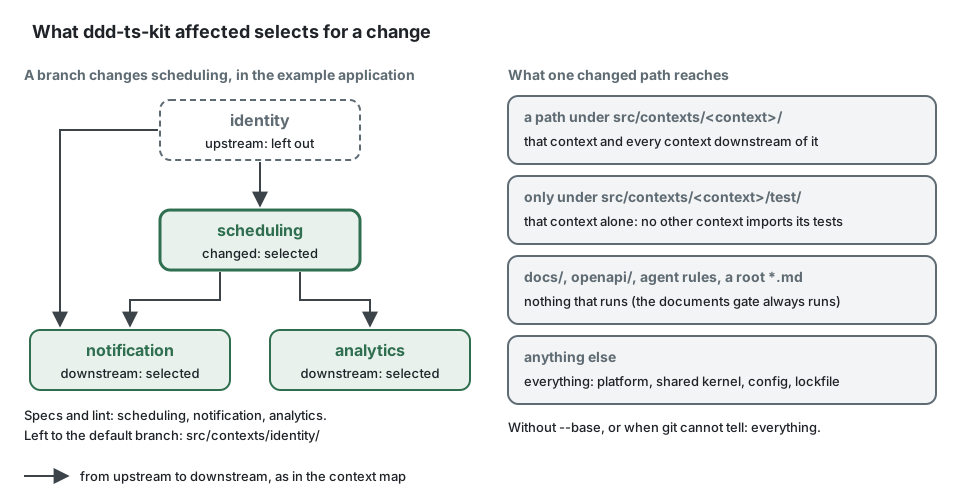
In the example application, a branch that changes one aggregate of scheduling:
$ npx ddd-ts-kit affected --base mainAffected contexts: scheduling, notification, analytics (the changed contexts and the contexts downstream of them in the context map).Specs: src/contexts/scheduling/**/*.spec.ts src/contexts/notification/**/*.spec.ts src/contexts/analytics/**/*.spec.ts !src/contexts/**Left to the default branch: src/contexts/identity/
$ npx ddd-ts-kit affected --base main --format githubscope=contextscontexts=scheduling,notification,analyticsargs=--passWithNoTestslint=--ignore-pattern src/contexts/identity/
--format github writes key=value lines for $GITHUB_OUTPUT, --format env the same keys in
upper case behind AFFECTED_ for a GitLab dotenv report, --json the selection as data
({ scope, reason, contexts, specs, leftOut }). contexts is what the test runner reads as
DDD_TS_KIT_AFFECTED, args what a partial run adds to it, lint what it adds to ESLint; the
generated pipelines wire all three.
ddd-ts-kit check [paths...] [--rule <id>]... [--format text|json|github|gitlab] [--changed-since <git-ref>] [--self]ddd-ts-kit check --clean-only <dir>... [--rule <id>]... [--format text|json|github]ddd-ts-kit check --commit-size [--staged] [--strict]Each violation has a rule id, a severity, a file, a line, a message and a fix: one sentence
saying what to do instead. Exit code 1 when there is at least one error. Suppose that the
Reminder aggregate of the example application read the system clock in its domain: an isDue()
at line 63 that calls Date.now(), where the real one receives the instant as isDue(asOf: Date).
check would report:
$ npx ddd-ts-kit check src/contexts/notification/domainsrc/contexts/notification/domain/aggregates/reminder.aggregate.ts:64  error  purity/no-system-clock  Date.now() is used in the domain layer.  fix: Receive the instant as a parameter in the domain, and take it from the Clock port (`this.clock.now()`) in a handler, so that a test fixes time with FixedClock.
1 error, 0 warnings, 0 suppressions in 772 files.
The fix is the change to make. Instead of that hypothetical method:
isDue(): boolean { return this.state.status === ReminderStatus.Planned && this.state.dueAt.getTime() <= Date.now();}write:
import { Clock, FixedClock } from '@ddd-ts-kit/kernel';
// domain: the instant is a parameter, as in the Reminder aggregate of the exampleexport class Reminder {  constructor(private readonly dueAt: Date) {}
  isDue(asOf: Date): boolean {    return this.dueAt.getTime() <= asOf.getTime();  }}
// application: the handler takes the instant from the Clock portexport class SendDueRemindersHandler {  constructor(private readonly clock: Clock) {}
  isDueNow(reminder: Reminder): boolean {    return reminder.isDue(this.clock.now());  }}
// a test fixes the timeconst handler = new SendDueRemindersHandler(new FixedClock(new Date('2026-03-02T09:00:00Z')));const due = handler.isDueNow(new Reminder(new Date('2026-03-01T09:00:00Z'))); // true
ddd-ts-kit explain <rule-id> prints the same kind of bad and good example for every rule.
pathsand--changed-sincelimit what is reported, not what is analysed.--changed-sincerunsgit diff --name-only --relative <ref>...in the project.--format githubprints::error file=...,line=...::annotations.--format gitlabprints a GitLab Code Quality report: one issue per violation,majorfor an error andminorfor a warning, with a fingerprint that does not depend on the line.- Severities come from
rulesin the config (error,warn,off). Defaulterror, excepttest/no-mocks,test/builder-required,clean/function-size,clean/no-noise-comment,clean/no-flag-argument,standard/no-parallel-interfaceand, held by ESLint,application/command-query-separation(warn).anyin a test file is always a warning. limits: { "maxParameters": 3, "maxFunctionLines": 30 }in the config setsclean/function-size.maxFunctionLinesgoes from 1 to 100: a value above is read as 100 and reported byconfig/valid, and a function of more than 100 lines is anerrorwhatever the severity of the rule (onlyoffsilences it).clean/file-size(350 lines) is not configurable.onePerFile: { "allow": [{ "file": "<path or glob>", "reason": "<why these exports are one thing>" }] }exempts files from the count ofclean/one-export-per-file, never from its file name check;*matches inside one path segment,**across segments; an entry without a reason is ignored and reported byconfig/valid.domainAllowedPackages,applicationAllowedPackagesandpublishedLanguageAllowedPackagesextend what the inner layers may import.@ddd-ts-kit/aspects,@ddd-ts-kit/audit,@ddd-ts-kit/redis,@ddd-ts-kit/scheduling,@ddd-ts-kit/sentryand@ddd-ts-kit/tracingstay refused indomain/andapplication/even when a list names them.standardInterfaces: { "<DeclaredName>": "<kernel interface to use instead>" }in the config adds names tostandard/no-parallel-interfaceover its defaults; the valuefalsedrops a default name.- Suppress one line with
// ddd-ts-kit-disable-next-line <rule-id> -- ADR-0007: <reason>. Without a reason the comment is itself a violation, and so is a reason that names no existing decision record. On the first line of a file it also covers file-level violations. --clean-onlyruns the rules that judge a file on its own (clean/stepdown,clean/function-size,clean/no-commented-out-code,clean/no-noise-comment,clean/no-escape-hatch,clean/no-hash-private,clean/blank-lines,clean/braces,clean/one-export-per-file,clean/file-size) on any directories, without a project or a config.--selfreplays the rule fixtures shipped with the CLI and exits 0 when every rule behaves as expected.
| Rule | Detects |
|---|---|
layer/domain-purity |
in domain/: a package outside domainAllowedPackages, any Node built-in, another layer, another context; any entry of @ddd-ts-kit/aspects, @ddd-ts-kit/audit, @ddd-ts-kit/redis, @ddd-ts-kit/scheduling, @ddd-ts-kit/sentry or @ddd-ts-kit/tracing, allowed or not; @ddd-ts-kit/kernel/declarations, although the kernel is allowed: the domain declares nothing |
layer/application-inward |
in application/: infrastructure/, presentation/, the platform, a package outside the allow-list, a Node built-in; any entry of @ddd-ts-kit/aspects, @ddd-ts-kit/audit, @ddd-ts-kit/redis, @ddd-ts-kit/scheduling, @ddd-ts-kit/sentry or @ddd-ts-kit/tracing, allowed or not, with where the concern belongs (the composition root, a bus middleware, an adapter, a port) |
layer/presentation-no-infrastructure, layer/infrastructure-no-presentation |
the forbidden import, inside one context |
context/published-language-only |
an import of another context outside its published-language/ |
context/declared-relationship |
an import of a published language whose context is not a declared upstream |
context/published-language-is-a-contract |
published-language/ importing anything but its allow-list and other published languages |
context/no-cycle |
a cycle in the declared upstreams, with its path |
tree/closed |
a directory outside the canonical tree and extraDirectories; a source file outside a role directory; in the declared style <context>.declarations.ts is accepted at the root of a context |
tree/context-doc |
a missing CONTEXT.md, a missing section, a classification that contradicts the config |
naming/suffix |
a file without the suffix of its role, or not in kebab-case. application/scheduling/ holds *.job.ts; a use case folder accepts *.result.ts next to its message and its handler; presentation/http/<context>.routes.ts, named after its context instead of a role, is accepted in both styles |
naming/one-concept-per-file |
several exported classes in an aggregate, entity, value object, event, command, query, handler, event handler, integration event handler or job file; in the declared style, several classes carrying a declaration decorator in one role file |
naming/search-not-list |
in a context, a method named list or list<Something> in a port (domain/repositories/*.repository.ts, application/ports/*.port.ts), in a class of infrastructure/ or in a fake of test/fakes/; under application/queries/, a folder or a file named list, list-... or list...., or a class named List or List<Something>. Properties and listAccessible (required by the Authorizer port) are not judged. Name them search...: generate query <context> Search<Things> --search |
naming/business-name |
in domain/ and application/ of a context and in the shared kernel outside presentation/, a variable, loop variable, destructured binding, parameter or property named with a generic word (target, data, item and the other words of the list, which businessNames of the config changes); the fix names the concept an initializer builds or reads when the text says it, and npx eslint --fix renames it |
test/spec-required |
an aggregate, value object, domain service, handler, domain event handler, integration event handler or job without a spec (a *.result.ts needs none) |
test/no-mocks |
vi.mock, vi.fn, vi.spyOn, their jest twins, or a mocking library in a context's tests |
test/builder-required |
an aggregate without test/builders/<name>.builder.ts |
events/name-format |
an event name that is not <context>.<aggregate>.<fact> in kebab-case with the right context |
events/name-declared-once |
a class of domain/events/ without static readonly eventName, or whose readonly name writes the name again instead of reading it |
events/defined-in-published-language |
defineIntegrationEvent outside a published language, without a payload, twice for one version; an event described by hand |
language/glossary-term |
a class of the model named with a word the glossary of its context does not define; an empty glossary; under "stack.refusals": "factories", an error class of domain/errors/ too |
language/declared-vocabulary |
a string literal whose value is a value of a closed vocabulary the project declares (an object as const exported with the union type of its name, a permission set of definePermissions), outside the file that declares it, in the place that speaks its language (its context; the platform and the route groups for the platform; everywhere for a permission id or the shared kernel); tests, published languages and the relationship schema are not judged; under "stack.literals": "named" |
language/no-technical-name |
Manager, Helper, Util, Utils, Data, Info, Processor, Wrapper, Impl, Base, Abstract, Dto, Entity, Model in a type declared under domain/ or in a use case folder |
purity/no-system-clock |
new Date() without argument, Date.now(), performance.now() in domain/ or application/ |
purity/no-ambient-randomness |
Math.random, the random source of crypto, an id library |
purity/no-environment |
process.env and friends, console, fetch, file system and network modules |
clean/stepdown |
a private method before the last public one or above its first caller; a non-exported function above its first use |
clean/function-size |
more parameters or body lines than the limits (constructors are exempt from the parameter limit, module files and describe callbacks from the line limit); any function of more than 100 lines, those included, reported as an error |
clean/no-commented-out-code |
comment lines shaped like statements |
clean/no-noise-comment |
banners, closing-brace labels, authors and dates, empty @param and @returns, a comment that only repeats the declared name, a TODO without owner or reference |
clean/no-escape-hatch |
any, a non-null assertion, @ts-ignore, @ts-nocheck, @ts-expect-error or eslint-disable without a reason |
clean/no-flag-argument |
a boolean parameter on a public method of a domain class or on execute |
clean/no-hash-private |
a #name class member: field, method, accessor, static |
clean/blank-lines |
an approximation of the layout ESLint and the formatter hold: a return whose previous line is neither blank, nor an opening brace, nor a case label; a blank line right after an opening brace or right before a closing one |
clean/braces |
an if, else, for, while or do whose body has no braces or shares a line with them, an else on a line of its own; an approximation of what ESLint (curly) and the formatter hold |
clean/one-export-per-file |
under the source root, tests apart: more than one exported class, interface or function that the allowances do not explain (the types of the signature of the main export, a type and a value sharing one name, a type with its constructors, the accessors of one private state, onePerFile.allow); a file not named after its main export in kebab-case (invoice.aggregate.ts for Invoice); an index.ts or a <context>.declarations.ts that holds anything but re-exports |
clean/file-size |
a file of more than 350 lines, sources and tests; a path with a segment generated and declaration files are exempt |
composition/only-in-module |
new X, or bind(..).toClass(X, ..) and rebind(..).toClass(X, ..), of a class imported from infrastructure/, outside the module file, main.ts, the platform and tests; in a file importing @ddd-ts-kit/di, a call of contextModule, discoverContext or .include( outside those places and apps/<context>/main.ts |
imports/alias-only |
under the source root, test/ and scripts/: an import, export ... from or import() with a relative specifier, the same directory included (the fix names the alias to write; eslint --fix writes it); an alias specifier with a . or .. segment |
imports/extension |
under the source root, test/ and scripts/: with importExtension none, an alias specifier that ends with .js, .mjs, .cjs, .ts, .mts or .cts, or that names a directory holding an index.ts; with js (or no key), an alias specifier that does not end with .js (the fix names the specifier to write; eslint --fix writes it). A package subpath is never judged |
imports/alias-declared |
an importAlias that is not @/ or $<name>/, or that is $test/, $scripts/, $generated/; a paths entry of tsconfig.json missing or different from what importAlias gives (the fix gives the entry); another paths entry under an alias; a baseUrl; a tsconfig.build.json whose paths differ; paths of knip.json mapping an alias; a script that compiles (tsc without --noEmit) and does not run ddd-ts-kit build-aliases afterwards; a script running tsx --tsconfig on another file; a vitest config at the root without tsconfigPaths: true, a jest config without the derived moduleNameMapper entries, or .dependency-cruiser.cjs without tsConfig; module and moduleResolution of tsconfig.json (or of a tsconfig.build.json that sets its own) that are not what importExtension gives: ESNext, Bundler and customConditions holding node under none, and under js a written value that is not a Node resolution; a jest mapping whose pattern does not end as the imports do. A project without package.json is not judged |
config/valid |
unknown upstream, classification, relationship, rule id, guard mode or importExtension; a context missing on disk or in the config; a commit limit that is not a positive integer |
config/suppression-needs-reason |
a suppression without a rule id or a reason (kept as an alias next to governance/recorded-deviation, which judges the reason) |
authz/declared |
in a module file, builder.command(X) or builder.query(X) without .requires( or .public( in its chain, unless the message class carries @Requires or @Public of @ddd-ts-kit/kernel/declarations; with manual or nest wiring, a command or query class absent from every requires(X, ...) and publicUseCase(X) of the module file and of application/authorization/; a defineRoute without security (the route type refuses it already, and an empty list too: this is the text-level net for a definition built loosely); in the declared style, the exported class of a *.command.ts or *.query.ts file carrying neither @Requires nor @Public |
authz/granted |
with stack.authz rbac, a permission of a context's definePermissions that neither platform/auth/roles.ts nor platform/auth/signed-in-grants.ts grants by name (by the entry of its set, its id or <context>:*); the super-admin * does not count (a warning) |
authz/in-application |
presentation/: a test on roles, isAdmin, the import of an authorizer or of Access; infrastructure/: authorize( or check( on an authorizer or access, ForbiddenError; domain/: any import of @ddd-ts-kit/auth, of the actor types of the kernel (Actor, ActorContext, Session, ExecutionContext, the authorized messages), a read of .roles or .permissions on an actor. The request glue of @ddd-ts-kit/auth (actorOf, sessionOf, resolveSession, SessionAuthenticator) is free in presentation/. presentation/ and infrastructure/: the import of Requires, Public or Policy from @ddd-ts-kit/kernel/declarations, or of the ports Access and PolicyAccess from @ddd-ts-kit/auth; they are free in application/ |
authz/actor-explicit |
in domain/ and application/: ActorContext, ExecutionScope (as a type or as a value: the class is the token of a dependency list), AsyncLocalStorageExecutionScope, ScopedActorContext, AsyncLocalStorage; .current() or .require() on an actor context or on something named scope, scopes or ...executionScope; an import of stampCreation, stampUpdate or tenantScopeOf |
authz/fields-by-schema |
under application/queries/: roles.includes(, .some(, .every(, .find(, .indexOf(, a comparison with a role, isAdmin |
aspects/outside-in |
an import of @ddd-ts-kit/aspects/decorators outside infrastructure/ of a context and the platform directory: presentation/, the module file, published-language/, the shared kernel, main.ts, any other source (domain/ and application/ are reported by the two layer/* rules instead) |
tracing/platform-only |
an import of @ddd-ts-kit/tracing or of an @opentelemetry/* package outside the platform directory, main.ts and apps/, tests included |
tenancy/scoped-statement |
with stack.tenancy other than none, in infrastructure/ of a context, tests aside: on Knex the executor used other than as an argument (executor()(, executor().from(, executor().raw(, const db = ...executor();) and any .raw(; on Drizzle, statement by statement, a read, update or delete on the executor whose where has no tenantCondition( nor ownTenantCondition( (inline or in the local it is given), an insert whose row has no tenantScopeOf(, a relational query (executor().query), a raw execute(, or the executor held in a variable; on both, a read model store built without its tenant option. A where built by another function is not followed |
standard/no-parallel-interface |
a class, interface or type alias declared as ILogger, AppLogger, LoggerService, LoggerInterface, IMetrics, MetricsService, ICache, CacheService, UserContext, CurrentUser, AuthContext, RequestContext (outside presentation/ and the platform), UserSession, AuthSession, SessionData, PaginatedResult, PageResult, PaginatedResponse, Paginated, PaginationParams, PageParams, AuditLog, AuditLogEntry, AuditRecord, IJobScheduler, JobSchedulerService, CronScheduler, TaskScheduler, IScheduledJob, CronJob, ScheduledTask, BackgroundJob, IErrorReporter, ErrorReporterService, ErrorTracker, ExceptionReporter, CrashReporter, CacheInvalidator, CacheInvalidationService, CachePurgeService, CdnPurger, I followed by a standard name (IClock, IIdGenerator, IUnitOfWork, ISession, ...) or a name of standardInterfaces; a class that implements or extends the standard interface is an adapter and is not reported |
events/outbox-required |
stack.events other than outbox with an ORM and no stack.events deviation; in domain/ and application/, the import of a broker client or of a bus or relay implementation; a publisher depending on more than IntegrationEventPublisher; a platform module that hands out a publisher and never names OutboxPublisher |
events/consumer-idempotent |
an integration event handler class (application/integration/handlers/*.integration-handler.ts) that neither carries @IntegrationEventHandler nor is registered in its module file under a consumer name; an @IntegrationEventHandler whose consumer is not a non-empty string literal; a free on( or consume( without processed; a consumer name used twice, in declarations and registrations alike |
domain-events/dispatched-on-save |
a call of pullEvents() in application/ or infrastructure/ of a context; DomainEventDispatcher imported, listed as a dependency or received by a constructor in application/commands/, application/queries/ or a repository adapter. The module file, the tests, the platform and main.ts are left alone |
domain-events/transactional-before-commit |
a domain event handler (a class of application/event-handlers/*.event-handler.ts or application/integration/publishers/*.publisher.ts, or any class carrying @DomainEventHandler) that runs before the commit and depends on Cache, CachePurger, Lock, RateLimiter, JobScheduler or EventBus of the kernel, on a port of application/ports/ that is not a persistence port (no adapter under infrastructure/persistence/, or one anywhere else under infrastructure/), on anything imported from infrastructure/, another context, the platform or a package other than @ddd-ts-kit/kernel and @ddd-ts-kit/auth; an after-commit handler (phase: 'after-commit' in its decorator, or in the third argument of every .on( of the module file that mentions it) depending on IntegrationEventPublisher. check-file leaves the adapters of a port to the whole check |
event-sourcing/state-in-apply |
in a class of domain/aggregates/ extending EventSourcedAggregate, a write to something of this (assignment, increment, mutating call) outside the constructor, static methods, apply<Fact> methods and restore; this.record(..) inside an apply method |
event-sourcing/past-tense |
in a file of domain/aggregates/ holding an event-sourced aggregate, a name imported from domain/events/ whose fact (the words after the name of the aggregate) holds no past participle, or only one spelled like its imperative at its head (SetPrice) |
event-sourcing/store-behind-repository |
EventStore, SnapshotStore, CheckpointStore, EventSourcedRepository, EventSerializer, CatchUpSubscription or InMemoryEventStore imported in domain/ or application/ |
event-sourcing/projection-never-appends |
in application/projections/ or a file declaring @Projection, EventStore or EventSourcedRepository imported; in a projection declared { feed: 'event-store' }, anything of domain/repositories/ too |
event-sourcing/upcaster-required |
a defineStoredEvent whose encode names no type, or a type not declared in the file, or a type it reaches that the file does not declare; a version above 1 without an upcaster from each version below; a version below the last one recorded in stored-events.lock.json, or a recorded version whose shape changed. ddd-ts-kit docs --stored-events records new versions and never rewrites one; docs --check fails while a declared version is unrecorded |
context/extractable |
a module file importing another context outside its published language; persistence importing another context's infrastructure or naming its schema; a handler importing another context's repository; export let or an exported new Map, Set, WeakMap at module level; deployable: true without apps/<context>/main.ts; in the declared style, a role file importing anything of a port file of another context |
governance/recorded-deviation |
a ddd-ts-kit-disable or eslint-disable comment whose reason names no ADR-<number> with a file docs/adr/<number>-*.md; a rule set to off (or to warn below its default), an extra directory, an extra allowed package, a guard other than enforce or stack.events off the outbox, without a deviations entry { what, adr, reason } pointing to an existing record |
declarations/role-declared |
declared style only: a role file (other than *.command.ts and *.query.ts, held by authz/declared; *.job.ts under application/scheduling/ with @Scheduled and *.publisher.ts with @DomainEventHandler are roles) exporting no class with the decorator of its suffix and folder, or one carrying another declaration; a declared class in a file that is not a role file; a consumer or name option that is missing, empty, a variable, a concatenation or a template with a substitution; any declaration decorator on a class under domain/ |
declarations/barrel-current |
declared style only: with stack.assembly: barrel, a missing <context>.declarations.ts or one that differs from one export * per role file sorted by path followed by one injected(Class, [Tokens]) per class whose constructor takes something (read from the signatures, with their imports); with discovery, a barrel that still exists, and a <context>.dependencies.ts that differs from those injected statements (absent is accepted while it would hold none). The message names the missing role file or the class whose list is stale. It needs the tree, so check-file does not run it |
declarations/constructor-injection |
declared style only, in a role file: on a class whose decorator lists nothing, a constructor parameter that is optional, has a default value, is a rest parameter or is destructured, has no type, or is typed by anything but one class name (type arguments aside): a union, an intersection, an array, a qualified name, a type of the language, an interface, a type alias, an enum or an unexported class of the file or of the file of the project it is imported from; a class that inherits its constructor from a class the project cannot read. Under stack.dependencies: signature, a decorator that carries a list although the constructor can be read: one that repeats it, one that differs |
ports/abstract-class |
in a port file (domain/repositories/*.repository.ts, application/ports/*.port.ts): a class that is not abstract; a member that is not an abstract method or property (static readonly tokenKey = '<text>' apart): a constructor, a body, an initializer, a private, protected or # member; an exported interface (a type alias, a data shape, is not reported) |
ports/implements-never-extends |
a class carrying @Repository(P), @Gateway(P) or @Adapter(P), or given to bind(P).toClass(C) or rebind(P).toClass(C), without implements P or with extends P; under infrastructure/, a class extending a class imported from a port file |
ports/no-token-constant |
a call of token imported from a @ddd-ts-kit/* package; Symbol(..), Symbol.for(..) or a string literal as the first argument of bind, rebind, resolve, fake or override in a file importing @ddd-ts-kit/di; an UPPER_SNAKE_CASE name in a dependency list; a file named *.ports.ts or tokens.ts |
ports/no-concrete-dependency |
a dependency list naming a class imported from infrastructure/ or from test/fakes/ of a context; in the declared style, a constructor parameter of a declared class that lists nothing, typed by such a class |
ports/value-import |
a class named in a dependency list, or given to bind or rebind, imported with import type or import { type X } |
scheduling/job-triggers-use-case |
in application/scheduling/*.job.ts: an exported class that does not implement ScheduledJob; a run that sends no command (no .execute( call); a repository in the dependency list or the constructor; an import from domain/aggregates/, domain/entities/, domain/services/ or infrastructure/. A builder.job(..) registration of a class that lives elsewhere |
scheduling/job-name |
the first argument of @Scheduled(..) or .job(..) that is not a string literal <context>.<job-name> in lower-case kebab-case with the context of its file; a systemActor(..) of a job file passing another name; one job name used twice in the project |
errors/code-unique |
under "stack.refusals": "factories", in the domain/errors/ of a context: a code set a second time, by a factory (refusal('CODE', ..)) or by a class (readonly code = 'CODE'), with the file and line of the first. The same code in two contexts is not reported |
schema/presentation-only |
under "stack.schemas": "shared": in the shared kernel outside presentation/, an import of a validation library; in domain/, application/, infrastructure/, published-language/ and the shared kernel outside presentation/, an import of a file of presentation/ of the shared kernel |
schema/no-duplicate-shape |
under "stack.schemas": "shared", in the presentation layer of one context, or in it and presentation/ of the shared kernel: a DTO class or an object schema (z.object, v.object, Type.Object) declaring the shape of another one, with the place of the original (the shared kernel, then presentation/http/shared/); two contexts are not compared, and request parameters and shapes still carrying a TODO(domain) of the generator are not judged |
errors/known-code |
under "stack.refusals": "factories", in a *.route.ts: a code of the errors list that no refusal of the context of the route sets, that no class outside the contexts sets, and that is not a code of the kit |
domain/value-object-class |
under "stack.values": "classes": in domain/value-objects/ of a context or a *.vo.ts of the shared kernel outside presentation/, no exported class or a second one, a class that extends neither ValueObject nor another value object of the project, a public constructor, a concrete class without a static method, an exported function, arrow constant or object literal (inline, listed or by default); in domain/ and in the shared kernel outside presentation/, an exported function that answers a record of data: data entries, no spread, nothing a call of the model built |
More ids belong to @ddd-ts-kit/eslint-plugin, which reads the syntax tree where this
checker reads text: domain/aggregate-encapsulation, domain/value-object-immutability,
domain/no-generic-error, application/handler-shape,
application/command-query-separation and clean/no-magic-number among them (ddd-ts-kit rules
lists them all). rules and explain show them as "checked by
@ddd-ts-kit/eslint-plugin", the config accepts them under rules, and check --rule on one of
them answers with npm run lint. One id, clean/formatted, belongs to the formatter: rules
and explain show it as "checked by Biome", and check --rule on it answers with
npm run format:check.
guard in the config (enforce, advise or off) tells the editor hook of the plugin how to
react to a violation after a write: refuse it, only report it, or stay silent. check ignores
it, apart from validating its value.
Commit size
Section titled “Commit size”check --commit-size [--staged] [--strict] counts the files and lines about to be committed
(tracked changes since HEAD and untracked files; the index only with --staged) against commit
in the config ({ "maxFiles": 20, "maxLines": 600 } by default). Generated documents, lockfiles,
.dependency-cruiser.cjs, docs/context-map.md, declaration barrels and
.ddd-ts-kit/worker.json are not counted; an untracked file over 1 MB counts no line. It names the
slices the changes belong to: a use case, a layer of a context, the platform. Advisory: exit code
0, unless --strict and over the limits. Outside a git repository it says so and exits 0. The
generated lefthook.yml runs it on the index at each commit, without blocking.
Limits
Section titled “Limits”The checker reads sources with a small lexer and a shallow reading of declarations, not with a
compiler. It follows relative specifiers, the aliases of the project (importAlias, $test/,
$scripts/, $generated/) and bare packages, and classifies files by their path: an alias
import is judged by every boundary rule exactly as the relative path to the same file.
- Comments, strings, templates and regular expressions are skipped; a regular expression in an
unusual position can hide the rest of its line.
.tsxsyntax is not understood. - Re-exports, barrels,
tsconfigpaths other than the alias and computed specifiers are not resolved, so a type reaching a layer through a barrel of an allowed layer is not seen. - Declarations: top-level
functiondeclarations and class methods are read; arrow functions assigned to constants or properties, object-literal methods and nested functions are not, soclean/stepdown,clean/function-sizeandclean/no-flag-argumentdo not judge them. clean/stepdownmatches uses by name: a helper shadowed by a local of the same name, or a private method called through another receiver thanthis, is misjudged. Protected methods are neutral.clean/no-commented-out-codeandclean/no-noise-commentare heuristics on the shape of a line: prose ending like a statement can be flagged, code written as a sentence is missed.language/glossary-termmatches word by word with a crude English inflection; it does not know synonyms, and a term of several words covers each of its words separately.purity/*looks for the listed tokens and modules; a wrapper around them goes unseen.clean/no-escape-hatchdoes not seeanyproduced by inference, nor a type assertion to another type thanany.composition/only-in-moduleseesnewandtoClasson imported names; a factory function or a re-exported adapter escapes it.events/name-formatchecks the shape and the context prefix, not the grammar of the fact.test/spec-requiredandtest/builder-requiredcheck that the file exists, not its content.authz/*,events/*andcontext/extractablematch names and shapes: an aliased import, a route definition built from a variable or a spread, an ownership test (invoice.ownerId === actor.id), a schema name in raw SQL, a cross-context transaction and a mutable exported array or object go unseen; the content ofapps/<context>/main.tsis not judged.governance/recorded-deviationchecks that the decision record exists, not what it says; a deviation entry that justifies nothing any more is not reported, andlimitsandstandardInterfacesare not governed.authz/actor-explicitknows no type:.current()or.require()without argument on a concept of the domain namedscopeis reported, an execution scope held under another name is not, andstampCreation,stampUpdateandtenantScopeOfare seen only when imported under their own name.aspects/outside-inand the outside packages of thelayer/*rules are matched on the import specifier: a decorator or a client re-exported by a file of an allowed place goes unseen.standard/no-parallel-interfacecompares whole declared names with a table and does not read the glossary: a domain concept legitimately calledAuditLogorCurrentUseris reported (drop the name instandardInterfacesor record a suppression), a copy under any other name is not, and the exemption of a class reads the names afterimplementsandextends, not what they resolve to.- A declaration decorator is seen when it sits on a top-level class and its own name is imported
from
@ddd-ts-kit/kernel/declarationsin the same file. An aliased import (Requires as Needs), a namespace import, a decorator re-exported by another module, applied by a helper or called as a function, and one on a class expression or a nested class go unseen (ESLint follows aliases and namespaces). Theconsumerandnameoptions are read only in an object literal written in the decorator call: held in a variable, spread or built by a function, they are reported as not being a string literal. authz/declaredfollows one direct import of the message from a module file.context/extractabletells a port by its file (domain/repositories/*.repository.ts,application/ports/*.port.ts): a port of another context reached through a re-export is not seen.composition/only-in-modulereports every.include(of a file importing@ddd-ts-kit/dioutside the composition places, whatever the receiver.declarations/barrel-currentcompares text exactly (line endings aside): a reformatted barrel is stale. It does not check that the composition root imports the barrel.clean/blank-linesholds the cheap part of the layout, thereturnand the padded block; the blank line after a group of declarations, aroundif,for,tryand a multiline statement and between class members is held by ESLint (@stylistic), which is authoritative and fixes it.clean/bracesreads control statements as text: a method or a property namedif,for,while,elseordois told apart by what follows it, not by a syntax tree. ESLint (curly) is authoritative for the braces and the formatter for where they go.clean/formattedis listed and explained, never judged: the formatter of the project, Biome, decides it (npm run format:check).clean/one-export-per-filereads declarations as text: the types of a signature are the exported interfaces and types whose name occurs in the text of the main export, a closed family is recognised by return type annotations and by the names of module-level bindings. A file the two analyzers judge differently is ESLint's to decide; what neither explains goes toonePerFile.allow.- The 100-line ceiling of
clean/function-sizeis judged on the functions this checker reads: an arrow function and the callback of adescribeare held by ESLint (clean-function-ceiling). - The
ports/*rules read a dependency list where it is written as an array literal: the last argument of a declaration decorator, the second of.toClass(..)and.handledBy(..). A list held in a constant or built by a function is not read.bind,rebind,resolve,fakeandoverrideare binding calls only in a file that imports@ddd-ts-kit/di.ports/implements-never-extendsreads the bound class through one direct relative or alias import; a class of a package or behind a barrel is not judged. - The constructor of a declared class is read as text, by the scanner of the checker: the
constructor of the exported class that carries the decorator of its role file, its own or
the nearest one it inherits through imports of the project. A type imported from a package
is trusted to be a class (the compiler judges the generated file, which imports it as a
value); a type reached through a barrel is trusted too. A constructor overloaded by
signatures without a body, or built by a mixin, is not read: write one plain constructor.
declarations/barrel-currentcompares text exactly, so the generated file is never reformatted by hand. scheduling/job-triggers-use-casetakes any.execute(call inrunfor a command sent; a job that executes something else, or sends its command from a helper, is misjudged.scheduling/job-namecompares literal names: a job registered under a computed name is reported for its name and escapes the uniqueness check.domain-events/transactional-before-commitreads dependencies where they are written: an array literal (the decorator,.toClass(Handler, [..])in the file of the class or in the module file) and the type of a constructor parameter, resolved through the imports of that file. A name that is not imported, a kernel port imported under another name and an effect reached without a dependency (a module-level client) are not seen. An explicit-style handler is matched to its.on(registrations by its class name or by a variable assigned fromnew <Class>(; an adapter is a class thatimplementsthe port under the name the port file exports.- Nothing constrains what
shared-kernel/,platform/andmain.tsimport.
check-file
Section titled “check-file”ddd-ts-kit check-file <path>Runs the per-file rules (layers, contexts, naming, events, language, purity, clean code, mocks, composition, suppressions) on one file without walking the project: meant for an editor or agent hook after each write. A file that is not a source of the project is ignored.
rules, explain
Section titled “rules, explain”ddd-ts-kit rulesddd-ts-kit explain <rule-id>rules lists the ids, descriptions and current severities, and says which ones ESLint checks.
explain prints the rule, why it exists, a bad and a good example, and the suppression syntax.
Development
Section titled “Development”node node_modules/@typescript/native/bin/tsc -b packages/clinpx vitest run packages/cli # the fast suitenpm run build && npm run ci:test:e2e # the slow suite: DDD_TS_KIT_E2E=1, one file after the othernode packages/cli/dist/bin.js check --selfnpm run clean:self --workspace ddd-ts-kit # the clean/* rules on this packagenpm run clean:packages --workspace ddd-ts-kit # the same rules on the sources of every other packageThe slow suite lives in test/e2e/, in its spec files and their support files; but for the
first-minute specs it generates every project with every kind, a job on an interval and one on a cron expression with a
time zone, adapter --decorators, generate service and generate worker included. It runs in
the process, without a container:
zero-violation.spec.ts(also part of the fast suite): the 39 stacks ofSTACKSintest/e2e/stacks.ts, the three loggers and both wiring families with--errors sentryamong them, passcheckanddocs --checkas generated.typecheck.spec.ts: the 36 of them the workspace can compile (jest, prisma and typeorm apart) type-check against the sources of the workspace packages.proven-stacks.spec.ts: the eight projects ofPROVENare installed as a published kit would be and held to everything their own pipeline runs:checkwith zero violation and zero warning, ESLint with the preset (the test first reads fromeslint --print-configthat the rules of ports, scheduling, file shape and layout are on), dependency-cruiser with the generated configuration, knip, their specs (each job run, byrunNowon tsyringe, and held to the command it sent, a decorated adapter, the extraction of every context), their end-to-end specs (401 without a token, 403 without the permission, 2xx with it, with tokens signed in the test, and the trace of the request as one tree), their build (the worker and the extracted service included) and their generated documents. They are the default stack, which is declared; declared with--authz rebac --broker rabbitmq --ci gitlab; declared with--orm knex --assembly discovery, alone and behind--broker natswith--errors sentry(no DSN is configured: nothing is reported, the wiring is linted, built and run); the explicit style on the default stack and on--authz rebac --broker rabbitmq --ci gitlab; and hand wiring (--di manual) on--authz abac --orm knexand on--http fastify --orm knex --broker rabbitmq --cache redis --errors sentry --logger winston.first-minute.spec.ts,first-minute-proven.spec.ts,first-minute-no-context.spec.tsandfirst-minute-two-contexts.spec.ts: a project is green from its first minute, before anything is generated. The first runs the quick start of the root README line by line as it is written, on pnpm and, in the words the README gives for it, on npm:initalone, the install and theverifythe note ofinitnames (also held to the README and theCLAUDE.mdof the project), then a context, a second one downstream of it, a use case with its route,docs:generate, with averifyat each step; and the sequence the defect of 0.1.0 was reported with, contexts asked ofinit. The second does the same on the seven other proven stacks, one package manager each in turn: no context, one, two with an upstream, a first use case. Both install for real from the packed kit and run in the package manager jobs of the pipeline (ci:test:managers). The last two take every stack the workspace can run, installed as a published kit would be, with no context and with two: no finding of the four analyzers, specs that pass, a build, and the contractsinitwrote equal to what the scripts of the project generate.package-managers.spec.ts: one project per package manager on the default stack and on NestJS with Prisma, every kind generated, installed for real from the packed kit: the frozen install of a pipeline, the build,verify, andaffectedfrom the installed CLI.first-class.spec.ts: the first-class stack,--validation class-validator --orm knex --authn keycloak --authz rebac --cache redis --http-cache varnish --audit on --errors sentry --logger pino --style declared(legacy decorator mode), three times, with--broker redis(one server for the cache and the event bus),--broker natsand--broker kafka: the same analyzers before and after the business decisions oftest/first-class-proof.ts, a failed job and a dead-lettered event reported to the reporter in memory of the test application, then a list narrowed by relationships, the audit trail read through its route, the correlation id of a request followed to the published event, that event carried from one context to the handler of another, and the whole of it asserted as one trace withexpectSpanTree.error-reporting.spec.ts:--errors sentryin both wiring families (declared on tsyringe behind RabbitMQ and the outbox, by hand without a database), installed as a published kit would be: the same analyzers without a finding, the three entry points built with the reporter as their second import, then a spec written into the project (fixtures/reported-failures.spec.ts.txt) that makes a query fail behind its route: one report on anInMemoryErrorReporter, named after the query, and one flush when the application stops; aNoopErrorReporterand a working application withoutSENTRY_DSN; and, with a DSN naming an endpoint of the loopback interface opened by the spec, exactly one event sent by the real SDK, carrying the environment, the release and the actor id, and neither the credential nor the query string of the request. No Sentry or GlitchTip server is involved.violations.spec.tsandnew-rule-violations.spec.ts: in a project of the default stack, one deliberate violation at a time has to be caught by the analyzer that holds the rule: a generic error in the domain (ESLint), a domain importing its infrastructure (dependency-cruiser), an unused export (knip), a stale barrel (the checker anddocs --check), and by both the checker and ESLint a command that says nobody may send it, a handler that no longer declares itself, an event handler named after another event, thenports/abstract-class,ports/implements-never-extends,ports/no-token-constant,ports/no-concrete-dependency,ports/value-import,clean/no-hash-private,clean/blank-lines(a gluedreturnand a padded block),clean/braces,clean/one-export-per-file,clean/file-size, the 100-line ceiling ofclean/function-size,scheduling/job-triggers-use-caseandscheduling/job-name; two jobs under one name are caught by the checker.
Events, cache and database stay in the process unless DDD_TS_KIT_TEST_REDIS_URL,
DDD_TS_KIT_TEST_NATS_URL, DDD_TS_KIT_TEST_KAFKA_BROKERS, DDD_TS_KIT_TEST_AMQP_URL and
DDD_TS_KIT_TEST_DATABASE_URL (first-class stack only, migrated by the test) name real services:
the event then really crosses the broker.