
Examples
scheduling is an appointment scheduling platform for practices, built
with the kit from a one-page statement of needs: the strategic steps of the method, one init
command, four bounded contexts built slice by slice by parallel workers, relationship-based
authorization combined with roles, one trace per booking across contexts, and a recorded run
against Keycloak, PostgreSQL, Dragonfly, Jaeger and GlitchTip. It comes with an honest
measurement of how the tooling behaved: scheduling/docs/tooling-report.md.
From the root of the repository: npm ci && npm run build && npm run example:verify.
This page is the way in: what the example is made of, how it was built, one request followed through its code, and how to run it. The README of the example then says, concept by concept, which file to open.
What is in it
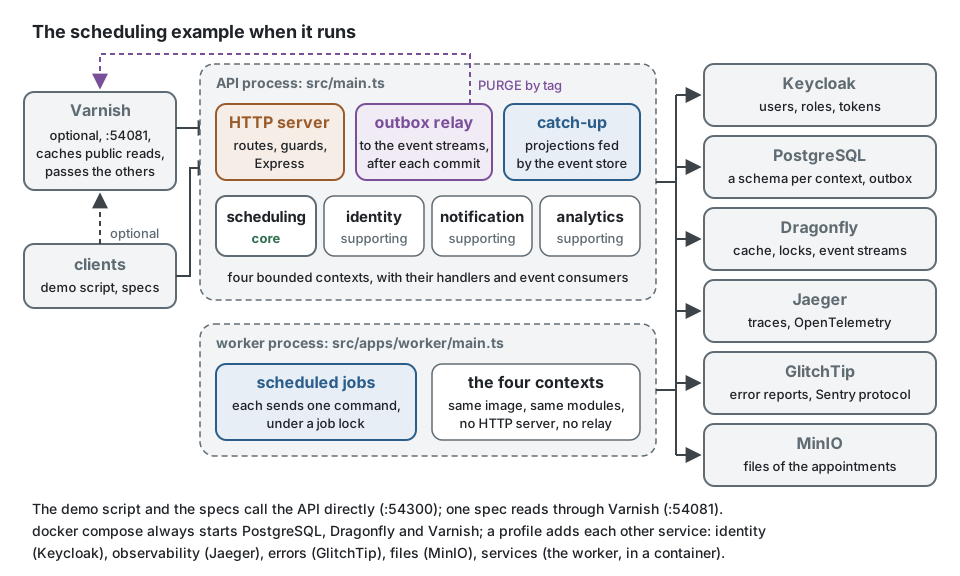
Section titled “What is in it”One deployable application and a worker process, built from the same image. Both compose the same four bounded contexts; the API process also serves HTTP, relays the outbox and keeps the projections fed by the event store up to date, the worker runs the scheduled jobs.
| Context | Kind | What it holds |
|---|---|---|
scheduling |
core | calendars and their opening hours across daylight-saving days, appointments from booking to completion with one hold per slot, the waitlist, the attendance record kept as its events |
identity |
supporting | people, the practices they work in, their roles there, and what a practitioner delegated to an assistant |
notification |
supporting | one notification per event and recipient, one reminder 24 hours before an appointment |
analytics |
supporting | the outcome of each appointment; the occupancy of a calendar, measured when it is read |
A context never imports the model of another, only its published-language/: the contexts
collaborate by versioned integration events,
written to the outbox in the transaction of the change and published after the commit (the
context map gives the pattern of each pair, the
integration notes the events). The audit trail is a
capability of the platform, not a context.
How it was built
Section titled “How it was built”Every step of the method left a document, so the build can be read, and replayed, in order.
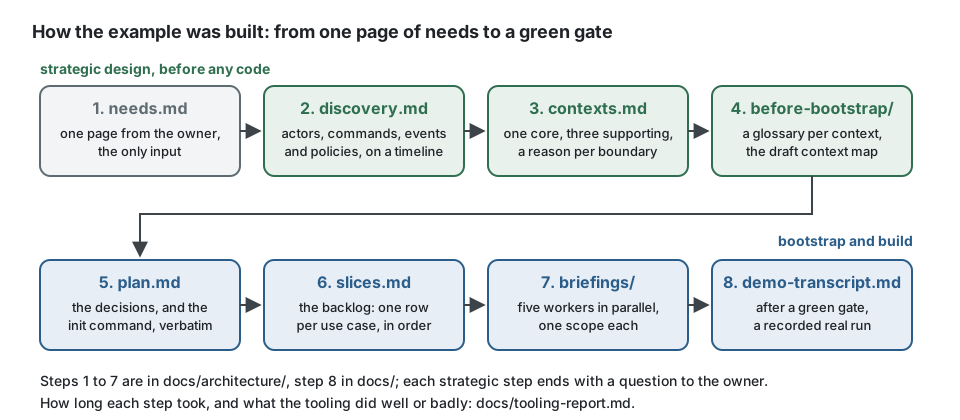
| Step | Read | What it shows |
|---|---|---|
| 1 | needs.md | the only input: one page written by the product owner |
| 2 | discovery.md | a light event storming in writing: actors, commands, domain events, policies, read models |
| 3 | contexts.md | the four contexts, their classification, and the cuts that were rejected |
| 4 | before-bootstrap/ | the glossary and the draft context map that the bootstrap consumed |
| 5 | plan.md | the decisions taken with the owner, and the init command, verbatim |
| 6 | slices.md | the backlog: contracts and skeletons first, then one row per use case |
| 7 | briefings/ | what each of the five parallel workers was given |
| 8 | demo-transcript.md | after a green gate, a real run against the services of the example |
The whole stack is chosen by one command. This is the one recorded in plan.md; in this
repository the CLI is node ../../packages/cli/dist/bin.js, run from examples/scheduling:
npx ddd-ts-kit init --http express --validation class-validator --di tsyringe --style declared \ --assembly barrel --orm knex --database postgres --events outbox --broker redis --cache redis \ --authn keycloak --authz rebac --audit on --errors sentry --logger pino --docs-ui swagger \ --ci both --jsonThen one generate context per context, with its terms, and every file of a slice from the
generator: the tooling report counts 213 generator runs
that succeeded and 27 that the generator refused.
Follow one request through the code
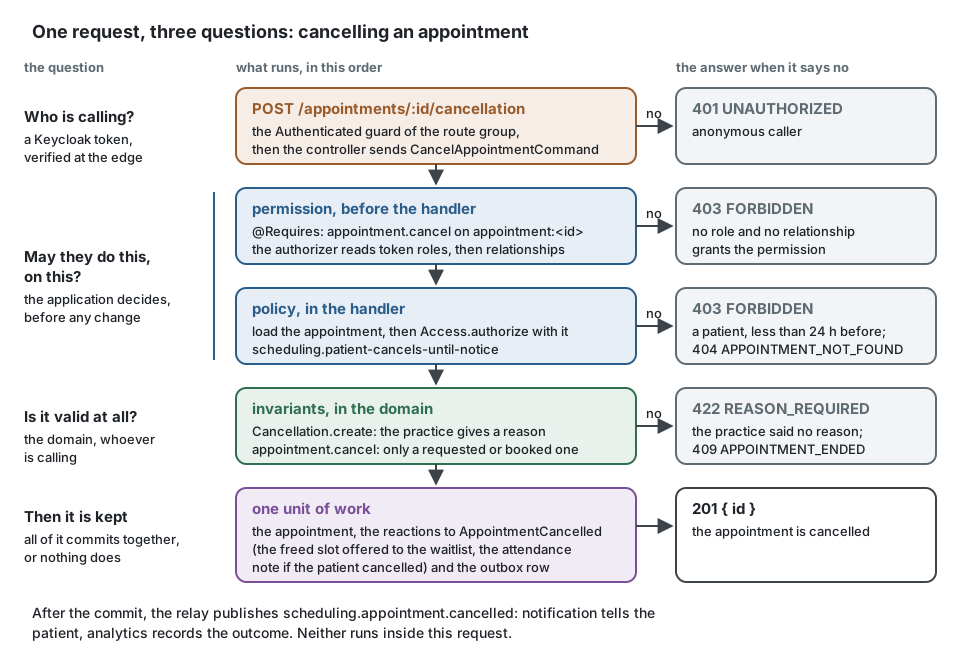
Section titled “Follow one request through the code”The best way into the code is one request. Here a patient, or someone of the practice, cancels
an appointment: POST /appointments/:id/cancellation. On its way it meets three questions, each
answered in one place and nowhere else: who is calling (the token, at the edge), may they do
this on this appointment (the application, before anything changes), and is it valid at all
(the domain, whoever is calling).
The application decides who may. The permission is data of the context; the command says which permission it requires and on which element; the rule that needs the loaded appointment is a named policy. This is the code of the example, shortened (the declarations of the context use the legacy decorators, as the example does):
import { definePermissions, type PolicyContext } from '@ddd-ts-kit/auth';import { AuthorizedCommand, isAuthenticated, type Actor } from '@ddd-ts-kit/kernel';import { Policy, Requires } from '@ddd-ts-kit/kernel/declarations';
// Declared here so that the sample compiles alone: in the example, it is the aggregate.declare class Appointment {  readonly patientId: string;  readonly slot: { readonly startsAt: Date };}
// application/authorization/scheduling.permissions.tsexport const schedulingPermissions = definePermissions('scheduling', {  'appointment.cancel': { description: 'Patient cancels until notice' },});
// application/commands/cancel-appointment/cancel-appointment.command.ts@Requires(schedulingPermissions['appointment.cancel'], {  resource: (command: CancelAppointmentCommand) => ({ type: 'appointment', id: command.appointmentId }),})export class CancelAppointmentCommand extends AuthorizedCommand<string> {  constructor(    actor: Actor,    readonly appointmentId: string,    readonly reason?: string,  ) {    super(actor);  }}
// application/authorization/patient-cancels-until-notice.policy.tsconst NOTICE_IN_HOURS = 24;const HOUR = 60 * 60_000;
@Policy(schedulingPermissions['appointment.cancel'], { name: 'scheduling.patient-cancels-until-notice' })export class PatientCancelsUntilNoticePolicy {  appliesTo(subject: unknown): subject is Appointment {    return subject instanceof Appointment;  }
  allows(actor: Actor, appointment: Appointment, { now }: PolicyContext): boolean {    if (!isAuthenticated(actor)) {      return false;    }
    // Anybody else who holds the permission acts for the practice, at any time.    return actor.id !== appointment.patientId || appointment.slot.startsAt.getTime() - now.getTime() >= NOTICE_IN_HOURS * HOUR;  }}
Nothing here names a role or a relationship. Who holds scheduling:appointment.cancel on
appointment:<id> is the business of the authorizer of the platform: the patient relationship
written at booking, or a relationship to the desk of the calendar (its practitioner, an
assistant it was delegated to, a manager of the practice)
(ADR 0001
explains how roles and relationships are combined).
The handler asks, the domain refuses. The handler loads the appointment, asks the policies with it, and leaves the rest to the domain: a value object that refuses a cancellation by the practice without a reason, and an aggregate whose state machine refuses to change an appointment that has ended.
import { Access, definePermissions } from '@ddd-ts-kit/auth';import { AuthorizedCommand, ConceptError, ValueObject, type Clock } from '@ddd-ts-kit/kernel';import { CommandHandler } from '@ddd-ts-kit/kernel/declarations';
// Declared here so that the sample compiles alone: they are files of the context in the example.declare class Appointment {  readonly id: string;  readonly patientId: string;  cancel(cancellation: Cancellation, now: Date): void;}declare abstract class AppointmentRepository {  findById(id: string): Promise<Appointment | undefined>;  save(appointment: Appointment): Promise<void>;}declare class CancelAppointmentCommand extends AuthorizedCommand<string> {  readonly appointmentId: string;  readonly reason?: string;}const schedulingPermissions = definePermissions('scheduling', {  'appointment.cancel': { description: 'Patient cancels until notice' },});
// domain/errors/appointment.error.ts: a refusal has a stable code; the platform maps it to a status.export class AppointmentError extends ConceptError {  static notFound(appointmentId: string) {    return AppointmentError.refusal('APPOINTMENT_NOT_FOUND', `Appointment ${appointmentId} does not exist.`, {      appointmentId,    });  }
  static reasonRequired() {    return AppointmentError.refusal('REASON_REQUIRED', 'The practice gives a reason when it cancels an appointment.');  }}
// domain/value-objects/cancellation.vo.ts: the invariant holds whoever is calling.type CancellationProps = {  readonly by: 'patient' | 'practice';  readonly reason: string | undefined;};
export class Cancellation extends ValueObject<CancellationProps> {  private constructor(props: CancellationProps) {    super(props);  }
  /** A patient may cancel without a word; the practice says why. */  static create(by: 'patient' | 'practice', reason?: string): Cancellation {    const given = reason?.trim() ?? '';
    if (by === 'practice' && given.length === 0) {      throw AppointmentError.reasonRequired();    }
    return new Cancellation({ by, reason: given.length === 0 ? undefined : given });  }}
// application/commands/cancel-appointment/cancel-appointment.handler.ts@CommandHandler(CancelAppointmentCommand)export class CancelAppointmentHandler implements CommandHandler<CancelAppointmentCommand> {  constructor(    private readonly appointmentRepository: AppointmentRepository,    private readonly access: Access,    private readonly clock: Clock,  ) {}
  async execute({ actor, appointmentId, reason }: CancelAppointmentCommand): Promise<string> {    const target = await this.appointmentRepository.findById(appointmentId);
    if (target === undefined) {      throw AppointmentError.notFound(appointmentId);    }
    // The policies of the permission, with the loaded appointment: 403 when one says no.    await this.access.authorize(actor, schedulingPermissions['appointment.cancel'], target);
    const cancellation = Cancellation.create(actor.id === target.patientId ? 'patient' : 'practice', reason);
    target.cancel(cancellation, this.clock.now());
    await this.appointmentRepository.save(target);
    return target.id;  }}
The handler opens no transaction and publishes nothing: the command bus runs it in a unit of
work. The handlers of the domain event AppointmentCancelled run in the same transaction (the
freed slot is offered to the waitlist, and a publisher writes the integration event
scheduling.appointment.cancelled to the outbox), and all of it commits together, or nothing
does. After the commit, the relay publishes the event: notification tells the patient and
analytics records the outcome, outside this request.
A practice it shows: a rule about rights is a policy, not an if in the handler. Instead of
testing the actor in the handler:
// Found by nobody who reads the permissions, tested only through the handler, and the context now names a role.if (actor.roles.includes('patient') && appointment.slot.startsAt.getTime() - now.getTime() < 24 * HOUR) { throw new ForbiddenError('Too late to cancel');}write the rule as a policy of the permission, as above: Access.authorize runs it, its name is
the reason of the refusal, it has a spec of its own (listed below), and the contexts keep
naming permissions only. The rule
authz/in-application says where a right is
decided; Authentication and authorization
explains why.
The files, under examples/scheduling/ (<s> stands for src/contexts/scheduling):
| Part | File |
|---|---|
| route | <s>/presentation/http/appointments/cancel-appointment/cancel-appointment.controller.ts |
| command and its permission | <s>/application/commands/cancel-appointment/cancel-appointment.command.ts |
| handler | <s>/application/commands/cancel-appointment/cancel-appointment.handler.ts |
| policy and its spec | <s>/application/authorization/patient-cancels-until-notice.policy.ts, <s>/test/unit/patient-cancels-until-notice.policy.spec.ts |
| value object | <s>/domain/value-objects/cancellation.vo.ts |
| aggregate and its state machine | <s>/domain/aggregates/appointment.aggregate.ts, <s>/domain/state-machines/appointment.state-machine.ts |
| reactions in the same transaction | <s>/application/event-handlers/appointment-cancelled.event-handler.ts, <s>/application/integration/publishers/appointment-cancelled.publisher.ts |
| the status of each refusal | src/platform/http/error-statuses.ts |
| the whole path, end to end | test/e2e/journey-authorization.e2e.spec.ts |
Run it
Section titled “Run it”The gate, without any container. From the root of the repository:
npm ci && npm run build && npm run example:verifyexample:verify runs two things:
| Part | What it proves |
|---|---|
npm run verify of the example |
types, lint with the kit's preset, format, unit and adapter tests with coverage, end-to-end specs, the architecture rules (ddd-ts-kit check), the import graph, dead code, and the drift of the generated documents |
npm run example:conformance |
every rule of the catalogue is broken once in a copy of the example and must be reported, on the file that breaks it, by every analyzer that holds it; the untouched copy reports nothing |
The real run. With Docker, the example starts its own PostgreSQL, Dragonfly, Varnish, Keycloak, Jaeger and GlitchTip, then a script plays the scenario of the demo transcript with real tokens: the three commands are in Run it in three commands, and the users of the demo in Demo users.
Where to read next
Section titled “Where to read next”- The README of the example: what the example shows and where to look, the business rules by context, the authorization model with two worked cases, the trace of a booking.
- Context map and Integration: how the four contexts collaborate.
- The decisions: ADR 0001 (roles and relationships in one authorizer), ADR 0002 (superseded), ADR 0003 (one network of practices is one tenant), ADR 0004 (the attendance records wait for a tenant in the event store).
- Tooling report: how long each step took, what the generator refused, the defects found in the kit and what is not built.