
Delivery guarantees and idempotent consumers
Summary. Integration events in this kit are delivered at least once: every event reaches every consumer, possibly more than once, in no guaranteed order. Exactly-once delivery is not on offer, here or elsewhere, because a sender cannot tell a lost message from a lost acknowledgement. What can be built is exactly-once effect: a consumer that records, in the same transaction as its own state change, that it has processed an event, and skips it the second time. This page explains the guarantee, the processed-event store, why it lives in the database, what ordering costs and where failed events go.
Three delivery guarantees
Section titled “Three delivery guarantees”| Guarantee | Meaning | Price |
|---|---|---|
| at most once | send and forget; a failure loses the message | none; events are lost |
| at least once | resend until acknowledged; a failure duplicates the message | consumers must tolerate duplicates |
| exactly once | each message delivered a single time | not achievable between independent systems |
Why the third does not exist: the relay publishes appointments.appointment.booked and the
connection drops before the acknowledgement arrives. Did the broker take it? The relay cannot
know. If it resends, the event may be delivered twice; if it does not, the event may be lost.
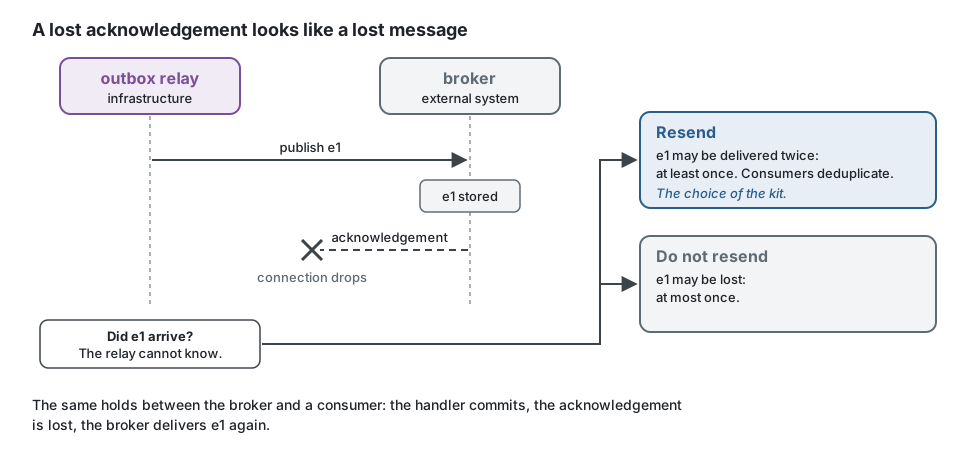
The same holds between the broker and the consumer: the handler commits, the acknowledgement is lost, the broker redelivers. Products that advertise exactly-once semantics achieve it inside their own boundary (for example a Kafka transaction covering Kafka topics and offsets), not across a broker and an application database (Kleppmann, chapter 11).
Duplicates are therefore normal operation, not an incident. In the kit they come from: a relay retry after a lost acknowledgement, a relay restarted between publishing and marking, a broker redelivery after a consumer crash, an operator replaying dead letters.
Idempotent consumers
Section titled “Idempotent consumers”A consumer is idempotent when handling the same event twice leaves the same state as handling it
once. Some operations are naturally so ("mark the appointment as cancelled"). Most are not:
notifications handling appointments.appointment.booked twice would schedule two reminders.
The general mechanism is a processed-event store: a table keyed by consumer name and event id.
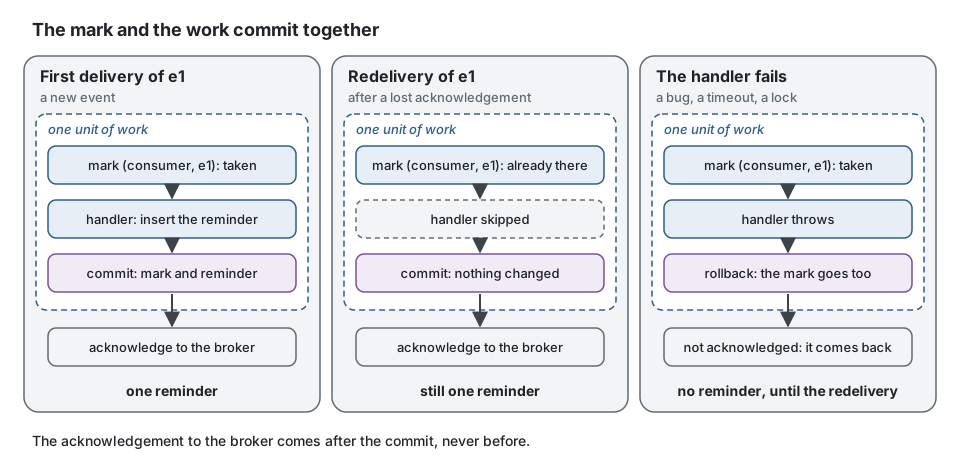
The decisive detail is that the mark and the state change commit together:
- if the handler fails, the mark is rolled back with the rest and the redelivery is processed;
- if the handler succeeds, the mark is durable and the redelivery is skipped;
- the acknowledgement to the broker comes after the commit, never before.
The kit does this for a declared integration event handler without code in the handler: the
mark and the work run in one unit of work, and the command the handler sends joins that
transaction. The rule is events/consumer-idempotent: every consumer has a stable, unique
consumer name and deduplicates through a processed-event store.
A declared handler only names its consumer; the platform subscribes it with the processed-event store and the unit of work bound in the container:
import { defineIntegrationEvent, type PayloadOf } from '@ddd-ts-kit/events';import { Command, CommandBus, type IntegrationEvent } from '@ddd-ts-kit/kernel';import { IntegrationEventHandler } from '@ddd-ts-kit/kernel/declarations';import { zodSchema } from '@ddd-ts-kit/validation/zod';import { z } from 'zod';
// appointments/published-language/appointment-booked.v1.integration-event.tsexport const appointmentBooked = defineIntegrationEvent({  type: 'appointments.appointment.booked',  version: 1,  payload: zodSchema(z.object({ appointmentId: z.string(), startsAt: z.iso.datetime() })),});
// notifications/application/commands/schedule-reminder/schedule-reminder.command.tsexport class ScheduleReminder extends Command {  constructor(    readonly appointmentId: string,    readonly startsAt: string,  ) {    super();  }}
// notifications/application/integration/handlers/remind-on-appointment-booked.integration-handler.ts@IntegrationEventHandler(appointmentBooked, { consumer: 'notifications.remind-on-appointment-booked' })export class RemindOnAppointmentBooked implements IntegrationEventHandler<PayloadOf<typeof appointmentBooked>> {  constructor(private readonly commands: CommandBus) {}
  // no deduplication here: the mark, this command and its writes commit in one unit of work  async handle(event: IntegrationEvent<PayloadOf<typeof appointmentBooked>>): Promise<void> {    await this.commands.execute(new ScheduleReminder(event.payload.appointmentId, event.payload.startsAt));  }}
Without the container, consume of @ddd-ts-kit/events gives a plain function the same
semantics. Here the broker is played by hand and delivers the same event twice; the reminder is
scheduled once:
import { consume, defineIntegrationEvent } from '@ddd-ts-kit/events';import { InMemoryProcessedEventStore, InMemoryUnitOfWork } from '@ddd-ts-kit/kernel';import { zodSchema } from '@ddd-ts-kit/validation/zod';import { z } from 'zod';
const appointmentBooked = defineIntegrationEvent({  type: 'appointments.appointment.booked',  version: 1,  payload: zodSchema(z.object({ appointmentId: z.string(), startsAt: z.iso.datetime() })),});
const reminders: string[] = [];
const remindOnBooked = consume(  appointmentBooked,  {    consumer: 'notifications.remind-on-appointment-booked', // an identity: a literal, never a class name    processed: new InMemoryProcessedEventStore(), // in production, the store of the ORM package    unitOfWork: new InMemoryUnitOfWork(), // in production, the transaction of the database  },  async (event) => {    reminders.push(event.payload.appointmentId);  },);
const e1 = appointmentBooked.create(  { appointmentId: 'a-17', startsAt: '2026-11-02T09:00:00Z' },  { id: 'e1', occurredAt: new Date('2026-10-13T08:00:00Z') },);
export async function deliverTwice(): Promise<number> {  await remindOnBooked.handler(e1); // first delivery: handled  await remindOnBooked.handler(e1); // redelivery after a lost acknowledgement: skipped
  return reminders.length; // 1}
The consumer name is an identity
Section titled “The consumer name is an identity”The name (notifications.remind-on-appointment-booked) keys the processed-event table and,
behind a broker, names the queue, the consumer group or the durable subscription. It is written
as a literal and survives the renaming of a class. Renaming it creates a new consumer that has
processed nothing: on a provider that retains history, it replays that history.
Why the store is not in Redis
Section titled “Why the store is not in Redis”A mark in one system and a state change in another are a dual write again. A crash between the two either loses the event (mark kept, change rolled back) or processes it twice (change committed, mark missing). The Redis package says it explicitly and ships no processed-event store; the stores are those of the ORM packages, in the unit of work of the consumer.
One case to mind, from the events README: a consumer registered with a processed-event store but without a unit of work takes its mark before the handler runs. With a transactional store, a failing handler then leaves the mark committed and the redelivery is skipped: the event is lost for that consumer. Use the unit of work, or a store that can release its mark.
When the handler calls the outside
Section titled “When the handler calls the outside”The transaction covers the database, not an email provider. If notifications sends an SMS
inside the handler and the commit then fails, the redelivery sends it again. Options, in order
of preference: make the outside call idempotent with a key derived from the event id, when the
provider supports one; record the intent in the transaction and let a separate, repeatable step
send it; accept the rare duplicate when it is harmless, and say so.
Instead of a handler that hides the failure of the provider:
async handle(event: IntegrationEvent<AppointmentBookedV1>): Promise<void> { try { await this.sms.send({ clientId: event.payload.clientId, text: 'Your appointment is booked.' }); } catch (error) { this.logger.warn('sms failed', { error }); // acknowledged: the event is lost for this consumer }}write one that lets the error reach the provider, which retries and then dead-letters, and that gives the outside call a key the provider deduplicates on:
import type { IntegrationEvent } from '@ddd-ts-kit/kernel';
// application/ports/sms-sender.port.ts: what notifications needs from the SMS provider;// its adapter looks the phone number up, so the event carries no personal dataexport abstract class SmsSender {  abstract send(message: { readonly clientId: string; readonly text: string; readonly idempotencyKey: string }): Promise<void>;}
interface AppointmentBookedV1 {  readonly appointmentId: string;  readonly clientId: string;}
export class ConfirmByText {  constructor(private readonly sms: SmsSender) {}
  async handle(event: IntegrationEvent<AppointmentBookedV1>): Promise<void> {    // a redelivery sends the same key: a provider that honours it sends the text once    await this.sms.send({      clientId: event.payload.clientId,      text: 'Your appointment is booked.',      idempotencyKey: `notifications.confirm-by-text:${event.id}`,    });  }}
Ordering
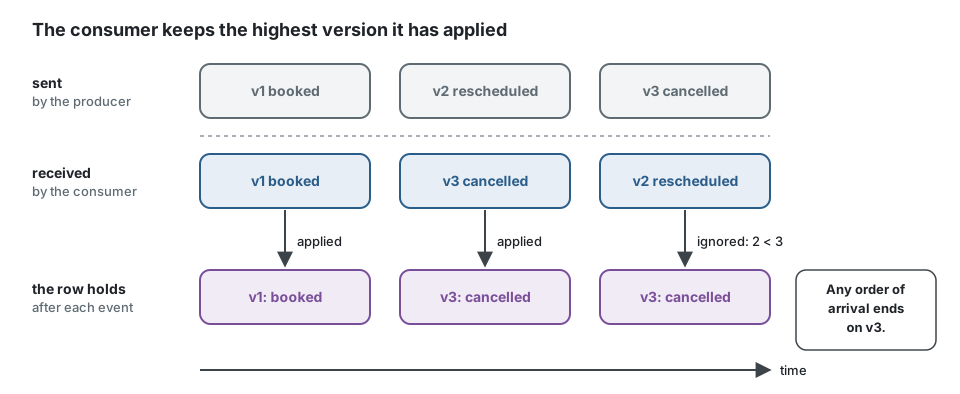
Section titled “Ordering”By default ordering is not guaranteed, not even for the events of one aggregate: a failed record is retried while its successors go out, several relays or consumer instances interleave, and a redelivery comes back after the messages that followed.
So appointments.appointment.cancelled can reach availability before the rescheduled that
preceded it. Three ways to cope, cheapest first:
-
Make order irrelevant. Carry a version or a sequence of the aggregate in the payload; the consumer keeps the highest it has applied and ignores anything older. This works on every provider and is what the provider READMEs recommend.
The kernel compares stamps for you:
stampOf(event, version)andisNewer, the rule the read model stores apply inupsertIfNewer:import { isNewer, stampOf, type EventStamp, type IntegrationEvent } from '@ddd-ts-kit/kernel';interface SlotChanged {readonly slotId: string;readonly version: number; // per slot, set by the producerreadonly state: 'open' | 'taken';}interface SlotRow {readonly state: 'open' | 'taken';readonly stamp: EventStamp;}/** Set the slot to what the event says, if the event is newer than what the row holds. */export function applySlotChanged(row: SlotRow | undefined, event: IntegrationEvent<SlotChanged>): SlotRow {const stamp = stampOf(event, event.payload.version);if (row !== undefined && !isNewer(stamp, row.stamp)) {return row; // older, or the same event again: nothing changes}return { state: event.payload.state, stamp };} -
Make handlers commutative where the business allows: "set the slot state to what this event says, if newer" instead of "toggle".
-
Ask for order per key. The relay can hold back a record while an earlier record of the same key is unpublished, and a log such as Kafka keeps the order of a partition.
Per-key ordering has stated caveats (events README): it needs a single relay; one event that cannot be published blocks every later event of its key until it goes out or is dead; a restart forgets which record blocks which key, so strict order across restarts is not provided; the broker and the consumer must keep the order too (one partition or one queue with a single active consumer per key, and no out-of-order retry). Among the kit's providers, the Kafka README describes itself as the one to choose when the order of an aggregate's events matters; RabbitMQ and NATS state "no ordering".
Order across aggregates or across contexts is never available. A flow that needs it is a process with explicit steps: see Sagas and process managers.
When a handler keeps failing
Section titled “When a handler keeps failing”A handler throws; the provider retries a bounded number of times with a delay; then the event is moved aside as a dead letter (a dead queue, a dead-letter topic or stream, depending on the provider). A message that cannot even be parsed as an envelope is poison and goes there directly. Rules that follow:
- let the handler throw: swallowing the error acknowledges the event and loses it;
- a dead letter is an alert, not a log line: the destination must be empty in normal operation;
- replay after fixing the cause; replaying a poison message only kills it again;
- only codes travel with a dead letter, never error messages, which may quote payload data.
Two more facts shared by the providers of the kit:
- A redelivery runs every handler of the consumer for that type again, those that succeeded included. Each handler deduplicates on its own consumer name.
- The retry delay is constant in the four broker providers: no exponential backoff on the consuming side.
Limits and when not to use it
Section titled “Limits and when not to use it”- The processed-event table grows. The kit's READMEs do not describe a purge for it; plan one by age, longer than the longest possible redelivery and replay horizon. (Not provided by the kit as far as its READMEs say.)
- Deduplication is per consumer and per event id. Two different events describing the same fact (a producer bug, a re-emission with a new id) are not caught: that needs a business key and a unique constraint.
- Idempotency does not give order, and order does not give idempotency. They are separate designs.
- A unit of work per event holds a transaction for the duration of the handler. Slow handlers hold connections; with Prisma, interactive transactions are time-bounded by default.
- It needs a transactional store on the consumer side. A consumer without a database uses the in-memory store that can release its mark, which protects one process only.
- When not to bother: a consumer whose effect is naturally idempotent and cheap (overwrite a cache entry). The rule still asks for a consumer name and a store; lowering it is a recorded deviation.
Sources
Section titled “Sources”- Martin Kleppmann, Designing Data-Intensive Applications, O'Reilly, 2017, chapter 11 (message delivery, idempotence, exactly-once) and chapter 8 (unreliable networks).
- Chris Richardson, "Idempotent consumer", https://microservices.io/patterns/communication-style/idempotent-consumer.html
- Gregor Hohpe and Bobby Woolf, Enterprise Integration Patterns, Addison-Wesley, 2003 (Idempotent Receiver, Dead Letter Channel, Resequencer).
- Pat Helland, "Idempotence Is Not a Medical Condition", ACM Queue, 2012.
- Apache Kafka documentation, "Message Delivery Semantics", https://kafka.apache.org/documentation/#semantics
- READMEs of
@ddd-ts-kit/events,@ddd-ts-kit/redisand the broker packages.