
Scheduling: the example application of ddd-ts-kit
An appointment scheduling platform for practices, built with the kit the way a user of the kit
would build it: from a one-page statement of needs, through the strategic steps of the method,
one init command, then the bounded contexts slice by slice, by several workers in parallel.
It exists for two things: to show what the tool yields on business rules that are not trivial
(availability across daylight-saving days, one hold per slot under concurrency, rights that
depend on relationships), and to measure honestly how the tool behaved
(docs/tooling-report.md).
Four bounded contexts in one deployable application and a worker process: scheduling (core),
identity, notification, analytics. Express, class-validator, tsyringe in the declared
style, Knex on PostgreSQL, the transactional outbox, one Redis protocol server (Dragonfly) for
the cache, the rate limiter, the job lock and the event streams, Keycloak, relationship-based
authorization combined with roles, the audit trail, pino, OpenTelemetry, the Sentry protocol,
and Varnish in front of the API.
Headline numbers of the build
Section titled “Headline numbers of the build”| From the statement of needs to a green gate and a recorded real run | about 1 h 25 min of wall clock |
| Generator runs | 213 succeeded, 27 refused |
| Files | 831: 133 generated and untouched, 584 generated then filled, 106 written by hand, 8 derived |
| Lines | 19 577 kept from generators, 21 937 written by hand (tests and documents included) |
| Markers filled | 656 TODO(domain), 317 it.todo |
| Tests | 1 288 unit and adapter, 57 end to end; adapter tests also on PostgreSQL 18 |
| Defects found in the kit | 2, with reproductions, and 13 ranked frictions with proposals |
After delivery, analytics was changed to compute its figures at read time (one stored read
model instead of two, no nightly job): the numbers above are those of the build, the change and
its counts are in the last section of the tooling report.
Run it in three commands
Section titled “Run it in three commands”From the root of the repository, once (npm ci && npm run build), then here:
cp .env.example .env && docker compose --profile identity --profile observability up -d --waitset -a && . ./.env && set +a && npm run db:migrate && (node dist/src/main.js & node dist/src/apps/worker/main.js &)node --env-file=.env scripts/demo.mjsThe first command starts the containers, the second migrates the database and starts the two processes of the application, the third plays the scenario of docs/demo-transcript.md with real tokens of the local Keycloak.
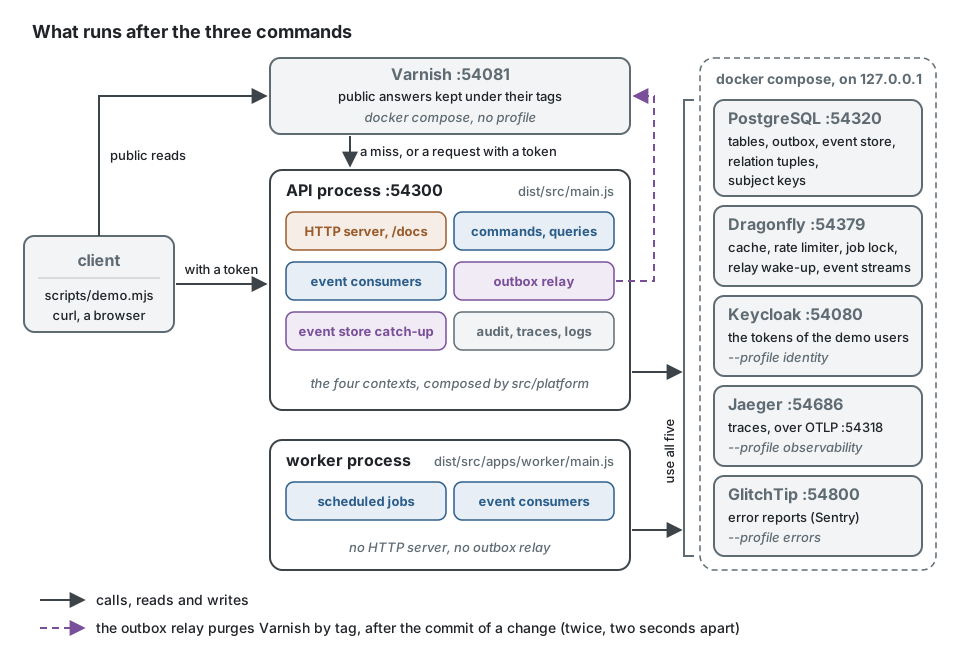
Everything listens on 127.0.0.1, on ports 54xxx chosen not to meet another stack:
| Open | At | Started by |
|---|---|---|
| The API, and its interactive documentation | http://127.0.0.1:54300, http://127.0.0.1:54300/docs |
the second command, node dist/src/main.js |
| The same API behind Varnish | http://127.0.0.1:54081 |
the first command, whatever the profiles |
| Keycloak, and the demo users below | http://127.0.0.1:54080 |
--profile identity |
| Jaeger, the traces | http://127.0.0.1:54686 |
--profile observability, with OTEL_EXPORTER_OTLP_ENDPOINT=http://127.0.0.1:54318 in .env |
| GlitchTip, the error reports | http://127.0.0.1:54800 |
--profile errors, with the DSN that docker compose logs glitchtip | grep 'DSN:' prints in SENTRY_DSN |
Varnish answers the same API: the opening hours of a calendar
(GET /calendars/:calendarId/opening-hours, public) come from its cache (x-cache: HIT) until
a change of the calendar commits and the relay purges them, twice two seconds apart; an
authenticated read passes through to the API. The API purges with VARNISH_PURGE_KEY of
.env, which Varnish is started with too. How a public answer is cached, then
purged follows one change through.
The gate is npm run verify (types, lint with the kit's preset, format, tests, end to end,
architecture rules, import graph, dead code, documentation drift); it needs no container. Stop
with docker compose --profile identity --profile observability --profile errors down --volumes.
Demo users
Section titled “Demo users”Local development only: they exist in docker/keycloak/scheduling-realm.json, and the password
of each is its user name.
| User | Role in the token | What makes their rights |
|---|---|---|
demo-admin |
network-admin, network north |
the role: opens the practices of its network |
demo-ops |
platform-admin, no network |
the role: reads the audit trail of every network, through an elevation the trail records |
demo-manager, demo-manager-b |
none | the relationship manager of one practice each, written when the practice is opened |
demo-practitioner |
none | practitioner of the practice, holder of their desk |
demo-assistant |
none | assistant of the practice; delegate of a desk once delegated |
demo-patient, demo-patient-2 |
patient |
the role to book for themselves; patient of each of their appointments |
demo-support |
support |
nothing by itself: impersonates a user in Keycloak, and that session is read-only here |
What the example shows, and where to look
Section titled “What the example shows, and where to look”| Concept or pattern | Where |
|---|---|
| The method, step by step | docs/architecture/: needs.md, discovery.md, contexts.md, before-bootstrap/, plan.md, slices.md, briefings/ |
| Ubiquitous language per context, generated reference | src/contexts/*/CONTEXT.md |
| Context map with its patterns | docs/context-map.md |
| Aggregates with value objects, no primitive obsession | src/contexts/scheduling/domain/ (Calendar, Appointment, Waitlist) |
| Time zones and daylight saving in the domain, without a library | scheduling/domain/value-objects/time-zone.vo.ts, test/unit/time-zone.vo.spec.ts, calendar.aggregate.spec.ts |
| A domain service over two aggregates | scheduling/domain/services/scheduler.service.ts |
| Overlap decided by the domain and by a PostgreSQL exclusion constraint | scheduling/infrastructure/persistence/create-scheduling-tables.schema.ts, knex-appointment.repository.ts, test/integration/concurrent-booking.spec.ts |
| Permissions on every use case, policies on the loaded element | scheduling/application/authorization/ |
| Relationships (Zanzibar style) combined with roles | src/platform/auth/relationship-schema.ts, resource-permissions.ts, role-grants.ts, roles-and-relationships.authorizer.ts, ADR 0001 |
| Persistent relation tuples, written in the unit of work | src/platform/auth/knex-relation-tuple-store.ts; */application/ports/*-relationships.port.ts and their adapters |
| Searches narrowed in the statement by the access scope, with criteria | scheduling/application/queries/search-appointments/, search-practice-agenda/, analytics/application/queries/search-occupancy/ |
| Field-level difference: busy without the name | scheduling/application/queries/get-calendar-day/ |
| A field reserved to the staff, in every representation: the internal note, hidden from the patient, read-only for an assistant, written by whoever runs the calendar | scheduling/presentation/http/appointments/book-appointment/book-appointment.controller.ts, get-appointment/get-appointment.controller.ts (withFieldAccess), test/e2e/book-appointment.e2e.spec.ts |
One route in JSON, XML and CSV by the Accept header; an XML body read and validated as JSON; a list streamed page by page through the bus as it is read |
scheduling/presentation/http/practices/ (produces), export-practice-agenda/, src/platform/http/presentation-of.ts, test/e2e/export-practice-agenda.e2e.spec.ts |
| A form described by the server, for the caller who asks (JSON Forms, or a tree of blocks) | GET /forms/bookAppointment, the form of book-appointment.controller.ts, src/platform/http/with-forms.ts, openapi/forms/bookAppointment.json |
| Read-only impersonation, visible in the trail | src/platform/buses/read-only-impersonation.ts, test/e2e/journey-authorization.e2e.spec.ts |
| Integration events, versioned, through the outbox | src/contexts/*/published-language/, docs/integration/event-catalog.md |
| A projection of another context (decides, labels lists) | scheduling/application/projections/practitioners.projection.ts |
| A gateway with hydration (one fresh element) | scheduling/application/queries/get-appointment/, infrastructure/external/in-process-person-directory.gateway.ts |
| A projection of the context's own events | scheduling/application/projections/agenda.projection.ts |
| Read models and their rebuild | analytics/application/projections/, analytics/test/integration/outcome-register.rebuild.spec.ts |
| One aggregate kept as its events, beside aggregates kept as rows: its history is the business | scheduling/domain/aggregates/attendance-record.aggregate.ts (apply methods), infrastructure/persistence/attendance-record-events.mapper.ts (stored shapes, a reason sealed per patient), event-store-attendance-record.repository.ts (snapshots every 20 events), stored-events.lock.json |
| A projection fed by the event store: catch-up with a checkpoint, rebuild from position zero, an erased patient | scheduling/application/projections/attendance-history.projection.ts, src/platform/events/store-fed-projections.ts, test/integration/attendance-history.rebuild.spec.ts, test/integration/appointment-journey.spec.ts; an erasure by npm run erase:patient |
| One row per fact, computed at read time: figures grouped in one statement when they are read, instead of counters kept by events (nothing to drift, nothing to verify at night) | analytics/CONTEXT.md ("How occupancy is measured"), analytics/infrastructure/persistence/knex-occupancy-reader.repository.ts |
| A business definition and its SQL held equal by one contract | analytics/domain/services/occupancy-measure.service.ts, analytics/test/integration/occupancy-reader.contract.spec.ts |
| A consumer with an outbound port, retry then dead letter | notification/application/integration/handlers/, infrastructure/external/remote-mailer.adapter.ts, test/integration/mailer-outage.spec.ts |
| Resilience on the adapter class, and at the binding | the mailer above (@Retry, @Timeout); src/platform/platform.module.ts (builder.around) |
| Files kept in a storage, never in the database: an upload streamed and checked, a short signed link, a removal after the commit, every read of a document audited | scheduling/application/commands/attach-appointment-document/, queries/get-appointment-document/, domain/value-objects/attached-document.vo.ts, src/platform/files/, test/e2e/journey-documents.e2e.spec.ts |
| Scheduled jobs that only send a command, in a worker | application/scheduling/ of scheduling, identity and notification, src/apps/worker/main.ts |
| One trace per action, logs, audit, error report | test/e2e/journey-observability.e2e.spec.ts |
| A typed client of the contract, its refusals typed by their error codes, called by the end-to-end specs as a consumer would | clients/api/ (generated by ddd-ts-kit sdk, regenerated by docs:generate), test/e2e/support/start-application.ts (apiAs), expect-answer.ts, expect-refusal.ts, test/e2e/identity-register-person.e2e.spec.ts |
| A deviation that was recorded, then retired when the kit made projections a role of its own | ADR 0002, superseded |
| Dependencies stated once, by the constructor: no list in a decorator, and every class of every context built by the composition root | any handler, for instance identity/application/commands/register-person/register-person.handler.ts; the generated <context>.declarations.ts; test/architecture/every-class-resolves.spec.ts |
Context map
Section titled “Context map”A copy of the diagram ddd-ts-kit docs generates in docs/context-map.md,
from ddd-ts-kit.config.json and the CONTEXT.md files; the reasons are written there too.
flowchart LR
  analytics["analytics<br/><small>supporting</small>"]:::supporting
  identity["identity<br/><small>supporting</small>"]:::supporting
  notification["notification<br/><small>supporting</small>"]:::supporting
  scheduling["scheduling<br/><small>core</small>"]:::core
  scheduling -->|conformist| analytics
  scheduling -->|published-language| notification
  identity -->|published-language| notification
  identity -->|customer-supplier| scheduling
  classDef core fill:#1f6feb,stroke:#0b3d91,color:#ffffff,stroke-width:2px
  classDef supporting fill:#ddf4ff,stroke:#1f6feb,color:#0b3d91
  classDef generic fill:#f6f8fa,stroke:#8c959f,color:#24292f,stroke-dasharray: 4 3
The audit trail is a capability of the platform (src/platform/audit/), not a context: it
records around every use case and decides nothing of its own.
Business rules, by context
Section titled “Business rules, by context”Paths are under src/contexts/<context>/.
scheduling
| Rule | Held by | Proven by |
|---|---|---|
| Opening hours are wall-clock ranges of the practice's time zone; a day of 23 or 25 hours keeps them | domain/value-objects/time-zone.vo.ts, opening-hours.vo.ts |
test/unit/time-zone.vo.spec.ts, calendar.aggregate.spec.ts |
| An exception replaces its day; a time off closes everything it covers and is refused over active appointments | domain/aggregates/calendar.aggregate.ts, application/commands/add-time-off/ |
test/unit/calendar.aggregate.spec.ts, add-time-off.handler.spec.ts |
| A slot starts on the grid of its type, inside one opening range, inside the booking window | Calendar.slotFor |
test/unit/calendar.aggregate.spec.ts |
| No overlap with an active appointment, buffer included; at most N future appointments per patient and practitioner | domain/services/scheduler.service.ts |
test/unit/scheduler.service.spec.ts |
Of two concurrent bookings of one slot exactly one wins; the other gets SLOT_TAKEN, 409 |
exclusion constraint, knex-appointment.repository.ts |
test/integration/concurrent-booking.spec.ts (truly concurrent with DATABASE_URL) |
| Requested, booked, confirmed, rescheduled, cancelled with party and reason, expired, completed, no-show; an ended appointment does not change | domain/aggregates/appointment.aggregate.ts |
test/unit/appointment.aggregate.spec.ts |
| Rescheduling is one change of one aggregate | application/commands/reschedule-appointment/ |
its handler spec, test/integration/appointment-journey.spec.ts |
| A patient cancels or reschedules until 24 hours before; the practice at any time, with a reason | the two policies of application/authorization/, Cancellation |
the policy specs, test/e2e/journey-authorization.e2e.spec.ts |
| A freed slot is offered to the first waiter it suits, as a requested appointment that expires | domain/aggregates/waitlist.aggregate.ts, application/commands/offer-freed-slot/ |
test/unit/waitlist.aggregate.spec.ts, offer-freed-slot.handler.spec.ts |
Unconfirmed appointments expire, idempotently, from the job's scheduledAt |
application/commands/expire-unconfirmed-appointments/, application/scheduling/ |
its handler and job specs |
identity: one role per member and practice, the last manager stays, removing a member ends
their delegations (domain/aggregates/practice.aggregate.ts, application/commands/remove-member/);
a delegation is between a practitioner and an assistant of one practice, with or without
availability, until an optional end, revocable (domain/aggregates/delegation.aggregate.ts);
relationships follow each fact in the same transaction (application/event-handlers/). Proven
by test/unit/ and test/e2e/identity-*.e2e.spec.ts.
notification: one notification per consumed event and recipient; one reminder per
appointment and start, due 24 hours before, sent once (domain/aggregates/,
application/commands/send-due-reminders/); a failing mailer is retried, then the event is
dead-lettered and reported (test/integration/mailer-outage.spec.ts).
analytics: one row per fact, computed at read time. An outcome per appointment is set whole
by each event, so replays and late deliveries end on the same row, and it is the only thing
stored (application/projections/outcomes.projection.ts); it is rebuilt from the export of
scheduling (test/integration/outcome-register.rebuild.spec.ts). The occupancy of a calendar
on a day is measured from the outcomes when it is read, in one grouped statement narrowed by the
practice, the filters and the scope of the actor
(infrastructure/persistence/knex-occupancy-reader.repository.ts): the time held by the
appointments held, completed or missed, the counts by state, a cancelled or expired appointment
freeing its time. No counter is kept, so none can drift and no job verifies one. The definition
is the domain service OccupancyMeasureService; the statement is held to it by
test/integration/occupancy-reader.contract.spec.ts. An earlier version stored a line per
calendar and day, recounted at each event and verified nightly: see
docs/tooling-report.md, "After delivery: analytics computed at read time".
Networks of practices: one tenant each
Section titled “Networks of practices: one tenant each”The application serves several networks of practices from one deployment, and each network is a
tenant (ADR-0003, "stack.tenancy": "shared-table"):
every table of the contexts carries the network of its rows, every repository reaches it through
tenantTable and ownTenantTable, the outbox keeps the network of each event so that its
consumers run in it, and each scheduled job runs once per network of NETWORKS. The token names
the network of its user (tenant_id); a request may name it in x-tenant-id, naming another
network than the caller's is refused with 403 before anything runs, and a network missing from
NETWORKS is not found (404), so that nothing is written where no job runs. A person belongs to
one network: a second network needs a second account. Platform staff belong to no
network: they read the audit trail of every network through an elevation that the trail records
first. Practices stay relationships inside a network. test/e2e/journey-tenancy.e2e.spec.ts
holds all of it; tenantIsolationContract holds it for every repository.
The authorization model, with two worked cases
Section titled “The authorization model, with two worked cases”Three questions, three places. Who is calling: Keycloak, verified at the boundary. May they do
this, on this: decided before the handler by one authorizer that first looks at the roles of
the token (network-admin, platform-admin; patient for self-service; nothing for support), then at
relationships stored as tuples object#relation@subject and rewritten Zanzibar style. Is it
valid at all: the domain. The contexts never name a role or a relation: they name permissions,
and write relationships through a port of their own when a fact happens.
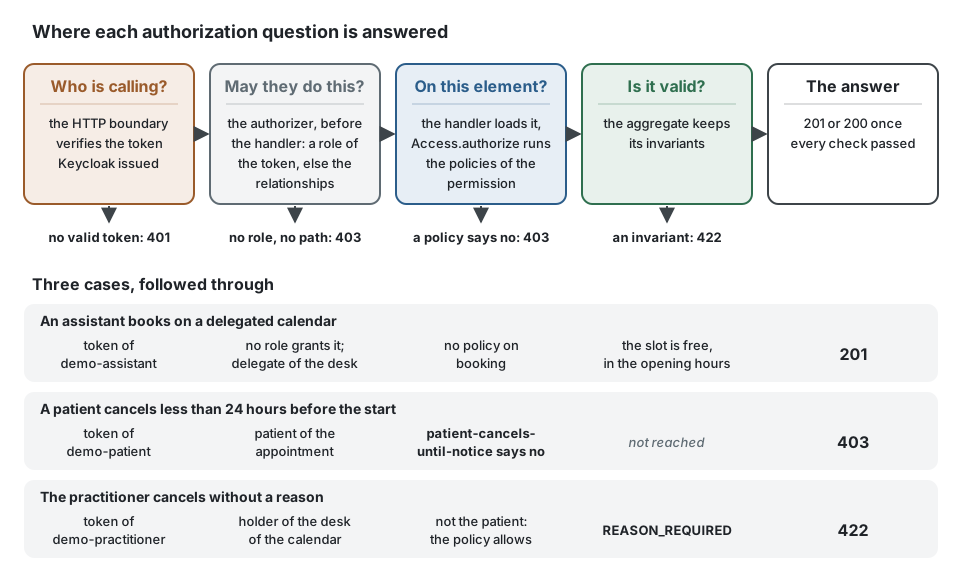
So a handler never tests a role or a relation itself. Instead of:
// The handler decides who may: the rule is lost among the business code, and changes with every role.if (!actor.roles.includes('practice-manager') && appointment.patientId !== actor.id) { throw new ForbiddenError();}the command names the permission it requires and the element it bears on, and the platform decides from the roles and the relationships; only a rule that needs the loaded element stays in the context, as a policy (second case below).
An assistant books on a delegated calendar. POST /appointments for another patient
requires scheduling:appointment.book on calendar:<id>. The assistant has no role that
grants it, so the relationships decide: the permission maps to run on a calendar, which is
run on its desk (calendar:<id>#desk@desk:<practice>.<practitioner>, written by scheduling
when the calendar was created), which holds for the holder, a delegate, or a manager of the
practice. The tuple desk:<practice>.<practitioner>#delegate@user:<assistant> was written by
identity in the transaction that granted the delegation: before it the answer is 403, after
it 201, and after the revocation 403 again. Changing opening hours asks for plan, which a
delegate has only through availability_delegate. scheduling never copied the delegation.
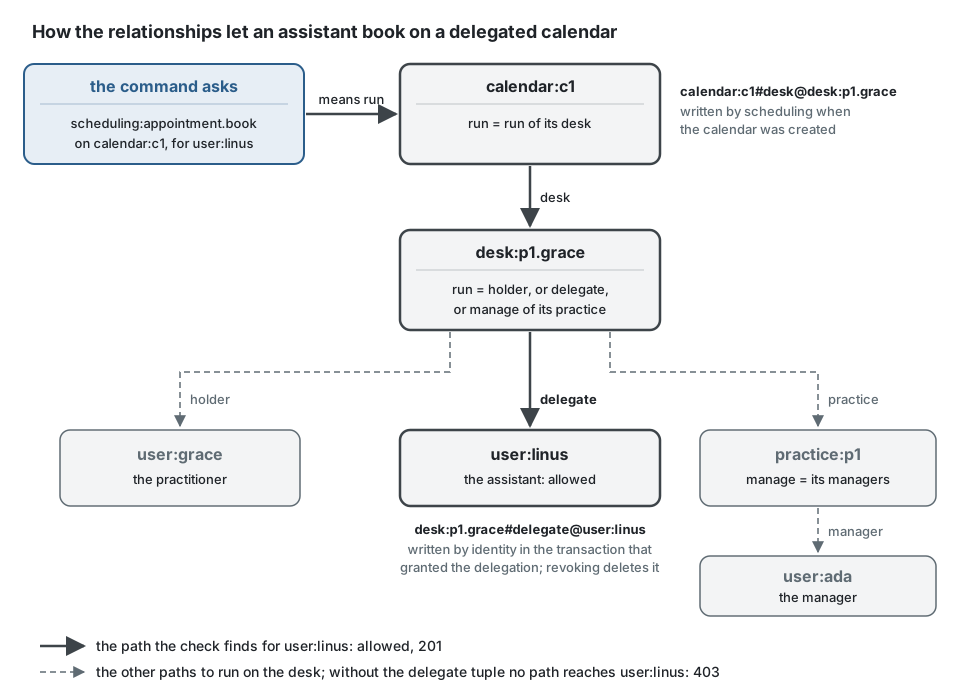
The same check, run with the in-memory store of @ddd-ts-kit/auth/rebac on the part of
src/platform/auth/relationship-schema.ts it walks through (the example binds a store on
PostgreSQL, knex-relation-tuple-store.ts, behind the same port):
import { definePermissions } from '@ddd-ts-kit/auth';import { defineSchema, from, InMemoryRelationTupleStore, RelationBasedAuthorizer, union } from '@ddd-ts-kit/auth/rebac';import type { Actor } from '@ddd-ts-kit/kernel';
const schedulingPermissions = definePermissions('scheduling', {  'appointment.book': { description: 'Book appointment' },});
// Who is what to which element: a desk is the post of one practitioner in one practice.const schema = defineSchema({  user: {},  practice: {    relations: { manager: ['user'] },    permissions: { manage: union('manager') },  },  desk: {    relations: { holder: ['user'], delegate: ['user'], practice: ['practice'] },    permissions: { run: union('holder', 'delegate', from('practice', 'manage')) },  },  calendar: {    relations: { desk: ['desk'] },    permissions: { run: from('desk', 'run') },  },});
const store = new InMemoryRelationTupleStore();const relationships = new RelationBasedAuthorizer({  schema,  store,  // From resource-permissions.ts: booking on a calendar is `run` on that calendar.  mapping: { calendar: { [schedulingPermissions['appointment.book'].id]: 'run' } },});
const linus: Actor = { id: 'linus', type: 'user', roles: [], attributes: {} };const booking = {  actor: linus,  permission: schedulingPermissions['appointment.book'],  resource: { type: 'calendar', id: 'c1' },};
// Written by scheduling when the calendar was created.await store.write([{ object: 'calendar:c1', relation: 'desk', subject: 'desk:p1.grace' }]);console.log(await relationships.check(booking)); // { allowed: false, reason: ... }: 403
// Written by identity, in the transaction that grants the delegation.const delegation = { object: 'desk:p1.grace', relation: 'delegate', subject: 'user:linus' };await store.write([delegation]);console.log(await relationships.check(booking)); // { allowed: true }: 201
// Deleted by identity, in the transaction that revokes it.await store.delete([delegation]);console.log(await relationships.check(booking)); // { allowed: false, reason: ... }: 403 again
A patient cancels too late. POST /appointments/<id>/cancellation requires
scheduling:appointment.cancel on appointment:<id>; the patient passes
(appointment:<id>#patient@user:<patient>, written at booking). The handler then loads the
appointment and asks Access.authorize with it: the policy
scheduling.patient-cancels-until-notice answers no when the actor is the patient and the start
is less than 24 hours away, and the answer is 403. The practitioner of the calendar passes both,
and the domain then asks for a reason (REASON_REQUIRED, 422): that is an invariant, not a
right.
The three places, in the code of this case (the domain of scheduling is reduced to the
declarations the handler needs; the real files are under
src/contexts/scheduling/application/):
import { Access, definePermissions, type PolicyContext } from '@ddd-ts-kit/auth';import { AuthorizedCommand, isAuthenticated, type Actor, type Clock } from '@ddd-ts-kit/kernel';import { CommandHandler, Policy, Requires } from '@ddd-ts-kit/kernel/declarations';
// The domain of scheduling, reduced to what this case needs.declare class Appointment {  readonly id: string;  readonly patientId: string;  readonly slot: { readonly startsAt: Date };  cancel(cancellation: Cancellation, at: Date): void;}declare class Cancellation {  /** Refuses with REASON_REQUIRED (422) when the practice gives no reason: an invariant. */  static create(by: 'patient' | 'practice', reason?: string): Cancellation;}declare class AppointmentError {  static notFound(appointmentId: string): Error;}declare abstract class AppointmentRepository {  abstract findById(id: string): Promise<Appointment | undefined>;  abstract save(appointment: Appointment): Promise<void>;}
const schedulingPermissions = definePermissions('scheduling', {  'appointment.cancel': { description: 'Patient cancels until notice' },});
// 1. Before the handler: the authorizer checks the permission on the element the command names.@Requires(schedulingPermissions['appointment.cancel'], {  resource: (command: CancelAppointmentCommand) => ({ type: 'appointment', id: command.appointmentId }),})export class CancelAppointmentCommand extends AuthorizedCommand<string> {  constructor(    actor: Actor,    readonly appointmentId: string,    readonly reason?: string,  ) {    super(actor);  }}
const NOTICE_MS = 24 * 60 * 60_000;
// 2. On the loaded element: a policy of the permission, run by Access.authorize.@Policy(schedulingPermissions['appointment.cancel'], { name: 'scheduling.patient-cancels-until-notice' })export class PatientCancelsUntilNoticePolicy {  appliesTo(subject: unknown): subject is Appointment {    return subject instanceof Appointment;  }
  allows(actor: Actor, appointment: Appointment, { now }: PolicyContext): boolean {    if (!isAuthenticated(actor)) {      return false;    }
    return actor.id !== appointment.patientId || appointment.slot.startsAt.getTime() - now.getTime() >= NOTICE_MS;  }}
@CommandHandler(CancelAppointmentCommand)export class CancelAppointmentHandler implements CommandHandler<CancelAppointmentCommand> {  constructor(    private readonly appointmentRepository: AppointmentRepository,    private readonly access: Access,    private readonly clock: Clock,  ) {}
  async execute({ actor, appointmentId, reason }: CancelAppointmentCommand): Promise<string> {    const appointment = await this.appointmentRepository.findById(appointmentId);
    if (appointment === undefined) {      throw AppointmentError.notFound(appointmentId);    }
    // Raises ForbiddenError (403) when a policy says no.    await this.access.authorize(actor, schedulingPermissions['appointment.cancel'], appointment);
    // 3. The domain: whoever is not the patient acts for the practice, and says why.    const cancellation = Cancellation.create(actor.id === appointment.patientId ? 'patient' : 'practice', reason);
    appointment.cancel(cancellation, this.clock.now());    await this.appointmentRepository.save(appointment);
    return appointment.id;  }}
Each practice is kept to itself by the same model: the agenda and the occupancy of a practice require a relationship to that practice, and every search is narrowed in the SQL statement by the scope the authorizer computes for the actor.
How one request is traced
Section titled “How one request is traced”A booking is one trace: POST /appointments, command BookAppointmentCommand, each repository
call, the domain event and its handlers (the relationships, the confirmation deadline, the agenda
projection, the outbox append), then, later and in the same trace,
publish scheduling.appointment.booked by the relay, and what each consumer does of it:
process notification.scheduling-appointment-booked with the commands it sends (the
notification, then the reminder), process analytics.outcomes with the row it writes.
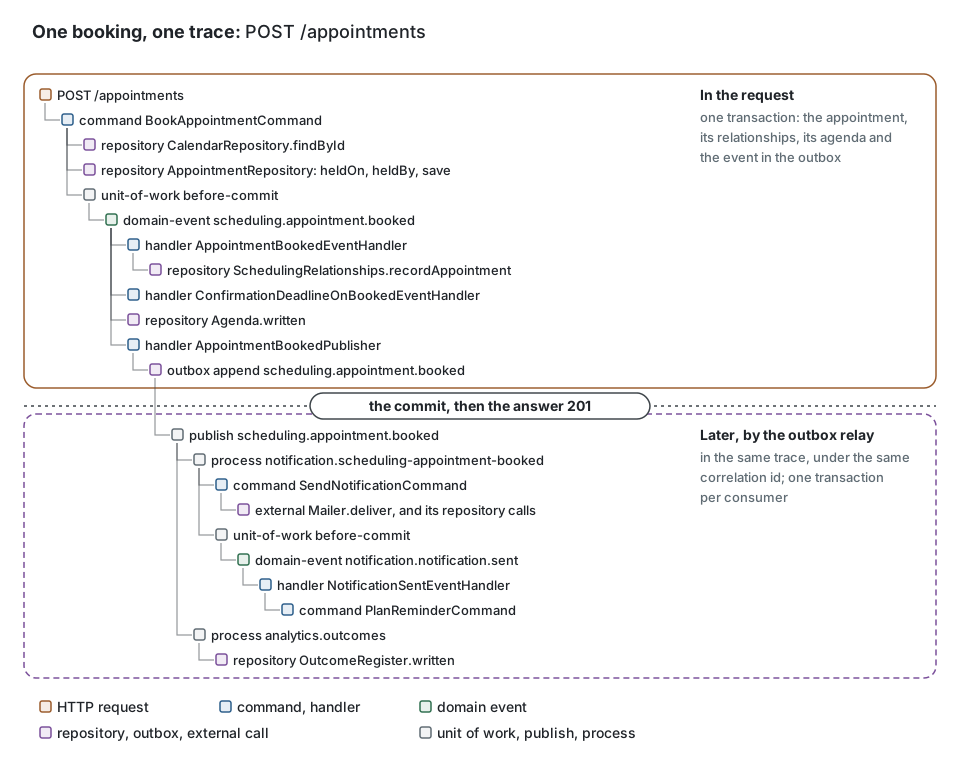
No context imports a tracing library: the spans are opened around the buses, the repositories,
the adapters and the relay by the platform. The same trace id is on the log lines and on the
error report of an unexpected failure; audit entries carry the correlation id.
test/e2e/journey-observability.e2e.spec.ts asserts the span tree; the real run reads the
trace back from Jaeger.
How a public answer is cached, then purged
Section titled “How a public answer is cached, then purged”The opening hours of a calendar are read far more often than they change, and they are the same for everybody: their route says so, and Varnish keeps them an hour under the tag of the calendar. A change of the hours asks for that tag to be purged, in the transaction of the change: the request goes into the outbox with the event, so a refused change purges nothing, and a committed one is purged even if the process stops right after the commit.
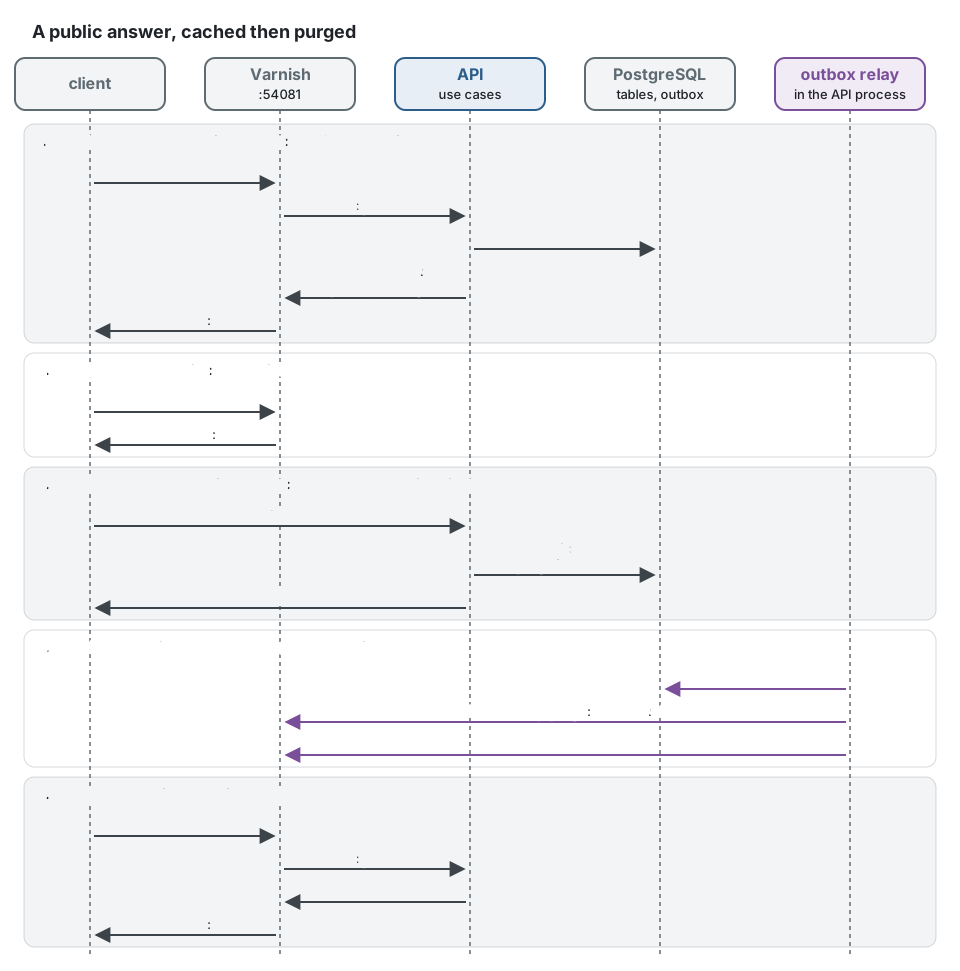
The route declares how its answer is cached, and under which tag (an excerpt of
presentation/http/calendars/get-opening-hours/get-opening-hours.controller.ts):
cache: { scope: CacheScope.public, maxAge: '1m', sMaxAge: '1h', staleWhileRevalidate: '30s', staleIfError: '1d', etag: { version: 'version' }, tags: [{ resource: 'calendar', param: 'calendarId' }],},and a handler of the domain event names the same tag with the same function, so the answer and
the purge always meet (application/event-handlers/calendar-opening-hours-set.event-handler.ts):
import { cacheTag, type CacheInvalidation, type DomainEvent } from '@ddd-ts-kit/kernel';import { DomainEventHandler } from '@ddd-ts-kit/kernel/declarations';
export class CalendarOpeningHoursSet implements DomainEvent {  static readonly eventName = 'scheduling.calendar.opening-hours-set';
  readonly name = CalendarOpeningHoursSet.eventName;
  constructor(    readonly aggregateId: string,    readonly occurredAt: Date,  ) {}}
// Runs before the commit, in the unit of work of the change: the purge is written with it, and sent after it.@DomainEventHandler(CalendarOpeningHoursSet)export class CalendarOpeningHoursSetEventHandler implements DomainEventHandler<CalendarOpeningHoursSet> {  constructor(private readonly cacheInvalidation: CacheInvalidation) {}
  async handle(event: CalendarOpeningHoursSet): Promise<void> {    await this.cacheInvalidation.invalidate([cacheTag('calendar', event.aggregateId)]);  }}
The relay of src/main.ts sends those requests to Varnish and every other event to the broker,
and purges a second time two seconds later: a read that loaded the old hours before the commit
may reach Varnish after the first purge. The PUT itself may carry the ETag of the hours it
read (If-Match): when somebody changed them since, the answer is 412.
Replay the method
Section titled “Replay the method”- Read
docs/architecture/needs.md: it is the only input. - With the plugin,
/ddd-ts-kit:starton those needs gives, step by step,discovery.md,contexts.md, the glossary and the draft map (before-bootstrap/), each closed by a question to the owner;plan.mdholds the decisions. - The bootstrap is the
initcommand recorded verbatim inplan.md, then onegenerate contextper context with its terms. slices.mdis the backlog: contracts and skeletons first, then one row per use case, with the generator commands and the rules.briefings/holds what each parallel worker was given.docs/tooling/generator-log.jsonllists every generator run of the build, in order, with its arguments;docs/commit-plan.mdcuts the result into commits.
Event sourcing: the catch-up, an erasure, the keys
Section titled “Event sourcing: the catch-up, an erasure, the keys”The attendance record of a patient is kept as its events; its history
(scheduling.attendance-history) is a projection fed by the event store.
- Where the catch-up runs. In the API process (
src/main.ts), at the pace of the outbox relay, and not in the worker: the history is read by the API, and a reader sees it current within one relay interval. With several replicas, each one polls, and the compare-and-set of the checkpoint lets one of them apply each batch; the others skip that round (a debug line, not an error). A tick that comes while a round runs is skipped. - An erasure.
DATABASE_URL=<url> npm run erase:patient -- <patientId>destroys the key the words of the patient were sealed with, then rebuilds every projection fed by the store (src/platform/events/erase-data-subject.ts,scripts/erase-patient.ts): the stream and the snapshots read[erased]at once, and so does the history once rebuilt. A rebuild never stops the catch-up, so the API may keep running. Running it again completes an erasure whose rebuild failed. - The keys.
PostgresSubjectKeyStore, in theschedulingschema of the one database, next to the events, so that the example runs with one PostgreSQL. A backup of that database taken before an erasure still holds the key and the sealed words until it expires. A deployment that promises erasure gives the key store a database of its own, backed up with a shorter retention, or a key management service behindSubjectKeyStore: Event sourcing, per aggregate.
Working in this repository
Section titled “Working in this repository”The example is an npm workspace of the kit's repository and resolves @ddd-ts-kit/* and the
CLI from it: node scripts/kit.mjs <command> is npx ddd-ts-kit <command>. Three things differ
from a project of its own, all recorded in the tooling report: scripts/tsc.mjs,
scripts/kit.mjs and .dependency-cruiser.workspace.mjs. The pipelines generated by init
(.github/, .gitlab-ci.yml) are kept as generated; in this repository they do not run from a
sub-directory, and the root pipeline has an example job instead. The rules for coding agents are the files init generated at the root of the example.
Imports
Section titled “Imports”Every file is imported by an alias from the project root, never by a relative path, and
without an extension: @/contexts/scheduling/domain/aggregates/appointment.aggregate,
$test/e2e/support/..., $scripts/... ("importExtension": "none" in
ddd-ts-kit.config.json). An import names a file, never a directory:
.../published-language/index.
// Instead of: a relative path, an extension, a directoryimport { Appointment } from '../../domain/aggregates/appointment.aggregate.js';import { appointmentBookedV1 } from '../../published-language';
// write: the alias from the project root, a file, no extensionimport { Appointment } from '@/contexts/scheduling/domain/aggregates/appointment.aggregate';import { appointmentBookedV1 } from '@/contexts/scheduling/published-language/index';
The alias is declared once, under paths in tsconfig.json,
which the compiler, npm run dev (tsx), vitest, knip and dependency-cruiser read: they all
load src/. Node reads no alias and needs the extension: npm run build compiles, then
ddd-ts-kit build-aliases rewrites each alias of dist/ into a relative path ending in .js,
so npm start and the Docker image are plain node on dist/. npm run lint:fix turns a
relative import into its alias and removes an extension; npm run check:arch reports a
declaration that no longer follows importAlias and importExtension of
ddd-ts-kit.config.json, or a build that skips the rewrite. The reasons and
what was measured: docs/tools/import-aliases.md.
What is not built
Section titled “What is not built”Listed precisely in docs/tooling-report.md, "Not built, or built smaller than asked": the policy's reason code in the HTTP answer, a metrics adapter, a real mail provider, occupancy as a rate, leaving a waitlist, listings of members and delegations.