
Message brokers: in-process, RabbitMQ, Kafka, NATS JetStream, Redis Streams
Summary. Integration events between bounded contexts leave through the transactional outbox and reach consumers at least once; the broker is the transport in between, behind two ports of the kernel. The kit ships five providers that pass the same contract suite: the in-memory bus, RabbitMQ, Apache Kafka, NATS JetStream and Redis Streams (on Redis, Dragonfly or Valkey). They are not interchangeable in what they guarantee: only Kafka keeps the order of an aggregate's events, only RabbitMQ and Kafka confirm after a replicated write to disk, and Redis Streams keeps events in memory. Start without a broker; add one when a context runs in its own process, and choose it on ordering, durability and what your team already operates.
What the broker does and does not do here
Section titled “What the broker does and does not do here”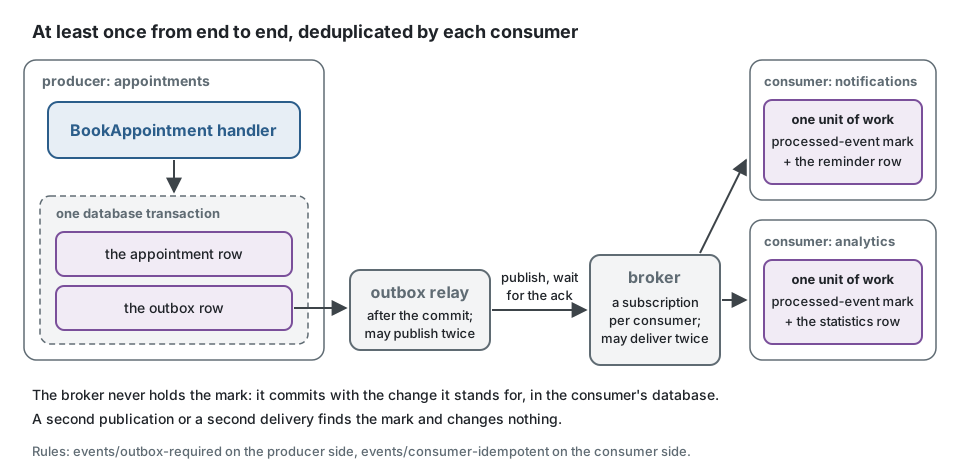
Whatever the broker, three things are fixed by the architecture (events/outbox-required,
events/consumer-idempotent in ARCHITECTURE.md):
- the event is written to the outbox in the transaction of the command, never sent to the broker by a handler (transactional outbox);
- the relay publishes and may publish twice; the broker may deliver twice; the consumer deduplicates with a processed-event store in its own database (delivery and idempotency);
- the processed-event store is never in the broker or in Redis: the mark must commit with the state change it stands for.
So "exactly once" is not a property to shop for. The broker's job is to hold events durably between two processes, give each consumer its own subscription, retry a bounded number of times and park what cannot be handled.
What the first rule means in code. Instead of sending to the broker from the handler:
await this.appointments.save(appointment);await this.rabbit.publish([booked]); // the commit can still fail after this line: an event for a booking that does not existpublish to the IntegrationEventPublisher port from the handler of a domain event. The
composition root binds that port to the OutboxPublisher, which only appends a row in the
transaction of the command; the relay sends it after the commit, whichever broker is behind it:
import { defineIntegrationEvent } from '@ddd-ts-kit/events';import { IdGenerator, IntegrationEventPublisher, type DomainEvent } from '@ddd-ts-kit/kernel';import { zodSchema } from '@ddd-ts-kit/validation/zod';import { z } from 'zod';
// contexts/appointments/domain/events/appointment-booked.event.tsexport class AppointmentBooked implements DomainEvent {  static readonly eventName = 'appointments.appointment.booked';
  readonly name = AppointmentBooked.eventName;
  constructor(    readonly aggregateId: string,    readonly occurredAt: Date,    readonly startsAt: Date,  ) {}}
// contexts/appointments/published-language/appointment-booked.v1.integration-event.tsexport const appointmentBooked = defineIntegrationEvent({  type: 'appointments.appointment.booked',  version: 1,  description: 'An appointment was booked.',  payload: zodSchema(z.object({ appointmentId: z.string(), startsAt: z.iso.datetime() })),});
// contexts/appointments/application/integration/publishers/appointment-booked.publisher.tsexport class AppointmentBookedPublisher {  constructor(    private readonly publisher: IntegrationEventPublisher,    private readonly ids: IdGenerator,  ) {}
  async handle(event: AppointmentBooked): Promise<void> {    const published = appointmentBooked.create(      { appointmentId: event.aggregateId, startsAt: event.startsAt.toISOString() },      { id: this.ids.next(), occurredAt: event.occurredAt },    );
    // Bound to the outbox: a row in the transaction of the command, not a message on the wire.    await this.publisher.publish([published]);  }}
In a project the publisher is declared with @DomainEventHandler(AppointmentBooked), attached
under the eventName the event class declares, and the generator writes it (domain and integration events).
Comparison
Section titled “Comparison”Server versions and licences checked on 2026-10-10 (GitHub releases and licence files). The "kit" rows repeat what the provider READMEs state.
| In-process | RabbitMQ | Apache Kafka | NATS JetStream | Redis Streams | |
|---|---|---|---|---|---|
| Kind | function calls in one process | queue broker (AMQP 0-9-1) | replicated, partitioned log | stream persistence over NATS | in-memory log in a key-value server |
| Server and licence | none | 4.3.6, MPL 2.0 | Apache 2.0 (kit tested against 4.3, KRaft; latest version not re-checked) | 2.15.1, Apache 2.0 | Redis 8.10.2 (RSALv2, SSPLv1 or AGPLv3), Valkey 9.1.2 (BSD-3), Dragonfly 2.0.2 (BSL 1.1) |
| Confirmation of a publish means | handlers ran | broker took it; quorum queues replicate before confirming | written to the in-sync replicas (acks=all) |
stored in the stream | held in memory by one server |
| Survives a server crash | no (the outbox does) | yes, with durable quorum queues | yes, with replication factor 3 and min.insync.replicas=2 |
yes, per the stream's storage and replicas | depends on persistence settings; can lose acknowledged entries |
| Order | per key with one relay, in one process | none | per partition, so per key | none | none across instances |
| Retention | none | until consumed | by time or size, replayable | by limits you set; replayable | bounded by memory; trimming ignores unread entries |
| A new consumer sees history | no | no | yes (starts at earliest by default) | yes (deliver policy all) |
no by default (starts at the end) |
| Publish-side deduplication | not needed | none | client retries only, not relay retries | by message id, in a short window (two minutes by default) | none (optional guard key) |
| Retries in the kit's provider | the relay's backoff | fixed delay, retry queue | fixed delay, in place, blocks the partition | fixed delay | fixed delay |
| Dead letters | the outbox (dead) |
dead queue per consumer queue | dead-letter topic | dead-letter stream | dead stream |
| Client used by the kit | none | amqplib 2.2 | @confluentinc/kafka-javascript 1.11 (native addon) |
@nats-io/transport-node, @nats-io/jetstream 3.4 |
ioredis 6 |
| Operations | none | one cluster, queues to watch | a cluster, partitions, consumer lag | light server, streams to size | a server you may already run |
Selection criteria
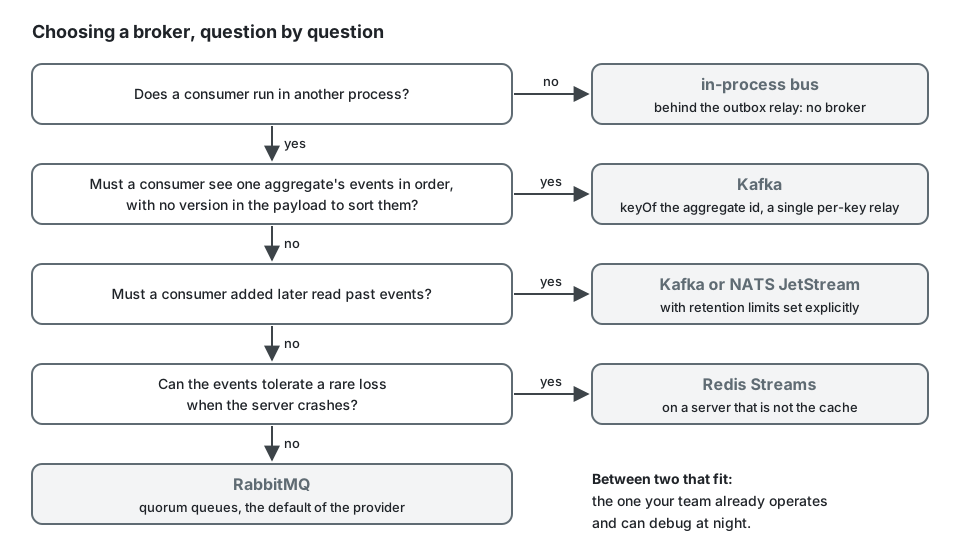
Section titled “Selection criteria”- Do two processes exist? While every context runs in one process, the in-memory bus behind the outbox relay is enough, and extraction later changes the provider, not the handlers (modular monolith).
- Does the order of one aggregate's events matter to a consumer? If
analyticsmust seebookedbeforecancelledfor the same appointment and cannot use a version in the payload, only Kafka gives it, with conditions (below). The cheaper answer is almost always to carry a version or a sequence in the payload and let the consumer ignore stale events. - Can an acknowledged event ever be lost? With Redis Streams, yes, depending on persistence. For reminders that may be acceptable; for billing it is not.
- Must a consumer added next year read last year's events? Only a log with retention does that (Kafka, JetStream).
- What does the team operate today? A broker nobody on the team can debug at night is a worse choice than a less capable one they know.
- Build and image constraints. The Kafka client is a native addon with an install script.
The second question is usually answered by the payload, not by the broker. A producer that puts the version of the aggregate in its event lets every consumer ignore what arrives late, on any broker, across restarts and redeliveries:
import { consume, defineIntegrationEvent } from '@ddd-ts-kit/events';import type { ProcessedEventStore, UnitOfWork } from '@ddd-ts-kit/kernel';import { zodSchema } from '@ddd-ts-kit/validation/zod';import { z } from 'zod';
export const appointmentStatusChanged = defineIntegrationEvent({  type: 'appointments.appointment.status-changed',  version: 1,  description: 'The status of an appointment changed.',  payload: zodSchema(    z.object({      appointmentId: z.string(),      status: z.enum(['booked', 'cancelled']),      // The version of the aggregate after the change: what lets a consumer sort the events.      appointmentVersion: z.number().int().positive(),    }),  ),});
interface OccupancyRow {  readonly status: 'booked' | 'cancelled';  readonly appointmentVersion: number;}
declare const occupancy: {  find(appointmentId: string): Promise<OccupancyRow | undefined>;  save(appointmentId: string, row: OccupancyRow): Promise<void>;};declare const processed: ProcessedEventStore;declare const unitOfWork: UnitOfWork;
// analytics: the mark of the event and the row commit together, in one unit of work.export const occupancyOnStatusChanged = consume(  appointmentStatusChanged,  { consumer: 'analytics.occupancy-on-status-changed', processed, unitOfWork },  async ({ payload }) => {    const known = await occupancy.find(payload.appointmentId);
    if (known !== undefined && known.appointmentVersion >= payload.appointmentVersion) {      return; // overtaken: a later change of this appointment is already applied    }
    await occupancy.save(payload.appointmentId, { status: payload.status, appointmentVersion: payload.appointmentVersion });  },);
With that field, cancelled arriving before booked is no longer a problem: booked comes
second, carries a lower version, and is ignored.
What this kit supports and verified
Section titled “What this kit supports and verified”All four broker providers implement IntegrationEventPublisher and
IntegrationEventSubscriber, pass eventBusContract, share the envelope, header names, option
names and methods (forConsumer, assertTopology, describeTopology, replayDead,
close), reconnect with backoff, treat an unparseable message as poison, and let only error
codes travel, never error messages. Facts below come from the package READMEs
(rabbitmq, kafka,
nats, redis,
events).
| Provider | Tested with | Topology per consumer | Stated limits |
|---|---|---|---|
| in-memory | the contract suite | handlers run inside publish |
one process; a redelivery runs every handler of the type again |
| RabbitMQ | amqplib 2.2, RabbitMQ 4.3; only RabbitMQ was run | one topic exchange; work, retry and dead queue per consumer and event type, quorum by default | no ordering; one retry delay; queue arguments fixed at creation; classic queues can lose an expired retry on a broker crash; the crash-mid-handler path is the broker's and is not exercised by the suite |
| Kafka | client 1.11 (librdkafka 2.16), Apache Kafka 4.3 in KRaft mode, Node 24; only Apache Kafka was run | one consumer group per consuming context, topic per event type, dead-letter topic | a failing record delays its partition; one commit per record; handler must finish within maxHandlingMs; transactions not used; partitions of an existing topic never changed |
| NATS JetStream | client 3.4, NATS Server 2.15 with -js, Node 24 |
one durable pull consumer per consumer and event type, dead-letter stream | no ordering; handler must finish within ackWaitMs; short duplicate window; retention limits with no limit set by default; names differing by a replaced character collide |
| Redis Streams | ioredis 6 against Dragonfly 2.0.2, Valkey 9.1.2 and Redis 8.10.2, same suite, same results | one consumer group per consumer, dead stream | durability is a server setting; no publish-side deduplication; retention bounded by memory; one entry at a time per stream and instance; run it with noeviction, not on the cache server |
Not verified by the test suites, as each README lists:
- Kafka: a cluster of several brokers (leader election, shrinking in-sync set), TLS and SASL, the cooperative assignor and the next-generation group protocol, a consumer killed mid-handler, a fatal producer error, brokers older than 4.3, Debezium in place of the relay.
- NATS: a cluster of several servers, TLS and authentication, an acknowledgement wait expiring
during a handler, a consumer killed mid-handler,
interestretention, servers older than 2.15, the WebSocket transport. - Redis Streams: Redis Cluster ("not tested on a cluster"; keys must share a slot).
- RabbitMQ: other AMQP 0-9-1 brokers; the delivery limit of quorum queues after a consumer crash.
In other words: every provider was proven against a single node on a developer machine or in CI. Multi-node behaviour, security configuration and crash recovery of the consumer process are yours to test before production.
Because the four share their option names, changing broker is a change of the platform, in
src/platform/events/create-event-provider.ts for a generated project. The handlers, the
outbox and the consumers stay as they are:
import { KafkaEventBus } from '@ddd-ts-kit/kafka';import type { EventBus } from '@ddd-ts-kit/kernel';import { NatsEventBus } from '@ddd-ts-kit/nats';import { RabbitMqEventBus } from '@ddd-ts-kit/rabbitmq';import { RedisStreamsEventBus } from '@ddd-ts-kit/redis/event-bus';
declare const url: string;declare const broker: 'rabbitmq' | 'kafka' | 'nats' | 'redis';
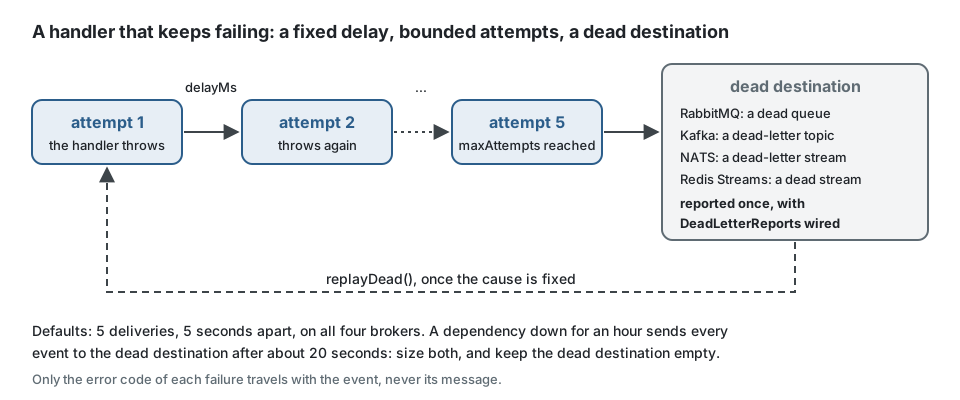
// The same policy everywhere: five deliveries, five seconds apart (the defaults), then the dead destination.const retry = { maxAttempts: 5, delayMs: 5_000 };
const providers: Record<typeof broker, () => EventBus> = {  rabbitmq: () => new RabbitMqEventBus({ connection: url, retry }), // quorum queues by default  kafka: () => new KafkaEventBus({ brokers: url, retry }), // keyOf: the key of each record, for ordering  nats: () => new NatsEventBus({ connection: url, retry }),  redis: () => new RedisStreamsEventBus({ connection: url, retry }), // Redis, Valkey or Dragonfly};
export const bus = providers[broker]();
When a handler keeps failing, all four do the same thing:
What the kit does not provide at all: SQS/SNS, Google Pub/Sub, Azure Service Bus, Pulsar,
Redpanda (may work as a Kafka-protocol broker; never run), change data capture (described as
a relay strategy, not shipped), exponential backoff on the consuming side (one fixed delay
everywhere), Kafka transactions, schema registries, and sagas or process managers
(sagas and process managers). stack.broker: custom generates a bus file and its contract spec for you to fill.
Ordering with Kafka holds only if all of these are true: keyOf gives the aggregate id, the
relay runs with ordering: 'per-key' and the same key, a single relay runs, and the topic
keeps its partition count. The relay's per-key memory is lost on restart, so one event may
overtake another once after a crash; strict ordering across restarts is stated as not done.
Limits and when not to use it
Section titled “Limits and when not to use it”- A broker does not replace the outbox. Publishing from a handler loses events when the commit fails after the publish, or invents them when the publish fails after the commit.
- A broker does not make consumers idempotent. Every provider redelivers.
- Same fixed retry delay on all four: a dependency that is down for an hour sends events
to the dead destination after
maxAttemptstimes the delay. Size both, monitor the dead destination (it must be empty), and usereplayDeadafter the fix. - Redis Streams on the cache server: an eviction policy that suits a cache can evict a
stream. Separate servers, or
noeviction. - New consumers and history differ by provider (see the table): a consumer added to Kafka or JetStream replays what is retained and must tolerate old events; one added to RabbitMQ or Redis Streams starts from now and needs a backfill by other means.
When not to add a broker: one deployable, one team, no consumer outside the process. The
in-memory provider behind the outbox has the same semantics for handlers, and
npm run dev needs one container fewer.
Recommendation by situation
Section titled “Recommendation by situation”| Situation | Choice |
|---|---|
| Modular monolith, single deployable | in-process, outbox relay woken by the database or polling |
| First extracted context, team knows RabbitMQ, no ordering need | RabbitMQ with quorum queues |
| Order per aggregate required by consumers, replay of history, many consumers | Kafka, if someone can operate it; otherwise a version in the payload and RabbitMQ |
| Small operations budget, replay wanted, ordering not needed | NATS JetStream, with retention limits set explicitly |
| Redis, Valkey or Dragonfly already operated, moderate volume, events that tolerate a rare loss | Redis Streams, on a server that is not the cache |
| A cloud queue service imposed | custom provider held to eventBusContract, following the strategy table of the events package |
Whatever the choice, write it in the project's integration documentation (delivery guarantees, retry and dead-letter policy, how to replay) and record it as a decision.
Sources
Section titled “Sources”- RabbitMQ documentation: publisher confirms https://www.rabbitmq.com/docs/confirms , quorum queues https://www.rabbitmq.com/docs/quorum-queues , dead lettering https://www.rabbitmq.com/docs/dlx
- Apache Kafka documentation (producer
acks, idempotence, consumer groups): https://kafka.apache.org/documentation/ - NATS JetStream documentation: https://docs.nats.io/nats-concepts/jetstream
- Redis Streams: https://redis.io/docs/latest/develop/data-types/streams/ ; Valkey: https://valkey.io/topics/streams-intro/ ; Dragonfly: https://www.dragonflydb.io/docs
- GitHub releases and licence files of
rabbitmq/rabbitmq-server,nats-io/nats-server,redis/redis,valkey-io/valkey,dragonflydb/dragonfly, read on 2026-10-10. - Chris Richardson, Microservices Patterns, Manning, 2018, chapter 3; microservices.io: Transactional outbox, Idempotent consumer.
- Gregor Hohpe and Bobby Woolf, Enterprise Integration Patterns, Addison-Wesley, 2003: Guaranteed Delivery, Dead Letter Channel, Idempotent Receiver.
- Martin Kleppmann, Designing Data-Intensive Applications, O'Reilly, 2017, chapter 11.
- Not verified: the latest Apache Kafka release on the day of writing (the kit's own README names 4.3); any behaviour of the providers on multi-node clusters.