
Invariants, permissions and validation
Summary. Three kinds of "this request is refused" exist in a business application, and
they are different things. Validation asks whether the input is well formed. A permission asks
whether this actor may do this, on this element. An invariant asks whether the action is valid
at all, whoever asks. This kit gives each one its own layer, its own mechanism and its own
kind of error: validation at the boundary behind the Schema port, permissions in the
application layer behind the Authorizer port, invariants in the domain as DomainErrors.
Mixing them is the usual way business rules end up in controllers and access rules end up in
entities.
Three questions
Section titled “Three questions”| Validation | Permission | Invariant | |
|---|---|---|---|
| Question | is the input well formed? | may this actor do this, on this? | is this a valid thing to do at all? |
| Depends on | the request alone | the actor, the action, sometimes the element | the state of the model |
| Knows the actor | no | yes | never |
| Knows the stored state | no | sometimes (a policy) | yes |
| Lives in | presentation/ |
application/authorization/ |
domain/ |
| Mechanism | a schema of the project's validation library, behind the Schema port |
a permission declared on the use case, decided by the Authorizer port; a policy for a rule on one element |
a check inside an aggregate, value object or domain service |
| Checked | before a command exists | before the handler runs (and by the handler, for a policy) | when the aggregate method runs |
| Refusal | validation issues, a 422 | not authenticated or forbidden, a 401 or 403 | a DomainError with a stable code, mapped once to a status |
| Example | startsAt is an ISO date-time |
only the client who booked, or the practitioner, may cancel | a cancelled appointment cannot be rescheduled |
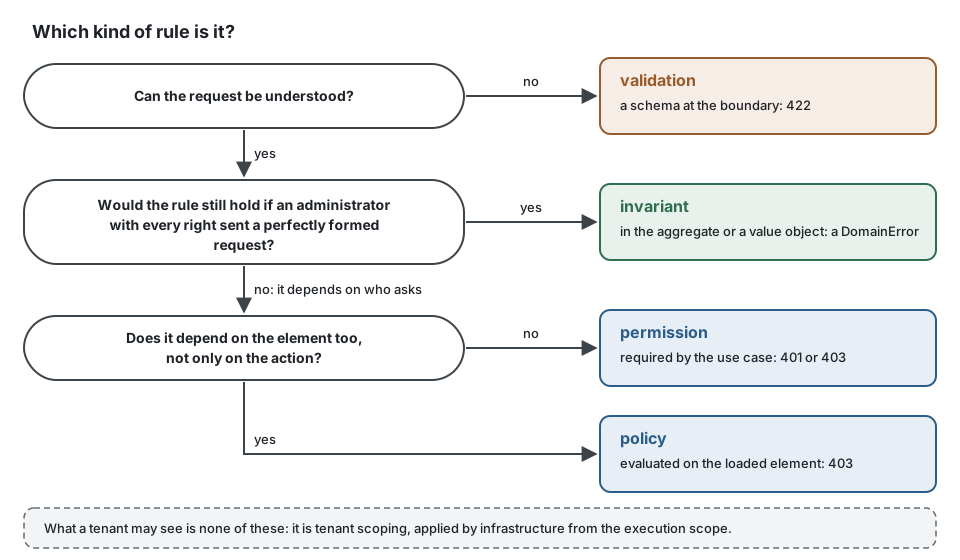
A simple discriminator: would the rule still hold if an administrator with every right sent a perfectly formed request? If yes, it is an invariant. If the answer depends on who asks, it is a permission. If the request could not even be understood, it is validation.
The same feature, seen three ways
Section titled “The same feature, seen three ways”Cancelling an appointment.
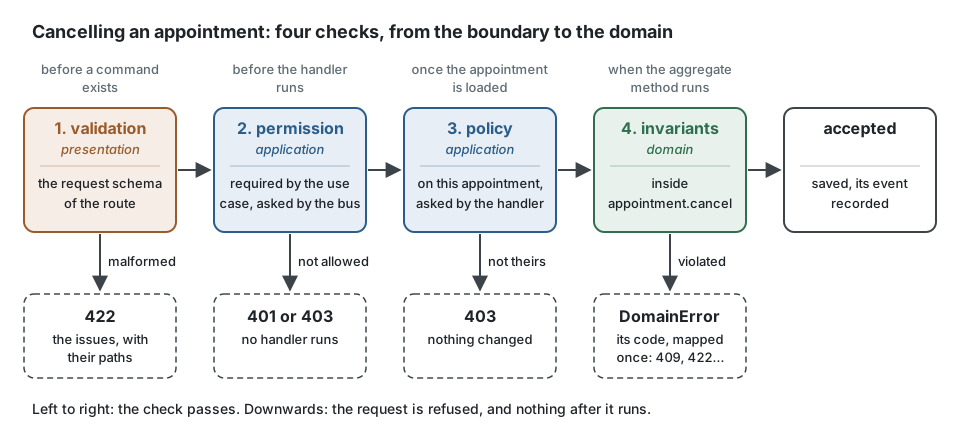
1. Validation, at the boundary. The route declares the shape of the input. It knows nothing about appointments beyond their identifier format.
import { zodSchema } from '@ddd-ts-kit/validation/zod';import { z } from 'zod';
// presentation/http: the request schema of the route (zod shown)export const cancelAppointmentBody = zodSchema(  z.object({    reason: z.enum(['client-request', 'practitioner-unavailable', 'other']),    note: z.string().max(500).optional(),  }),);
2. Permission, in the application. The use case declares what it requires; a bus middleware
asks the authorizer before the handler runs. Nothing is reachable by default
(authz/declared).
import { definePermissions } from '@ddd-ts-kit/auth';import { AuthorizedCommand, type Actor } from '@ddd-ts-kit/kernel';import { Requires } from '@ddd-ts-kit/kernel/declarations';
// application/authorization/appointments.permissions.tsexport const permissions = definePermissions('appointments', {  'appointment.cancel': { description: 'Cancel an appointment' },});
// application/commands/cancel-appointment/cancel-appointment.command.ts@Requires(permissions['appointment.cancel'], {  resource: (command: CancelAppointment) => ({ type: 'appointment', id: command.appointmentId }),})export class CancelAppointment extends AuthorizedCommand<void> {  constructor(    actor: Actor,    readonly appointmentId: string,    readonly reason: string,  ) {    super(actor);  }}
"Only the client who booked it, or its practitioner" depends on the loaded appointment. That is
a policy in application/authorization/*.policy.ts: a named, unit-tested rule that the handler
evaluates once the aggregate is loaded, through the Access port of @ddd-ts-kit/auth, which
asks every policy of the permission, then the authorizer.
import { Access, definePermissions, type PolicyContext } from '@ddd-ts-kit/auth';import { AuthorizedCommand, ConceptError, isAuthenticated, type Actor, type Clock } from '@ddd-ts-kit/kernel';import { CommandHandler, Policy } from '@ddd-ts-kit/kernel/declarations';
const permissions = definePermissions('appointments', {  'appointment.cancel': { description: 'Cancel an appointment' },});
declare class CancelAppointment extends AuthorizedCommand<void> {  readonly appointmentId: string;  readonly reason: string;}
declare class Appointment {  readonly clientId: string;  readonly practitionerId: string;  cancel(reason: string, at: Date): void;}
declare abstract class AppointmentRepository {  abstract findById(id: string): Promise<Appointment | undefined>;  abstract save(appointment: Appointment): Promise<void>;}
declare class AppointmentError extends ConceptError {  static notFound(appointmentId: string): AppointmentError;}
// application/authorization/own-appointment.policy.ts/** Only the client who booked the appointment, or its practitioner, may cancel it. */@Policy(permissions['appointment.cancel'], { name: 'appointments.own-appointment' })export class OwnAppointmentPolicy {  appliesTo(subject: unknown): subject is Appointment {    return subject instanceof Appointment;  }
  allows(actor: Actor, appointment: Appointment, _context: PolicyContext): boolean {    return isAuthenticated(actor) && (actor.id === appointment.clientId || actor.id === appointment.practitionerId);  }}
// application/commands/cancel-appointment/cancel-appointment.handler.ts@CommandHandler(CancelAppointment)export class CancelAppointmentHandler implements CommandHandler<CancelAppointment> {  constructor(    private readonly appointments: AppointmentRepository,    private readonly access: Access,    private readonly clock: Clock,  ) {}
  async execute({ actor, appointmentId, reason }: CancelAppointment): Promise<void> {    const appointment = await this.appointments.findById(appointmentId);
    if (appointment === undefined) {      throw AppointmentError.notFound(appointmentId);    }
    await this.access.authorize(actor, permissions['appointment.cancel'], appointment); // 403 when a policy refuses    appointment.cancel(reason, this.clock.now()); // the invariants: a DomainError when one is violated    await this.appointments.save(appointment);  }}
3. Invariants, in the domain. The aggregate refuses what is never valid.
import { AggregateRoot, ConceptError } from '@ddd-ts-kit/kernel';
const FREE_CANCELLATION_MS = 24 * 60 * 60_000;
export class AppointmentError extends ConceptError {  static alreadyCancelled(appointmentId: string) {    return AppointmentError.refusal('APPOINTMENT_ALREADY_CANCELLED', `Appointment ${appointmentId} is already cancelled.`, {      appointmentId,    });  }
  static cancellationWindowPassed(appointmentId: string, startsAt: Date) {    return AppointmentError.refusal(      'CANCELLATION_WINDOW_PASSED',      `Appointment ${appointmentId} starts at ${startsAt.toISOString()}: free cancellation ended 24 hours before.`,      { appointmentId, startsAt },    ).exposing('startsAt');  }}
export class Appointment extends AggregateRoot<string> {  private cancelledFor: string | undefined;
  constructor(    id: string,    private readonly startsAt: Date,  ) {    super(id);  }
  /** No actor: these rules hold whoever asks. */  cancel(reason: string, at: Date): void {    this.assertNotCancelled();    this.assertCancellationStillFree(at);    this.cancelledFor = reason;    // then record the event, see Aggregates  }
  private assertNotCancelled(): void {    if (this.cancelledFor !== undefined) {      throw AppointmentError.alreadyCancelled(this.id);    }  }
  private assertCancellationStillFree(at: Date): void {    if (this.startsAt.getTime() - at.getTime() < FREE_CANCELLATION_MS) {      throw AppointmentError.cancellationWindowPassed(this.id, this.startsAt);    }  }}
The aggregate method takes no actor. It cannot be tricked by a missing check elsewhere, and its tests need no user.
Where each lives, and why
Section titled “Where each lives, and why”Validation stays outside because the shape of a request is a transport matter. The same use
case may be reached by HTTP, by a consumed event or by a scheduled job, each with its own input
format. The domain never imports a validation library (layer/domain-purity).
Value objects blur the line in a useful way: TimeSlot.create refuses an end before its start.
That is not input validation, it is the definition of a slot, and it holds for every caller.
The boundary schema checks that two date-times were sent; the value object checks that they
form a slot. A little overlap between the two is normal and harmless.
Permissions stay in the application because who may do what is the context's policy about
its use cases, not a property of its model. Roles, attributes or relationships can change
without touching an aggregate, and the authorization model can be swapped behind the port
(Authentication and authorization). The rule ids:
authz/declared, authz/in-application, authz/actor-explicit.
Invariants stay in the domain because they are the model. They must hold on every path: HTTP, event, job, test, a future import script. The only place every path goes through is the aggregate method.
One exception is stated by the reference: a context whose model is access itself (managing members and roles is its business) may hold roles as its own state. Then a role is domain data, not the acting user's rights.
Typical mistakes
Section titled “Typical mistakes”| Mistake | What goes wrong | Where it belongs |
|---|---|---|
if (appointment.status === 'cancelled') return 409 in a route |
the rule is skipped by every other entry point | an invariant in appointment.reschedule |
a schema that refuses a startsAt in the past |
a business rule ("no booking in the past") hidden in presentation, and dependent on a clock | an invariant, with now passed in |
if (user.role === 'admin') in a handler or a route |
rights scattered, invisible to audit | a permission required by the use case |
appointment.cancel(reason, actor) checking actor.id === this.clientId |
access knowledge in the model; every test needs an actor | a policy in application/authorization/ |
an isAdmin flag on a domain entity deciding access |
access leaking into the model | roles or relations in the authorizer |
a DomainError for "missing field" |
a malformed request reaches the domain | validation at the boundary |
| a 403 for "appointment already cancelled" | the client is told it lacks a right it has | a domain error mapped to a conflict |
| loading a list, then filtering by rights in memory | leaks counts, breaks paging, slow | an access scope from the authorizer, handed to the read port |
| trusting the schema and skipping the invariant | the next entry point has no schema | keep both: each answers its own question |
The two mistakes that put access in the model, next to what to write instead:
import { isAuthenticated, type Actor } from '@ddd-ts-kit/kernel';
declare function forbidden(): Error;
// Instead of: the aggregate checks who asks; every test of cancel needs an actor,// and a rule about rights hides in the model, invisible to the audit trailexport class AppointmentDecidingAccess {  constructor(    readonly clientId: string,    readonly isAdmin: boolean,  ) {}
  cancel(reason: string, actor: Actor): void {    if (!this.isAdmin && (!isAuthenticated(actor) || actor.id !== this.clientId)) {      throw forbidden();    }    // ...  }}
// Write: the aggregate keeps its own rules and takes no actor; who may cancel is the// policy of the permission, evaluated by the handler (above)export class Appointment {  constructor(readonly clientId: string) {}
  cancel(reason: string, at: Date): void {    // the invariants only  }}
Rules that look ambiguous usually separate cleanly with the discriminator above:
| Rule | Kind | Reasoning |
|---|---|---|
| free cancellation ends 24 hours before the start | invariant | true for anyone |
| a practitioner may cancel inside the 24 hours, a client may not | policy | depends on who asks; the aggregate then offers two intentions, or the handler chooses the method the actor is allowed to call |
| not after the appointment has started | invariant | it holds whoever asks |
| a tenant sees only its own appointments | neither: tenant scoping, applied by infrastructure from the execution scope | Actor and execution scope |
Errors, three shapes
Section titled “Errors, three shapes”- Validation produces a list of issues with paths (
items.0.sku), answered as a problem document with status 422 by the HTTP pipeline. - Authentication and authorization refusals are produced by the platform and the authorization middleware, answered 401 or 403.
- Invariants raise
DomainErrors with a stablecode(SLOT_TAKEN,CANCELLATION_WINDOW_PASSED). Presentation maps codes to transport statuses in one place, and each route declares the codes it can answer, which flow into the OpenAPI contract (errors/known-codeholds that each declared code exists). ADomainErroris an answer, not an incident: it is not sent to the error tracker.
How a refusal is written
Section titled “How a refusal is written”One error class per concept of the language, one static factory per refusal:
import { ConceptError } from '@ddd-ts-kit/kernel';
declare const calendar: { readonly id: string };declare const slot: { readonly startsAt: Date };
export class AppointmentError extends ConceptError {  static slotTaken(calendarId: string, startsAt: Date) {    return AppointmentError.refusal(      'SLOT_TAKEN',      `The slot starting at ${startsAt.toISOString()} on calendar ${calendarId} is already held.`,      { calendarId, startsAt },    ).exposing('startsAt');  }}
// where the rule is keptthrow AppointmentError.slotTaken(calendar.id, slot.startsAt);- The name is the business's, twice. The factory is what the developer who refuses reads,
the code what the client, the mapper, the audit trail and the tests read. They say the same
words:
slotTakenandSLOT_TAKEN(errors/factory-name). A code names one refusal of a context (errors/code-unique). - The concept is what was asked for, not the class that detects the problem: a calendar
that finds a slot held refuses with
AppointmentError.slotTaken, because the caller asked for an appointment. The refusals of a value object are factories of the concept it describes:PersonError.invalidEmail(raw), thrown byEmail.create(or returned in itsResultunder"stack.valueObjects": "result"). - The facts are data, and private. What the message was built from is kept on the error as
facts, so that a handler or a test reads a date and not a sentence. A fact reaches the client, underfactsin the problem document, only when the factory names it with.exposing(..); nothing that identifies a person ever is. The message is answered asdetail: write nothing in it that the caller did not send. - Nothing downstream knows the class.
isRefusal(error, 'SLOT_TAKEN'),AppointmentError.is(error, 'SLOT_TAKEN'),thenError('SLOT_TAKEN', { calendarId }),expectProblem(response, { status: 409, code: 'SLOT_TAKEN' }): the code is the key. - A class that grows names a second concept. Past some twenty factories (a file holds 350 lines), split along a term of the glossary, never along a technical line.
A project written with one class per error (new SlotTakenError(..)) keeps working, and
ddd-ts-kit error-factories moves it: CONFIG.md, stack.refusals.
Limits and when not to use it
Section titled “Limits and when not to use it”- The split is a discipline the tools only partly hold.
authz/in-applicationmatches names and shapes: the CLI README states that an ownership test written asappointment.clientId === actor.idgoes unseen by the text-level checker. Review still matters. - A use case with no rule of any kind (a public health check, a reference list) needs none of the three beyond declaring itself public. Do not add ceremony for symmetry.
- Set-wide invariants are not fully expressible in an aggregate. "No double booking" needs a database constraint as well (Aggregates).
- Client-side validation is a fourth thing, for user comfort only. It never replaces the boundary schema.
- Some rules are both. "A client may book at most three appointments a week" is an invariant over a set, expensive to guard strictly; decide with the business whether it must be exact (constraint or counter in the same transaction) or may be approximate (checked on a projection).
Sources
Section titled “Sources”- Eric Evans, Domain-Driven Design, Addison-Wesley, 2003, chapter 6 (invariants and aggregates) and chapter 9 (specifications, making implicit rules explicit).
- Vaughn Vernon, Implementing Domain-Driven Design, Addison-Wesley, 2013, chapter 5 (validation of entities) and chapter 10.
- Robert C. Martin, Clean Architecture, Prentice Hall, 2017, chapter 22 (boundaries and what crosses them).
- RFC 9457, "Problem Details for HTTP APIs", rfc-editor.org/rfc/rfc9457.
- Repository: ARCHITECTURE.md, section 4, "Authentication and
authorization" and "Validation";
plugin/skills/access-control/SKILL.md.