
Persistence: Drizzle, Knex, Prisma, TypeORM, and which database
Summary. In this architecture an ORM is an implementation detail of
infrastructure/persistence/: rows never leave it, a mapper turns them into aggregates, and
transactions belong to the application through the UnitOfWork port. The kit ships the same
three pieces for four libraries (a unit of work with an ambient transaction, an outbox store, a
processed-event store), all held to the same contract suites. What differs is how each library
handles transactions, migrations, type safety and raw SQL, and how far each adapter was
actually tested: PostgreSQL is covered by the automated suites for all four, MySQL 8 and
SQLite were run by hand once for three of them, and nothing else was run at all.
What the application asks of persistence
Section titled “What the application asks of persistence”The requirements come from the model, not from the library (aggregates, transactional outbox):
| Need | Why | Consequence for the tool |
|---|---|---|
| load and save one whole aggregate | Appointment is a consistency boundary |
a mapper, not an "entity" that is both row and model |
| one transaction per command, opened by a bus middleware | the handler never sees it | an ambient transaction the repository picks up |
optimistic concurrency on version |
two reschedules of one appointment | "update where version matches", count the rows |
| the outbox row in the same transaction | scheduling.appointment.booked exists if and only if the booking does |
the outbox store joins the unit of work |
| the processed-event mark with the consumer's change | notification handles a redelivery once |
same |
| a constraint the database enforces | no double booking, whatever any process believes | raw SQL in a migration (below) |
| one schema per context, no cross-context join | context/extractable in ARCHITECTURE.md |
schema-qualified tables |
The no-double-booking invariant shows what "raw SQL" means in practice. On PostgreSQL it is an
exclusion constraint over the calendar and the time an active appointment holds. None of the
four libraries expresses it in its schema language as far as this page could establish: it is
written by hand in a migration, and the repository adapter maps the violation to the refusal
SLOT_TAKEN of the domain (AppointmentError.slotTaken). The example application declares it
in create-scheduling-tables.schema.ts, after create extension if not exists btree_gist:
alter table scheduling.appointments add constraint appointments_slot_held_once exclude using gist (calendar_id with =, tstzrange(starts_at, held_until, '[)') with &&) where (status in ('requested', 'booked'));Two transactions that both read a free slot cannot both write it: the second one fails on the
constraint (SQLSTATE 23P01), whatever each believed when it checked.
The pieces, in one command
Section titled “The pieces, in one command”Four pieces do the work, and only the last one knows the library: the repository port of the domain, the unit of work the bus opens around each command, the repository adapter with its mapper, and the stores of the messaging (outbox, processed events). The sequence below follows one command, "pay an invoice", through them. Every statement runs in the transaction the unit of work opened, and the handler never touches it.
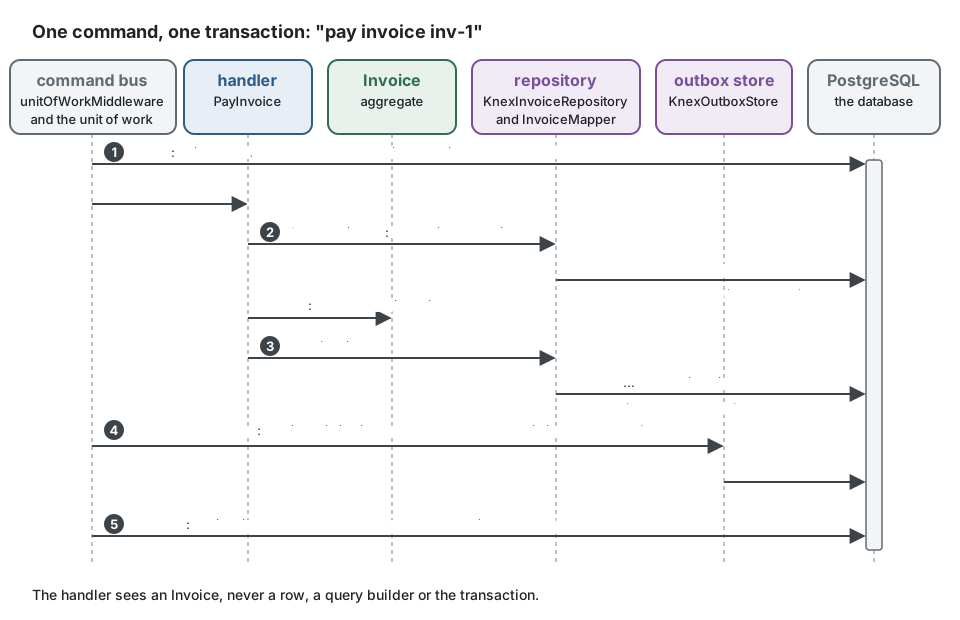
unitOfWorkMiddlewareof the kernel wraps every command of the bus inunitOfWork.run. The Knex unit of work opensknex.transactionand keeps it in anAsyncLocalStorage.- The adapter asks
KnexContext.executor()for its query handle: inside a run it is the transaction, outside it the pool. No method takes a transaction as a parameter. - The mapper turns the row into an
Invoiceand back. The aggregate carries theversionit was read at; theUPDATEonly matches that version. - When the handler has returned, the domain events the saves recorded are dispatched, still
inside the transaction. The handler of
InvoicePaidpublishes an integration event; theOutboxPublisherof@ddd-ts-kit/eventsonly appends it to the outbox store, which writes through the same executor. A relay sends it to the broker later. - The commit writes the invoice and the outbox row together; any failure rolls both back.
A repository adapter
Section titled “A repository adapter”The port is declared in the domain, the adapter and its mapper in
infrastructure/persistence/. The sample puts them in one module so that it compiles alone; in
a project each part is a file of its own, named in the comments. It follows KnexAppointmentRepository of the example
application.
import type { Knex } from 'knex';import { AggregateRoot, ConceptError, type DomainEvent, Repository } from '@ddd-ts-kit/kernel';import { type KnexContext, insertIgnoringConflict, optimisticUpdate } from '@ddd-ts-kit/knex';
// domain/events/invoice-paid.event.ts: the domain knows no row, no SQL, no library.export class InvoicePaid implements DomainEvent {  static readonly eventName = 'billing.invoice.paid';
  readonly name = InvoicePaid.eventName;
  constructor(    readonly aggregateId: string,    readonly occurredAt: Date,  ) {}}
// domain/errors/invoice.error.tsexport class InvoiceError extends ConceptError {  static alreadyPaid(invoiceId: string) {    return InvoiceError.refusal('INVOICE_ALREADY_PAID', `Invoice ${invoiceId} is already paid.`, { invoiceId });  }}
// domain/aggregates/invoice.aggregate.tsexport class Invoice extends AggregateRoot {  private constructor(    id: string,    readonly amountInCents: number,    private paidOn: Date | null,  ) {    super(id);  }
  static issue(id: string, amountInCents: number): Invoice {    return new Invoice(id, amountInCents, null);  }
  /** Rebuilds a stored invoice: used by the mapper only. */  static rehydrate(id: string, amountInCents: number, paidOn: Date | null): Invoice {    return new Invoice(id, amountInCents, paidOn);  }
  get paidAt(): Date | null {    return this.paidOn;  }
  pay(on: Date): void {    if (this.paidOn !== null) {      throw InvoiceError.alreadyPaid(this.id);    }
    this.paidOn = on;    this.record(new InvoicePaid(this.id, on));  }}
// domain/repositories/invoice.repository.ts: the port, findById and save come from Repository.export abstract class InvoiceRepository extends Repository<Invoice> {}
// infrastructure/persistence/invoice-row.schema.ts: the row never leaves infrastructure.type InvoiceRow = {  readonly id: string;  readonly amount_in_cents: number;  readonly paid_at: Date | null;  readonly version: number;};
// infrastructure/persistence/invoice.mapper.tsconst InvoiceMapper = {  toDomain(row: InvoiceRow): Invoice {    const loaded = Invoice.rehydrate(row.id, row.amount_in_cents, row.paid_at);
    loaded.version = row.version;
    return loaded;  },
  toRow(saved: Invoice, version: number): InvoiceRow {    return { id: saved.id, amount_in_cents: saved.amountInCents, paid_at: saved.paidAt, version };  },};
// infrastructure/persistence/knex-invoice.repository.tsexport class KnexInvoiceRepository implements InvoiceRepository {  constructor(private readonly database: KnexContext) {}
  async findById(id: string): Promise<Invoice | undefined> {    const row = await invoicesOf(this.database).where({ id }).first();
    return row === undefined ? undefined : InvoiceMapper.toDomain(row);  }
  /** No row written means another transaction saved it first: optimisticUpdate throws ConcurrencyError. */  async save(saved: Invoice): Promise<void> {    await optimisticUpdate(saved, async ({ expected, next }) => {      const row = InvoiceMapper.toRow(saved, next);
      if (expected === 0) {        const inserted = await insertIgnoringConflict(this.database.executor(), invoicesOf(this.database), {          row,          conflict: 'id',        });
        return inserted ? 1 : 0;      }
      return invoicesOf(this.database).where({ id: saved.id, version: expected }).update(row);    });  }}
/** The transaction of the running unit of work, or the pool outside one. */function invoicesOf(database: KnexContext): Knex.QueryBuilder<InvoiceRow, InvoiceRow[]> {  return database.executor()<InvoiceRow, InvoiceRow[]>('invoices').withSchema('billing');}
What each part holds:
| Part | Holds | Never holds |
|---|---|---|
Invoice |
the rules, the state, the events it records, and version (from AggregateRoot) |
a column name, a query |
InvoiceRepository |
what the application may ask: findById, save, the finders you add |
a type of the library |
InvoiceMapper |
the translation between the row and the aggregate, both ways | a query, a rule |
KnexInvoiceRepository |
the queries, the schema, the concurrency check, the mapping of a database error to a refusal | the transaction itself (executor() gives it) |
Instead of handing rows to the handler
Section titled “Instead of handing rows to the handler”The handler talks to the aggregate through the port; it never sees a row, a query builder or a transaction.
// Instead of: the handler edits a row, and the rule "an invoice is paid once" lives nowhere.const row = await db('billing.invoices').where({ id }).first();await db('billing.invoices').where({ id }).update({ paid_at: new Date() });
// Write: the handler loads the aggregate, asks it (it refuses a second payment), saves it.const invoice = await invoices.findById(id);if (invoice === undefined) throw new NotFoundError(`Invoice ${id} does not exist.`); // NotFoundError: @ddd-ts-kit/kernelinvoice.pay(clock.now());await invoices.save(invoice);
Composing the unit of work
Section titled “Composing the unit of work”One object answers both ports: the bus runs commands through UnitOfWork, the adapters and the
stores query through KnexContext. The example application composes it this way in
platform/database/persistence-over.ts.
import knex from 'knex';import { unitOfWorkMiddleware } from '@ddd-ts-kit/kernel';import { createKnexUnitOfWork, KnexOutboxStore, KnexProcessedEventStore } from '@ddd-ts-kit/knex';
const db = knex({ client: 'pg', connection: 'postgres://localhost:5432/app' });
// Bound to UnitOfWork (for the bus) and to KnexContext (for the adapters).export const unitOfWork = createKnexUnitOfWork(db);
// The stores write through it too: their rows commit or roll back with the command.export const outbox = new KnexOutboxStore(unitOfWork, { schema: 'messaging' });export const processedEvents = new KnexProcessedEventStore(unitOfWork, { schema: 'messaging' });
// The bus runs every command in unitOfWork.run; a query runs outside any transaction.export const transactional = unitOfWorkMiddleware(unitOfWork);
await unitOfWork.run(async () => {  // Here unitOfWork.executor() is the transaction and unitOfWork.inTransaction() is true.  await unitOfWork.run(async () => {    // A nested run joins the outer one: one commit, or one rollback, for both.  });});
The same pieces, under the name each package gives them:
| Knex | Drizzle (@ddd-ts-kit/drizzle/postgres) |
Prisma | TypeORM | |
|---|---|---|---|---|
| Unit of work | createKnexUnitOfWork |
createDrizzleUnitOfWork |
createPrismaUnitOfWork |
createTypeOrmUnitOfWork |
| What adapters query through | KnexContext |
DrizzleContext |
PrismaContext |
TypeOrmContext |
| Outbox store | KnexOutboxStore |
DrizzleOutboxStore |
PrismaOutboxStore |
TypeOrmOutboxStore |
| Processed-event store | KnexProcessedEventStore |
DrizzleProcessedEventStore |
PrismaProcessedEventStore |
TypeOrmProcessedEventStore |
Optimistic concurrency, and one contract for the fake and the adapter
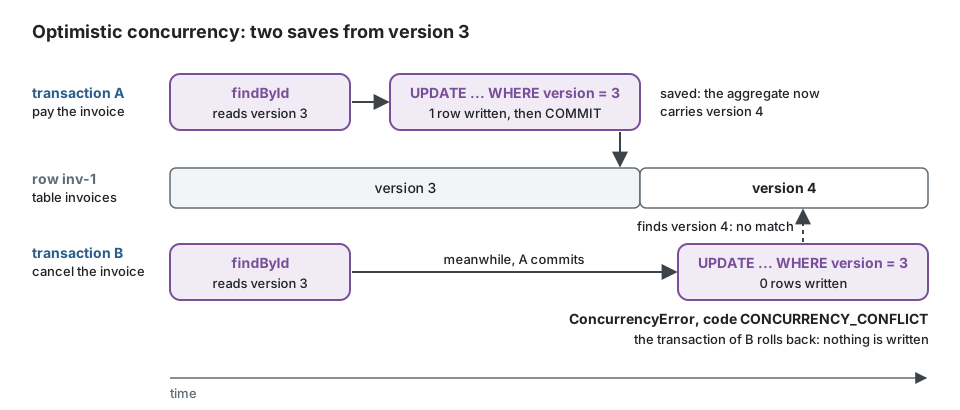
Section titled “Optimistic concurrency, and one contract for the fake and the adapter”Two commands may load the same invoice at the same version. The first save matches the
version and moves it on; the second matches no row, and optimisticUpdate throws
ConcurrencyError (code CONCURRENCY_CONFLICT), which rolls its transaction back.
The fake of the unit specs and the real adapter keep that promise alike: the same
repositoryContract runs against both, the fake in memory and the adapter on PGlite or a real
server.
import { randomUUID } from 'node:crypto';import { afterEach, beforeEach, describe, expect, it } from 'vitest';import { AggregateRoot, type Repository } from '@ddd-ts-kit/kernel';import { InMemoryRepository } from '@ddd-ts-kit/testing';import { repositoryContract } from '@ddd-ts-kit/testing/contracts';
// From the sample above, and from the test database of the project.declare class Invoice extends AggregateRoot {  static issue(id: string, amountInCents: number): Invoice;  static rehydrate(id: string, amountInCents: number, paidOn: Date | null): Invoice;  readonly amountInCents: number;  readonly paidAt: Date | null;  pay(on: Date): void;}declare function knexInvoiceRepositoryOnAnEmptyDatabase(): Promise<Repository<Invoice>>;
const runner = { describe, it, expect, beforeEach, afterEach };
const expectations = {  createAggregate: () => Invoice.issue(randomUUID(), 12_000),  mutate: (invoice: Invoice) => invoice.pay(new Date('2026-10-01T09:00:00.000Z')),  idOf: (invoice: Invoice) => invoice.id,  stateOf: (invoice: Invoice) => ({ amountInCents: invoice.amountInCents, paidAt: invoice.paidAt }),};
// The fake the unit specs use: a Map that checks the version like the adapter.repositoryContract<Invoice>(runner, {  ...expectations,  name: 'InMemoryRepository<Invoice>',  createRepository: () =>    new InMemoryRepository<Invoice>({      clone: (invoice) => Invoice.rehydrate(invoice.id, invoice.amountInCents, invoice.paidAt),    }),});
// The adapter, on a database emptied before each test.repositoryContract<Invoice>(runner, {  ...expectations,  name: 'KnexInvoiceRepository',  createRepository: knexInvoiceRepositoryOnAnEmptyDatabase,});
The contract checks that a saved aggregate is found with its state, that two aggregates stay
apart, that later saves are stored, that a change not saved is not, and that a save over a
version it did not read is refused with CONCURRENCY_CONFLICT.
Comparison
Section titled “Comparison”Versions checked on 2026-10-10 against the npm registry.
| Drizzle | Knex | Prisma | TypeORM | |
|---|---|---|---|---|
| What it is | typed SQL builder with schema in TypeScript | SQL query builder | client generated from a schema file | ORM, data mapper or active record |
| Version | 0.45.4 stable; a 1.0 release candidate is published (rc tag) |
3.3.0 (June 2026) | 7.10.0 is the last 7.x; the npm latest tag pointed at 8.0.0-rc.22 on the day of the check |
1.1.2 (0.3.x kept under legacy) |
| Licence | Apache-2.0 | MIT | Apache-2.0 | MIT |
| Weekly downloads | about 27 million | about 6 million | about 19 million | about 5 million |
| Type safety of queries | inferred from the table definitions | weak: types are annotations you write | from the generated client | from entity definitions; query builder strings are unchecked |
| Transactions | callback; savepoints | callback or manual; savepoints | interactive transactions, bounded in time (5 s by default) and holding a connection | QueryRunner or callback |
| Row locking | in the builder | in the builder (forUpdate().skipLocked()) |
none in the client: raw SQL | in the query builder |
| Migrations | generated from the schema diff by drizzle-kit, SQL files | hand-written JavaScript, up and down | generated from the schema diff, SQL files | generated from entities, or hand-written |
| Raw SQL | sql template, table objects interpolated |
first class: it is a query builder | $queryRaw, typed SQL files |
query() |
| Runtime weight | library only | library only | generated client plus a driver adapter | library, reflect-metadata with decorated entities |
| Decorators | none | none | none | optional: the kit uses EntitySchema, no decorator |
Reading the table for this architecture: the ORM features that matter least are the ones ORMs advertise most. Lazy relations, identity maps, cascades and active records have no use when an aggregate is loaded whole and mapped by hand; what matters is honest SQL, a transaction that can be made ambient, row locks for the outbox relay and migrations you can read.
Selection criteria
Section titled “Selection criteria”- Team knowledge and existing schema. A running application on one of the four keeps it: the domain does not care.
- How much raw SQL you expect. Constraints, partial indexes, read models with window functions: Knex and Drizzle stay closest to SQL.
- Type safety of read models. Query handlers may bypass aggregates and read projections through a port; typed queries pay off there.
- Transaction length. Prisma's interactive transactions are bounded in time by default.
- What the kit generates for it. Tenant scoping and the SQL audit trail are not available for all four (below).
- Version currency. Prefer the current stable line; on the day of the check Prisma's npm
latesttag carried a release candidate, so pin the version you tested.
What this kit supports and verified
Section titled “What this kit supports and verified”Common to the four packages (drizzle,
knex, prisma,
typeorm): a unit of work whose transaction repositories
never see, where a nested run joins the outer transaction and the domain events are
dispatched at the end of the outermost run, before its commit; an outbox store whose
claimBatch leases due rows so several relays share the work and a dead relay's rows come
back; a processed-event store whose mark commits with the handler's effects; the standard
audit columns and tenant_id; cursor and offset pages. The units of work pass
unitOfWorkContract, the stores outboxStoreContract and processedEventStoreContract; your repositories are held to repositoryContract next to
their in-memory fake. Delivery through the outbox is at least once and unordered.
Tenant isolation is uneven across the four: Knex ships the four strategies (shared tables, row-level
security, schema per tenant, database per tenant), Drizzle the first two, Prisma and TypeORM none
beyond the tenant_id column. The table, and the tenantIsolationContract each strategy passes,
are in Multitenancy.
For the read side, each of the four also ships a translator of the kernel criteria into its
query (criteriaToDrizzle, criteriaToKnex, criteriaToPrisma, criteriaToTypeOrm) and a
read model store for projections, held to criteriaContract and readModelStoreContract on
PostgreSQL; neither was run on MySQL or SQLite. The CLI does not generate them yet: see the
read side proposal for the status per part.
For event-sourced aggregates, each of the four runs the PostgreSQL event store of the kernel
(createKnexEventSourcing, createDrizzleEventSourcing, createPrismaEventSourcing,
createTypeOrmEventSourcing): the streams, the snapshots, the checkpoints of the subscriptions
and the keys of the data subjects, with the tables declared the way each ORM migrates
(createEventStoreTables, eventStoreTables, the models of
prisma/event-store.postgresql.prisma, eventStoreEntities). Each is held to
eventStoreContract and eventStoreUnitOfWorkContract on PGlite in the unit run; knex, Prisma
and TypeORM also passed them on PostgreSQL 17 by hand. Not provided on MySQL or SQLite. When to
choose it: Event sourcing, per aggregate.
Per database
Section titled “Per database”| Drizzle | Knex | Prisma | TypeORM | |
|---|---|---|---|---|
| PostgreSQL | automated: contract suites on PGlite (in process); works with node-postgres, postgres-js, PGlite, Neon drivers | automated on PGlite over the wire protocol, and on a real server when a URL is given (last run: PostgreSQL 18): contracts, rollback, nested unit of work, concurrent claims | same as Knex, through @prisma/adapter-pg, both claim strategies |
same as Knex |
| MySQL 8 | not provided: the package is PostgreSQL only | by hand, once, against 8.4: outbox and processed-event contracts, rollback of append |
by hand, once, against 8.4 through @prisma/adapter-mariadb |
by hand, once, against 8.4 |
| SQLite | not provided | by hand, once (better-sqlite3); no SKIP LOCKED, no schemas |
by hand, once, outbox contract only; the processed-event store needs a custom delegate | by hand, once; no SKIP LOCKED, no schemas |
| MariaDB, CockroachDB, SQL Server, Oracle | not provided | never run | CockroachDB, SQL Server never run | never run |
| MongoDB | not provided | not applicable | never run | never run |
| Library version tested | not stated in the README | not stated | Prisma 7.10; the peer range admits 6, on which nothing was run | TypeORM 1.1; the peer range admits 0.3, on which nothing was run |
"By hand, once" is the READMEs' own wording: those suites are not in CI, so a regression on MySQL or SQLite would not be caught by the kit.
What the generator and the other packages add
Section titled “What the generator and the other packages add”From packages/cli/README.md and
packages/audit/README.md:
- The generated persistence of the four ORMs is written for PostgreSQL.
customstarts on in-memory adapters held to the contract suites, for you to replace. generate repository --tenant-scoped, and every repository of a project initialised with--tenancy shared-table, is implemented for Drizzle and Knex; with another ORM the regular adapter is written and a note says what to add, andinitrefuses the strategy.- The SQL audit trail exists for Knex and Drizzle, on PostgreSQL only. With Prisma, TypeORM,
customor no ORM the generated project starts on an in-memory trail behind aTODO(platform). - Fast adapter specs run on PGlite; Docker Compose provides the real server.
PostgreSQL versus the others
Section titled “PostgreSQL versus the others”| Database | Position in this kit | What you lose or must check |
|---|---|---|
| PostgreSQL | the default and the only one in the automated suites | nothing |
| MySQL 8 | stores run by hand once (Knex, Prisma, TypeORM) | no generated persistence, no SQL audit trail; DATETIME without time zone under Knex; no SKIP LOCKED on 5.7; one schema per context becomes one database or a table prefix |
| SQLite | stores run by hand once | no schemas, compare-and-set claim, single writer: tests and tools, not several instances |
| MongoDB, others | no adapter | stack.orm: custom: your own unit of work (its run built on withinUnitOfWork of the kernel), outbox store and processed-event store, each passing the contract suites; without multi-document transactions the outbox guarantee is not available |
stack.database accepts postgres, mysql, sqlite, mongodb and none
(CONFIG.md). init refuses anything but postgres with one of the four
ORMs: the other values go with --orm custom, where they record a choice and select no
package. init --database mongodb is accepted with --orm custom although the usage line of
--help does not list it.
Limits and when not to use it
Section titled “Limits and when not to use it”- Ordering. No store orders events, not even per aggregate; see delivery and idempotency.
- Prisma. No row locking in the client (one raw
SELECT ... FOR UPDATE SKIP LOCKED, or the compare-and-set claim);claimmust be chosen by you because the client does not reveal its database; interactive transactions time out; no partial index in the schema language;stats()is three queries. - TypeORM. An
EntitySchemais static: column types follow thedialectyou pass.synchronize: trueis for tests only. - Knex. The payload is serialized with
JSON.stringify; MariaDB would return it as text. - Drizzle. Never name a table in raw SQL: interpolate the table object so the schema qualification follows (persistence skill). The audit package notes that Drizzle prints the parameters of a failed statement in its error message: log the code, not the message.
- All. Migrations are forward-only and compatible with the version still running (expand, migrate, contract). The kit provides table definitions for each tool's own migration tooling; it runs no migration of its own.
When not to use an ORM adapter at all: a context with no state (a pure translator), or a read model better served by a search engine or a cache, behind a port of its own.
Migrations: names, merges and order
Section titled “Migrations: names, merges and order”Several people add migrations at the same time, on one context or on several. Every migration
a generated project writes is named <timestamp>_<what-it-does>, and npm run db:generate
refuses to run without the description: two branches never write the same file.
| Tool | db:generate |
Writes | A migration merged older than one already applied |
|---|---|---|---|
| drizzle-kit 0.31 | drizzle-kit generate --name (migrations.prefix: 'timestamp' in drizzle.config.ts) |
migrations/20261012093000_add-invoices.sql, its snapshot meta/20261012093000_snapshot.json, one entry of meta/_journal.json |
skipped without a word: the migrator applies the entries newer than the last one recorded |
| knex 3 | knex migrate:make (the ES module stub of knex, set in knexfile.js) |
migrations/20261012093000_add-invoices.js |
applied: knex runs every file it has not recorded |
| Prisma 7 | prisma migrate dev --create-only --name |
prisma/migrations/20261012093000_add_invoices/migration.sql (Prisma turns - into _) |
applied by migrate deploy, which runs every migration it has not recorded (its documentation; not measured here) |
| TypeORM 1.1 | typeorm migration:generate -d <data source>, given the path: npm run db:generate migrations/add-invoices |
migrations/1791829645467-add-invoices.ts (milliseconds, and a -: TypeORM fixes both) |
applied: TypeORM runs every migration it has not recorded |
The command takes the description after the script: npm run db:generate add-invoices
(npm run db:generate -- audit-guard --custom for a hand-written drizzle-kit migration).
The first knex migration that init writes is 00000000000000_initial.js: it sorts before any
timestamp; a project created before 0.5 keeps its 0001_initial.js, since an applied
migration is never renamed.
Measured with drizzle-kit 0.31.11 and drizzle-orm 0.45.4 (2026-10-12), two copies of one project each generating a migration, as two branches would:
- with the former default (
prefix: 'index'), both write0001_<random words>.sqlandmeta/0001_snapshot.json: the snapshot conflicts as a file added twice; - with
prefix: 'timestamp', the files and the snapshots no longer collide, butmeta/_journal.jsonstill conflicts (each branch appends an entry at the same place), and once merged by hand two snapshots name the same parent:drizzle-kit checkexits 1 anddrizzle-kit generateprints the collision and writes nothing (with exit code 0); - worse, a database that applied the later migration first (the other branch was merged and
deployed before) skips the earlier one for good: drizzle-orm's migrator applies only the
entries whose
whenis newer than the last one it recorded. Measured on PGlite: afteradd-payments, then the merge ofadd-invoicesgenerated three seconds before it, the database hadaccounts, paymentsand noinvoices, without an error.
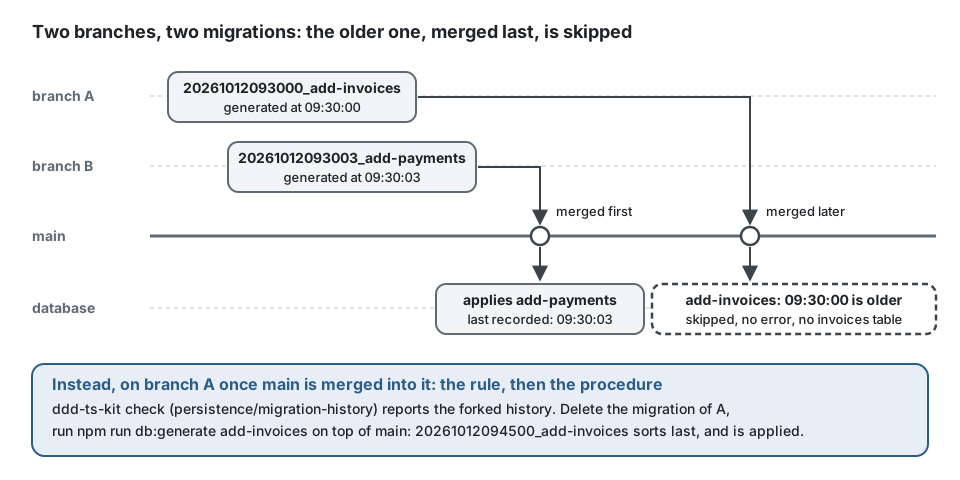
The kit's answer is the rule persistence/migration-history of ddd-ts-kit check (so
npm run check:arch, the guard of the plugin and the pipeline): every migration starts with the
number that orders it and no two share one; under drizzle-kit, the journal and the .sql files
match, the entries keep the order they were generated in, and each snapshot follows the one
before it. On the measured merge it reports the forked snapshot; on a journal merged in the
order of the branches it also reports the entry out of order.
After a merge or a rebase that brought a migration from the main branch, while yours is not merged yet:
- take the migrations of the main branch as they are (
.sqlfiles, snapshots, journal); - delete yours: its
.sqlfile, its snapshot undermeta/and its entry of the journal (drizzle-kit), or its file or directory (the other tools); - run
npm run db:generate <what-it-does>again: it is generated on top of the main branch, with a later timestamp; npm run check:archreports nothing, and the branch is merged before another migration lands, or the steps are repeated.
A migration already merged on the main branch is never edited or regenerated: a correction is a new migration.
Not chosen: one migrations folder per context. drizzle-kit can run one config per context
(its own schema, out and migrations table), so it would work, but it solves the wrong half:
two people on one context still collide, the platform tables (outbox, audit trail) belong to no
context, and db:migrate would become an ordered list of commands to keep in step with the
config. The timestamp, the rule and the procedure above cover a single folder and a team
working on one context alike. A context extracted as a service takes its tables with it then
(generate service).
Recommendation by situation
Section titled “Recommendation by situation”| Situation | Choice |
|---|---|
| New project | Drizzle on PostgreSQL: the default, typed queries, SQL migrations, tenant scoping and SQL audit trail generated |
| SQL-first team, many hand-written queries, or an existing Knex code base | Knex on PostgreSQL: the "first-class stack" proven end to end by the CLI uses it |
| Existing Prisma schema | Prisma 7, with the limits above understood; plan the audit trail store yourself |
| Existing TypeORM application | TypeORM 1.x with EntitySchema; plan the audit trail store yourself |
| MySQL imposed | Knex or TypeORM, and run the contract suites against your server in your own CI |
| Another store | custom, behind the same ports, with a decision record |
Sources
Section titled “Sources”- Drizzle ORM documentation: https://orm.drizzle.team/docs/overview ; drizzle-kit configuration,
migrations.prefix: https://orm.drizzle.team/docs/drizzle-config-file - drizzle-kit 0.31.11 (
prepareMigrationMetadata) and drizzle-orm 0.45.4 (PgDialect.migrate), knex 3.3.0 (MigrationGenerator,getNewMigrations), Prisma 7.10.0 (migrate dev --name), TypeORM 1.1.2 (MigrationGenerateCommand,MigrationExecutor): read in their published code on 2026-10-12. - Knex documentation: https://knexjs.org/guide/
- Prisma documentation, transactions: https://www.prisma.io/docs/orm/prisma-client/queries/transactions
- Prisma documentation, migrations in development and production: https://www.prisma.io/docs/orm/prisma-migrate/workflows/development-and-production
- TypeORM documentation: https://typeorm.io
- PostgreSQL documentation,
SELECT ... FOR UPDATE SKIP LOCKEDand exclusion constraints: https://www.postgresql.org/docs/current/sql-select.html , https://www.postgresql.org/docs/current/ddl-constraints.html - PGlite: https://pglite.dev
- npm registry: versions, dist-tags, licences and weekly downloads read on 2026-10-10.
- Martin Fowler, Patterns of Enterprise Application Architecture, Addison-Wesley, 2002: Data Mapper, Unit of Work, Repository, Optimistic Offline Lock.
- Not verified: that no version of the four libraries can declare a PostgreSQL exclusion constraint in its schema language; the latest stable Drizzle 1.0 date.