
Eventual consistency, explained to a product person
Summary. In an application cut into bounded contexts, a change is immediately true in the context that made it and becomes true in the others a moment later, when they have processed the event that announces it. During that moment two screens can disagree. This is eventual consistency. It is not a defect to hide but a property to design: decide what must be true at once, how long "a moment" may last, what the user sees meanwhile and what happens when the second step fails. This page is written for product managers and designers as much as for developers, and uses the scheduling application throughout.
The idea in one picture
Section titled “The idea in one picture”A client books a slot. appointments records the appointment at once. availability (the list
of open slots), notifications (the reminder) and analytics (occupancy figures) learn about
it through an event.
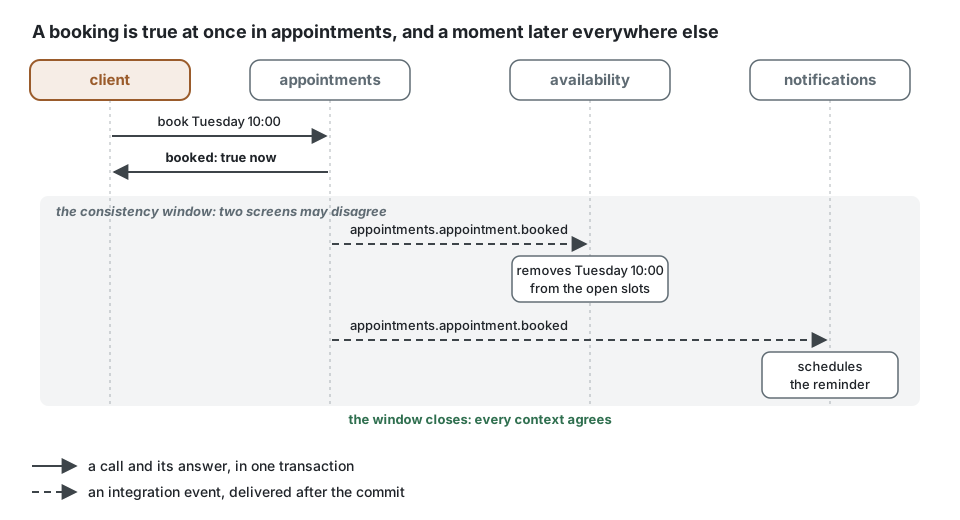
An everyday comparison: a bank transfer. Your balance drops immediately; the recipient sees the money later. Nobody calls that a bug, because the delay is known and the statement says "pending".
What it looks like in the product
Section titled “What it looks like in the product”| Situation | What the user may see | Why |
|---|---|---|
| Two clients look at the same open slot | both see Tuesday 10:00 as open; the second to confirm is refused | the list of open slots is advisory and a moment late; the booking itself is checked at once |
| A client books, then opens the list of open slots | for a second, the slot they just took is still listed | availability has not processed the event yet |
| A practitioner adds time off | a slot inside the time off stays bookable for a moment in the list | availability learns of time off through an event from calendars |
| A client books | the confirmation message arrives a few seconds later | notifications reacts to the event |
| A manager opens the occupancy dashboard | today's last booking is missing | analytics is fed by events, sometimes in batches |
| The email provider is down | the booking succeeds; the confirmation arrives when the provider is back | the two steps are independent on purpose |
The last row is the benefit. If booking and sending the confirmation were one indivisible operation, an outage of the email provider would stop all bookings.
What stays immediately consistent
Section titled “What stays immediately consistent”Not everything is eventual. Inside one aggregate, rules hold at every instant, in one transaction:
- No double booking. Two clients confirming the same slot at the same millisecond: exactly one succeeds, the other gets "this slot has just been taken". The rule is guarded where the appointment is written, by the aggregate and a database constraint, never by the list of open slots.
- A cancelled appointment cannot be rescheduled.
- A cancellation is accepted or refused against the cancellation window, at once.
The design question is therefore: which rules must never be seen broken, even for a second? Those belong to one aggregate in one context. Everything else can follow.
In code, the difference is where the check reads from. Instead of asking the projection of another context, which is a moment late:
// appointments, handler of BookAppointment: the rule rests on data that may be a second oldif (!(await availabilityGateway.isOpen(practitionerId, slot))) { throw AppointmentError.slotTaken(practitionerId, slot.startsAt);}decide it where the appointment is written, against the appointments read in the same transaction, with a unique constraint behind it: the sample of Bounded context shows it.
Questions to settle for each cross-context flow
Section titled “Questions to settle for each cross-context flow”- How long may the window be? "A few seconds" for the reminder; "under a second" for the list of open slots; "a few minutes" for analytics. This becomes a monitored number: the age of the oldest unprocessed event.
- What does the user see during the window? See the wording patterns below.
- What if the second step fails for good? The reminder cannot be scheduled because the client has no phone number. Is that an alert to support, a message to the client, nothing?
- Does a later step ever undo an earlier one? If payment were required and failed after the booking, the booking would have to be cancelled: a compensation, visible to the user. See Sagas and process managers.
- Can the same thing happen twice? Events can be delivered twice; the design must make the second one harmless (one reminder, not two). See Delivery and idempotency.
- Does order matter? A reschedule and a cancellation arriving in the wrong order must not reopen a slot. Events are not ordered by default.
Interface patterns that make the window acceptable
Section titled “Interface patterns that make the window acceptable”| Pattern | Example |
|---|---|
| Say what is true now, promise the rest | "Your appointment is booked. A confirmation is on its way." |
| Show the state from the source after a write | after booking, display the appointment returned by appointments, not a refreshed list from availability |
| Apply the user's own change locally | remove the slot the client just booked from the list on screen without waiting for the server's list |
| Word refusals as normal events | "This slot has just been taken. Here are the nearest ones." rather than an error page |
| Date derived data | "Occupancy as of 14:05" on the analytics dashboard |
| Name pending states | "Reminder scheduled" versus "Reminder sent" |
| Never promise from an advisory read | the list says "available", the button says "Request this slot", the answer confirms |
What not to do: disable the delay by making every screen read every context synchronously. The application then fails whenever any part does, and the contexts are no longer independent.
For developers: where the window comes from
Section titled “For developers: where the window comes from”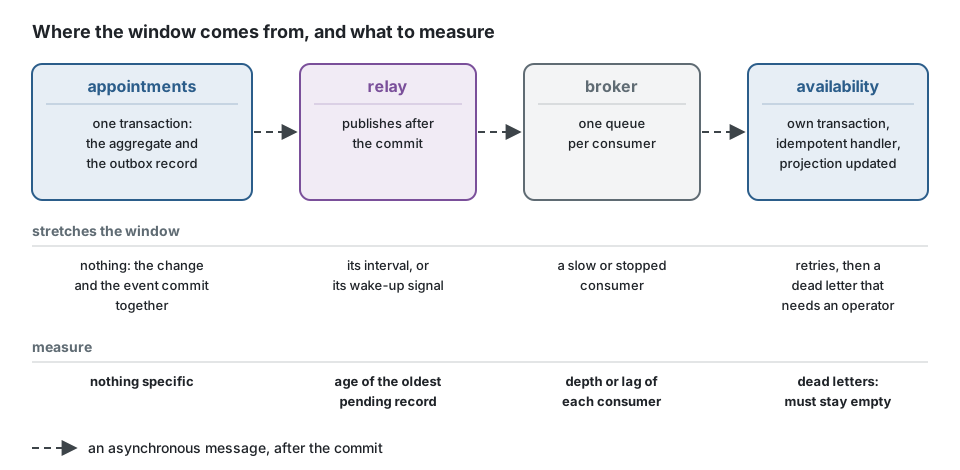
- The event is stored in the outbox with the state change, and a relay publishes it afterwards: the relay interval, or its wake-up signal, sets the floor of the window (Transactional outbox).
- The consumer processes it in its own transaction, after possible retries: a failing consumer stretches the window, up to a dead letter that needs an operator.
- A projection such as the open slots of
availabilityis a read model fed that way (CQRS as used here). - The eventual-consistency window of each cross-context flow is written in
docs/integration/README.md, next to its sequence diagram, and a context that relies on a projection says so in itsCONTEXT.md(thedocumentandextract-serviceskills ask for both).
To measure the window: the age of the oldest pending outbox record on the producing side, the depth or lag of each consumer on the broker, and the dead-letter destinations, which must be empty.
Duplicates and disorder in a projection
Section titled “Duplicates and disorder in a projection”Questions 5 and 6 above have a short answer in code. A row of a read model remembers the event
that last changed it (its EventStamp), and an incoming event changes the row only when it is
newer (isNewer). A duplicate carries the same stamp, a late event an older one: both change
nothing. ReadModelStore.upsertIfNewer makes that comparison for every write:
import { ReadModelStore, stampOf, type IntegrationEvent } from '@ddd-ts-kit/kernel';
// availability: one row per slot, fed by the events of appointments.interface OpenSlotRow {  readonly slotId: string;  readonly open: boolean;}
export abstract class OpenSlots extends ReadModelStore<OpenSlotRow> {}
type SlotEvent = IntegrationEvent<{ readonly slotId: string }>;
// A booking closes the slot, a cancellation reopens it. A duplicate, or a cancellation// delivered after a later booking of the same slot, is not newer than what the row holds:// the write is skipped and the slot stays as the latest fact says.export async function project(slots: OpenSlots, event: SlotEvent, open: boolean): Promise<void> {  const { slotId } = event.payload;
  await slots.upsertIfNewer(slotId, stampOf(event), () => ({ slotId, open }));}
Ordering by instant relies on the clock of the producer; when the upstream gives a version per
key, stampOf(event, version) carries it and the order no longer depends on clocks. The
projections of the kit are written this way (CQRS as used here).
Limits and when not to use it
Section titled “Limits and when not to use it”- Do not use it for an invariant. If the business cannot tolerate seeing the rule broken even briefly (double booking, overselling a limited seat, a balance going negative), the rule belongs to one aggregate and one transaction. A lock or a "check then act" across contexts is not a substitute.
- Do not use it to answer the request that caused it. A user who must see the result of step two in the response of step one is describing one use case, or needs a synchronous call with a stated behaviour when the other side is down.
- "Eventually" has no upper bound by itself. Without monitoring and alerts on the window, a stopped consumer is noticed by users.
- It moves complexity to the edges. Wording, pending states, compensations and support procedures are real work that an immediately consistent design does not need. In a small application with one context there is nothing to make eventual.
- Reading your own write from a projection can confuse users unless the interface handles it (see the patterns above).
Sources
Section titled “Sources”- Werner Vogels, "Eventually Consistent", Communications of the ACM, 2009, https://www.allthingsdistributed.com/2008/12/eventually_consistent.html
- Pat Helland, "Life beyond Distributed Transactions: an Apostate's Opinion", CIDR 2007.
- Vaughn Vernon, "Effective Aggregate Design", part 2, 2011 (eventual consistency between aggregates; "whose job is it?"), https://www.dddcommunity.org/library/vernon_2011/
- Vaughn Vernon, Implementing Domain-Driven Design, Addison-Wesley, 2013, chapter 10.
- Martin Kleppmann, Designing Data-Intensive Applications, O'Reilly, 2017, chapters 5 and 9.
- Sam Newman, Building Microservices, 2nd edition, O'Reilly, 2021, chapter 6 (workflow).