
Working as a team on a DDD project
Summary. A bounded context is a unit of ownership as much as a unit of code. This guide describes how a team organises around that: one owner per context, the glossary as a shared asset with a named editor, contracts agreed before both sides build, a context map that says who may touch what, a review that looks at something different in each layer, small pull requests, a fixed order for changes that cross two contexts, decision records, and automated checks that take the recurring review comments off people's hands. It ends with a one-day onboarding plan.
Ownership per bounded context
Section titled “Ownership per bounded context”Each context has one owning team or person. Owning means deciding its model, editing its
glossary, approving changes to its published-language/, and answering for its tests. It does
not mean nobody else may open a pull request there; it means nobody merges one without the
owner.
| Thing | Owner | Others may |
|---|---|---|
src/contexts/<context>/domain, application, infrastructure, presentation |
the context's owner | propose a change, reviewed by the owner |
src/contexts/<context>/published-language/ |
the context's owner, with its consumers consulted | import it, if the relationship is declared |
src/contexts/<context>/CONTEXT.md |
the context's owner | propose a term |
src/shared-kernel/ |
every context that uses it, jointly | nothing without the co-owners |
src/platform/, src/main.ts, ddd-ts-kit.config.json, the pipeline files |
a named platform owner (often the tech lead) | propose; these files hold the rules |
docs/context-map.md written sections, docs/adr/ |
the tech lead, with the owners concerned | propose |
On GitHub or GitLab, a code owners file expresses this table mechanically. The kit does not
generate one: write it by hand from the context list (npx ddd-ts-kit list). For a project
with an appointments and an analytics context:
# .github/CODEOWNERS (GitHub) or CODEOWNERS (GitLab): the last matching line winssrc/contexts/appointments/ @clinic/appointments-teamsrc/contexts/analytics/ @clinic/data-teamsrc/shared-kernel/ @clinic/appointments-team @clinic/data-teamsrc/platform/ @clinic/tech-leadsrc/main.ts @clinic/tech-leadddd-ts-kit.config.json @clinic/tech-lead.github/workflows/ @clinic/tech-leaddocs/adr/ @clinic/tech-leadWith branch protection asking for a code owner's review, a change under
src/contexts/appointments/ cannot merge without the appointments team. A line with two
owners asks for one of them, not both: the joint approval of the shared kernel is a rule the
team keeps, which the file alone does not enforce. The consumers of a published-language/
are asked by name on its pull requests, as reviewers.
Why one owner: a model stays coherent only if somebody can say no. Conway's law works in both directions (Skelton and Pais call the deliberate use the inverse Conway manoeuvre): boundaries that follow team boundaries hold, boundaries that cut across a team's daily work erode. A context a single team cannot hold in its head is too big, see When to extract microservices for what cognitive load justifies and what it does not.
The glossary is a shared asset
Section titled “The glossary is a shared asset”The ## Ubiquitous language table of each CONTEXT.md is the source of every class, method
and event name in the context, and the checker holds code to it (language/glossary-term).
That makes the glossary the most reviewed file of a context, so decide who edits it:
- The owner edits; anyone proposes. A new term arrives in the same pull request as the
first name that uses it (
--term "<Term>=<meaning>"on the generator), and the owner reviews the meaning, not the spelling. - A domain expert validates the meaning. A developer can write "Slot: a start and an end instant at which a practitioner can receive"; only somebody from the business can say whether a slot includes the buffer between two appointments.
- Same word, two contexts: two rows.
Appointmentinappointmentsis a commitment with rules; inanalyticsit is a counted fact. Each glossary says what the word must not be confused with next door. Do not unify them in the shared kernel to save a row. - A term changes meaning: treat it as a breaking change. Rename in code in the same pull request, and look at the published events that carry the word.
--allow-name exists to override the scaffolder; check still reports the name. Using it is a
signal that the glossary conversation was skipped.
Contracts first
Section titled “Contracts first”Two teams can build in parallel only if what flows between them is agreed before either starts. There are three kinds of contract in this kit, and all are files that can be reviewed on their own:
| Contract | File | Agreed between |
|---|---|---|
| integration event | a defineIntegrationEvent declaration in the producer's published-language/ |
producer and every consumer |
| read contract for a synchronous need | an abstract class in the upstream's published-language/ (*.contract.ts, written by generate gateway), behind a gateway port of the caller |
upstream and caller |
| HTTP API | route definitions, from which openapi/openapi.yaml is generated |
the backend and its clients |
The practice:
- The consumer says what it needs to act without calling back ("to send a confirmation I need the appointment id, the client id, the practitioner id and the start instant").
- The producer's owner writes the declaration (type, version, payload schema with a description per field) and opens a pull request that contains only that: the event, its publisher and the regenerated catalog.
- Consumers review that pull request. Once merged, both sides build: the producer makes the aggregate emit the fact, the consumer writes its handler against the declared type, tested with events built from the declaration.
The declaration at the heart of that first pull request is short, and every line of it is something the consumers can argue about:
import { z } from 'zod';import { zodSchema } from '@ddd-ts-kit/validation/zod';import { defineIntegrationEvent, type PayloadOf } from '@ddd-ts-kit/events';import type { IntegrationEvent } from '@ddd-ts-kit/kernel';
// src/contexts/appointments/published-language/appointment-booked.v1.integration-event.tsexport const appointmentBookedV1 = defineIntegrationEvent({  type: 'appointments.appointment.booked',  version: 1,  description: 'An appointment was booked: the practitioner expects the client at the start instant.',  payload: zodSchema(    z.object({      appointmentId: z.string().describe('Identifier of the appointment.'),      clientId: z.string().describe('The client who comes.'),      practitionerId: z.string().describe('The practitioner who receives the client.'),      startsAt: z.string().describe('Start instant, ISO 8601 in UTC.'),    }),  ),});
export type AppointmentBookedV1 = IntegrationEvent<PayloadOf<typeof appointmentBookedV1>>;
// In the consumer's specs, the next day: an event built from the declaration, before the// producer emits anything. A payload that breaks the schema throws here, not in production.export const booked: AppointmentBookedV1 = appointmentBookedV1.create(  { appointmentId: 'a-1', clientId: 'c-1', practitionerId: 'p-1', startsAt: '2026-10-20T09:00:00.000Z' },  { id: 'evt-1', occurredAt: '2026-10-13T08:00:00.000Z' },);
The same applies to a route: merge the route definition with its schemas and declared errors,
regenerate the OpenAPI document, and a front-end team can generate its client from the
committed file while the handler is still a TODO(domain).
A contract-first pull request is small and cheap to argue about. The same argument held after both sides are built costs a rewrite on one of them.
The context map bounds who can touch what
Section titled “The context map bounds who can touch what”The map is not only documentation. Three rules turn it into a permission system for imports:
- another context is reached only through its
published-language/(context/published-language-only); - and only if the relationship is declared in the config (
context/declared-relationship); - and the declared relationships form no cycle (
context/no-cycle).
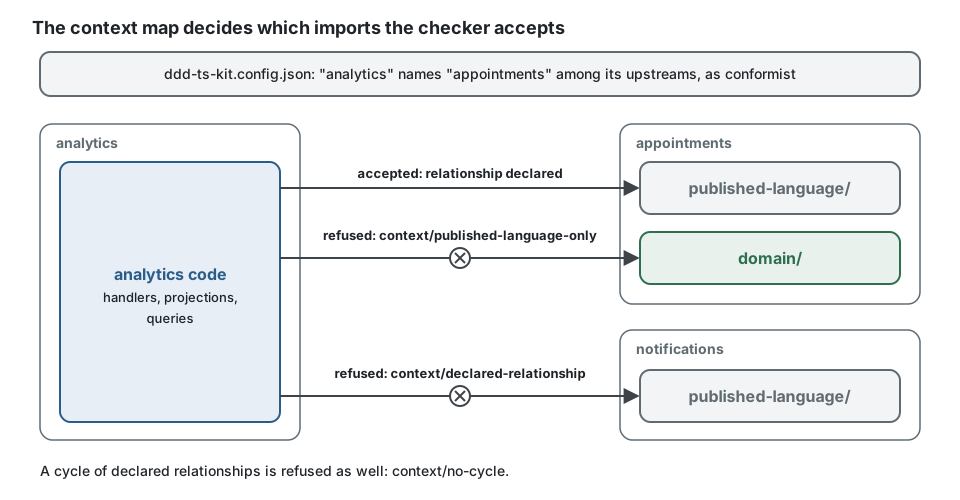
The relationship is one entry of the config, in the downstream's list of upstreams:
{ "contexts": { "appointments": { "classification": "core", "upstreams": [] }, "analytics": { "classification": "supporting", "upstreams": [{ "context": "appointments", "relationship": "conformist" }] } }}and the import that goes with it names the published language, never what is behind it:
// Instead of: the aggregate of another context (context/published-language-only)import { Appointment } from '@/contexts/appointments/domain/aggregates/appointment.aggregate';
// write: what appointments publishes for its consumersimport { appointmentCancelledV1 } from '@/contexts/appointments/published-language/index';
So "may my context use something of yours?" has a mechanical answer, and adding a dependency
between two contexts is a visible change of ddd-ts-kit.config.json, reviewed by both owners,
not a stray import found six months later. The relationship pattern says how the two teams
work together: under customer-supplier the downstream's needs enter the upstream's planning;
under conformist the downstream accepts what comes; a shared-kernel needs joint approval
of every change. See Context map.
Review focus per layer
Section titled “Review focus per layer”Automated checks hold the structure, so a human review can spend its attention where a tool cannot judge. What to look for differs by layer:
| Layer | The reviewer asks | Not worth a comment (a check holds it) |
|---|---|---|
domain/ |
Is the rule in the aggregate, and is it the right rule? Can an invalid state be built? Do names say what the business says? Is the aggregate the right size? | constructor visibility, setters, imports, new Date() |
application/ |
Does the handler only orchestrate (load, one intention, save)? Is the permission the right one? Is each failure a named domain error? | handler shape, missing permission declaration, reading the ambient scope, a manual dispatch of domain events (the save hands them over, the unit of work dispatches them), a domain event handler with an effect outside the database left in the before-commit phase |
infrastructure/ |
Does the mapper cover every field both ways? Is the query scoped by tenant? Does the adapter pass the same contract suite as its fake? What happens when the dependency is down? | importing presentation/, an adapter built outside the composition root |
presentation/ |
Is the response a DTO and not the aggregate? Are all error codes declared on the route? Is the change breaking for clients? | missing security, a role test in the route |
published-language/ |
Would a consumer understand this payload without asking? Is anything internal or personal leaking? Is this additive, or a new version? | importing outside the allow-list |
| tests | Does the name read as a business rule? Does it assert an outcome through the public API? | mocks, a missing spec file, a missing builder |
The plugin offers the same split as a tool: the architecture-reviewer agent reviews a diff
or a whole context read-only, starting from the checker's output and then judging what tools
cannot.
Branching and small pull requests
Section titled “Branching and small pull requests”- Trunk-based: short-lived branches off the default branch, merged within a day or two. A long-lived branch per context defeats the generated files (barrels, context map, OpenAPI), which conflict more the longer they diverge.
- One use case or one concept per pull request; sizes and reasoning are in Commit discipline.
- Squash merge, with a conventional commit title: the pipeline checks the pull request title with the same commitlint configuration as the commit hook, because with squash merges the title becomes the commit on the default branch.
- The final
gatejob is the one required check; see pipeline/README.md.
A change that crosses two contexts
Section titled “A change that crosses two contexts”"When an appointment is cancelled late, analytics should count it as a late cancellation."
This touches appointments (the fact must say whether it was late) and analytics (the
count). It is never one pull request. Split it along the contract and order it upstream first:
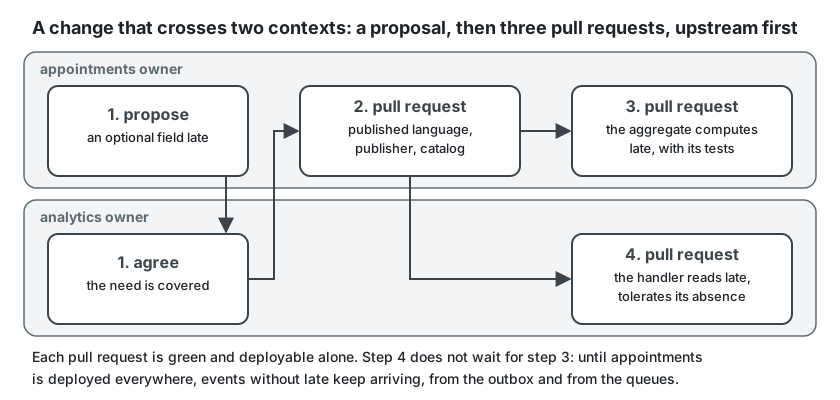
Steps 2 and 4 in code. The field is optional, so it stays inside version 1, and the consumer reads an event without it as "unknown", never as "on time":
import { z } from 'zod';import { zodSchema } from '@ddd-ts-kit/validation/zod';import { defineIntegrationEvent, type PayloadOf } from '@ddd-ts-kit/events';import type { IntegrationEvent } from '@ddd-ts-kit/kernel';import { IntegrationEventHandler } from '@ddd-ts-kit/kernel/declarations';
// Step 2, appointments: published-language/appointment-cancelled.v1.integration-event.tsexport const appointmentCancelledV1 = defineIntegrationEvent({  type: 'appointments.appointment.cancelled',  version: 1,  description: 'An appointment was cancelled before it took place; its slot is free again.',  payload: zodSchema(    z.object({      appointmentId: z.string().describe('Identifier of the appointment.'),      cancelledAt: z.string().describe('When it was cancelled, ISO 8601 in UTC.'),      late: z        .boolean()        .optional()        .describe('True when cancelled less than 24 hours before the start; absent from the events published before.'),    }),  ),});
export type AppointmentCancelledV1 = IntegrationEvent<PayloadOf<typeof appointmentCancelledV1>>;
// Step 4, analytics: a port of its own, and a handler that tolerates both worldsexport abstract class CancellationCounts {  abstract count(appointmentId: string, kind: 'late' | 'on-time' | 'unknown'): Promise<void>;}
@IntegrationEventHandler(appointmentCancelledV1, { consumer: 'analytics.appointments-appointment-cancelled' })export class AppointmentsAppointmentCancelledHandler {  constructor(private readonly counts: CancellationCounts) {}
  async handle(event: AppointmentCancelledV1): Promise<void> {    const { appointmentId, late } = event.payload;
    if (late === undefined) {      // published before step 3, or by a producer not deployed yet      await this.counts.count(appointmentId, 'unknown');      return;    }
    await this.counts.count(appointmentId, late ? 'late' : 'on-time');  }}
Rules of the split:
- Upstream first. The downstream cannot import a field that is not published.
- Additive whenever possible. A new optional field stays inside the version; the consumer deployed before step 3 keeps working. Anything else is a new version published next to the old one, see Event versioning.
- The consumer tolerates both worlds until the producer is deployed everywhere: events already in the outbox or in a queue were produced by the old code.
- Each pull request is deployable on its own. If step 4 cannot ship before step 3, the order is wrong.
A change that seems to need both contexts to change in the same transaction is not a split problem but a boundary problem: go back to the consistency test of Bounded context.
Architecture decision records
Section titled “Architecture decision records”A choice that constrains the future gets a record in docs/adr/: a boundary, a relationship
pattern other than the default, a provider, an exception to a rule.
npx ddd-ts-kit generate adr "<title>" writes the numbered file; with --deviation <what> it
also writes the deviations entry of the config that points to it, which
governance/recorded-deviation requires for any relaxed rule:
npx ddd-ts-kit generate adr "No spec for generated adapters" \ --deviation rules.test/spec-required --reason "Generated adapters are covered by the contract suite."writes docs/adr/0009-no-spec-for-generated-adapters.md (the next free number) and adds to
ddd-ts-kit.config.json:
"deviations": [ { "what": "rules.test/spec-required", "adr": "0009", "reason": "Generated adapters are covered by the contract suite." }]The rule itself is relaxed in the same pull request, in the rules of the config, where the
reviewers see the exception and its record side by side.
Keep them to half a page: context, decision, consequences, alternatives rejected. An accepted record is never rewritten; a later one supersedes it. The record is what lets a newcomer tell a decision from an accident.
Checks replace recurring review comments
Section titled “Checks replace recurring review comments”Every comment a reviewer writes for the third time should become a check, and most of the usual ones already are:
| The comment that no longer needs writing | Held by |
|---|---|
| "the domain must not import the ORM" | layer/domain-purity |
| "don't reach into the other context's internals" | context/published-language-only |
"what does Manager mean here?" |
language/no-technical-name, language/glossary-term |
| "inject the clock" | purity/no-system-clock |
| "this use case has no permission" | authz/declared |
| "where is the test?" | test/spec-required |
| "don't mock the repository" | test/no-mocks |
| "remove the commented-out code" | clean/no-commented-out-code |
| "why is this rule disabled?" | governance/recorded-deviation |
| "you forgot to regenerate the OpenAPI file" | the documentation drift gate |
Rule ids and their exact statements are in the architecture reference. A finding names its rule, and the rule explains itself, so the author learns the reason without waiting for a reviewer:
$ npx ddd-ts-kit explain purity/no-system-clockpurity/no-system-clock
No new Date() without argument, Date.now() or performance.now() in domain/ or application/: time comes from the Clock port.
Why: Code that reads the clock gives a different answer every time it runs, so its tests are either flaky or need a mocked module. Passing the instant in, from the Clock port, makes every rule about time testable with a fixed date and replayable in production.
Bad:    isOverdue(): boolean { return this.dueDate < new Date(); }
Good:    isOverdue(now: Date): boolean { return this.dueDate < now; }
Suppress one line (with a reason): // ddd-ts-kit-disable-next-line purity/no-system-clock -- <reason>
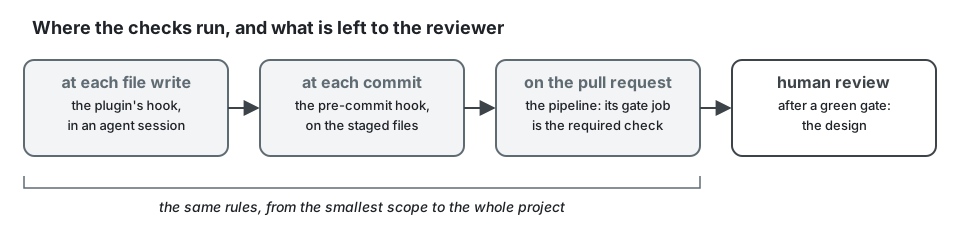
The checks run at three moments: at each file write in an agent session (the plugin's hook), on staged files (pre-commit), and in CI. A review that starts after a green gate is a review of design.
Onboarding a newcomer in a day
Section titled “Onboarding a newcomer in a day”| When | What | Why |
|---|---|---|
| first hour | read docs/context-map.md, then the CONTEXT.md of the context they join; run npx ddd-ts-kit list and npx ddd-ts-kit describe <context> |
the map before the territory |
| second hour | npm install, npm run infra:up, npm run dev, open /docs; run npm run verify (on pnpm, the default of init: pnpm install, pnpm run <script>; the README of the project says them as its package manager does) |
prove the machine works before changing anything |
| morning | read one existing slice top down: route, command, handler, aggregate, their specs | the tree is the same in every context, so one slice teaches all |
| after lunch | with the owner, pick a small real use case; restate it in the glossary's words | the first conversation is about language |
| afternoon | build it with the generator: fill the TODO(domain) places, replace the it.todo entries, break a rule on purpose and run npx ddd-ts-kit explain <rule-id> |
the checks teach the architecture faster than a document |
| end of day | open the pull request; the owner reviews design, the gate has reviewed the rest | a merged change on day one |
The command for each of these moments, and the reference of every flag: Which command, when.
What makes this possible is not the newcomer's speed but the closed tree: a file of a given role is always in the same place under the same suffix, so knowledge of one context transfers to the next.
Limits and when not to use it
Section titled “Limits and when not to use it”- Ownership per context needs enough people. A team of two cannot have six owners; then ownership is per person-with-a-backup, and the review rule is "the other one".
- Strict ownership slows a change that spans contexts. That friction is intended (it is the cost of coupling made visible), but if most changes span the same two contexts, the boundary is wrong: merge them.
- Contract-first assumes the contract can be known first. In early discovery it cannot; keep the two sides in one context until the shape settles, then split.
- Checks do not review design. A model can pass every rule and still be wrong: the checker verifies that a term is in the glossary, not that it means the right thing.
- Code owners files, branch protection and merge request settings are not enforced by the
kit. The pipeline ships a description of the settings to apply
(
branch-protection.md,merge-request-settings.md); applying them is a manual step, and the pipeline README states that these were written from the platforms' documentation and not executed.
Sources
Section titled “Sources”- Eric Evans, Domain-Driven Design, Addison-Wesley, 2003, chapter 14 (context map, team relationships).
- Vaughn Vernon, Implementing Domain-Driven Design, Addison-Wesley, 2013, chapter 3.
- Matthew Skelton and Manuel Pais, Team Topologies, IT Revolution, 2019 (team cognitive load, inverse Conway manoeuvre).
- Michael Nygard, "Documenting Architecture Decisions", 2011.
- Conventional Commits 1.0.0, https://www.conventionalcommits.org/
- This repository: pipeline/README.md, the skills
bounded-contexts,glossary,context-map,document,deviation.