
@ddd-ts-kit/rabbitmq
The integration event provider for RabbitMQ: an EventBus of the kernel that publishes with
publisher confirms, so the outbox relay can mark a record published safely, and consumes from
one durable queue per consumer and event type with manual acknowledgement, a bounded number of
delayed retries and a dead queue. It is the "queue brokers" row of the strategy table of
@ddd-ts-kit/events, implemented, and it passes eventBusContract of @ddd-ts-kit/testing.
npm i @ddd-ts-kit/rabbitmq @ddd-ts-kit/events amqplibTested with amqplib 2.2 against RabbitMQ 4.3. Any AMQP 0-9-1 broker with publisher confirms
should work with queueType: 'classic'; only RabbitMQ was run.
Composition root
Section titled “Composition root”Handlers never see this package. They publish to the outbox; the relay publishes to RabbitMQ;
each consuming context listens through the bus under its own name. The bus is given to the
application as two ports of the kernel: IntegrationEventPublisher stays the outbox, and
EventSubscribers hands each context the subscriber of its own consumer name.
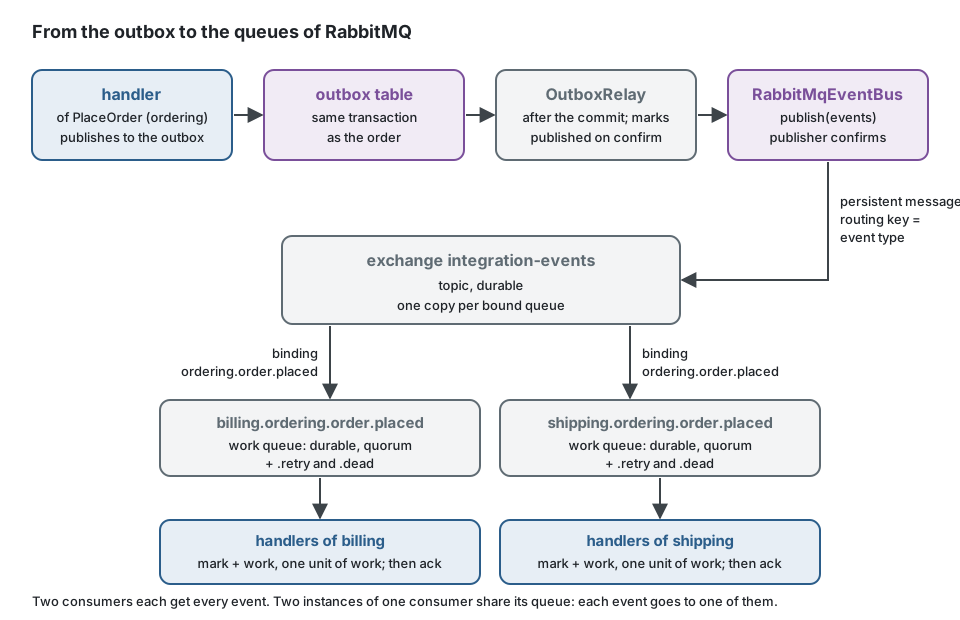
init --broker rabbitmq writes this wiring in the platform of the project: the bus is built by
platform/events/create-event-provider.ts, platform/platform.module.ts rebinds
EventSubscribers on it, and main.ts gives it, traced, to the outbox relay. By hand, the
same thing reads:
import { defineContextModule } from '@ddd-ts-kit/di';import { EventSubscribers, IntegrationEventPublisher, type Logger, type Metrics } from '@ddd-ts-kit/kernel';import { OutboxPublisher, OutboxStore } from '@ddd-ts-kit/events';import { RabbitMqEventBus } from '@ddd-ts-kit/rabbitmq';
declare const config: { readonly amqpUrl: string };declare const logger: Logger;declare const metrics: Metrics;
export const bus = new RabbitMqEventBus({  connection: config.amqpUrl, // or amqplib options, or a factory opening a new connection  exchange: 'integration-events', // the default  retry: { maxAttempts: 5, delayMs: 5_000 }, // the defaults  prefetch: 10, // the default  onFailure: (failure) => logger.warn('event bus failure', { ...failure }), // codes only, never an error message  // The label `outcome` of the kernel is success or failure: the four outcomes of a delivery take another name.  onDelivery: ({ queue, outcome }) => metrics.counter('event_deliveries_total').increment({ queue, status: outcome }),});
export const messagingModule = defineContextModule({  name: 'messaging',  register(builder) {    // Publishing side: handlers write to the outbox, in the transaction of the command.    builder.rebind(IntegrationEventPublisher).toClass(OutboxPublisher, [OutboxStore]);    // Consuming side: one subscriber per consuming context, named after it.    builder.rebind(EventSubscribers).toValue({ forContext: (name) => bus.forConsumer(name) });  },});
import { Command, CommandBus, systemActor, type Actor, type IntegrationEvent } from '@ddd-ts-kit/kernel';import { IntegrationEventHandler } from '@ddd-ts-kit/kernel/declarations';import { defineIntegrationEvent, type PayloadOf } from '@ddd-ts-kit/events';import { zodSchema } from '@ddd-ts-kit/validation/zod';import { z } from 'zod';
// contexts/ordering/published-language: the contract billing listens to.export const orderPlaced = defineIntegrationEvent({ type: 'ordering.order.placed', version: 1, payload: zodSchema(z.object({ orderId: z.string() })),});
// contexts/billing/application/commands/issue-invoice/issue-invoice.command.tsexport class IssueInvoice extends Command { constructor( readonly actor: Actor, readonly orderId: string, ) { super(); }}
// contexts/billing/application/integration/handlers/invoice-on-order-placed.integration-handler.ts@IntegrationEventHandler(orderPlaced, { consumer: 'billing.invoice-on-order-placed' })export class InvoiceOnOrderPlacedIntegrationHandler { constructor(private readonly commands: CommandBus) {}
// Nobody is calling: the handler acts as a system actor named after its consumer. readonly actor = systemActor('billing.invoice-on-order-placed');
async handle(event: IntegrationEvent<PayloadOf<typeof orderPlaced>>): Promise<void> { await this.commands.execute(new IssueInvoice(this.actor, event.payload.orderId)); }}import { contextModule, createApplication, kernelModule, type ContextModule, type DeclaredSource } from '@ddd-ts-kit/di';import { Clock } from '@ddd-ts-kit/kernel';import { OutboxRelay, OutboxStore } from '@ddd-ts-kit/events';import type { RabbitMqEventBus } from '@ddd-ts-kit/rabbitmq';
// In a project: import { bus, messagingModule } from '@/platform/messaging.module';declare const bus: RabbitMqEventBus;declare const messagingModule: ContextModule;declare const persistenceModule: ContextModule;declare const orderingDeclarations: DeclaredSource;declare const billingDeclarations: DeclaredSource;
const app = createApplication({ modules: [ kernelModule(), persistenceModule, messagingModule, contextModule('ordering', orderingDeclarations), contextModule('billing', billingDeclarations), ],});
// The relay target is the bus. A record is marked published when the broker confirmed it.const relay = new OutboxRelay({ store: app.resolve(OutboxStore), publisher: bus, clock: app.resolve(Clock) });
await app.start(); // subscribes the handler of billing on bus.forConsumer('billing')await bus.assertTopology(); // fail at startup, not at the first messagerelay.start({ intervalMs: 500 });
process.on('SIGTERM', async () => { await relay.stop(); // the tick in progress finishes await app.stop(); // the handlers are unsubscribed await bus.close(); // consumers stop, handlers in progress finish and acknowledge});persistenceModulebindsOutboxStore, and rebindsUnitOfWorkandProcessedEventStoreto the database: see the README of the persistence adapter. A declared integration event handler is subscribed on the subscriber of its own context (forContextreceives the name of its module), and sinceUnitOfWorkandProcessedEventStoreare bound, its idempotency mark and its work commit in one unit of work: a redelivery is deduplicated, a failure leaves nothing behind.- Without an outbox the bus is the event bus of the kernel module, and handlers publish
straight to the broker:
kernelModule({ eventBus: bus, eventSubscribers: () => ({ forContext: (name) => bus.forConsumer(name) }) }). - Without a container the same objects are wired by hand:
bus.forConsumer('billing')is anIntegrationEventSubscriber, to give tosubscribeAllandconsumeof@ddd-ts-kit/events. A bus built without theconsumeroption has no name to give its queues, sobus.subscribe(...)throwsConsumerNameRequiredError: name the consuming context instead.
import { consume, defineIntegrationEvent, subscribeAll } from '@ddd-ts-kit/events';import type { ProcessedEventStore, UnitOfWork } from '@ddd-ts-kit/kernel';import { RabbitMqEventBus } from '@ddd-ts-kit/rabbitmq';import { zodSchema } from '@ddd-ts-kit/validation/zod';import { z } from 'zod';
declare const processed: ProcessedEventStore; // the store of the persistence adapterdeclare const unitOfWork: UnitOfWork; // the transaction of the databasedeclare function issueInvoice(orderId: string): Promise<void>;
const orderPlaced = defineIntegrationEvent({  type: 'ordering.order.placed',  version: 1,  payload: zodSchema(z.object({ orderId: z.string() })),});
const bus = new RabbitMqEventBus({ connection: 'amqp://kit:kit@127.0.0.1:5672' });
// Instead of: bus.subscribe(orderPlaced.type, handler), which throws ConsumerNameRequiredError here.// Write: the subscriber of one consuming context, whose name its queues carry.export const billing = subscribeAll(bus.forConsumer('billing'), [  consume(orderPlaced, { consumer: 'billing.invoice-on-order-placed', processed, unitOfWork }, async (event) => {    await issueInvoice(event.payload.orderId);  }),]);
await bus.assertTopology(); // declares billing.ordering.order.placed and its .retry and .dead, then consumespublish(events)resolves only when the broker confirmed every message of the batch and rejects otherwise (PUBLISH_NOT_CONFIRMED,BROKER_UNAVAILABLE,UNROUTABLE_EVENT,EVENT_BUS_CLOSED). Nothing is buffered for later: the outbox is the buffer.- A consumer name is required to subscribe:
bus.forConsumer('billing')gives anIntegrationEventSubscriberfor one context on the shared connection (a modular monolith has several), and theconsumeroption names the onebus.subscribeworks for (a service that is a single context). - Tracing is put around both sides from outside, as with any provider:
tracedPublisher(bus)as the relay target, and on the consuming side the instrumentation of the kernel module (kernelModule({ instrumentation: traceApplication() })), which gives each declared handler one spanprocess <consumer>per attempt.tracedSubscriber(bus.forConsumer(name))is for a composition withoutkernelModule. The bus carriestraceparentandcorrelationIduntouched, in the envelope and in the message headers. - The correlation makes the round trip. Publish through
scopedPublisher(publisher, scope)of the kernel: a declared handler (orconsume(definition, { ..., scope }, handler)by hand) runs in an execution context whosecorrelationIdis the one of the request that published, whosecausationIdis the event, and a redelivery after a failure runs in the same one. An operator reads it on the message without opening the body, in thecorrelation_idproperty and thex-correlation-idheader. - A context extracted to its own service keeps its consumer name and so its queues: nothing changes on the broker.
Topology
Section titled “Topology”bus.describeTopology() returns the exchanges, queues and bindings as data, for a review or
a generated document; bus.assertTopology() declares them, idempotently. The bus also declares
them on every (re)connection. For forConsumer('billing') subscribed to
ordering.order.placed:
| Object | Name | Properties |
|---|---|---|
| exchange | integration-events |
topic, durable |
| work queue | billing.ordering.order.placed |
durable, quorum; bound to the exchange with the routing key ordering.order.placed; dead-letters to the dead queue |
| retry queue | billing.ordering.order.placed.retry |
durable, quorum; x-message-ttl = retry.delayMs; dead-letters back to the work queue, at least once |
| dead queue | billing.ordering.order.placed.dead |
durable, quorum; no consumer |
Retries and dead letters travel through the default exchange of the broker (routing key =
queue name), so there is one exchange to manage and no binding besides the one above. A quorum
retry queue also takes x-dead-letter-strategy: at-least-once and x-overflow: reject-publish,
so that an expired retry is not lost on its way back to the work queue.
A message is the envelope as JSON (id, type, version, occurredAt, payload,
traceparent, correlationId, tenantId), persistent, with the routing key and the type
property set to the event type, messageId to the event id, correlationId to the correlation
id, and the headers traceparent, x-correlation-id, x-tenant-id and x-event-version. Any
AMQP client can consume it.
Two consumers of one type have a queue each and both receive every event. Two instances of one consumer share its queue: each event goes to one of them.
Retry and dead-letter behaviour
Section titled “Retry and dead-letter behaviour”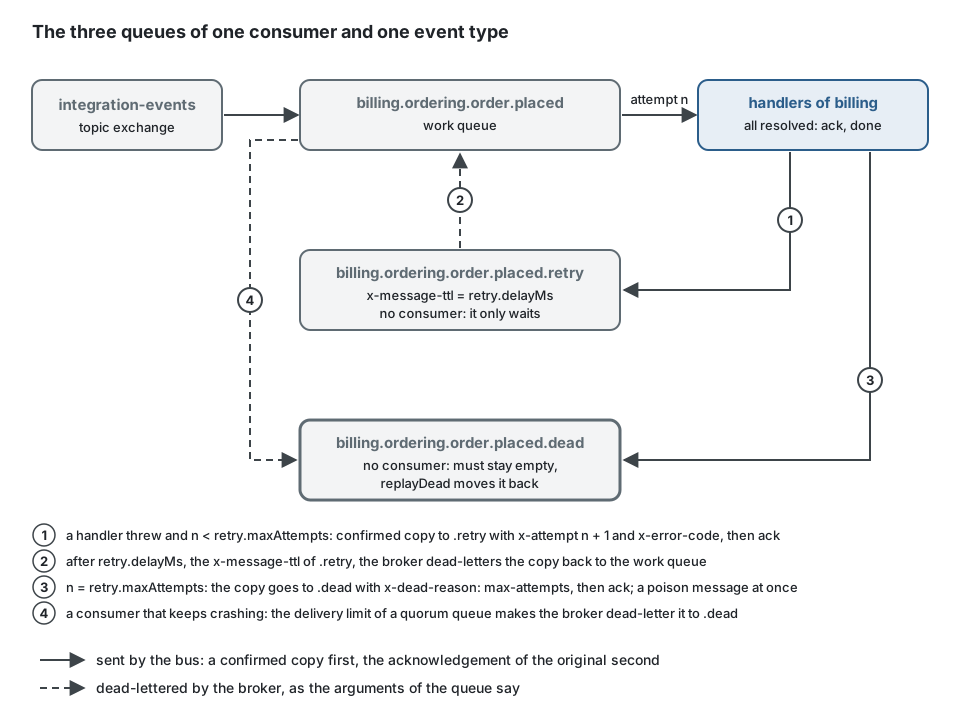
- A message is acknowledged after every handler subscribed to its queue resolved. A declared
@IntegrationEventHandler(orconsumeof@ddd-ts-kit/eventsby hand) commits its work and its idempotency mark in one unit of work: the acknowledgement then follows that commit, and a redelivery is deduplicated. - When a handler throws, the bus sends a confirmed copy of the message to the retry queue
with the header
x-attemptincremented andx-error-codeset, then acknowledges the original. The copy waitsretry.delayMsthere and comes back to the work queue. A failed message is never requeued on the spot: no hot loop. - At the
retry.maxAttempts-th failed delivery the copy goes to the dead queue instead, withx-dead-reason: max-attempts. - A message whose body is not an envelope (unparseable, without
id,type,versionoroccurredAt, or with atenantIdthatisTenantIdof the kernel refuses) is poison: it goes straight to the dead queue withx-dead-reason: poisonandx-error-code: POISON_MESSAGE, and no handler sees it. - Only codes travel:
x-error-codeis thecodeof the error or its class name. The message of an error is never logged, reported or attached, because it may quote payload data.
Delivery is at least once and unordered. The copy-then-acknowledge order means a crash in between delivers the message twice, never zero times.
On a lost connection the bus reconnects with an exponential backoff (reconnect, 200 ms
doubling up to 30 s), declares its topology again and resumes its consumers. Publications in
flight reject, and so does publish between two attempts, so the outbox relay keeps the
records and retries them. Messages that were being handled are redelivered by the broker.
Credentials. The URL or the options of connection are held by the function that opens the connection, in no field. A RabbitMqEventBus that is logged, spread or
serialised shows RabbitMqEventBus [connection concealed] and nothing else: its fields are not enumerable,
and toJSON and util.inspect answer that name. The failures it reports are codes. What the
client library itself shows when one of its own objects is inspected is not in the hands of
this package: do not log those.
What a handler is told. Next to the event, each handler receives the delivery
(EventDelivery of the kernel): { attempt, maxAttempts, system: 'rabbitmq', destination, consumer },
where destination is the work queue and consumer the consumer name (billing). Handlers of the application ignore it; @ddd-ts-kit/tracing reads it
to make one CONSUMER span per attempt and to mark the redeliveries and the attempt after which
the event is buried. The bus names itself messagingSystem: 'rabbitmq', and traceparent travels in
the envelope and as a real header, intact across a retry.
Operations
Section titled “Operations”What to watch:
| Signal | Where | Meaning |
|---|---|---|
outbox stats() (pending, failed, dead) |
the outbox store | the publishing side: see @ddd-ts-kit/events |
depth of <consumer>.<type> |
broker | the consumer lags or is stopped |
depth of <consumer>.<type>.dead |
broker | must be 0: alert on anything else |
depth of <consumer>.<type>.retry |
broker | failures in progress; a plateau means a handler that keeps failing |
onDelivery counted by outcome |
this bus | rate of retried, dead, poison against acknowledged |
onFailure with kind: 'connection' |
this bus | reconnections, and declarations the broker refused (AMQP_406) |
bus.deliveriesInFlight |
this bus | handlers running now; stuck above 0 means a handler that hangs |
With an error tracker, DeadLetterReports of the kernel turns onFailure into reports of the
events given up, and of those only: onFailure: (failure) => reports.onFailure(failure), and
reports.observing(bus.forConsumer(name)) as the subscriber of each context, so that a report
carries what the handler threw. init wires it when the project has one.
Replaying dead messages, once the cause is fixed:
import type { RabbitMqEventBus } from '@ddd-ts-kit/rabbitmq';
declare const bus: RabbitMqEventBus;
// Up to 100 messages of billing.ordering.order.placed.dead, back to the work queue with x-attempt 1.const replayed = await bus.replayDead({ consumer: 'billing', type: 'ordering.order.placed' }, 100);console.log(`${String(replayed)} message(s) replayed`);
It moves up to that many messages from the dead queue back to the work queue with a fresh
attempt budget, each with a confirmed copy before the acknowledgement. The management UI or
a shovel can move them too; reset or drop the x-attempt header if you do, or the message
dies again at its first failure. Look at x-dead-reason and x-error-code first: replaying
a poison message only kills it again.
To stop a consumer for good, delete its three queues: unsubscribing leaves them bound, and the work queue keeps filling.
Limits
Section titled “Limits”- No ordering. Retries and competing instances reorder. Carry a version in the payload.
- One delay. The retry wait is the TTL of the retry queue: the same for every attempt, no exponential backoff.
- Queue arguments are fixed at creation. Changing
retry.delayMsorqueueTypefor an existing queue is refused by the broker (reported asAMQP_406while the bus keeps trying to reconnect): delete the queue, or migrate under another consumer name. - A redelivery runs every handler of the queue again, those that succeeded included, when several handlers of one consumer subscribe to the same type. Each must be idempotent.
- A batch is not atomic. When
publishrejects, some events of the batch may have been taken by the broker. The relay publishes one by one and retries, consumers deduplicate. onUnroutable: 'fail'rejects an event no queue is bound for; behind the outbox relay such a record is retried, then dead. Use it only when a missing consumer is an incident.- A consumer that crashes mid-handler gets its messages back without
x-attemptbeing incremented. Quorum queues bound that with their delivery limit, after which the message is dead-lettered to the dead queue by the broker; classic queues do not bound it. This path is the broker's and is not exercised by the test suite. - Classic queues dead-letter the expired retries at most once: a broker crash at that instant can lose one. Quorum queues (the default) use the at-least-once strategy.
- A connection factory must open a new connection at each call; the bus closes what it opened. A connection shared with other code cannot be given.
- Large batches are written without waiting for the socket to drain: memory grows with the batch. The relay publishes record by record, which avoids it.
- Queue names are
<consumer>.<type>plus a suffix, within the 255 bytes of AMQP.
Other brokers
Section titled “Other brokers”@ddd-ts-kit/kafka, @ddd-ts-kit/nats and
@ddd-ts-kit/redis (Redis Streams) implement the same two ports and
pass the same contract suite. docs/other-brokers.md says what every
provider owes, maps the concepts of this one to Kafka and JetStream as those packages do it,
and outlines SQS/SNS, which is not built.
Testing
Section titled “Testing”The suites need a real broker and are skipped without DDD_TS_KIT_TEST_AMQP_URL:
docker run -d --rm --name ddd-ts-kit-test-rabbitmq -e RABBITMQ_DEFAULT_USER=kit -e RABBITMQ_DEFAULT_PASS=kit -p 127.0.0.1:5672:5672 rabbitmq:4-management-alpineDDD_TS_KIT_TEST_AMQP_URL=amqp://kit:kit@127.0.0.1:5672 npx vitest run packages/rabbitmqdocker rm -f ddd-ts-kit-test-rabbitmqThey run the contract suite on quorum and on classic queues, then the behaviours of this
provider, one suite per behaviour (publishing, consuming, correlation, retries,
dead-letters, topology, connection-loss through a TCP relay the test cuts, closing)
and the whole chain from the outbox to an idempotent consumer. Every test works on an exchange and queues of its
own and deletes them.