
The same provider on other brokers
What an integration event provider owes, whatever the broker, and where each one stands:
Kafka, NATS JetStream and Redis Streams are packages of the kit, held to what
RabbitMqEventBus is held to; SQS/SNS is an outline, without code or dependencies.
| Broker | Status | Where |
|---|---|---|
| RabbitMQ | package | @ddd-ts-kit/rabbitmq |
| Kafka | package | @ddd-ts-kit/kafka |
| NATS JetStream | package | @ddd-ts-kit/nats |
| Redis Streams (Redis, Dragonfly, Valkey) | package | @ddd-ts-kit/redis, entry ./event-bus |
| SQS and SNS | outline, nothing built | below |
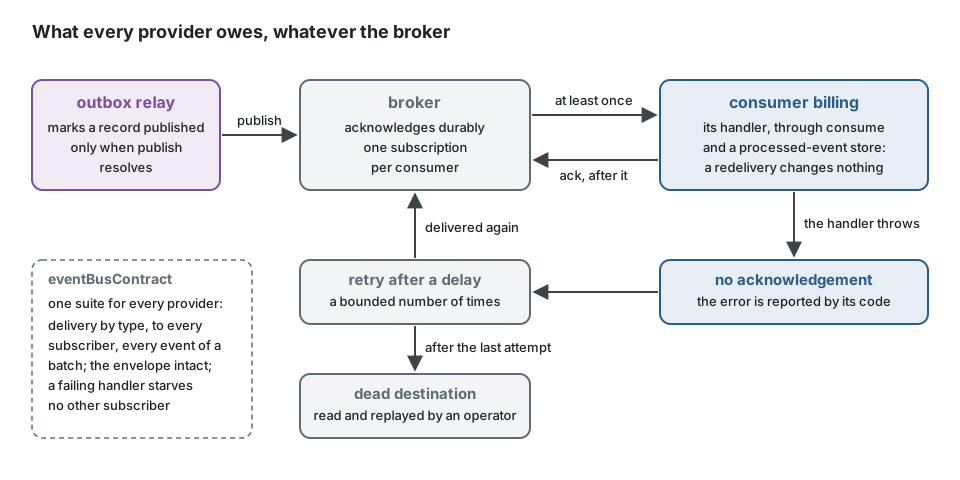
What every provider owes
Section titled “What every provider owes”Two ports of @ddd-ts-kit/kernel, nothing else:
IntegrationEventPublisher.publish(events): resolves only when the broker has taken responsibility for every event (its durable acknowledgement), rejects otherwise, and buffers nothing for later. The outbox relay marks a record published on that promise.IntegrationEventSubscriber.subscribe(type, handler): delivers every event of the type to the handler at least once, acknowledges after the handler resolved, never before, and returns aSubscription. The consumer name comes from the instance (forConsumer(name)or an option), because the port has no room for it.
And one suite: eventBusContract(runner, { name, createBus }) of
@ddd-ts-kit/testing/contracts, where createBus returns { bus, settle, close }. settle
resolves once everything published was delivered or given up on; close releases the
connection and removes what the test created. The suite checks: delivery by type, to every
subscriber, of every event of a batch; an event nobody subscribed to is accepted;
unsubscribing stops the delivery; the envelope comes back exactly as published, with
traceparent, correlationId and tenantId, and without inventing a trace or a correlation
when none was published; a failing handler does not starve the others and the event comes back.
import { afterEach, beforeEach, describe, expect, it } from 'vitest';import type { EventBus } from '@ddd-ts-kit/kernel';import { eventBusContract } from '@ddd-ts-kit/testing/contracts';
// What your test support provides: a bus on a fresh topology, and how to wait for it and drop it.interface TestBroker {  readonly bus: EventBus;  settled(): Promise<void>;  dispose(): Promise<void>;}
declare function connectTestBroker(url: string): Promise<TestBroker>;
const url = process.env['MY_BROKER_TEST_URL'];
describe.skipIf(url === undefined)('against a real broker', () => {  eventBusContract({ describe, it, expect, beforeEach, afterEach }, {    name: 'MyBrokerEventBus',    async createBus() {      const broker = await connectTestBroker(url ?? '');
      return { bus: broker.bus, settle: () => broker.settled(), close: () => broker.dispose() };    },  });});
On top of the contract, the behaviours to write a test for, with a real broker and a skip when its URL is absent: publication rejected when the acknowledgement does not come; redelivery after a failure; dead-lettering after the bounded attempts; poison message; two consumers each get everything while two instances of one consumer share; reconnection; graceful close.
Common decisions, the same everywhere:
- the body is the envelope as JSON; type, version, event id,
traceparentand correlation id are repeated in headers or attributes for routing and tracing; - errors are reported by code, never by message;
- retries are bounded and delayed, then the message is parked where an operator can see it and replay it;
- consumers deduplicate, through a declared
@IntegrationEventHandler(orconsumeby hand) and a processed-event store: every one of these brokers redelivers.
The shape of a provider, reduced to these duties. BrokerClient stands for the client library
of the broker; a real provider adds what the packages carry: the topology, the reconnection,
the onFailure hook, the poison messages and a graceful close.
import type { EventBus, EventDelivery, IntegrationEvent, IntegrationEventCallback, Subscription } from '@ddd-ts-kit/kernel';
interface OutgoingMessage {  readonly body: string;  readonly headers: Readonly<Record<string, string>>;}
interface ReceivedMessage {  readonly body: string;  readonly receiveCount: number; // counted by the broker, or carried in a header  ack(): Promise<void>;  retryAfter(delayMs: number): Promise<void>;  park(reason: string): Promise<void>; // to the dead destination, readable and replayable}
interface BrokerClient {  /** Resolves once the broker durably holds every message: its acknowledgement. */  send(messages: readonly OutgoingMessage[]): Promise<void>;  receive(queue: string, onMessage: (message: ReceivedMessage) => Promise<void>): () => void;}
const MAX_ATTEMPTS = 5;const RETRY_DELAY_MS = 5_000;
export class MyBrokerEventBus implements EventBus {  constructor(    private readonly client: BrokerClient,    private readonly consumer: string, // the port has no room for it: it comes from the instance  ) {}
  /** Resolves only when the broker took every event; rejects otherwise, and buffers nothing. */  async publish(events: readonly IntegrationEvent[]): Promise<void> {    await this.client.send(events.map((event) => ({ body: JSON.stringify(event), headers: headersOf(event) })));  }
  subscribe(type: string, handler: IntegrationEventCallback): Subscription {    const queue = `${this.consumer}-${type}`;    const stop = this.client.receive(queue, async (message) => {      const delivery: EventDelivery = {        attempt: message.receiveCount,        maxAttempts: MAX_ATTEMPTS,        system: 'my-broker',        destination: queue,        consumer: this.consumer,      };
      try {        await handler(JSON.parse(message.body) as IntegrationEvent, delivery);        await message.ack(); // after the handler resolved, never before      } catch {        await (message.receiveCount >= MAX_ATTEMPTS ? message.park('max-attempts') : message.retryAfter(RETRY_DELAY_MS));      }    });
    return { unsubscribe: stop };  }}
/** Repeated outside the body, for routing and tracing without parsing it. */function headersOf(event: IntegrationEvent): Record<string, string> {  return {    'x-event-id': event.id,    'x-event-type': event.type,    'x-event-version': String(event.version),    ...(event.traceparent === undefined ? {} : { traceparent: event.traceparent }),    ...(event.correlationId === undefined ? {} : { 'x-correlation-id': event.correlationId }),    ...(event.tenantId === undefined ? {} : { 'x-tenant-id': event.tenantId }),  };}
The cast of the body is where a real provider checks the envelope first (id, type,
version, occurredAt) and parks what fails as poison, before any handler sees it.
The concepts, on RabbitMQ
Section titled “The concepts, on RabbitMQ”The tables below map each concept of RabbitMqEventBus to another broker. On RabbitMQ, for
forConsumer('billing') subscribed to ordering.order.placed (the
topology and the
retry behaviour give the details):
| Concept | RabbitMQ |
|---|---|
| exchange | the topic exchange integration-events, durable |
| routing key | the event type, ordering.order.placed |
| publisher confirm | publish resolves once the broker confirmed every message of the batch |
| queue per consumer | the quorum queue billing.ordering.order.placed, bound with the routing key |
| manual ack | acknowledgement after every handler of the queue resolved |
| retry queue | billing.ordering.order.placed.retry, whose message TTL is retry.delayMs, dead-lettering back to the work queue |
| dead queue | billing.ordering.order.placed.dead, with no consumer |
x-attempt |
the header the bus increments on each copy sent to the retry queue |
| deduplication id | the messageId property, set to the event id; the broker does not deduplicate, the processed-event store does |
Built: @ddd-ts-kit/kafka, which is the reference for its options,
guarantees and limits. How the concepts of the RabbitMQ provider map, for
forConsumer('billing') subscribed to ordering.order.placed:
| Concept here | Kafka, as the package does it |
|---|---|
| exchange and routing key | one topic per event type, named after the type (topicOf gives one per producing context instead); the record key is keyOf(event), the ordering key |
| publisher confirm | idempotent producer with acks=all; publish resolves on the acknowledgement of every record |
| queue per consumer | the consumer group billing, starting at the earliest record |
| manual ack | offset committed after the handlers resolved, never automatically |
| retry queue | none: a failed record is retried in place, its partition paused for retry.delayMs, so the order of a key holds through a failure that heals |
| dead queue | the dead-letter topic billing.ordering.order.placed.dead (<consumer>.<topic>.dead) |
x-attempt |
counted by the consumer, written as a header on the dead-letter record |
| deduplication id | the header x-event-id; the idempotent producer absorbs the retries of the client only, so the processed-event store stays necessary |
NATS JetStream
Section titled “NATS JetStream”Built: @ddd-ts-kit/nats, the reference for its options, guarantees
and limits. Core NATS has no persistence: only JetStream fits the ports. For
forConsumer('billing') subscribed to ordering.order.placed:
| Concept here | JetStream, as the package does it |
|---|---|
| exchange | the stream integration-events capturing the subjects events.>, limits retention, file storage |
| routing key | the subject events.ordering.order.placed (<subjectPrefix>.<event type>) |
| publisher confirm | the publish acknowledgement of the stream, awaited for every message |
| queue per consumer | the durable pull consumer billing_ordering_order_placed: consumer name and type, every character outside [A-Za-z0-9_-] replaced by _ |
| manual ack | explicit acknowledgement after the handlers resolved |
| retry queue | none: nak with retry.delayMs, the server redelivers |
| dead queue | the subject dead.events.billing.ordering.order.placed (dead.<subjectPrefix>.<consumer>.<event type>) kept by the stream integration-events-dead; the bus publishes the copy, waits for its acknowledgement, then terminates the original |
x-attempt |
the delivery count of the server |
| deduplication id | the header Nats-Msg-Id, set to the event id: the stream drops a second publication inside its duplicate window (2 minutes), which absorbs a retry of the relay, not a replay an hour later |
Redis Streams
Section titled “Redis Streams”Built: @ddd-ts-kit/redis, entry
./event-bus, the reference for its options, guarantees and limits; it runs on Redis, Valkey
and Dragonfly. For forConsumer('billing') subscribed to ordering.order.placed:
| Concept here | Redis Streams, as the package does it |
|---|---|
| exchange | none: one stream per event type |
| routing key | the stream integration-events:ordering.order.placed (<prefix>:<event type>) |
| publisher confirm | the entry id the server answers for each XADD, all of a batch in one MULTI |
| queue per consumer | the consumer group billing on that stream; the instances of billing are members of the group and share its entries |
| manual ack | XACK after the handlers resolved |
| retry queue | none: a failed entry stays pending in the group and is claimed again (XCLAIM) once idle for retry.delayMs |
| dead queue | the stream integration-events:ordering.order.placed:billing:dead, the copy and the XACK in one script |
x-attempt |
the delivery counter of the pending entry list, one more at each claim |
| deduplication id | none on the publishing side; the option deduplication.windowMs narrows the window of a relay retry, and consumers still deduplicate |
SQS and SNS
Section titled “SQS and SNS”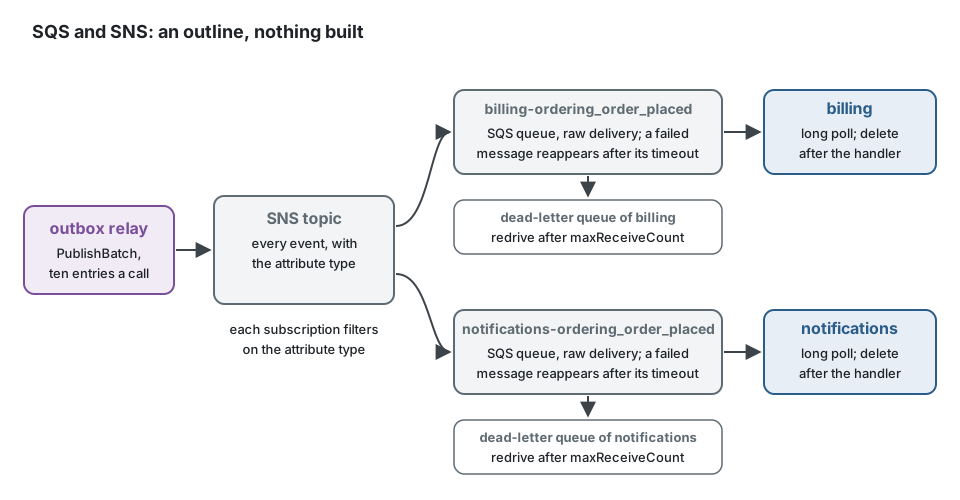
| Concept here | SQS / SNS |
|---|---|
| exchange | one SNS topic for all events, or one per producing context |
| routing key | the message attribute type, matched by the filter policy of each subscription |
| publisher confirm | the response of Publish / PublishBatch, checked entry by entry |
| queue per consumer | an SQS queue <consumer>-<type>, every dot of the type replaced by _ (billing-ordering_order_placed), subscribed to the topic with a filter on type |
| manual ack | DeleteMessage after the handler resolved |
| retry queue | none: the message reappears after its visibility timeout |
| dead queue | a second SQS queue, target of the redrive policy (maxReceiveCount) |
x-attempt |
the ApproximateReceiveCount attribute |
| deduplication id | none on standard queues; on FIFO topics and queues, the MessageDeduplicationId, set to the event id, over five minutes |
How it maps:
publish: batches of ten entries; a batch call (PublishBatch) succeeds even when some entries fail, so read the failed list and reject if it is not empty. Entry id = event id.subscribe: derive the queue name from the consumer and the type, replacing every dot of the type (an SQS queue name accepts only letters, digits,-and_, plus a final.fifo, up to 80 characters), then long-poll the queue, dispatch, delete on success. On failure, set the visibility timeout of that message to the retry delay (this is the delayed retry, and it can grow with the receive count) and leave it.- Subscribe the queue with raw message delivery, or unwrap the SNS envelope: otherwise the body is not the event and the attributes are inside it.
- Poison: delete it after sending it to the dead-letter queue explicitly, or let the redrive
policy carry it after
maxReceiveCountreceptions; the first keeps the reason. settle: no visible, no invisible and no delayed message on the queue, read several times in a row: the counters are approximate.
Pitfalls:
- A visibility timeout below the worst case of the handler delivers the message a second time while the first is still running. Set it well above, and extend it from a heartbeat for long handlers.
- 256 KiB per message, attributes included, and ten attributes at most with raw delivery: large payloads need a claim check, which the envelope does not provide.
- Standard queues are unordered and deliver duplicates in normal operation. FIFO topics and
queues order per message group (the
keyOf) and deduplicate over five minutes only, at a lower throughput. - The queue policy must allow the topic to send to it; without it the subscription exists and
nothing arrives, silently.
onUnroutable: 'fail'has no equivalent: SNS does not report an event that matched no subscription. - A filter policy change takes minutes to apply: a test that subscribes then publishes at once is flaky unless it waits for the first delivery of a probe.
- A consumer created after a publication never sees it: there is no replay. Create the queues and subscriptions at deployment, before the producers.
- The local emulators differ from the service on filter policies and redrive timing: run the contract suite against the real service at least once.