
Cache and coordination: Redis, Dragonfly, Valkey
Summary. @ddd-ts-kit/redis implements three kernel ports on the Redis protocol: Cache,
RateLimiter and Lock, plus a wake-up signal for the outbox relay, a store of background jobs
and an event bus on Redis Streams (message brokers). It uses a common subset
of commands, so the same code runs on Redis, Valkey and Dragonfly, and the choice of server is
operational and legal (the three have different licences), not architectural. The important
part of this page is what these tools do not guarantee: a cache may be stale or absent, a rate
limiter depends on synchronized clocks, and the lock is an efficiency tool that can have two
holders. Anything that must never happen twice is guarded by a database constraint.
Three different jobs
Section titled “Three different jobs”| Port | Question it answers | Wrong answer costs | In the running domain |
|---|---|---|---|
Cache |
"have I computed this recently?" | a slower or slightly stale read | availability caching a practitioner's working hours read through a gateway |
RateLimiter |
"has this caller done this too often?" | a few calls too many, or a refused call | 120 requests a minute per address in front of the API; three booking attempts a minute per client |
Lock |
"is somebody else already doing this work?" | the work done twice | one instance running the notifications.send-reminders job for a given occurrence |
None of them answers "is this slot still free?". That is the no-double-booking invariant of
appointments, and it is held by the aggregate and a database constraint
(invariants, permissions and validation).
Use cases depend on the ports of the kernel; the adapter is chosen in src/platform/ and
bound at the composition root. @ddd-ts-kit/redis is refused in domain/ and application/
even when an allow-list names it (layer/domain-purity, layer/application-inward in
ARCHITECTURE.md). Without a server, kernelModule() binds in-memory
implementations that are correct for one process and for tests.
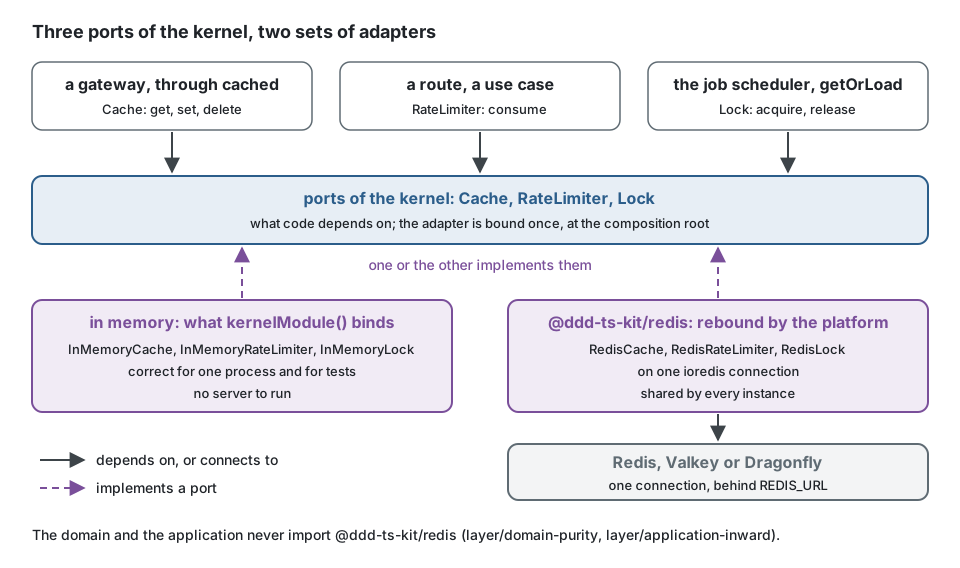
Moving from one instance to several changes the platform and nothing else. The example
application binds the three Redis adapters on one connection, each under its own namespace, as
src/platform/redis/open-redis.ts does:
import { kernelModule } from '@ddd-ts-kit/di';import { Metrics } from '@ddd-ts-kit/kernel';import { RedisCache, RedisLock, RedisRateLimiter, connectRedis } from '@ddd-ts-kit/redis';
declare const redisUrl: string;
// redis://..., the same for Redis, Valkey and Dragonfly. Commands time out after two seconds.const redis = connectRedis(redisUrl);
// src/platform/: the in-memory defaults of kernelModule() replaced by adapters every instance shares.export const kernel = kernelModule({  cache: (resolve) => new RedisCache(redis.client, { namespace: 'scheduling', metrics: resolve(Metrics) }),  // A server that is away lets requests through rather than refusing them all.  rateLimiter: new RedisRateLimiter(redis.client, { namespace: 'scheduling:rate', onError: 'allow' }),  lock: new RedisLock(redis.client, { namespace: 'scheduling:lock' }),});
The three servers
Section titled “The three servers”Checked on 2026-10-10 against each project's GitHub repository (latest release, licence file).
| Redis | Valkey | Dragonfly | |
|---|---|---|---|
| Latest release | 8.10.2 (2026-09-17) | 9.1.2 (2026-09-01) | 2.0.2 (2026-10-07) |
| Licence | since Redis 8: your choice of RSALv2, SSPLv1 or AGPLv3; 7.2 and earlier were BSD 3-clause | BSD 3-clause | Business Source License 1.1; converts to Apache 2.0 on the change date written in the licence file (1 November 2030 on the day of the check) |
| What the licence restricts | RSALv2 and SSPLv1 restrict offering it as a managed service; AGPLv3 is copyleft over the network | nothing beyond attribution | use as part of your own product is granted; offering it as an in-memory data store service is not |
| Origin | the original project | fork of Redis 7.2 under the Linux Foundation (2024) | independent implementation of the protocol, multi-threaded |
| Embedded Lua | 5.1 | 5.1 | 5.4 |
| Persistence | append-only file and snapshots | append-only file and snapshots | snapshots |
| Protocol compatibility as the kit measured it | reference | same results as Redis on the kit's suite | same results on the kit's suite; two reply differences absorbed by the event bus; refuses a script touching an undeclared key |
Licences are summarised, not interpreted: have the terms read by whoever is responsible for that in your organisation, especially if you resell hosting. This page did not benchmark the servers and makes no performance claim.
Selection criteria
Section titled “Selection criteria”- Licence fit. For most internal services all three are usable; a hosting provider or a company with a policy against source-available or AGPL software narrows the list quickly.
- What your platform offers. A managed Redis or Valkey from your cloud is one less thing to run.
- Persistence needs. A cache needs none. A lock and a rate limiter tolerate a restart. Redis Streams as an event bus is another matter (message brokers).
- One server or two. Eviction suits a cache and harms locks, rate-limit keys and streams.
- Do you need a server at all? A single instance needs none of this: the in-memory ports are enough.
What this kit supports and verified
Section titled “What this kit supports and verified”From packages/redis/README.md and
packages/kernel/README.md:
-
Tested against Dragonfly 2.0.2, Valkey 9.1.2 and Redis 8.10.2 with ioredis 6, the same suite with the same results. ioredis 5 is accepted as a peer; nothing was run on it. The suite needs a server and is skipped when no URL is given.
-
Contract suites (
cacheContract,lockContract,rateLimiterContract) that the in-memory implementation and the adapter both pass; an adapter of your own is held to them. -
Portability choices: scripts sent with
EVALand every key declared; no arithmetic in Lua (the two Lua versions differ on numbers); noKEYS, modules, functions or keyspace notifications. -
Connection: a command timeout of two seconds and one retry per request by default, so a server that is away fails fast instead of stalling every request;
redisHealthfor a readiness probe. -
Generated by the CLI:
init --cache rediswritessrc/platform/redis/open-redis.ts(one connection behindREDIS_URL) and rebinds the kernelCache,RateLimiterandLockto it in the platform module, with the relay signal for the outbox; the compose file runs Dragonfly 2.0.2 for local development. Without the option the three stay in the memory of the process.init --queue redisbindsRedisJobStorefor the background jobs, andinit --broker redisthe event bus on Redis Streams. -
Background jobs:
RedisJobStoreis theJobStoreof@ddd-ts-kit/schedulingon the same servers. Redis cannot join the transaction of the database: a job added inside a unit of work is written once it committed, and a process that dies in between loses that write silently. A write Redis refuses after the commit is passed toonLostJob, whichreportLostJobs(logger, errors)logs and reports. With a database, the jobs table of the ORM package is the safer store (background jobs).
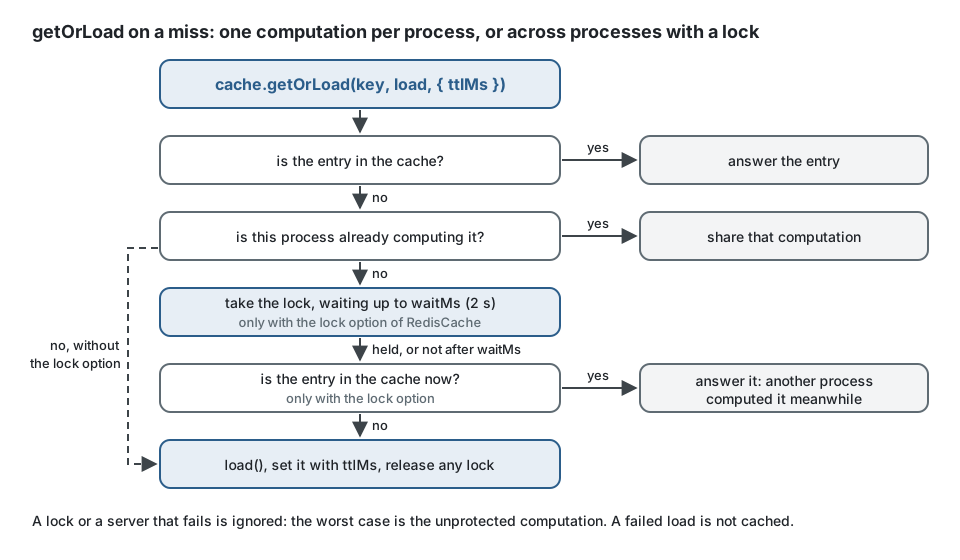
Cache. Typed keys, a namespace per context or application, time to live in milliseconds.
A failing server is a miss on read and a dropped write by default: the application runs as if
it had no cache, and cache_errors_total is the signal to watch. getOrLoad protects against
a stampede: callers of one process share a computation, and with a lock only one process
computes while the others wait up to waitMs for the lock, then answer the value it stored, or
compute it themselves when it is still missing. It never fails because of the lock. The
cached aspect refuses to wrap a repository or a use case unless explicitly allowed: an
aggregate served from a cache hides that it is stale, and the next command would decide on old
state.
What to cache, and where. Instead of caching what a command decides on:
// AspectNotAllowedError as soon as the repository is wrappedbuilder.bind(AppointmentRepository).toClass(KnexAppointmentRepository).as('repository') .with(cached({ key: (method, [id]) => `appointment:${String(id)}`, ttlMs: 60_000 }));cache what is read from elsewhere and may be a little old, from the composition root, so that the gateway itself knows nothing of it:
import { cached } from '@ddd-ts-kit/aspects';import type { Cache } from '@ddd-ts-kit/kernel';
interface WorkingHours {  readonly practitionerId: string;  readonly opensAt: string;  readonly closesAt: string;}
// contexts/availability/application/ports/calendar.gateway.tsexport abstract class CalendarGateway {  abstract workingHoursOf(practitionerId: string): Promise<WorkingHours>;}
declare const httpCalendars: CalendarGateway; // the adapter that calls the calendars contextdeclare const cache: Cache; // RedisCache with several instances, InMemoryCache with one
// src/platform/: five minutes of staleness are acceptable for working hours.export const calendars = cached({  key: (method, [practitionerId]) => (method === 'workingHoursOf' ? `working-hours:${String(practitionerId)}` : undefined),  ttlMs: 5 * 60_000,  cache,})(httpCalendars, { kind: 'gateway', context: 'availability' });
Concurrent identical calls share one call to the calendars context; a failed call is not cached;
a cache that fails is a miss. With a container, the same aspect goes on the binding:
.as('gateway').with(cached({ ... })).
Rate limiter. An exact sliding window: one sorted-set member per allowed call, decided in
one script, so concurrent instances cannot both take the last place. A refused call is not
counted. onError chooses between throw (default), allow (usual in front of an API) and
deny (for limits that are a security control).
A limit that is a business rule ("three booking attempts a minute per client") belongs to the use case, which depends on the port and refuses with a code of its own:
import { ConceptError, RateLimiter } from '@ddd-ts-kit/kernel';
export class BookingError extends ConceptError {  static tooManyAttempts(retryAfterMs: number) {    return BookingError.refusal('TOO_MANY_BOOKING_ATTEMPTS', 'Too many booking attempts, try again later.', {      retryAfterMs,    });  }}
// contexts/appointments/application/: called by the handler of BookAppointment before anything else.export class BookingAttempts {  constructor(private readonly limiter: RateLimiter) {}
  async admit(clientId: string): Promise<void> {    const decision = await this.limiter.consume(`booking:${clientId}`, { limit: 3, windowMs: 60_000 });
    if (!decision.allowed) {      throw BookingError.tooManyAttempts(decision.retryAfterMs);    }  }}
In a spec, InMemoryRateLimiter on a FixedClock is its fake: advance the clock by a minute
and the fourth attempt is admitted.
Lock. The single-instance algorithm of the Redis documentation: SET NX PX with a random
owner, release by compare-and-delete, a fencing token incremented in the same script.
Relay signal. Publish/subscribe used as a hint to wake the outbox relay; a lost notification only delays publication until the next poll.
What the lock does and does not guarantee
Section titled “What the lock does and does not guarantee”It guarantees at most one holder at a time provided the server keeps its data and the
holder finishes within ttlMs. It is not a consensus lock. The README lists when two holders
exist at once:
- the holder is paused (garbage collection, a stalled disk, a suspended container) longer than the time to live and resumes working;
- the server fails over to a replica that had not received the key;
- the server restarts without persistence, or evicts the key under memory pressure;
- clocks on the server side jump.
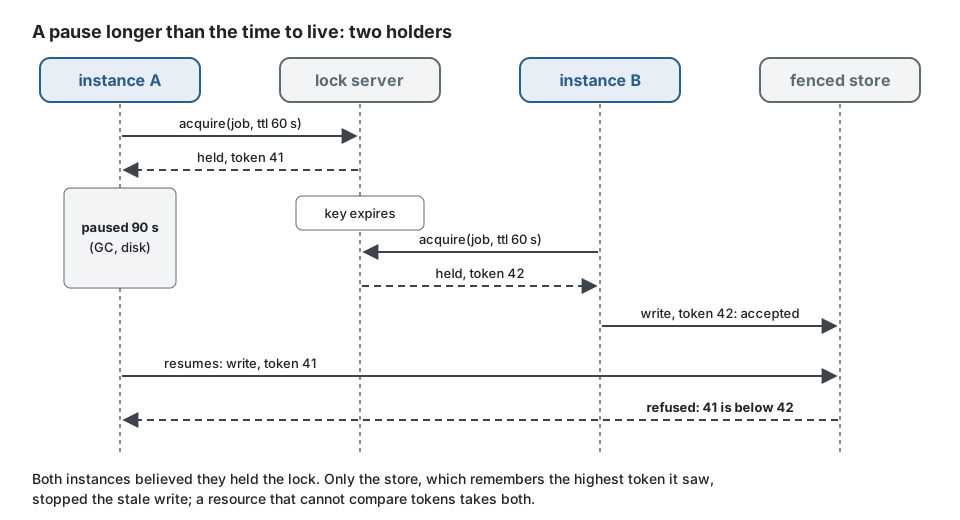
The fencing token narrows this for resources able to compare: a store that remembers the
highest token it has seen refuses the write carrying 41 after it saw 42. It is not a proof
either: the counter lives in the same server and restarts if that server loses its data. The
lock is also not re-entrant and not renewed: choose ttlMs above the worst case of the
work, or split the work. A server that is away makes acquire reject, since nobody can know
whether the key is held.
A store compares tokens with a condition on its write. Here the row of an export keeps the token of the holder that wrote it last, and a holder whose lock expired changes nothing:
import type { LockHandle } from '@ddd-ts-kit/kernel';
interface Database {  execute(sql: string, values: readonly unknown[]): Promise<{ readonly rowCount: number }>;}
/** Answers false when a newer holder of the lock already wrote: this one was paused past its ttlMs. */export async function writeExport(database: Database, holder: LockHandle, content: string): Promise<boolean> {  const { rowCount } = await database.execute(    'update exports set content = $1, fencing_token = $2 where id = $3 and fencing_token <= $2',    [content, holder.fencingToken, 'nightly'],  );
  return rowCount === 1;}
Hence the rule the kernel states of Lock itself: an efficiency tool, never the guard of an
invariant. Instead of guarding the no-double-booking invariant with it:
// a pause past five seconds, a failover, an eviction: and two bookings of one slot get inconst handle = await lock.acquire(`slot:${practitionerId}:${startsAt}`, { ttlMs: 5_000 });if (handle === undefined) { throw AppointmentError.slotTaken(practitionerId, startsAt);}await appointments.save(Appointment.book(practitionerId, startsAt));leave the invariant to the aggregate and to a constraint of the database (the exclusion constraint of the persistence page), and keep the lock for work whose double run only costs work, such as sending this morning's reminders through a command that skips what was already sent:
import type { Lock } from '@ddd-ts-kit/kernel';
declare function sendTodaysReminders(): Promise<void>; // idempotent: a reminder already sent is skipped
export async function sendRemindersOnce(lock: Lock, day: string): Promise<void> {  const handle = await lock.acquire(`notifications.send-reminders:${day}`, { ttlMs: 15 * 60_000 });
  if (handle === undefined) {    return; // another instance is sending them, or has sent them  }
  // Not released at the end: an instance whose timer fires a little later finds the key still  // held and sends nothing. The lock frees itself after ttlMs.  await sendTodaysReminders();}
A scheduled job declared singleInstance gets this from the scheduler of
@ddd-ts-kit/scheduling, which takes the lock under job:<name>:<scheduled instant> before each
occurrence; the others record skipped-locked
(scheduled jobs).
| Need | Right tool | Why |
|---|---|---|
| one instance sends this morning's reminders | Lock, and an idempotent command |
a rare double run wastes work; the command sends each reminder once anyway |
| recompute an expensive cache entry once | Lock through getOrLoad |
worst case is the unprotected computation |
| a practitioner is never double booked | exclusion or unique constraint in the appointments schema, plus the aggregate |
holds whatever any process believes about a lock |
| an appointment is not rescheduled by two requests at once | optimistic concurrency on the aggregate version |
the second writer gets a conflict |
| an integration event is handled once per consumer | processed-event store in the consumer's transaction | a mark in Redis and a change in PostgreSQL are two systems |
| a job occurrence runs exactly once and survives a crash | not available: a row in a table processed by a repeatable job | scheduled jobs |
Limits and when not to use it
Section titled “Limits and when not to use it”Stated by the package:
- One server or a primary with replicas. A Redis Cluster works for the cache and the lock;
deleteByPrefixdoes not scan every node. Not tested on a cluster. - Eviction applies to everything. Under
allkeys-lrua lock or a rate-limit key can be evicted like a cache entry. Use avolatile-*policy, or a second server for what is not a cache. - No client-side caching, no pipelining of reads: each
getis a round trip. - Values are JSON by default:
Date,Map,bigintand class instances do not survive. Cache plain data. deleteByPrefixis not atomic and is an administrative tool; prefer short times to live to invalidation.- Rate limiter memory grows with the limit (one member per allowed call): fine up to thousands per window. Its clock is the caller's: instances must be synchronized, and a skew shifts the window by as much.
- No processed-event store on Redis, deliberately, and no outbox: what must be atomic with business data lives in the database.
When not to use a cache: in front of a repository of aggregates; to hide a slow query that an index or a read model would fix; when the data must be correct at the instant of a decision. When not to use the lock: whenever the sentence describing the need contains "never".
Recommendation by situation
Section titled “Recommendation by situation”| Situation | Choice |
|---|---|
| One instance | no server: the in-memory ports of kernelModule() |
| Several instances, a cache and jobs, no licence constraint | any of the three; the generated compose file runs Dragonfly for local development |
| A policy requiring a permissive open-source licence | Valkey |
| Managed service from your cloud provider | whatever it offers that speaks the protocol; run the contract suites against it once |
| Cache plus Redis Streams as the event bus | two servers or two policies: the bus needs noeviction and persistence |
| A hard mutual exclusion requirement | not this package: a database constraint, or a consensus system you operate knowingly |
Sources
Section titled “Sources”- Redis documentation, distributed locks (the single-instance pattern and its limits): https://redis.io/docs/latest/develop/clients/patterns/distributed-locks/
- Martin Kleppmann, "How to do distributed locking" (2016), on pauses and fencing tokens: https://martin.kleppmann.com/2016/02/08/how-to-do-distributed-locking.html
- Redis licence: https://github.com/redis/redis/blob/unstable/LICENSE.txt ; Valkey: https://github.com/valkey-io/valkey ; Dragonfly licence: https://github.com/dragonflydb/dragonfly/blob/main/LICENSE.md (all read on 2026-10-10)
- Redis eviction policies: https://redis.io/docs/latest/develop/reference/eviction/
- Michael Nygard, Release It!, 2nd edition, Pragmatic Bookshelf, 2018 (caching as a stability risk).
- Martin Kleppmann, Designing Data-Intensive Applications, O'Reilly, 2017, chapter 8.
- Not verified: the persistence modes of Dragonfly beyond what the kit's README states (snapshots); behaviour of any of the three under cluster mode.
See also
Section titled “See also”- Resilience
- Scheduled jobs
- Aggregates
- Delivery and idempotency
- Message brokers
- Persistence
- HTTP caches: the shared cache in front of the API, Varnish and the CDNs