
Layers and the dependency rule
Summary. A bounded context of this kit is cut into four layers: presentation, application, domain and infrastructure. One rule governs them: source code dependencies point towards the domain, and the domain depends on nothing but itself and the kernel. Hexagonal architecture, onion architecture and clean architecture are three names for that same rule, with different drawings and vocabulary. This page explains the rule, what the three names share and where they differ, how the kit maps them to folders, and which analyzer holds which part.
The problem the rule solves
Section titled “The problem the rule solves”In a classic three-tier application the business code calls the database code, so the business code imports the ORM, and every business rule is written in terms of rows and sessions. Two things follow. The rule "a client cannot book a slot that is already taken" cannot be tested without a database, and replacing or upgrading the ORM means editing business rules.
The dependency rule reverses the direction of that one arrow. The business code declares what it needs as an abstraction (a port), and the database code implements it. The call still goes from the business code to the database at run time; the import goes the other way.
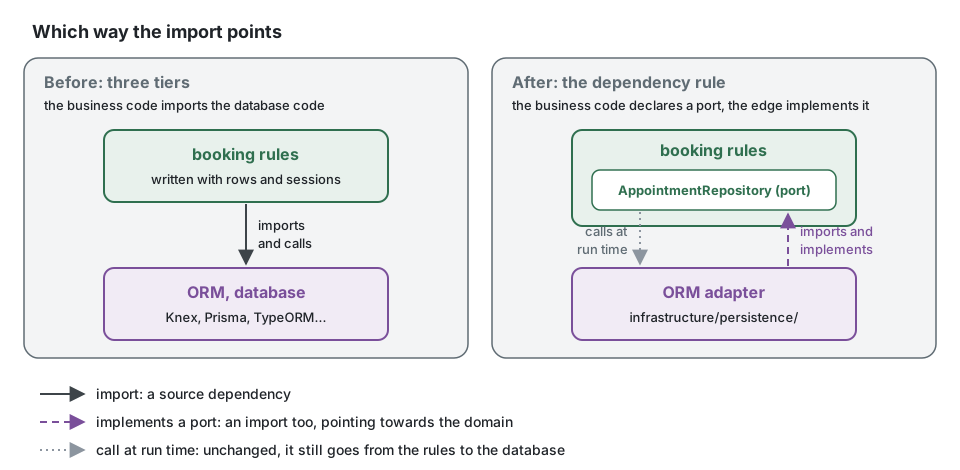
In code, the difference is one import. Instead of a domain that reaches for the database:
import type { Knex } from 'knex'; // layer/domain-purity: an ORM inside the domain
export class Appointment {  static async book(db: Knex, calendarId: string, startsAt: Date) {    const taken = await db('appointments').where({ calendar_id: calendarId, starts_at: startsAt }).first();    // the rule is now written in terms of rows, and cannot be tested without a database  }}
write a domain that states what it needs, and an application that uses it without knowing who answers. The four files are shown as one module here; the comments name the file each part lives in:
import { definePermissions } from '@ddd-ts-kit/auth';import {  AggregateRoot,  AuthorizedCommand,  ConceptError,  Repository,  type Actor,  type Clock,  type DomainEvent,  type IdGenerator,} from '@ddd-ts-kit/kernel';import { CommandHandler, Requires } from '@ddd-ts-kit/kernel/declarations';
// domain/: imports nothing but the kernelexport class AppointmentBooked implements DomainEvent {  static readonly eventName = 'appointments.appointment.booked';
  readonly name = AppointmentBooked.eventName;
  constructor(    readonly aggregateId: string,    readonly occurredAt: Date,  ) {}}
export class AppointmentError extends ConceptError {  static slotTaken(calendarId: string, startsAt: Date) {    return AppointmentError.refusal('SLOT_TAKEN', `The slot at ${startsAt.toISOString()} is already taken.`, {      calendarId,      startsAt,    });  }}
export class Appointment extends AggregateRoot {  private constructor(    id: string,    readonly calendarId: string,    readonly startsAt: Date,  ) {    super(id);  }
  static book(id: string, calendarId: string, startsAt: Date, now: Date): Appointment {    const appointment = new Appointment(id, calendarId, startsAt);    appointment.record(new AppointmentBooked(id, now));
    return appointment;  }}
// domain/repositories/appointment.repository.ts: the port, an abstract class the domain ownsexport abstract class AppointmentRepository extends Repository<Appointment> {  abstract isTaken(calendarId: string, startsAt: Date): Promise<boolean>;}
// application/: the use case knows the port, never the adapter behind itconst appointmentsPermissions = definePermissions('appointments', {  'appointment.book': { description: 'Book an appointment' },});
@Requires(appointmentsPermissions['appointment.book'])export class BookAppointment extends AuthorizedCommand<string> {  constructor(    actor: Actor,    readonly calendarId: string,    readonly startsAt: Date,  ) {    super(actor);  }}
@CommandHandler(BookAppointment)export class BookAppointmentHandler implements CommandHandler<BookAppointment> {  constructor(    private readonly appointments: AppointmentRepository,    private readonly ids: IdGenerator,    private readonly clock: Clock,  ) {}
  async execute({ calendarId, startsAt }: BookAppointment): Promise<string> {    if (await this.appointments.isTaken(calendarId, startsAt)) {      throw AppointmentError.slotTaken(calendarId, startsAt);    }
    const appointment = Appointment.book(this.ids.next(), calendarId, startsAt, this.clock.now());    await this.appointments.save(appointment);
    return appointment.id;  }}
// infrastructure/persistence/: the adapter imports the port and implements itexport class InMemoryAppointmentRepository implements AppointmentRepository {  private readonly rows = new Map<string, Appointment>();
  async findById(id: string): Promise<Appointment | undefined> {    return this.rows.get(id);  }
  async save(appointment: Appointment): Promise<void> {    this.rows.set(appointment.id, appointment);  }
  async isTaken(calendarId: string, startsAt: Date): Promise<boolean> {    return [...this.rows.values()].some(      (held) => held.calendarId === calendarId && held.startsAt.getTime() === startsAt.getTime(),    );  }}
The rule "a slot cannot be booked twice" now reads without any library, and a spec runs it against the in-memory adapter in milliseconds. The ORM adapter of production (Knex, Drizzle, Prisma or TypeORM) is one more class that implements the same port; nothing above it changes.
The four layers, on the scheduling application
Section titled “The four layers, on the scheduling application”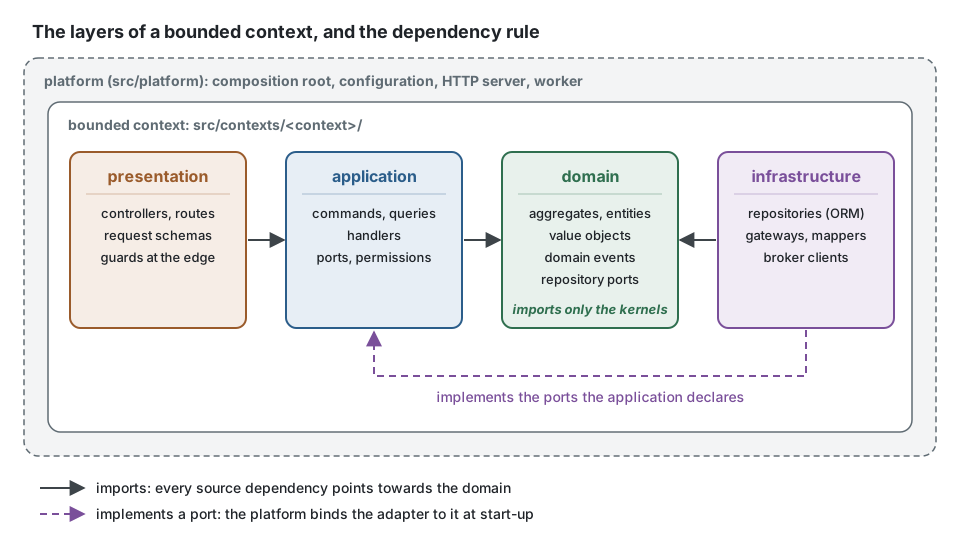
| Layer | Holds | Example in appointments |
May import |
|---|---|---|---|
| domain | the model: aggregates, entities, value objects, domain events, domain errors, repository ports, domain services | Appointment, TimeSlot, SlotAlreadyTaken, the AppointmentRepository port |
its own domain, the shared kernel, the kernel package |
| application | use cases: one command or query and its handler, ports to the outside, permissions and policies, reactions to events, jobs | BookAppointment and its handler, a port to read working hours |
domain, application, published languages, the kernel |
| infrastructure | adapters: repository implementations, clients of outside systems, anti-corruption translators | the ORM adapter of AppointmentRepository, its mapper |
the ports it implements, drivers and libraries |
| presentation | the way in: HTTP routes and their DTOs, CLI | POST /appointments mapped to BookAppointment |
application, domain types for mapping |
The exact import lists are the rules layer/domain-purity, layer/application-inward,
layer/presentation-no-infrastructure and layer/infrastructure-no-presentation in
ARCHITECTURE.md section 3. The folder for each role is the canonical tree
of section 2.
A request to book an appointment crosses the layers like this:
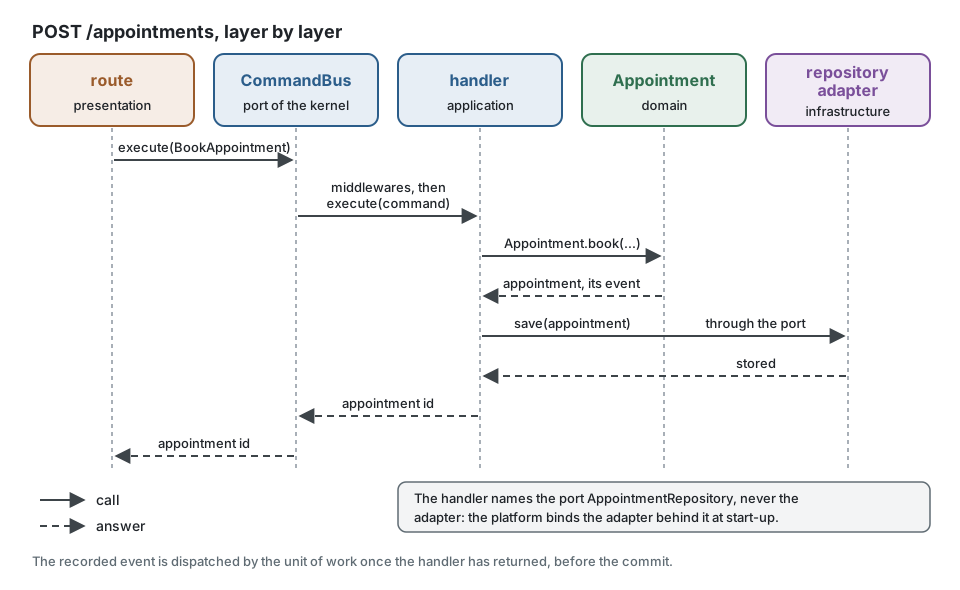
The handler knows the port AppointmentRepository, an abstract class of the domain. It never
names the adapter. Which adapter stands behind the port is decided in the composition root (see
Ports and composition).
Three names, one rule
Section titled “Three names, one rule”| Hexagonal (ports and adapters) | Onion | Clean architecture | |
|---|---|---|---|
| Author, year | Alistair Cockburn, 2005 | Jeffrey Palermo, 2008 | Robert C. Martin, 2012 (article), 2017 (book) |
| Central idea | the application talks to the outside only through ports; adapters plug technology into them | concentric rings; coupling goes towards the centre, the domain model | concentric rings; the dependency rule: source dependencies point inwards only |
| Inside | "the application", not subdivided | domain model, domain services, application services | entities, use cases |
| Outside | adapters, split in driving (primary) and driven (secondary) | infrastructure, user interface, tests | interface adapters, then frameworks and drivers |
| What it names well | the port, the adapter, the symmetry between the UI side and the database side | that the domain model is the centre and infrastructure an outer ring | the use case as a first-class element, and the rule itself |
| What it leaves open | how the inside is organised | how the outside is entered | how many rings: the book says four is only an example |
What they share: the business code is at the centre and owns the abstractions it needs; technology is at the edge and implements them; the direction of imports is from the edge to the centre; the centre is testable without the edge.
Where they differ is emphasis, not substance. Hexagonal draws two sides (who drives the application, whom the application drives) and says nothing about the inside. Onion and clean architecture draw rings and split the inside into a model and use cases. Clean architecture adds a ring of "interface adapters" (controllers, presenters, gateways) between use cases and frameworks, where hexagonal has just adapters.
How the kit maps them
Section titled “How the kit maps them”| In this kit | Hexagonal | Onion | Clean architecture |
|---|---|---|---|
domain/ |
inside the hexagon | domain model and domain services | entities |
application/ |
inside the hexagon | application services | use cases |
domain/repositories/, application/ports/ |
driven ports | interfaces of the inner rings | output boundaries, gateways interfaces |
CommandBus, QueryBus, commands and queries |
driving ports | application services API | input boundaries |
presentation/ |
driving adapters | user interface | controllers (interface adapters) |
infrastructure/ |
driven adapters | infrastructure | gateways implementations, frameworks and drivers |
<context>.declarations.ts (or <context>.module.ts in the explicit style), platform/compose-application.ts, main.ts |
configurator | dependency resolution | main component |
The kit keeps two sides of the edge apart (presentation/ and infrastructure/) and forbids
them to import each other. That is the hexagonal symmetry made checkable: a route cannot reach a
repository adapter directly, it goes through a use case.
Why the domain may import almost nothing
Section titled “Why the domain may import almost nothing”layer/domain-purity is the strictest rule of the kit: no framework, no ORM, no validation
library, no I/O. The purity/* rules extend it to time, randomness and the environment, which
reach the inner layers through the Clock and IdGenerator ports. The reason is practical:
- the model can be tested in milliseconds without any double (see Testing strategy);
- a rule of the business is readable without knowing a library;
- an upgrade of a library never touches a business rule.
The application layer is allowed a little more (published languages of declared upstreams, the permission types), and still no driver and no framework.
Who checks
Section titled “Who checks”Three analyzers share the rule ids, each exact at a different level. The table "Who checks what" of ARCHITECTURE.md section 3 is the reference; in short:
| Analyzer | What it sees of the layers |
|---|---|
ddd-ts-kit check |
import specifiers as text, classified by path; fast enough to run at every file write |
| the ESLint plugin | the syntax tree of one file; authoritative for code rules when the two disagree |
| dependency-cruiser | the resolved import graph: a type reaching a layer through a barrel or a re-export |
npx ddd-ts-kit explain layer/domain-purity prints the rule, its reason and a good and a bad
example. Tool comparison: Static analysis and pipeline.
Limits and when not to use it
Section titled “Limits and when not to use it”- It costs indirection. A port, an adapter, a mapper and a fake for every outside dependency. The generator writes them, but they remain files to read. For a script, a prototype thrown away next month or a CRUD screen with no rule, a transaction script (Fowler, PoEAA) is shorter and honest.
- Layers do not make a model. Four folders around an anemic model give the cost without the benefit: see Anemic model.
- Mapping is real work. Rows never leave
infrastructure/persistence/and aggregates never leave through a route, so each boundary has a mapping to write and keep current. - The checker has blind spots, listed in the CLI README under "Limits": the text-level
checker does not resolve barrels and re-exports, and nothing constrains what the shared
kernel, the platform and
main.tsimport. dependency-cruiser covers the first; the second is review. - Layers are per context. They say nothing about how contexts depend on each other: that is
the context map and the
context/*rules (see Context map and Modular monolith).
Sources
Section titled “Sources”- Alistair Cockburn, "Hexagonal architecture", 2005, https://alistair.cockburn.us/hexagonal-architecture/
- Jeffrey Palermo, "The Onion Architecture: part 1", 2008, https://jeffreypalermo.com/2008/07/the-onion-architecture-part-1/
- Robert C. Martin, "The Clean Architecture", 2012, https://blog.cleancoder.com/uncle-bob/2012/08/13/the-clean-architecture.html
- Robert C. Martin, Clean Architecture, Prentice Hall, 2017, chapter 22 ("The Clean Architecture") and chapter 11 (the dependency inversion principle).
- Martin Fowler, Patterns of Enterprise Application Architecture, Addison-Wesley, 2002 (Transaction Script, Domain Model, Service Layer).
- Eric Evans, Domain-Driven Design, Addison-Wesley, 2003, chapter 4 ("Isolating the Domain").