
Contract pairs: an HTTP framework and a validation library
Summary. A project of this kit declares each route once, as a controller class with one
handle method, its schemas, its response and its error codes; an adapter mounts it on a
framework and the OpenAPI contract is generated from the same declaration. The framework and the
validation library are therefore two choices made at init and changed later without touching a
route's behaviour. Four pairs are generated and run end to end by the kit: Express and zod,
Fastify and TypeBox, Hono on Node and zod, NestJS and class-validator. oRPC was evaluated and is
not one of them. What separates the pairs is less speed than the team: what it already knows,
how it writes types, and how much of a framework it is ready to leave unused.
What every pair keeps
Section titled “What every pair keeps”Whatever the pair, these hold the same way, through one pipeline (executeRoute) and one suite
of behaviour tests run on every adapter:
| Invariant | How |
|---|---|
| one route, one class | @Controller on a class with one handle; the route group gives the prefix, the tags and the guards |
| guards at the edge, permissions on the use case | guards of the group or the controller; @Requires on the command, decided by the bus |
| refusals as problem documents | RFC 9457 application/problem+json, the stable code of the static factory, 422 with one issue per path for a refused input |
| error codes in the contract | errors of the controller, one problem response per status in the OpenAPI document |
| tracing | the request is the root span named after its route, the command, the repository and the events below it (asserted by the generated end-to-end spec) |
| one contract | OpenAPI 3.1 generated from the declarations, committed, checked for drift in CI; a shape declared once lands once in components.schemas (shared schemas) |
| a typed client | ddd-ts-kit sdk writes it from the committed contract, whatever framework produced it (client SDK): a shared shape is one named type of the client, Accepted included; generated and compiled in each pair's project by contract-pairs.spec.ts |
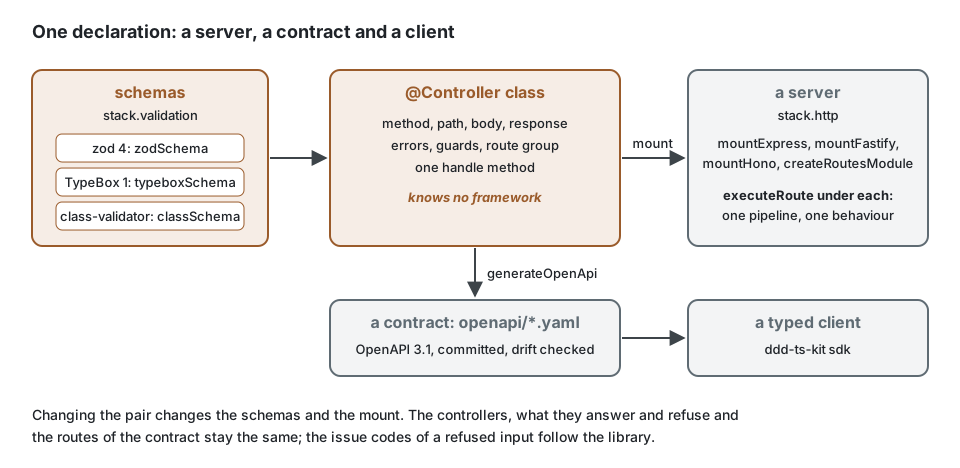
The framework sits at the right edge of the drawing and the validation library at the left
edge; everything in between is the kit's. That is why a pair can be changed: a controller
imports no framework, and its schemas are values it names in its declaration, wrapped in the one
Schema interface of @ddd-ts-kit/validation.
The pairs
Section titled “The pairs”| Pair | init flags |
Proven by |
|---|---|---|
| Express and zod 4 | the default (--http express --validation zod) |
contract-pairs.spec.ts, proven-stacks.spec.ts |
| Fastify and TypeBox | --http fastify --validation typebox |
contract-pairs.spec.ts |
| Hono on Node and zod | --http hono |
contract-pairs.spec.ts |
| NestJS and class-validator | --http nest --di nest --validation class-validator |
contract-pairs.spec.ts |
The end-to-end spec generates one project per pair (with --sdk), adds two command routes that
nest one shape declared with generate schema (its generated file filled in, not replaced) and a
search, installs the kit as published, and holds the project to zero finding (the checker,
ESLint, dependency-cruiser, knip), its unit specs, its end-to-end specs (401, 403, 201 and the
span tree of the request), a contract regenerated, current, holding the shared shape once and
the Accepted answer of the platform, and the client generated from that contract: current,
naming Money and Accepted once each, and compiling on its own. Other combinations are
generated, checked and type-checked by the matrix of stacks.ts (Fastify with zod among them,
and two added with this page: Hono with TypeBox and a Redis cache, Fastify with TypeBox on
Knex); only these four are run end to end.
The routes are a list of plain values, whatever the pair: mounting them is one call of the
adapter of the framework. The three adapters below receive the same routes and the same
options, and answer the same way:
import { serve } from '@hono/node-server';import type { ExecuteOptions, Route } from '@ddd-ts-kit/http';import { mountExpress } from '@ddd-ts-kit/http/express';import { mountFastify } from '@ddd-ts-kit/http/fastify';import { mountHono } from '@ddd-ts-kit/http/hono';import express from 'express';import Fastify from 'fastify';import { Hono } from 'hono';
declare const routes: readonly Route[]; // controllerRoutes([...], { resolve }): the same list for every pairdeclare const options: ExecuteOptions; // execution scope, authentication, error mapper, onError
export async function listen(framework: 'express' | 'fastify' | 'hono'): Promise<void> {  if (framework === 'express') {    const app = express();
    app.use(express.json()); // the adapter does not parse bodies    mountExpress(app, routes, options);    app.listen(3000);  } else if (framework === 'fastify') {    const app = Fastify();
    mountFastify(app, routes, options);    await app.listen({ port: 3000 });  } else {    const app = new Hono();
    mountHono(app, routes, options); // reads the JSON body itself, up to bodyLimit    serve({ fetch: app.fetch, port: 3000 });  }}
NestJS takes the same list through createRoutesModule(routes, options) of
@ddd-ts-kit/http/nest, imported by the root module; the
@ddd-ts-kit/http README shows each mount.
"zod-openapi" in the request that started this page: zod-openapi (6.0.2) and
@asteasolutions/zod-to-openapi (9.1.0) exist to turn zod schemas into an OpenAPI document. The
kit does not need them: zod 4 writes its own JSON Schema (z.toJSONSchema, draft 2020-12, ids
from .meta({ id }) as $defs), which the generator of @ddd-ts-kit/http places in the
document. That is the maintained equivalent, built into zod itself.
Decision table
Section titled “Decision table”| Express + zod | Fastify + TypeBox | Hono + zod | NestJS + class-validator | |
|---|---|---|---|---|
| Types of a request | inferred from the schema (Infer<typeof body>) |
inferred from the schema (Static) |
inferred from the schema | the DTO class, written by hand |
| Composition of shapes | .pick, .omit, .partial, .extend, .meta({ id }) |
Type.Pick, Type.Omit, Type.Partial, Type.Intersect, Type.Interface, $id |
as Express + zod | pickClass, omitClass, partialClass of the kit, extends, nested classes |
| Contract fidelity | high: zod writes its JSON Schema; transforms and refinements are not described | highest: the schema is JSON Schema | as Express + zod | good, through class-validator-jsonschema; custom validators need a converter |
| Issue codes for a client | zod's (too_small, invalid_format) |
the JSON Schema keyword (minLength, format) |
zod's | the constraint name (isUuid) |
| Decorators | none | none | none | legacy mode for the whole program |
| Ecosystem | the widest (middlewares, hiring) | plugins, hooks, pino built in | runs on Node, Bun, Deno and edge runtimes; Node only here | modules, DI, GraphQL, queues; the kit's routes bypass its pipes, guards and filters |
| Maintenance seen on npm (2026-10-13) | express 5.3.0, zod 4.6.5 | fastify 5.12.5, typebox 1.3.37 (published the day before) | hono 4.13.13, @hono/node-server 2.1.4 | @nestjs/core 12.1.2, class-validator 0.15.1, class-transformer 0.5.1 (2021) |
| Fits | a new team, a plain JSON API, the default | a team that wants the contract to be the schema itself, and fewer milliseconds of validation per request than class-validator | a team that may move the service to another runtime later, or that likes Web standard Request and Response |
an existing Nest application adopting the kit context by context |
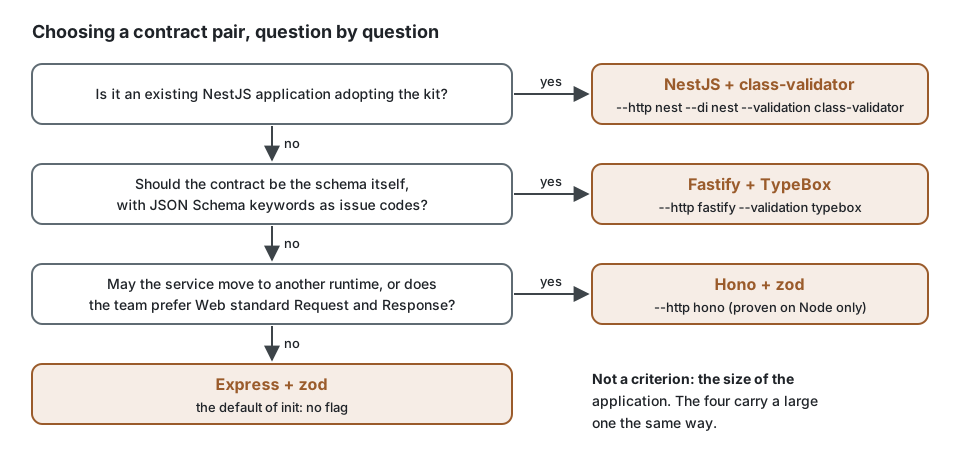
Size of the application does not pick the pair: the tree, the rules and the shared schemas carry a large application the same way on all four. What grows with it is the number of schemas, so the composition of shapes and the issue codes clients read matter more than the framework.
The same body, in each library
Section titled “The same body, in each library”The body of "book an appointment", with a shared Slot, declared for each pair. The controller
does not change: its body option names the schema, and handle reads the same type.
import type { Infer } from '@ddd-ts-kit/validation';import { typeboxSchema } from '@ddd-ts-kit/validation/typebox';import { zodSchema } from '@ddd-ts-kit/validation/zod';import Type from 'typebox';import { z } from 'zod';
// Express + zod, Hono + zod: the id in the metadata makes Slot one component of the contract.const slot = z.object({ startsAt: z.iso.datetime(), endsAt: z.iso.datetime() }).meta({ id: 'Slot' });
export const bookWithZod = zodSchema(z.object({ patientId: z.uuid(), slot }));
// Fastify + TypeBox: the schema is JSON Schema already; the $id makes Slot one component.const slotSchema = Type.Object(  { startsAt: Type.String({ format: 'date-time' }), endsAt: Type.String({ format: 'date-time' }) },  { $id: 'Slot' },);
export const bookWithTypeBox = typeboxSchema(Type.Object({ patientId: Type.String({ format: 'uuid' }), slot: slotSchema }));
// What handle receives, either way: { patientId: string; slot: { startsAt: string; endsAt: string } }export type BookBody = Infer<typeof bookWithZod>;export const sameBody: Infer<typeof bookWithTypeBox> extends BookBody ? true : false = true;
NestJS + class-validator writes a class per shape, with decorators, and compiles in the legacy decorator mode:
import { classSchema } from '@ddd-ts-kit/validation/class-validator';import { Type } from 'class-transformer';import { IsISO8601, IsUUID, ValidateNested } from 'class-validator';
// A nested class is always a component of the contract, named after the class.class SlotDto {  @IsISO8601() startsAt = '';  @IsISO8601() endsAt = '';}
class BookBodyDto {  @IsUUID() patientId = '';
  @ValidateNested()  @Type(() => SlotDto)  slot: SlotDto = new SlotDto();}
export const bookWithClassValidator = classSchema(BookBodyDto);
Where the pairs differ for a client is the 422. The same invalid body,
{ "patientId": "p-1", "slot": { "startsAt": "tomorrow" } }, is refused by each schema with these
issues (run against the packages of this repository); the pipeline answers them under
issues of a VALIDATION_FAILED problem, each path prefixed by body.:
| Path | zod | TypeBox | class-validator |
|---|---|---|---|
patientId |
invalid_format |
format |
isUuid |
slot.startsAt |
invalid_format |
format |
isIso8601 |
slot.endsAt (missing) |
invalid_type |
required |
isIso8601 |
A client that branches on issue codes is written for one library. Changing the pair later
changes these codes and their messages; the status, the code of the problem and the paths
stay.
Measured
Section titled “Measured”node pipeline/monorepo/measure-contract-pairs.mjs, after npm run build. Node 24.21.0,
Linux x64, 20 cores, on a shared machine (load average about 10 during the runs): three runs,
the first of them without the warm-up round of 1,000 requests the script now makes; the range
is given where the runs disagreed. One body: a UUID, an optional text of 500
characters at most, and a nested shared Slot of two instants.
| Measure | zod | TypeBox | class-validator |
|---|---|---|---|
| OpenAPI document of 200 routes (ms) | 7.3 to 12.3 | 2.5 to 5.2 | 8.5 to 13.1 |
One parse of a valid body (µs) |
0.49 to 0.68 | 6.2 to 11.2 | 5.3 to 8.6 |
One request through executeRoute, in the process (µs) |
1.4 to 1.6 | 7.3 to 8.9 | 5.8 to 8.6 |
The same request through executeRoute without a body costs 1.1 to 1.4 µs: the pipeline of
the kit (principal, execution scope, error mapping, answer) is about a microsecond, the rest is
validation. TypeBox checks in 0.75 µs on its own; the adapter also fills defaults and drops
undeclared properties (Default, Clean), which is where its time goes.
| Framework, 50 routes | Cold start to the first answer, median of 5 (ms) | Requests per second, kit, 32 concurrent, client in another process |
|---|---|---|
| Express 5 | 167 to 244 | 4,800 to 11,700 |
| Fastify 5 | 188 to 268 | 6,000 to 14,700 |
Hono 4 on @hono/node-server |
152 to 205 | 7,300 to 14,200 |
| NestJS 12 on Express | 301 to 395 | 7,800 to 13,600 |
The request rates are bounded by the client measuring them and by the other work on the machine: the same framework varied by more than a factor of two between runs, and the rate through the kit and through a bare handler of the framework were within that noise. Read them as "all four serve thousands of requests a second through the kit"; the cold start, where Nest pays for its container, is the one framework difference the runs agree on.
Limits of each pair
Section titled “Limits of each pair”- Express + zod.
express.json()must be installed; a body Express refuses (malformed JSON) is answered by Express's own error handler, not as a problem. zod describes the input side by default: a schema with defaults used as a response gets a second component (Slot_2) unless it has its own id. - Fastify + TypeBox. Fastify's own validation and serialization are not used: the routes
carry no Fastify schema, TypeBox validates in the pipeline. TypeBox 1 (
typebox) is recent and ESM only;@sinclair/typebox0.34 is its predecessor and is not supported by the adapter.Type.Refis not resolved: share a schema by nesting the schema built with an$id. - Hono + zod. Proven on Node only. The adapter reads the body as JSON itself, up to
bodyLimit(1 MiB by default, Fastify's bound; Express stops at 100 kB): it answers a larger body 413 (BODY_TOO_LARGE) and a malformed one 400 (MALFORMED_BODY), both as problems, where Express and Fastify answer them with their own error handler. The raw request isHonoRaw, so code that readrequest.ipof Express readsgetConnInfo(context)of@hono/node-server/conninfo. - NestJS + class-validator. The legacy decorator mode, two containers' worth of concepts,
and Nest's pipes, guards, interceptors, filters and
@nestjs/swaggerdo not see the routes (HTTP frameworks). class-transformer has had no release since 2021.
oRPC: evaluated, not a pair
Section titled “oRPC: evaluated, not a pair”oRPC 1.15.6 (MIT, first release November 2024) is contract-first: a contract
(oc.route({ method, path }).input(schema).output(schema).errors({...})) is implemented by
procedures, served over HTTP by an OpenAPIHandler, and turned into an OpenAPI document by an
OpenAPIGenerator with a converter per schema library. Checked by running it with zod 4:
| Kit invariant | What oRPC does instead |
|---|---|
a controller class with one handle |
a procedure is a function (os.book.handler(({ input, context, errors }) => ...)); a class would only be called from it |
| guards | middlewares on the procedure or the router, with their own context |
| problem documents with the code of the factory | its own error body, application/json: {"defined":true,"code":"SLOT_TAKEN","status":409,"message":"..."}; a refused input is a 400 BAD_REQUEST with the issues under data, not a 422 problem |
| a shape declared once in the contract | a zod schema with .meta({ id }) was inlined twice; it is referenced only when also listed in the commonSchemas option of the generator, a second registry |
| one contract generator | oRPC generates its own document from its contract, next to the kit's |
Integrating it as a pair would give a project two ways to declare a route, two error formats and
two contract generators, which is what the kit exists to avoid. What oRPC offers that a team may
want, an end-to-end typed client, the kit gets from the contract it already generates: ddd-ts-kit sdk
writes a typed client from openapi/*.yaml (client SDK). Use oRPC on its own, outside the bounded contexts, for an
internal RPC between a front end and its backend-for-frontend; use the kit's controllers for
the API of the contexts.
Sources
Section titled “Sources”- npm registry, read on 2026-10-13: express, fastify, hono, @hono/node-server, @nestjs/core, zod, typebox, @sinclair/typebox, class-validator, class-transformer, zod-openapi, @asteasolutions/zod-to-openapi, @orpc/server, @orpc/contract, @orpc/openapi, @orpc/zod.
- zod, JSON Schema and metadata: https://zod.dev/json-schema
- TypeBox: https://github.com/sinclairzx81/typebox
- Hono on Node: https://hono.dev/docs/getting-started/nodejs
- oRPC: https://orpc.dev (contract-first, OpenAPI handler and generator)
- The probe of oRPC was run in a throwaway directory with
@orpc/server,@orpc/contract,@orpc/openapiand@orpc/zod1.15.6 and zod 4.6.5; its code is summarised in the table above. - Not verified: Hono on Bun, Deno or an edge runtime; TypeBox through
Type.Refand a context.
See also
Section titled “See also”- HTTP frameworks and validation libraries
- Architecture reference, shared schemas under section 2
- Configuration:
stack.http,stack.validation,stack.schemas