
@ddd-ts-kit/scheduling
Scheduled jobs and background jobs for a project built with the kit. A scheduled job is a class of the application layer that says when it runs and triggers use cases: it decides nothing, the business rules stay in the domain. The scheduler opens an execution scope around each run, makes sure one instance of the application runs a given occurrence, and records what became of it. A background job is enqueued by a use case and run later by the worker of this package (see "Background jobs" below). Why a job only triggers a use case, and how to design one that is safe to run twice: Scheduled jobs.
npm i @ddd-ts-kit/scheduling| Entry | Holds | Imports |
|---|---|---|
@ddd-ts-kit/scheduling |
InProcessJobScheduler, nextOccurrence, latestOccurrence, systemJobTimers, the JobTimers and JobCheckpoints ports, JobTimeoutError, JobAbortedError, JobLockUnavailableError, reportFailedRuns, UNEXPECTED_ERROR, the metric names; for background jobs QueueWorker, StoredJobQueue, the JobStore port, InMemoryJobStore, tenantKeyOf, reportFailedBackgroundJobs, JobInterruptedError, InvalidEnqueueError, UnknownBackgroundJobError, AttemptsExhaustedError; for process managers StoredProcessRunner, NoTimeoutJobError |
the kernel |
@ddd-ts-kit/scheduling/testing |
ManualJobScheduler, ManualJobTimers |
the kernel |
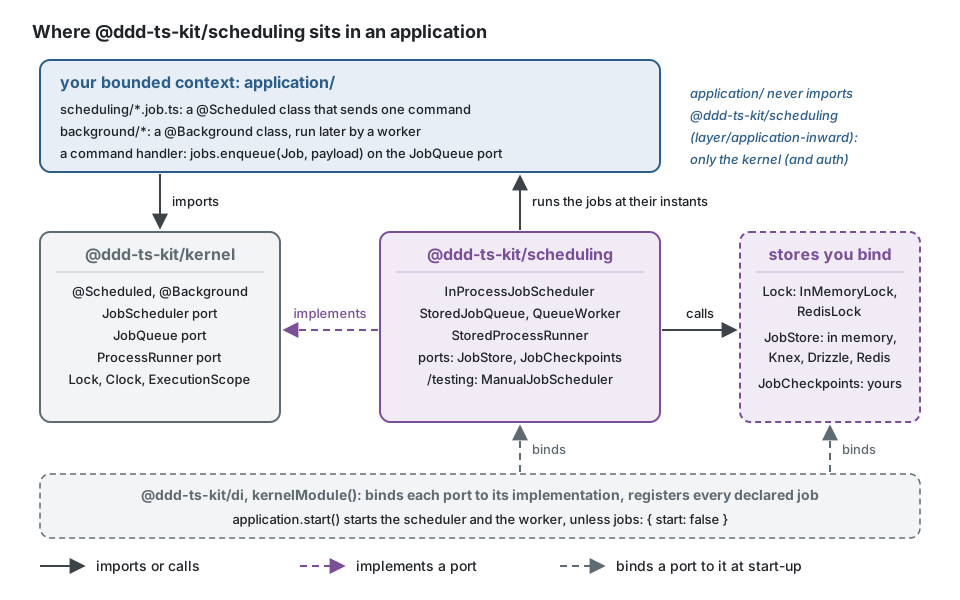
The declarations (@Scheduled, @Background), the ports (JobScheduler, JobQueue,
ProcessRunner) and the schedule parser live in @ddd-ts-kit/kernel, so application/ imports
the kernel and nothing else. @ddd-ts-kit/di binds JobScheduler to an InProcessJobScheduler
in its kernel module and registers the declared jobs: an application built with it needs no line
of this README but the job itself.
JobScheduler is not the Scheduler of @ddd-ts-kit/aspects. That one is a timer for retry
and timeout (schedule(work, delayMs)); this one knows jobs, schedules and instances.
import { AuthorizedCommand, CommandBus, systemActor, type Actor } from '@ddd-ts-kit/kernel';import { Scheduled, type JobExecution, type ScheduledJob } from '@ddd-ts-kit/kernel/declarations';
// the command of the use case, in application/commands/send-payment-reminders/declare class SendPaymentReminders extends AuthorizedCommand {  constructor(actor: Actor, dueOn: Date);}
@Scheduled('billing.send-payment-reminders', { cron: '0 7 * * 1-5', timeZone: 'Europe/Paris' })export class SendPaymentRemindersJob implements ScheduledJob {  constructor(private readonly commands: CommandBus) {}
async run(execution: JobExecution): Promise<void> { await this.commands.execute( new SendPaymentReminders(systemActor('billing.send-payment-reminders'), execution.scheduledAt), ); }}-
Where:
application/scheduling/, in a file named*.job.ts, one job per file. -
The name is
<context>.<job-name>, in lower case, written as a string literal and unique in the application: it is the system actor the job runs as, the key of its lock, its label in the metrics and the key of its settings. It survives the renaming of the class. -
Its dependencies are what its constructor takes, each parameter typed by a port, as for every declaration of the kit:
constructor(private readonly commands: CommandBus) {}, with no list in the decorator. A job receives buses and ports. It does not receive a repository: what it would do with one is a use case. -
run(execution)receives:Field scheduledAtthe instant the run was due. Pass it to the command: "the reminders of that morning" is the same work whenever it really runs startedAtthe instant it started: later by the jitter, a queue or a catch-up attempt1 with this scheduler, which never retries signalaborted when the run exceeds its timeout or the scheduler stops; a long job checks it between two steps -
The command is sent as the system actor of the job, as an integration event handler does for its consumer. With
@ddd-ts-kit/auth, grant that actor the permission of the command, or declare the command@Public()when nothing else can send it. -
Checked when the file loads: a name that is not
<context>.<job-name>, a cron that cannot be read or never fires, a zero interval, an unknown time zone and an option out of its values throw aDeclarationErrorthat names the job.
The execution scope
Section titled “The execution scope”The scheduler opens an ExecutionScope around each run, so the job writes none of it:
| Field of the context | Value |
|---|---|
origin |
schedule |
actor |
systemActor('<job name>') |
correlationId |
a fresh one for each run, from the IdGenerator |
scheduledAt |
the instant the run was due |
deadline |
the start plus timeoutMs, when the job has one |
Audit columns, the audit trail, log fields, tracing and the correlation stamped on published events therefore work as for a request.
Global or per tenant
Section titled “Global or per tenant”A job says which, explicitly. tenancy: 'global' (the default) runs once per occurrence in no
tenant: persistence helpers that need one (tenantScopeOf) refuse it, and a use case that works
per tenant receives the tenant in its command. tenancy: 'per-tenant' runs once per tenant of
the TenantDirectory given to the scheduler (tenants option; registering such a job without
it throws InvalidJobScheduleError):
import {  InMemoryTenantDirectory,  type Clock,  type ExecutionScope,  type IdGenerator,  type JobExecution,  type Lock,} from '@ddd-ts-kit/kernel';import { InProcessJobScheduler } from '@ddd-ts-kit/scheduling';
declare const clock: Clock, lock: Lock, scope: ExecutionScope, ids: IdGenerator;declare function closeMonthOf(tenantId: string, month: Date): Promise<void>;
const scheduler = new InProcessJobScheduler({ clock, lock, scope, ids, tenants: new InMemoryTenantDirectory(['acme', 'globex']) });
scheduler.register({  name: 'billing.close-month',  schedule: { cron: '0 2 1 * *' },  tenancy: 'per-tenant',  // called twice per occurrence: once with tenantId 'acme', then once with 'globex'  run: async (execution: JobExecution) => {    if (execution.tenantId !== undefined) {      await closeMonthOf(execution.tenantId, execution.scheduledAt);    }  },});
Each tenant's run happens in its own execution scope, tenantId set, and execution.tenantId
tells the job which; the runs of one occurrence share its correlation id and run one after the
other. A tenant that fails does not stop the others: the occurrence fails with the first error
once every tenant had its run. An aborted signal (timeout, stop) stops before the next tenant.
Schedules
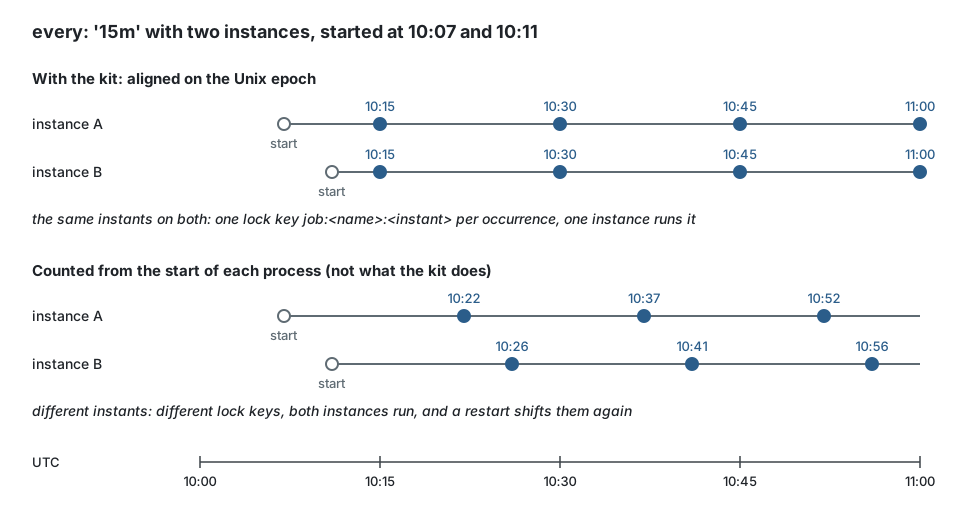
Section titled “Schedules”{ every: '15m' } // or a number of milliseconds{ cron: '0 7 * * 1-5', timeZone: 'Europe/Paris' } // timeZone defaults to UTCIntervals are a whole number of milliseconds or a number and a unit: '500ms', '30s',
'15m', '2h', '1d'. They are aligned on the Unix epoch, not on the start of the
process: '15m' falls at :00, :15, :30 and :45, '1d' at midnight UTC. This is what makes every
instance name the same instants, and a restart keep them. An interval that does not divide a
day ('7h') drifts against the wall clock, and none follows a time zone: for "every morning",
write a cron.
Cron has the five standard fields, no seconds:
| Field | Values | Names |
|---|---|---|
| minute | 0-59 | |
| hour | 0-23 | |
| day of month | 1-31 | |
| month | 1-12 | jan to dec |
| day of week | 0-7, 0 and 7 are Sunday | sun to sat |
Each field takes *, a value, a range a-b, a step on either (*/15, 8-18/2) and lists of
those (0,30, mon-fri). Names ignore case. When the day of month and the day of week are
both restricted (neither starts with *), a day that fits either one fits, as in every cron:
0 0 13 * fri is the 13th and every Friday. Not supported: @daily and the like, ?, L,
W, #, a step on a single value (5/15), a range that wraps (fri-mon).
Time zones are IANA names, evaluated with Intl.DateTimeFormat, without a dependency: the
rules are those of the runtime, updated with it. The fields are read on the clocks of the zone,
day fields included.
| When clocks are | A job pinned to an hour (30 2 * * *) |
A job of every hour (0 * * * *, */20 * * * *) |
|---|---|---|
| set forward (02:00 to 03:00) | a local time that does not exist is skipped: no run that day, nothing is moved to 03:00 | keeps its rhythm: 01:00, then 03:00, one hour later |
| set back (03:00 to 02:00) | a local time that occurs twice runs once, the first time | keeps its rhythm: the repeated hour is run through twice |
A job is "of every hour" when its hour field starts with *: it follows elapsed time. Any
other job follows the clocks. Do not schedule in the changed hour what must run every day:
30 2 * * * in Europe/Paris has no run on the last Sunday of March.
nextOccurrence(parseJobSchedule(schedule), after) and latestOccurrence(parsed, { after, notAfter }) answer the instants, for a screen that shows when a job runs next, or for a spec
that pins a schedule before it is deployed:
import { describeJobSchedule, parseJobSchedule } from '@ddd-ts-kit/kernel';import { latestOccurrence, nextOccurrence } from '@ddd-ts-kit/scheduling';
const every15 = parseJobSchedule({ every: '15m' });nextOccurrence(every15, new Date('2026-03-02T10:07:00Z')); // 2026-03-02T10:15:00Z, whenever the process started
const weekdayMornings = { cron: '0 7 * * 1-5', timeZone: 'Europe/Paris' };const parsed = parseJobSchedule(weekdayMornings);describeJobSchedule(weekdayMornings); // 'cron 0 7 * * 1-5 (Europe/Paris)'nextOccurrence(parsed, new Date('2026-03-06T08:00:00Z')); // Monday 2026-03-09T06:00:00Z: 07:00 in Paris, UTC+1latestOccurrence(parsed, { after: new Date('2026-03-02T00:00:00Z'), notAfter: new Date('2026-03-04T12:00:00Z') }); // 2026-03-04T06:00:00Z
// 02:30 does not exist in Paris on 2026-03-29: that day has no runnextOccurrence(parseJobSchedule({ cron: '30 2 * * *', timeZone: 'Europe/Paris' }), new Date('2026-03-28T12:00:00Z')); // 2026-03-30T00:30:00Z
Options
Section titled “Options”Written next to the schedule: { every: '15m', overlap: 'queue', timeoutMs: 60_000 }.
| Option | Default | |
|---|---|---|
overlap |
'skip' |
an occurrence that comes while the previous run is in progress is not started (skipped-overlap). 'queue' starts it when the run ends; one occurrence waits at most, the next ones are skipped |
missed |
'skip' |
occurrences the scheduler did not reach in time are dropped (missed) and the job waits for its next one. 'run-once' runs the latest of them, once, however many passed |
timeoutMs |
none | the signal of a longer run is aborted with a JobTimeoutError and the run is recorded failed, JOB_TIMEOUT |
jitterMs |
0 |
a random delay up to this before each run, so that jobs do not all start on the minute |
enabled |
true |
false never starts the job by time; runNow still runs it |
singleInstance |
true |
one instance runs an occurrence: see below |
Each option acts at one step of an occurrence, and each step that stops it records an outcome (see "Observability"):
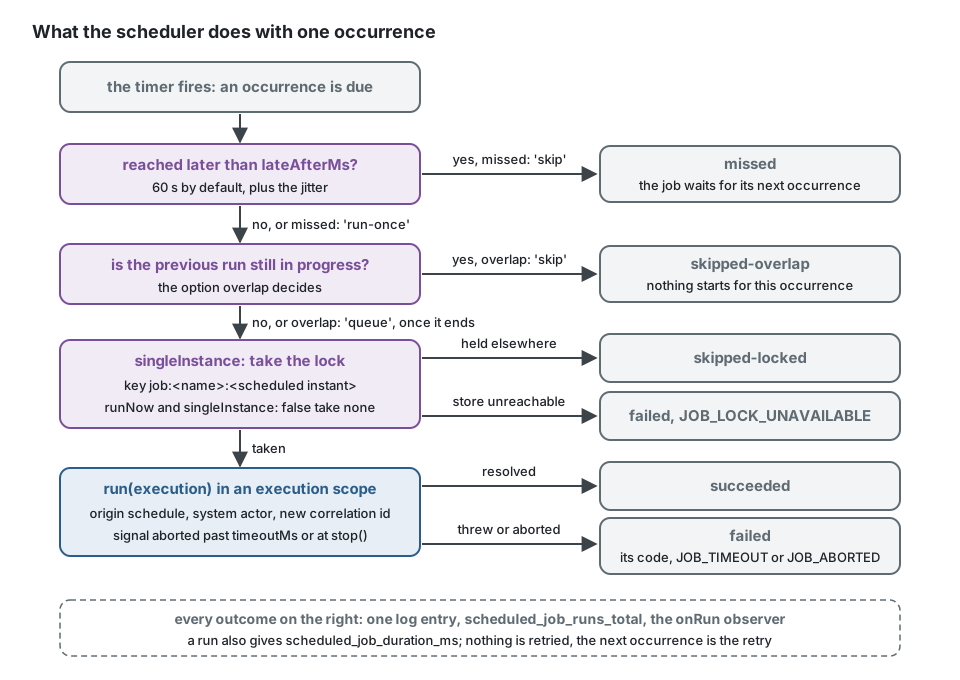
Missed means reached later than lateAfterMs (60 s by default, an option of the
scheduler) after the instant, jitter aside: the process was down, asleep, or its event loop
blocked. A timer a few seconds late still runs its occurrence. What passed while the process
was down is only known with checkpoints:
// the port, exported by this packageexport abstract class JobCheckpoints {  abstract read(job: string): Promise<Date | undefined>;
  abstract write(job: string, handled: Date): Promise<void>;}
The scheduler writes there the last occurrence it handled for each job and reads it when it
starts. Without it a restart forgets: every job starts from the instant of the start, and
run-once only covers what was missed while the process was alive. The store is yours, a
table or a key shared by the instances. It is given to the scheduler where the scheduler is
built: see "Replacing the scheduler".
An adapter on a SQL client of your own, one row per job:
import { JobCheckpoints } from '@ddd-ts-kit/scheduling';
// the client of your database, a port your platform bindsdeclare abstract class Sql {  abstract rows<Row>(text: string, values: readonly unknown[]): Promise<readonly Row[]>;  abstract execute(text: string, values: readonly unknown[]): Promise<void>;}
export class SqlJobCheckpoints implements JobCheckpoints {  constructor(private readonly sql: Sql) {}
  async read(job: string): Promise<Date | undefined> {    const [row] = await this.sql.rows<{ handled_at: Date }>('select handled_at from job_checkpoints where job = $1', [job]);
    return row?.handled_at;  }
  async write(job: string, handled: Date): Promise<void> {    await this.sql.execute(      `insert into job_checkpoints (job, handled_at) values ($1, $2)       on conflict (job) do update set handled_at = greatest(job_checkpoints.handled_at, excluded.handled_at)`,      [job, handled],    );  }}
greatest keeps the latest instant when two instances write at once: the checkpoint only moves
forward.
A timeout does not kill. A run is a promise, and nothing can stop a promise: the scheduler aborts the signal, stops waiting and frees the job for its next occurrence. A job that ignores its signal goes on behind, and then overlaps the next run. Pass the signal on, or check it.
// instead of: a loop that never looks at the signal, still sending commands after the timeoutfor (const batch of batches) { await this.commands.execute(new ArchiveBatch(actor, batch, execution.scheduledAt));}import { AuthorizedCommand, CommandBus, systemActor, type Actor } from '@ddd-ts-kit/kernel';import { Scheduled, type JobExecution, type ScheduledJob } from '@ddd-ts-kit/kernel/declarations';
declare class ArchiveBatch extends AuthorizedCommand { constructor(actor: Actor, batch: number, asOf: Date);}
const BATCHES = 20;
// write: stop between two steps once the run is aborted (timeout or stop())@Scheduled('archive.archive-old-records', { cron: '0 3 * * *', timeoutMs: 10 * 60_000 })export class ArchiveOldRecordsJob implements ScheduledJob { constructor(private readonly commands: CommandBus) {}
async run(execution: JobExecution): Promise<void> { const actor = systemActor('archive.archive-old-records');
for (let batch = 0; batch < BATCHES; batch += 1) { execution.signal.throwIfAborted(); // throws the JobTimeoutError or the JobAbortedError await this.commands.execute(new ArchiveBatch(actor, batch, execution.scheduledAt)); } }}Make the command of each batch safe to send again: what a timeout leaves undone, the next occurrence picks up from the state.
Switching a job off, per environment
Section titled “Switching a job off, per environment”A job is switched off, rescheduled or tuned by configuration, never by a code change. With
@ddd-ts-kit/di:
import { createApplication, type ContextModule } from '@ddd-ts-kit/di';
declare const modules: readonly ContextModule[];declare const config: { readonly jobs: { readonly reminders: { readonly enabled: boolean }; readonly ledgerCron: string } };
createApplication({  modules,  jobs: {    settings: {      'billing.send-payment-reminders': { enabled: config.jobs.reminders.enabled },      'billing.export-ledger': { schedule: { cron: config.jobs.ledgerCron, timeZone: 'Europe/Paris' } },    },  },});
Settings for a job no module declares are refused (UNKNOWN_JOB), so a renamed job cannot stay
on by a stale key; settings that cannot be read are refused too (INVALID_JOB_SETTINGS).
Several instances
Section titled “Several instances”Every instance of a horizontally scaled application runs a scheduler and computes the same
instants. Before running an occurrence of a singleInstance job, the scheduler takes the
kernel Lock under the key job:<name>:<scheduled instant>. The instance that gets it runs;
the others record skipped-locked.
- The lock is not released when the run ends. An instance whose timer fires a little later
would take it and run the occurrence again. It is kept until this instance handles the next
occurrence of the job, or until its time to live has passed:
timeoutMs(15 minutes for a job without timeout,lockTtlMs) plus the jitter andlateAfterMs. - With
InMemoryLock, the default ofkernelModule(), the lock excludes inside one process only: two instances both run every job. It is correct for a single instance and for tests, and nothing more. - With a lock between processes (
RedisLockof@ddd-ts-kit/redis, bound toLock), the guarantee is real, and it is this one: at most one run per occurrence, best effort.
What is not guaranteed, so that you design for it:
- An occurrence may run twice: the lock expires while its holder is paused or the run
outlives the time to live and a late instance arrives; the lock store fails over and forgets
a key; an instance restarts with
missed: 'run-once'after the lock of the occurrence it catches up has expired; clocks disagree by more than the time to live. - An occurrence may run zero times: the instance that took the lock crashes before or
during the run (nobody retries, the lock stays), every instance is down at the instant
(
missed), or the lock store cannot be reached, in which case the occurrence is not run and is recordedfailed,JOB_LOCK_UNAVAILABLE, rather than run everywhere. runNowtakes no lock: it is one deliberate run.
Therefore a job is idempotent, or the command it sends is. A run that happens twice must
leave the same state as once: derive what to do from the state ("invoices due and not yet
reminded"), not from the fact of being called, or key the work on scheduledAt behind a unique
constraint. The kernel says it of Lock itself: an efficiency tool, never the guard of an
invariant. Work that must happen exactly once and survive a crash is not a scheduled job but
a row in a table, processed by a job that is safe to repeat.
Instances should keep their clocks within a few seconds of each other (NTP): the instants are
computed from the Clock, and the lock key is the instant.
A dedicated worker process
Section titled “A dedicated worker process”By default every process that starts the application runs the jobs. To run them in one deployment and serve requests in another, tell the others not to:
// src/main.ts, the process that serves requestsconst app = createApplication({ modules, jobs: { start: false } });
// src/apps/worker/main.ts, the process that runs the jobs: the same modules, no HTTP serverconst app = createApplication({ modules, jobs: { settings: jobSettings(config) } });await app.start();process.on('SIGTERM', () => void app.stop());
With start: false the jobs are still registered and described, and runNow still runs one,
which gives an operations endpoint for free. One composition root reading a flag
(jobs: { start: config.runJobs }) is the same thing with one entry point. Keep
singleInstance on even with one worker: a rolling deployment runs two for a while.
A context extracted as its own service takes its jobs with it: they are declarations of the context, registered by the application that lists its module. Nothing is global.
In a project generated by the CLI: ddd-ts-kit generate job writes the job and its line in
src/platform/job-settings.ts (switched off with JOB_<CONTEXT>_<JOB>_ENABLED=false),
main.ts passes jobs: { start: config.runJobs, settings: jobSettings(process.env) }
(RUN_JOBS), and ddd-ts-kit generate worker writes src/apps/worker/main.ts and turns the
default of RUN_JOBS off for the API.
Lifecycle
Section titled “Lifecycle”application.start() starts the scheduler last, once the consumers are subscribed, and
application.stop() stops it first. stop() starts no new run, waits for the runs in
progress up to graceMs (30 s by default), then aborts their signals with a JobAbortedError
and returns; a run that waited in a queue is dropped and recorded missed. Set the grace
below the termination grace of the platform.
Replacing the scheduler
Section titled “Replacing the scheduler”kernelModule() builds the scheduler on the kernel ports it binds: Clock, Lock,
ExecutionScope, IdGenerator, Logger and Metrics, with reportFailedRuns on the bound
ErrorReporter as onRun. To build it otherwise (with checkpoints, another grace period,
another observer), give the kernel module yours:
import { Clock, ErrorReporter, ExecutionScope, IdGenerator, Lock, Logger, Metrics } from '@ddd-ts-kit/kernel';import { createApplication, kernelModule, type ContextModule } from '@ddd-ts-kit/di';import { InProcessJobScheduler, JobCheckpoints, reportFailedRuns } from '@ddd-ts-kit/scheduling';
declare const platformModule: ContextModule, billingModule: ContextModule;
const kernel = kernelModule({  jobScheduler: (resolve) =>    new InProcessJobScheduler({      clock: resolve(Clock),      // asked at each occurrence: building the scheduler must not open a connection      lock: { acquire: (key, options) => resolve(Lock).acquire(key, options) },      scope: resolve(ExecutionScope),      ids: resolve(IdGenerator),      logger: resolve(Logger),      metrics: resolve(Metrics),      checkpoints: resolve(JobCheckpoints),      graceMs: 10_000,      // what the default scheduler does with failed runs: keep it      onRun: reportFailedRuns(resolve(ErrorReporter)),    }),});
const app = createApplication({ modules: [kernel, platformModule, billingModule] });
with, in the module of the platform, builder.bind(JobCheckpoints).toClass(SqlJobCheckpoints, [Sql]).
A later module replaces the scheduler the same way, with
builder.rebind(JobScheduler).toFactory((resolve) => new InProcessJobScheduler({ ... })), and
so does another implementation of the JobScheduler port (on a database, on a queue).
Without @ddd-ts-kit/di:
import type { Clock, ExecutionScope, IdGenerator, Lock, Logger, Metrics, ScheduledJob } from '@ddd-ts-kit/kernel';import { InProcessJobScheduler } from '@ddd-ts-kit/scheduling';
declare const clock: Clock, lock: Lock, scope: ExecutionScope, ids: IdGenerator, logger: Logger, metrics: Metrics;declare const job: ScheduledJob;
const scheduler = new InProcessJobScheduler({ clock, lock, scope, ids, logger, metrics });scheduler.register({ name: 'billing.send-payment-reminders', schedule: { every: '15m' }, run: (execution) => job.run(execution) });await scheduler.start();| Option | Default | |
|---|---|---|
clock, lock, scope, ids |
required | every instant comes from the Clock; the system clock is never read |
logger, metrics |
write and measure nothing | |
timers |
systemJobTimers |
how it sleeps; ManualJobTimers in a test |
checkpoints |
none | see "Options" |
lateAfterMs |
60000 |
later than this, an occurrence is missed |
graceMs |
30000 |
how long stop() waits |
lockTtlMs |
900000 |
time to live of the lock of a job without timeoutMs |
random |
Math.random |
draws the jitter |
onRun |
none | (run, error?, detail?) => void for every occurrence handled, with what the job threw and the correlation id of the run: reportFailedRuns(errorReporter) is the observer that reports to the kernel ErrorReporter every run that failed with anything but a DomainError |
It sleeps at most one hour at a time and computes again when it wakes, so a clock that is corrected, or a suspended machine, is noticed within the hour.
Observability
Section titled “Observability”scheduler.describe() answers, for each job, name, schedule (every 15m,
cron 0 7 * * 1-5 (Europe/Paris)), enabled, running, nextRunAt and lastRun, as data.
application.describe().jobs lists the declared jobs with the settings they run with.
Every occurrence handled has one outcome, recorded three times:
| Outcome | Means | Log level |
|---|---|---|
succeeded |
the job ran | info |
failed |
the job threw, timed out, was aborted, or its lock could not be asked | error |
skipped-overlap |
the previous run was still in progress | warn |
skipped-locked |
another instance runs this occurrence | debug |
missed |
the occurrence passed and was not run | warn |
- Log: one entry,
Scheduled job succeeded,Scheduled job failed,Scheduled job missed,Scheduled job skipped: the previous run is still in progressorScheduled job skipped: another instance runs this occurrence, withjob,context,outcome,scheduledAt, and for a rundurationMs,correlationId,errorCode,errorType. What goes wrong around the runs (a checkpoint that cannot be read or written) is logged aterrorasScheduled job could not be followed, and the job goes on. - Metrics: the counter
scheduled_job_runs_totaland, for a run, the histogramscheduled_job_duration_ms, labelledjob,context,status(the outcome) anderror_code. An alert on "nosucceededfor this job since N intervals" catches every way a job stops running, which an alert on failures does not. onRun: the same record, plus the error and the correlation id of the run.
missed is recorded once for a gap, with the first instant that was missed, not once per
instant. The errorCode is the code of what was thrown (a DomainError, JOB_TIMEOUT,
JOB_ABORTED, JOB_LOCK_UNAVAILABLE) or UNEXPECTED_ERROR. The message of an error is
never recorded: it quotes data. A job that fails stops neither the scheduler nor the other
jobs, and its next occurrence runs as usual: there is no retry, the next occurrence is the
retry.
Testing
Section titled “Testing”A spec of a job is a spec of the use case it triggers: run the job, assert the fakes. Time is
not involved, and the test application of @ddd-ts-kit/di never starts jobs by time.
import { contextModule, createTestApplication, fake, type DeclaredSource } from '@ddd-ts-kit/di';import { expect } from 'vitest';
// the barrel of the context, and the fake of its Mailer portdeclare const billing: DeclaredSource;declare abstract class Mailer {  abstract send(to: string, subject: string): Promise<void>;}declare class FakeMailer extends Mailer {  readonly sent: readonly { readonly to: string; readonly subject: string }[];  send(to: string, subject: string): Promise<void>;}const mailer = new FakeMailer();
const app = createTestApplication({ modules: [contextModule('billing', billing)], fakes: [fake(Mailer, mailer)] });
await app.jobs.runNow('billing.send-payment-reminders');
expect(mailer.sent).toHaveLength(2);
app.jobs.runNow(name) runs the job as the scheduler would (scope of origin schedule,
system actor, lock aside) and throws what the job threw. For a spec about time itself,
app.jobs.scheduler is a ManualJobScheduler on the clock of the application:
import { FixedClock, FixedExecutionScope, InMemoryLock, SequentialIdGenerator } from '@ddd-ts-kit/kernel';import { ManualJobScheduler } from '@ddd-ts-kit/scheduling/testing';import { expect } from 'vitest';
const run = async (): Promise<void> => undefined;const clock = new FixedClock(new Date('2026-03-02T09:58:30Z'));const scheduler = new ManualJobScheduler({ clock, lock: new InMemoryLock(clock), scope: new FixedExecutionScope(), ids: new SequentialIdGenerator() });scheduler.register({ name: 'billing.send-payment-reminders', schedule: { every: '15m' }, run });await scheduler.start();
await scheduler.advance(32 * 60_000);
expect(scheduler.runs.map((run) => run.scheduledAt.toISOString())).toEqual(['2026-03-02T10:00:00.000Z', '2026-03-02T10:15:00.000Z', '2026-03-02T10:30:00.000Z']);advance(ms)moves the clock and fires each timer at its instant, in order. When it resolves, every job that waits on promises alone has ended; a job the test keeps blocked is still running, which is how overlap, timeout and stop are tested.runslists every occurrence handled with its outcome,failureswhat the failed runs threw,runsOf(job)the runs of one job. There is no jitter.ManualJobTimersalone drives anInProcessJobSchedulerbuilt by hand, for a spec that setsrandomorcheckpoints.- Two schedulers sharing a clock and a lock are two instances: this is how the single-instance behaviour is specified in this package.
Another scheduler (on a database, on a queue) implements the JobScheduler port of the kernel
and passes jobSchedulerContract of @ddd-ts-kit/testing/contracts.
Background jobs
Section titled “Background jobs”Work a use case hands to a worker, to run later: the port (JobQueue), the declaration
(@Background) and the payload type live in the kernel; this package runs them. Why and when,
with the guarantees: Background jobs.
| Piece | |
|---|---|
StoredJobQueue |
the JobQueue of the kernel on a JobStore: names the job, captures the correlation, the actor, the tenant and the traceparent of the work that enqueues, adds it to the store; find and cancel reach the jobs of the tenant of the work in progress only (of the tenants of its elevation; every job when the work has no tenant) |
JobStore |
the port of the stores: add, claim (a lease), heartbeat, update (progress, checkpoint), complete, fail, release, cancel, find, retryDead, purgeFinished, stats; every report names its attempt (JobLease) |
InMemoryJobStore |
the store of tests and of a process without a database: add, cancel and retryDead wait for the commit of the unit of work; list() for assertions |
tenantKeyOf(enqueuedBy) |
the tenant part of the idempotency key, for a store that keeps it in a unique index: the tenant, or the empty text |
QueueWorker |
claims and runs the jobs of the queues it has jobs for: register, start, stop (waits for a claim in flight, whose jobs go back uncounted, then for the attempts in progress), runDue |
reportFailedBackgroundJobs(reporter) |
the observer that sends an attempt that failed unexpectedly to the error reporter |
import type {  BackgroundJob,  BackgroundJobExecution,  Clock,  ErrorReporter,  ExecutionScope,  IdGenerator,  Logger,  Metrics,} from '@ddd-ts-kit/kernel';import { InMemoryJobStore, QueueWorker, reportFailedBackgroundJobs, StoredJobQueue } from '@ddd-ts-kit/scheduling';import { captureTraceparent } from '@ddd-ts-kit/tracing';
declare const clock: Clock, ids: IdGenerator, scope: ExecutionScope, logger: Logger, metrics: Metrics, errors: ErrorReporter;interface CompileStatementsPayload {  readonly month: string;}declare class CompileStatementsBackgroundJob implements BackgroundJob<CompileStatementsPayload> {  static readonly jobName: 'billing.compile-statements';  run(payload: CompileStatementsPayload, execution: BackgroundJobExecution): Promise<void>;}declare const job: CompileStatementsBackgroundJob;
const store = new InMemoryJobStore(); // KnexJobStore, DrizzleJobStore or RedisJobStore in production// the JobQueue a use case enqueues on: jobs.enqueue(CompileStatementsBackgroundJob, { month: '2026-10' })export const jobs = new StoredJobQueue({ store, clock, ids, scope, traceparent: captureTraceparent });
const worker = new QueueWorker({  store,  clock,  scope,  logger,  metrics,  concurrency: { billing: 4, default: 1 }, // the queue of a job is its context  onRun: reportFailedBackgroundJobs(errors),});
worker.register({  name: CompileStatementsBackgroundJob.jobName,  options: { maxAttempts: 3 },  // the payload comes back from the store as plain JSON  run: (payload, execution) => job.run(payload as CompileStatementsPayload, execution),});await worker.start();
@ddd-ts-kit/di does all of it: kernelModule({ jobStore }) binds the store, the queue and the
worker, the declared jobs are registered on the worker, and the worker runs in the processes
that run the jobs (jobs: { start: true }).
Option of QueueWorker |
Default | |
|---|---|---|
concurrency |
1 |
attempts of one queue at once in this process: a number, or { <queue>: n, default: n } |
pollIntervalMs |
1000 |
how long an idle queue waits before asking the store again |
graceMs |
30000 |
how long stop() waits for the attempts in progress before aborting them; an aborted attempt gives its job back uncounted |
timers |
the runtime | ManualJobTimers in a spec |
Each attempt is recorded as a BackgroundJobRun (succeeded, retried, dead, released,
interrupted), logged at info, warn or error, and counted in background_job_runs_total
and background_job_duration_ms (BACKGROUND_RUNS_COUNTER, BACKGROUND_DURATION_HISTOGRAM),
labelled job, context, status and error_code. A store of your own passes
jobStoreContract of @ddd-ts-kit/testing/contracts, with its unit of work.
Process managers
Section titled “Process managers”StoredProcessRunner is the ProcessRunner of the kernel: new StoredProcessRunner({ store, jobs, commands, unitOfWork }). A step runs in one unit of work: the instance is loaded, the step
decides, the timeouts it disarms are cancelled and those it arms are enqueued on the JobQueue
as delayed jobs of the timeoutJob of the process (NoTimeoutJobError without one), the state
is saved at the next version, then the commands are sent. timeout(process, { id, timeout, jobId }, step) runs only while jobId is the armed job of that timeout. @ddd-ts-kit/di binds
it on ProcessStore, JobQueue, CommandBus and UnitOfWork. See
Sagas and process managers.
Limits
Section titled “Limits”- No persistence of its own. Runs, outcomes and
lastRunlive in the memory of the instance;describe()is the view of one instance, and onlycheckpointscrosses a restart. - No retry and no backoff. A failed occurrence is over. Put retry where the failure is: an
aspect on the adapter (
retryof@ddd-ts-kit/aspects), or a command that is safe to send again at the next occurrence. - Minute resolution for cron, millisecond for intervals; an interval under a second is possible and rarely wise, as each occurrence costs a lock.
- At most once per occurrence is best effort, as said above. Exactly-once does not exist here.
- The scheduler is not a queue. A scheduled job does a bounded amount of work on a schedule. Work a command asks for, which must not be lost and must be retried, is a background job (above).
- The worker: at least once, no ordering, concurrency per process, polling: see the limits of Background jobs.
- One process, one event loop. A job that blocks the loop delays every other job; past
lateAfterMstheir occurrences are missed. - Time zone rules are those of the runtime. A zone whose rules changed needs an updated Node. Two changes of offset within two days of each other, which no zone has, are not handled.