
Commit and pull request discipline
Summary. A commit carries one use case or one concept, together with everything that was generated from it; a pull request carries one reviewable idea and stays small enough to be read in one sitting. This guide gives the unit of a commit, the rule for generated files, the message format, target sizes with the reasons behind them (review quality, bisectability, revertability), ways to split a change that grew, and an exact list of what the kit's hooks and pipeline enforce, and what they leave to people.
The unit: one use case or one concept
Section titled “The unit: one use case or one concept”The architecture already cuts work into units that make good commits:
| Unit | What the commit contains |
|---|---|
| one concept of the domain | a value object or an aggregate method, its spec, its builder change, the glossary term |
| one use case | the command or query, its handler, the domain behaviour it needs, specs, the route, the regenerated OpenAPI document |
| one contract | an integration event declaration, its publisher, the regenerated catalog and AsyncAPI document |
| one consumer | an integration event handler, its spec, the regenerated lists |
| one adapter | the adapter, its integration spec, the contract suite call for it and for the fake |
| one decision | an ADR, and the config entry or suppression it justifies |
| one structural change | a rename or a move, with no behaviour change at all |
Two things never share a commit: a structural change and a behavioural one. A rename that touches forty files is trivial to review alone and impossible to review when a rule change hides inside it.
Each commit should leave the project in a state where npm run verify passes. That is what
makes the history usable by git bisect and makes any single commit revertable.
Generated files travel with what generated them
Section titled “Generated files travel with what generated them”Several files are outputs of the sources and are committed: openapi/openapi.yaml,
docs/integration/asyncapi.yaml, docs/integration/event-catalog.md, docs/context-map.md
and the generated lists of each CONTEXT.md, the barrel <context>.declarations.ts,
.dependency-cruiser.cjs.
The rule: the regenerated file is in the same commit as the change that caused it.
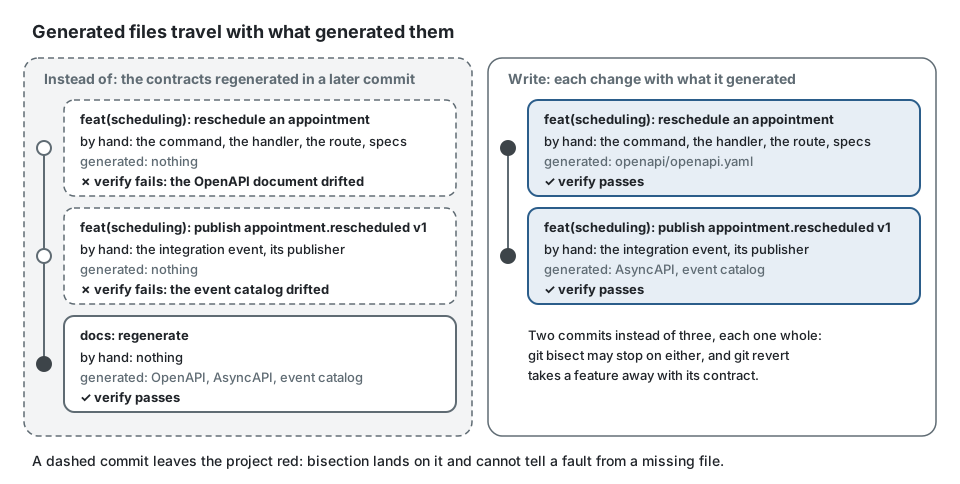
- A route added without its OpenAPI diff fails the drift gate in CI.
- A reviewer reads the generated diff as a summary: the catalog diff says in ten lines what the event change means for consumers.
- A commit "regenerate docs" that follows three feature commits makes those three commits individually red, which breaks bisection.
In a review, generated diffs are read, not line-commented: if the output is wrong, the source
or the generator is wrong. They are never edited by hand, and the plugin's hook refuses such
an edit for the three generated contracts, the barrels and .dependency-cruiser.cjs.
Messages: conventional commits
Section titled “Messages: conventional commits”<type>(<scope>): <summary>
<body: why, not what>- type:
feat,fix,refactor,test,docs,chore,perf,build,ci(the conventional set). - scope: the bounded context, or
platform,pipeline,docs. It tells which owner reviews. - summary: imperative, in the ubiquitous language:
feat(scheduling): refuse to book a slot that is already taken, notfeat: add check in handler. - body: the reason, the rule encoded and where, what was deliberately left out. The diff already says what changed.
- breaking changes: a
!after the scope and aBREAKING CHANGE:footer, for a route or an event whose contract breaks.
Examples, with the contexts of examples/scheduling:
feat(scheduling): publish scheduling.appointment.cancelled v1
docs(scheduling): add TimeOff to the glossary
refactor(scheduling): extract BookingWindow from Calendar
fix(notification): send one reminder when the event is redelivered
A message is read in git log --oneline a year later, by someone who does not have the diff in
mind:
# Instead offix: stufffeat: add check in handlerwip
# Writefeat(scheduling): refuse to book a slot that is already taken
Two patients confirming the same slot at once both got it. The aggregate nowrefuses the second booking; the unique index on the slot stays as the last lineof defence, not as the rule.
With squash merges the pull request title becomes the commit on the default branch, so the title follows the same format and the pipeline checks it with the same configuration.
Target sizes, and why
Section titled “Target sizes, and why”These are targets to steer by. The kit measures one of them, with a threshold a little above
the targets: npx ddd-ts-kit check --commit-size counts the files and lines about to be
committed (--staged reads the index only) against commit in the config, 20 files and 600
changed lines by default, generated files not counted (see Configuration).
Past the limits it names the slices to commit one by one. It is advisory: it exits 1 only
with --strict. The generated lefthook.yml runs it at pre-commit without --strict, and
the plugin's hook gives the same reminder in an agent session, without blocking. Its answer
is one line, wrapped here:
$ npx ddd-ts-kit check --commit-size --staged34 changed files and 912 changed lines are staged (advised at most 20 files and 600 lines acommit, generated files not counted): over the limits. Commit each finished slice on its own,with the files its generator wrote: scheduling: reschedule-appointment (12 files),scheduling: cancel-appointment (10 files), scheduling: domain (8 files), scheduling: test (4 files).A slice is a use case of a context (the folder of its command or query, its route, their
specs), else a layer of a context, else platform or the top folder of the file. "Generated"
means what a command rewrites: the lock files, the OpenAPI and AsyncAPI documents, the event
catalog, docs/context-map.md, .dependency-cruiser.cjs, and the barrel and dependency files
of each context. The limits are a key of ddd-ts-kit.config.json:
{ "commit": { "maxFiles": 15, "maxLines": 400 }}and a team that wants the limit to block adds --strict to the job of its lefthook.yml:
- name: commit size run: npx --no -- ddd-ts-kit check --commit-size --staged --strict| Measure | Target | Past this, expect |
|---|---|---|
| lines changed by hand in a pull request | up to about 400 | reviewers skim instead of reading |
| files changed by hand | up to about 15 | the change holds more than one idea |
| use cases per pull request | 1 | a failure in one blocks the merge of the other |
| contexts touched by hand | 1 | two owners, two reviews, a coupled deployment |
| age of a branch | 1 to 2 days | conflicts in the aggregate and in every generated file |
Generated files are excluded from the counts: a 600-line OpenAPI diff caused by a 40-line route is a 40-line change.
Review quality. The best-known measurements come from a study of code review at Cisco published by SmartBear: defect detection fell off sharply once a review exceeded a few hundred lines, and reviewers were most effective below roughly 200 to 400 lines and within about an hour. Google's engineering practices give no number but the same direction: a change should be one self-contained thing, and about 100 lines is called a usually reasonable size while 1000 is usually too large. Treat the figures as orders of magnitude; the mechanism is not in doubt: attention is finite, and a reviewer who cannot hold the change in mind approves it.
Bisectability. git bisect finds the commit that introduced a fault in a number of steps
logarithmic in the history. Its answer is useful only if that commit is small and builds.
Finding "the fault is somewhere in this 3000-line commit" is not an answer.
Revertability. A small commit with one purpose can be reverted in production without taking unrelated work with it. A use case and its regenerated contract revert together precisely because they were committed together.
Merge conflicts. They grow with the lifetime and the breadth of a branch, and the shared files of this architecture (see Parallel work) make long branches especially costly.
Agent sessions. A small, scoped task also bounds what a coding agent must read and what it can break; see Token economy.
Splitting a change that grew
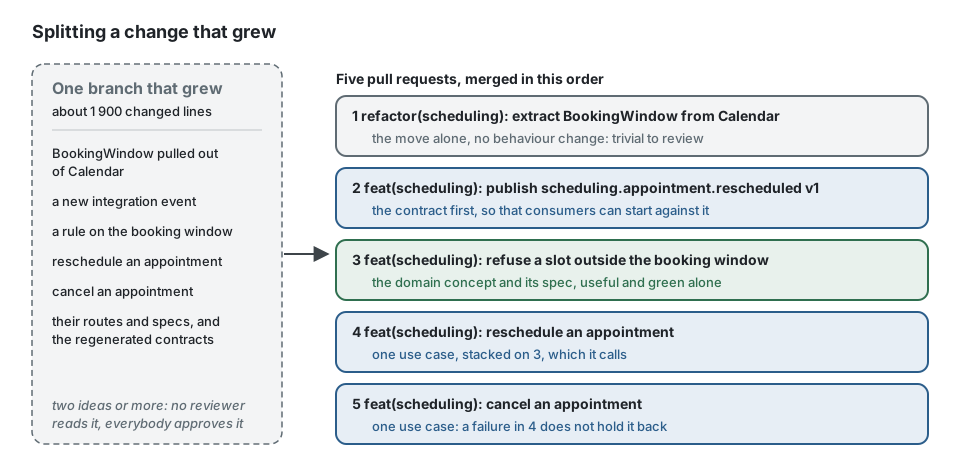
Section titled “Splitting a change that grew”It happens: a use case turned out to need a new value object, a port, a contract change. Split before review, not after.
- Extract the refactoring. If the feature needed a rename or a move first, that goes in its own commit, ahead of the feature: "make the change easy, then make the easy change" (Kent Beck).
- Extract the contract. A new or changed integration event or route definition is its own pull request, merged first; see "Contracts first" in Team workflow.
- Cut along the layers only from the inside out. Domain concept with its spec first (useful and green alone), then the use case that uses it. Never the handler before the domain behaviour it calls.
- Cut along use cases.
RescheduleAppointmentandCancelAppointmentwritten together are two pull requests. - Stack them. When the second depends on the first, open it on top of the first and say so; merge in order.
The mechanics with git: git add -p to stage part of a file, git reset to the base (the
changes stay in the working tree) and recommit in pieces for a branch nobody else uses, or
git rebase -i locally. Never rewrite a branch somebody else has pulled; add commits instead.
# a branch nobody else has pulled: undo its commits, keep the changes, recommit in piecesgit reset "$(git merge-base HEAD origin/main)"
# the refactoring first, hunk by hunkgit add -p src/contexts/scheduling/domain/aggregates/calendar.aggregate.tsgit add src/contexts/scheduling/domain/value-objects/booking-window.vo.tsgit commit -m "refactor(scheduling): extract BookingWindow from Calendar"
# then one use case with everything its generator and docs:generate wrote:# command and handler, route, their specs, the regenerated barrel and the contractgit add src/contexts/scheduling/application/commands/reschedule-appointment/ \        src/contexts/scheduling/presentation/http/appointments/reschedule-appointment/ \        src/contexts/scheduling/test/unit/reschedule-appointment.*.spec.ts \        src/contexts/scheduling/scheduling.declarations.ts \        openapi/openapi.yamlnpx ddd-ts-kit check --commit-size --stagedgit commit -m "feat(scheduling): reschedule an appointment"
After any split, run the gate on each piece: a commit that only builds together with the next one is not split, just cut. To test exactly what is staged, put the rest aside first:
git stash push --keep-index --include-untracked # the working tree is now the indexnpm run verifygit stash popWhat the hooks and the pipeline enforce
Section titled “What the hooks and the pipeline enforce”Stated exactly, from pipeline/lefthook.yml, pipeline/README.md and the plugin:
| Moment | What runs | Enforces |
|---|---|---|
| every file write in an agent session | the plugin's hook | refuses a hand-written file where a generator exists, an edit of a generated file (contracts, barrels, .dependency-cruiser.cjs) and, for a worker of one context, a write outside that context; asks the owner before a suppression, a skipped test or a change of the governed files; returns the violations of the written file; refuses to finish while architecture errors remain, then reminds of the commit size without blocking |
pre-commit (lefthook) |
ESLint and the formatter (biome format) on staged files; ddd-ts-kit check on staged sources under src/; ddd-ts-kit check --commit-size --staged |
code rules, format and structure on what is being committed; the size of the commit, as advice |
commit-msg (lefthook) |
commitlint | the conventional commit format |
pre-push (lefthook) |
type check and unit tests | the project compiles and its fast tests pass |
| pull request | the title check | the title is a conventional commit |
| CI | type check, lint, architecture, dead code, tests, documentation and contract drift, security, build, image, then the single gate job |
everything, including stale generated files |
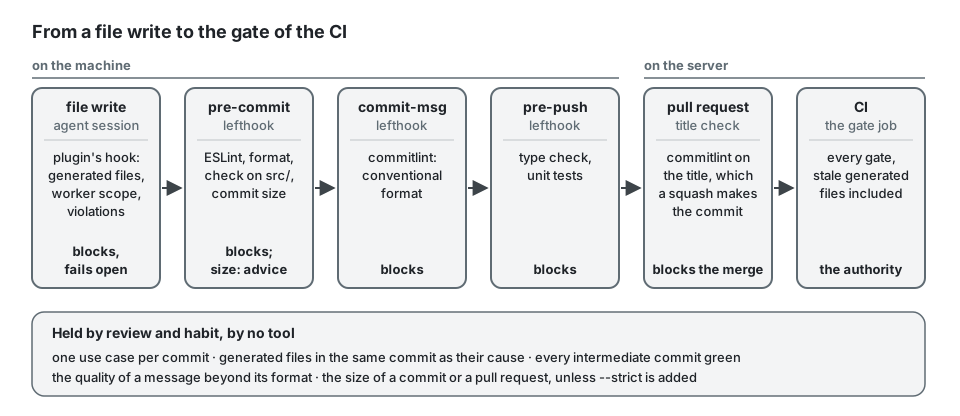
The hooks are installed once per clone (npm run hooks:install). The plugin's hook fails open
by design: a broken guard never blocks work, so it is a convenience and CI is the authority.
Not enforced by any tool: the size of a commit or a pull request (check --commit-size
and the plugin's hook only advise, unless you add --strict to the pre-commit job), one
use case per commit,
generated files being in the same commit as their cause (the gate checks the final state of
the branch, not each commit), the quality of a message beyond its format, and whether each
intermediate commit builds. These are held by review and by habit. If per-commit greenness
matters to you, squash-merge: then the only commit that reaches the default branch is the one
the gate checked.
Limits and when not to use it
Section titled “Limits and when not to use it”- Small pull requests need fast review. If a review takes two days, ten small pull requests take longer than one large one, and people respond by batching. Fix the review latency first.
- Stacked pull requests are awkward on platforms without native support: a change requested in the first ripples through the others.
- Some changes are atomic and large: a dependency major upgrade, a mechanical rename, a migration of every repository adapter. Keep them pure (nothing else in the commit) rather than small.
- Squash merging trades history for cleanliness. It guarantees a green, titled commit per pull request and loses the intermediate steps; a team that bisects inside pull requests should merge without squashing and keep every commit green itself.
- The size targets are heuristics. The cited study is one company's data from the 2000s; the direction is well supported, the exact thresholds are not laws.
Sources
Section titled “Sources”- Conventional Commits 1.0.0, https://www.conventionalcommits.org/en/v1.0.0/
- SmartBear, "Best Practices for Peer Code Review" (reporting the Cisco study, Jason Cohen, 2006), https://smartbear.com/learn/code-review/best-practices-for-peer-code-review/
- Google Engineering Practices, "Small CLs", https://google.github.io/eng-practices/review/developer/small-cls.html
- Git documentation,
git-bisect, https://git-scm.com/docs/git-bisect - Kent Beck, on making the change easy before making the easy change (2012).
- This repository: pipeline/README.md, the root README section on the hook.