
Modular monolith
Summary. A modular monolith is one deployable application whose inside is cut into modules with enforced boundaries. In this kit the module is the bounded context: it owns its data, exposes a published language, shares no transaction with another context and can be booted alone. This is the default deployment of a project built with the kit. It gives most of the design benefits attributed to microservices (clear ownership, replaceable parts, independent reasoning) without the operational cost of a distributed system, and it keeps extraction cheap for the day a measured reason appears.
Three shapes compared
Section titled “Three shapes compared”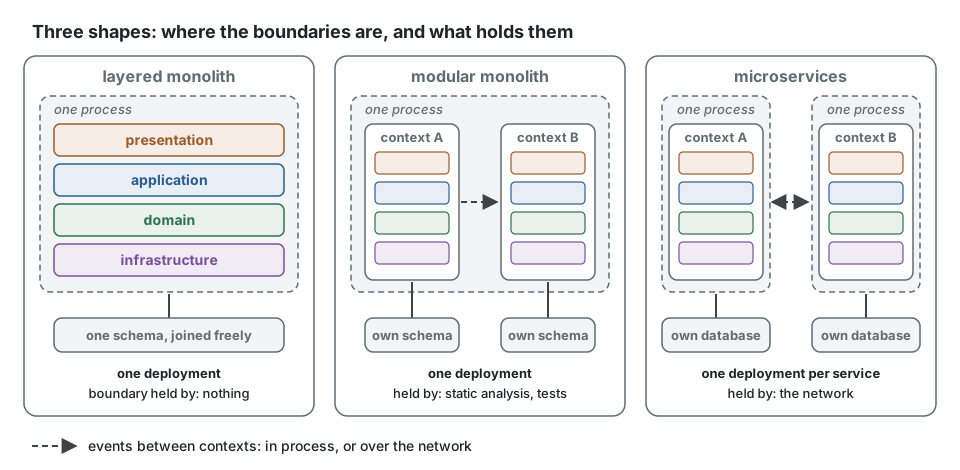
| Layered monolith | Modular monolith | Microservices | |
|---|---|---|---|
| Unit of structure | technical layer across the whole application | bounded context, layered inside | bounded context, one process each |
| Deployment | one | one | one per service |
| Data | one schema, joined freely | one schema per context, no cross-context join or foreign key | one database per service |
| A call between parts | a method call anywhere | published language, integration events, a gateway port | network: events, HTTP or RPC |
| Transactions | span anything | one aggregate of one context | local; anything wider is a saga |
| What enforces the boundary | nothing | static analysis and tests | the network |
| Failure of one part | usually takes all down | usually takes all down | can be isolated, if designed for |
| Independent scaling and release | no | no | yes |
| Operational cost | low | low | high |
The layered monolith fails slowly: with nothing between features, every table ends up read from everywhere, and no part can be changed without reading the whole. Microservices solve that with a process boundary, which also brings partial failure, network latency, distributed data and one pipeline per service. The modular monolith takes the boundary and leaves the network out.
What makes a module real
Section titled “What makes a module real”A folder named after a business capability is not a module. In this kit a context is a module because four things hold, each checked:
| Property | In the scheduling application | Held by |
|---|---|---|
| It owns its data | appointments has its database schema; analytics never reads those tables, it keeps its own figures fed by events |
context/extractable, the persistence conventions of ARCHITECTURE.md section 4 |
| It exposes a contract and hides the rest | notifications imports only appointments/published-language/ |
context/published-language-only, context/published-language-is-a-contract |
| Its dependencies are declared and acyclic | availability names calendars and appointments as upstreams in the config |
context/declared-relationship, context/no-cycle |
| It shares no transaction | booking an appointment and scheduling its reminder are two transactions joined by an event | the unit of work per command, events/outbox-required, events/consumer-idempotent |
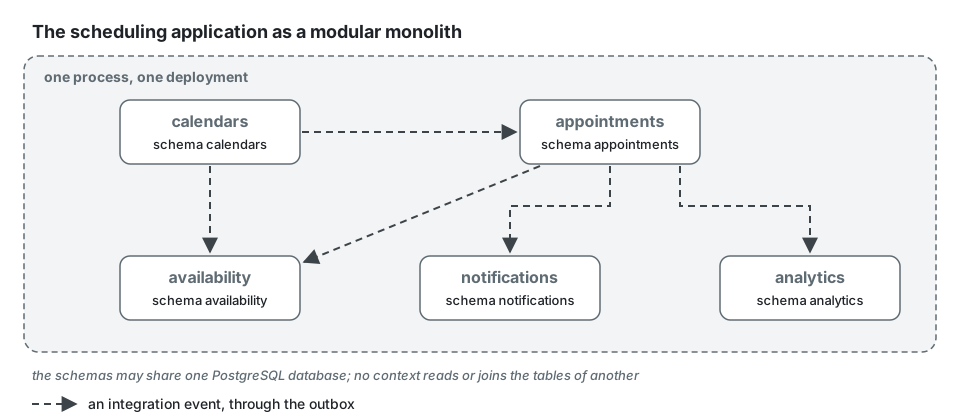
The schemas can live in one PostgreSQL database. What matters is that no context reads or joins another's tables: a context reads another's data through a published contract or through its own projection fed by integration events.
Instead of a query that reaches into the tables of another context:
-- contexts/analytics/infrastructure/...: refused, analytics reads the schema of appointmentsSELECT practitioner_id, count(*) FROM appointments.appointment WHERE status = 'no-show' GROUP BY practitioner_id;analytics keeps its own table, analytics.visit, written by its handler of
appointments.appointment.marked-no-show and read by its own queries. The two schemas can then
move apart, to two databases or two services, without a line of SQL to rewrite.
How contexts collaborate inside one process
Section titled “How contexts collaborate inside one process”- To react to something that happened elsewhere: an integration event. Even in one process it goes through the transactional outbox and an idempotent consumer, so the semantics do not change the day a broker sits in between (see Transactional outbox).
- To hold data of another context that is needed often: a local projection updated by those events, eventually consistent.
- To get an answer now: a port of the caller bound as a gateway
(
npx ddd-ts-kit generate gateway <context> <upstream> <Name>). Its adapter calls the published read contract of the upstream in process today and could be an HTTP client tomorrow. Timeouts and failure behaviour are part of the port from the first day. - To change two contexts in one transaction: not available. Either the two are one context, or the requirement is a process in steps (see Sagas and process managers).
The three pieces of a gateway, in the shape generate gateway writes them: the read contract
the upstream publishes, the port of the caller in its own words, and the in-process adapter
that translates one into the other.
import { Gateway } from '@ddd-ts-kit/kernel/declarations';
// contexts/calendars/published-language/working-hours.contract.ts (the upstream)// Serializable types only, changed additively: it is a contract.export interface WorkingInterval {  readonly from: string;  readonly to: string;}
export abstract class WorkingHoursContract {  /** The intervals a practitioner works on a day (`YYYY-MM-DD`), or undefined for an unknown practitioner. */  abstract workingHours(practitionerId: string, day: string): Promise<readonly WorkingInterval[] | undefined>;}
// contexts/appointments/application/ports/working-hours-gateway.port.ts (the caller, in its words)export abstract class WorkingHoursGateway {  abstract worksDuring(practitionerId: string, startsAt: Date, endsAt: Date): Promise<boolean>;}
// contexts/appointments/infrastructure/external/in-process-working-hours.gateway.ts// When calendars runs as its own service, this class becomes an HTTP client with a timeout:// the port and every handler that uses it stay as they are.@Gateway(WorkingHoursGateway)export class InProcessWorkingHoursGateway implements WorkingHoursGateway {  constructor(readonly upstream: WorkingHoursContract) {}
  async worksDuring(practitionerId: string, startsAt: Date, endsAt: Date): Promise<boolean> {    const intervals = await this.upstream.workingHours(practitionerId, startsAt.toISOString().slice(0, 10));
    return (intervals ?? []).some(      (interval) => Date.parse(interval.from) <= startsAt.getTime() && endsAt.getTime() <= Date.parse(interval.to),    );  }}
The decision list is in the extract-service skill; the choice of relationship pattern is in
Context map.
Extractable by construction
Section titled “Extractable by construction”The kit treats a context as a deployable unit in waiting: moving one to its own service must be
a change of composition root and adapters, never of domain/ or application/ code. Two
mechanisms keep that true while the application is still one process:
- the rule
context/extractable(a context wires with the kernel and the platform only, reads no table of another context, shares no transaction and no mutable state with one); - a generated architecture test (
test/architecture/extractable.spec.ts) that boots every context alone on the kernel and the platform. A hidden dependency on another context makes that boot fail.
A context can also be given its own entry point: npx ddd-ts-kit generate service <context>
writes src/apps/<context>/main.ts, which composes that context, the kernel and the platform,
and sets contexts.<name>.deployable in the config (CONFIG.md). The same
code then runs in the monolith and as a service.
The discipline has a price inside the monolith: an in-process call that could have been a join becomes an event and a projection. That price is the option being paid for. Whether and when to exercise it is a separate decision, with measurable signals: see When to extract microservices.
What stays shared
Section titled “What stays shared”- The kernel: building blocks and standard interfaces, no business meaning.
- The platform (
src/platform/): configuration, database connection, authentication, the event provider, tracing, the HTTP server. Technical capabilities, not a context. - The shared kernel (
src/shared-kernel/), optional: value objects used by at least two contexts. It is the one place where contexts share code with meaning, so it is kept small; a file used by one context belongs to that context. - The process: memory, CPU, the event loop, the release.
Limits and when not to use it
Section titled “Limits and when not to use it”- One process, one fate. A memory leak in
analyticsrestartsappointments. A blocked event loop delays every context. Isolation of failure is a reason to extract, not something modules give. - One release, one cadence. Every context ships together. With several teams this needs a pipeline fast enough that nobody waits on anybody.
- Boundaries are held by tools, and tools have blind spots. The checker's limits are listed in the CLI README: a schema name in raw SQL, a cross-context transaction and a mutable exported object can go unseen. The per-context boot test and review cover part of it.
- Module boundaries drawn wrong are still wrong. A modular monolith makes moving a boundary cheaper than between services (one repository, one refactoring), not free: data must be moved between schemas.
- It is too much for a small application with one model. One context is a perfectly good
modular monolith. Do not invent contexts to fill the tree; the
bounded-contextsskill says the same (prefer few contexts). - It is not enough when a part must scale, be released or fail independently, or must be isolated for compliance. That is what the extraction guide is for.
Sources
Section titled “Sources”- Martin Fowler, "MonolithFirst", 2015, https://martinfowler.com/bliki/MonolithFirst.html
- Martin Fowler, "MicroservicePremium", 2015, https://martinfowler.com/bliki/MicroservicePremium.html
- Sam Newman, Monolith to Microservices, O'Reilly, 2019, chapter 1 (the modular monolith).
- Sam Newman, Building Microservices, 2nd edition, O'Reilly, 2021, chapters 1 and 3.
- Simon Brown, "Modular monoliths" (talk, 2015 and later), https://www.youtube.com/watch?v=5OjqD-ow8GE (not re-verified today).
- Chris Richardson, Microservices Patterns, Manning, 2018, chapter 1; microservices.io, "Database per service", https://microservices.io/patterns/data/database-per-service.html
- Vlad Khononov, Learning Domain-Driven Design, O'Reilly, 2021, chapter 14 (microservices).