
Domain events, domain services, repositories and factories
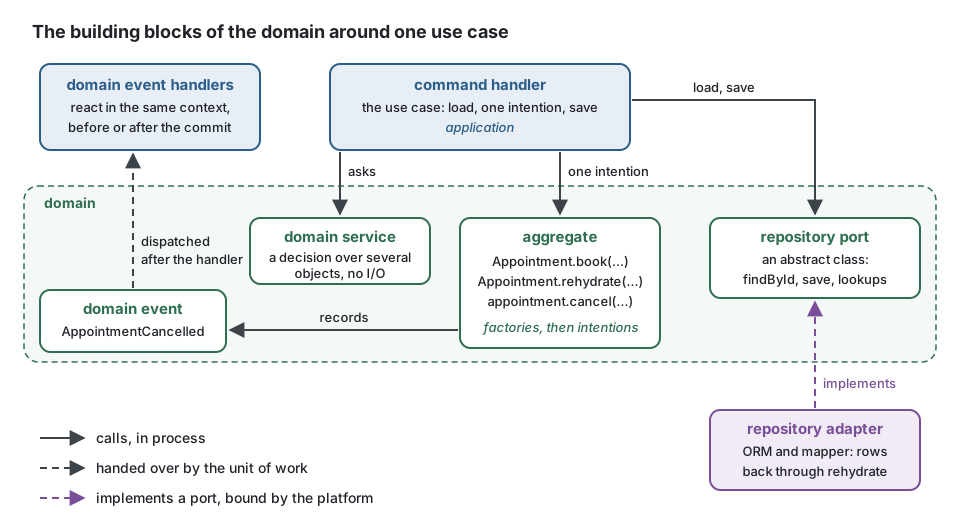
Summary. Four building blocks complete entities, value objects and aggregates. A domain event is a fact the business cares about, recorded by an aggregate in the past tense. A domain service holds a business decision that belongs to no single aggregate. A repository gives the illusion of an in-memory collection of aggregates, and hides storage behind an abstraction owned by the domain. A factory builds a valid aggregate when construction is more than assigning fields. In this kit a repository is an abstract class of the domain with adapters in infrastructure, a domain service is stateless and performs no I/O, domain events stay inside their context, and factories are static methods on the aggregate.
Domain events
Section titled “Domain events”A domain event states that something happened: AppointmentBooked,
AppointmentRescheduled, AppointmentCancelled. It is named in the past tense, it is
immutable, and it carries the facts a reaction needs, never the aggregate itself.
import type { DomainEvent } from '@ddd-ts-kit/kernel';
// a value object of the model, from domain/value-objects/: declared here so that the sample stands aloneinterface CancellationReason {  readonly by: 'client' | 'practice';  readonly late: boolean;}
export class AppointmentCancelled implements DomainEvent {  static readonly eventName = 'appointments.appointment.cancelled';
  readonly name = AppointmentCancelled.eventName;
  constructor(    readonly aggregateId: string,    readonly occurredAt: Date,    readonly reason: CancellationReason,  ) {}}
The name is written once, in eventName: the event carries it in name, and every reaction is
attached by it, @DomainEventHandler(AppointmentCancelled) reads it from the class it is given
and domainEvents.on(AppointmentCancelled.eventName, ..) names it, so a renamed event cannot
leave a handler listening to the old name. events/name-format holds its form,
<context>.<aggregate>.<fact>, and events/name-declared-once its place: every class of
domain/events/ declares static readonly eventName, consumed or not, and its name reads it.
An event written before 0.7, readonly name = '..' alone, is reported by that rule, and
@DomainEventHandler and @On refuse it at compile time: add static readonly eventName to the
class.
The aggregate records the event in the method that changes its state, after the invariant and the change:
// contexts/appointments/domain/aggregates/appointment.aggregate.ts (an excerpt)import { AggregateRoot, ConceptError, type DomainEvent } from '@ddd-ts-kit/kernel';
class AppointmentCancelled implements DomainEvent {  static readonly eventName = 'appointments.appointment.cancelled';
  readonly name = AppointmentCancelled.eventName;
  constructor(    readonly aggregateId: string,    readonly occurredAt: Date,    readonly reason: string,  ) {}}
class AppointmentError extends ConceptError {  static alreadyCancelled(appointmentId: string) {    return AppointmentError.refusal('APPOINTMENT_ALREADY_CANCELLED', `Appointment ${appointmentId} is already cancelled.`, { appointmentId });  }}
export class Appointment extends AggregateRoot<string> {  private constructor(    id: string,    private status: 'booked' | 'cancelled',  ) {    super(id);  }
  cancel(reason: string, at: Date): void {    if (this.status === 'cancelled') {      throw AppointmentError.alreadyCancelled(this.id); // the invariant first    }
    this.status = 'cancelled'; // then the change of state    this.record(new AppointmentCancelled(this.id, at, reason)); // then the fact, recorded, not published  }}
The life of a domain event:
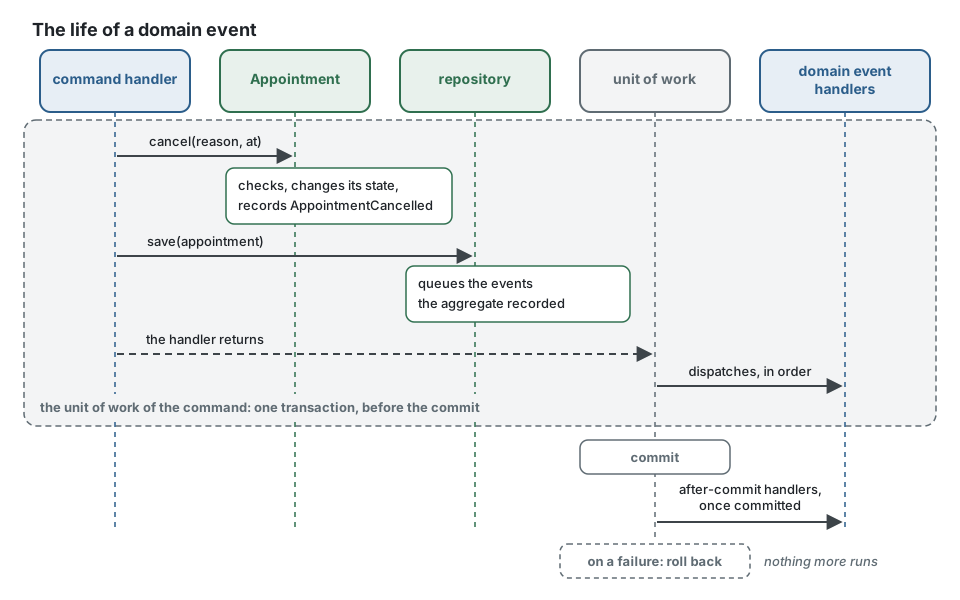
- The aggregate records the event in the method that made the change. It does not publish anything: it has no bus and no dependency.
- Events are handed over by the save and dispatched at the end of the unit of work: a
repository method handed the aggregate queues the events it recorded, and once the command
handler has returned they are dispatched in recording order, inside the transaction, before
the commit (ARCHITECTURE.md, section 4, "Domain events"). Every handler
sees every save of the command. The handlers and the outbox commit or roll back with the
state change. A command handler only saves: it never calls
pullEvents()and receives no dispatcher (domain-events/dispatched-on-save). - A handler runs before the commit by default, and may only have effects the transaction
covers. One whose effect is outside the database is declared
phase: 'after-commit': it runs once the transaction has committed, at most once, and never saves an aggregate. The phases and their failures are in Domain and integration events. - A domain event handler (
application/event-handlers/) reacts inside the same context. A publisher (application/integration/publishers/) is a reaction whose job is to translate the domain event into an integration event for the other contexts.
Two reactions to the same event, one in each phase:
import type { DomainEvent } from '@ddd-ts-kit/kernel';import { DomainEventHandler } from '@ddd-ts-kit/kernel/declarations';
declare class AppointmentCancelled implements DomainEvent {  static readonly eventName: 'appointments.appointment.cancelled';  readonly name: 'appointments.appointment.cancelled';  readonly aggregateId: string;  readonly occurredAt: Date;}
// ports of the application: what the reactions need, implemented in infrastructureexport abstract class Waitlist {  abstract offerFreedSlot(appointmentId: string): Promise<void>;}
export abstract class Mailer {  abstract sendCancellationNotice(appointmentId: string): Promise<void>;}
// before the commit (the default): its writes commit or roll back with the cancellation@DomainEventHandler(AppointmentCancelled)export class OfferFreedSlotOnCancellation implements DomainEventHandler<AppointmentCancelled> {  constructor(private readonly waitlist: Waitlist) {}
  async handle(event: AppointmentCancelled): Promise<void> {    await this.waitlist.offerFreedSlot(event.aggregateId);  }}
// after the commit: an effect no transaction covers, run at most once@DomainEventHandler(AppointmentCancelled, { phase: 'after-commit' })export class SendCancellationNotice implements DomainEventHandler<AppointmentCancelled> {  constructor(private readonly mailer: Mailer) {}
  async handle(event: AppointmentCancelled): Promise<void> {    await this.mailer.sendCancellationNotice(event.aggregateId);  }}
A domain event is internal: it may carry value objects of the model and change shape freely with it. What crosses a context boundary is an integration event, a versioned contract with a schema. The difference, and why the two are kept apart, is in Domain and integration events.
Events are also the natural assertion of a domain test: given a state, when an intention, then these events or this error (Testing strategy).
npx ddd-ts-kit generate domain-event appointments Appointment Cancellednpx ddd-ts-kit generate event-handler appointments Appointment CancelledDomain services
Section titled “Domain services”Some decisions belong to the domain but to no single aggregate: they need two aggregates, or an aggregate and a policy that has its own reasons to change. Forcing such logic into one aggregate makes it reach for data it does not own; leaving it in the handler makes the application layer decide business matters. A domain service is the third place.
import { ConceptError } from '@ddd-ts-kit/kernel';
// value objects and errors of the model, declared here so that the sample stands aloneinterface TimeSlot {  readonly startsAt: Date;  readonly endsAt: Date;}
interface PractitionerSchedule {  covers(slot: TimeSlot): boolean;  isOffDuring(slot: TimeSlot): boolean;}
export class AppointmentError extends ConceptError {  static outsideWorkingHours(startsAt: Date) {    return AppointmentError.refusal('OUTSIDE_WORKING_HOURS', `The practitioner does not work at ${startsAt.toISOString()}.`, { startsAt });  }}
export class BookingEligibilityService {  assertBookable(slot: TimeSlot, schedule: PractitionerSchedule): void {    if (!schedule.covers(slot) || schedule.isOffDuring(slot)) {      throw AppointmentError.outsideWorkingHours(slot.startsAt);    }  }}
PractitionerSchedule here is the local projection appointments keeps of the working hours
and time off published by calendars: the handler loads it through a port and hands it over.
The example application has a fuller one, SchedulerService
(examples/scheduling/src/contexts/scheduling/domain/services/scheduler.service.ts): given a
calendar and the appointments already held, it checks the slot and the limit of the patient and
returns the new Appointment, a domain service acting as a factory.
Instead of the same decision in the handler:
// instead of: the application decides a business matterconst schedule = await this.schedules.of(command.practitionerId);if (!schedule.covers(slot) || schedule.isOffDuring(slot)) {  throw AppointmentError.outsideWorkingHours(slot.startsAt);}
// write: the handler loads, the domain decidesconst schedule = await this.schedules.of(command.practitionerId);this.eligibility.assertBookable(slot, schedule);
The rules for a domain service:
- Stateless. It holds no data between calls.
- No I/O. It receives the aggregates and values it reads as parameters; it does not load them. Loading is the handler's job, through repositories and ports. The reference describes it as "stateless domain logic over several aggregates".
- Named in the language. The class and its operation are terms of the glossary
(
language/glossary-term);BookingHelperis refused (language/no-technical-name). - It has a spec (
test/spec-required), with no test double: its inputs are built objects.
Do not confuse it with the two other things called "service":
| Lives in | Does | |
|---|---|---|
| domain service | domain/services/ |
a business decision over several domain objects, pure |
| use case (command or query handler) | application/ |
orchestration: load, call the domain, save, publish |
| adapter of an outside system | infrastructure/ |
I/O behind a port |
The kit has no generic "application service" class: one handler per command or query plays that role.
Repositories
Section titled “Repositories”A repository makes aggregates look like an in-memory collection: find one, save one. The domain declares what it needs; infrastructure decides how it is stored.
import { AggregateRoot, Repository } from '@ddd-ts-kit/kernel';
declare class Appointment extends AggregateRoot<string> {} // from domain/aggregates/
export abstract class AppointmentRepository extends Repository<Appointment> { abstract findUpcomingOf(clientId: string, after: Date): Promise<readonly Appointment[]>;}- A port of the domain. It is an abstract class with abstract members only, extending the
kernel
Repository<Aggregate>(findById,save). The adapter ininfrastructure/persistence/implements it and never extends it (Ports and composition). - One per aggregate root. Whole-aggregate load and save. No repository for an inner entity.
- Rows stay inside. A mapper translates stored rows to the aggregate through
rehydrateand back. No ORM entity, row type or query builder crosses the interface. - No transaction in the signature. The unit of work is opened by the application (a bus middleware does it for every command); the adapter joins the current transaction and never commits.
- Only the lookups a use case needs, named in the language. Queries for screens go through a read port instead, and may skip aggregates entirely (CQRS).
- A fake and a contract. Each repository has an in-memory fake in
test/fakes/, and the fake and the real adapter pass the samerepositoryContractsuite, optimistic concurrency included.
npx ddd-ts-kit generate repository appointments Appointmentwrites the port, the adapter for the project's ORM with its mapper and table, the fake, the contract spec run on both, and the registration.
A handler then reads as the use case:
import { AggregateRoot, AuthorizedCommand, ConceptError, Repository, type Actor, type Clock } from '@ddd-ts-kit/kernel';import { CommandHandler } from '@ddd-ts-kit/kernel/declarations';
// from the domain and the command file of the use case, declared here so that the sample stands alonedeclare class Appointment extends AggregateRoot<string> {  cancel(reason: string, at: Date): void;}declare abstract class AppointmentRepository extends Repository<Appointment> {}declare class AppointmentError extends ConceptError {  static notFound(appointmentId: string): AppointmentError;}declare class CancelAppointment extends AuthorizedCommand<void> {  constructor(actor: Actor, appointmentId: string, reason: string);  readonly appointmentId: string;  readonly reason: string;}
@CommandHandler(CancelAppointment)export class CancelAppointmentHandler implements CommandHandler<CancelAppointment> {  constructor(    private readonly appointments: AppointmentRepository,    private readonly clock: Clock,  ) {}
  async execute(command: CancelAppointment): Promise<void> {    const appointment = await this.appointments.findById(command.appointmentId);    if (appointment === undefined) {      throw AppointmentError.notFound(command.appointmentId);    }
    appointment.cancel(command.reason, this.clock.now());
    await this.appointments.save(appointment);  }}
Load, one intention, save. An if on business state in a handler belongs in the domain:
// instead of: the rule of the late cancellation, in the handlerif (appointment.startsAt.getTime() - this.clock.now().getTime() < 24 * 60 * 60 * 1000) {  appointment.markLateCancellation();}appointment.cancel(command.reason, this.clock.now());
// write: one intention; the aggregate knows what late meansappointment.cancel(command.reason, this.clock.now());
The handler never calls pullEvents() and never publishes: the save hands the recorded events
over, and the unit of work dispatches them.
Factories
Section titled “Factories”A factory encapsulates the creation of an aggregate so that it is born valid and the caller does not need to know how. Evans presents factories as methods or separate objects. This kit settles on the simplest form:
| Factory | Role |
|---|---|
a static birth method on the aggregate (create, or a word of the language such as Appointment.book) |
checks birth invariants, sets the initial state, records the birth event |
rehydrate |
restores an aggregate from stored state, checks nothing, records nothing; used by mappers only |
create on a value object |
validates and returns the value, or the reason it is invalid |
| a method on another aggregate | when one aggregate gives birth to another and supplies part of its state |
The constructor is private so that these are the only ways in:
// contexts/appointments/domain/aggregates/appointment.aggregate.ts (the ways in)import { AggregateRoot, ConceptError, type DomainEvent } from '@ddd-ts-kit/kernel';
class AppointmentBooked implements DomainEvent {  static readonly eventName = 'appointments.appointment.booked';
  readonly name = AppointmentBooked.eventName;
  constructor(    readonly aggregateId: string,    readonly occurredAt: Date,  ) {}}
class AppointmentError extends ConceptError {  static startsInThePast(startsAt: Date) {    return AppointmentError.refusal('STARTS_IN_THE_PAST', `An appointment cannot start at ${startsAt.toISOString()}, in the past.`, { startsAt });  }}
export interface AppointmentState {  readonly clientId: string;  readonly startsAt: Date;  readonly status: 'booked' | 'cancelled';}
export class Appointment extends AggregateRoot<string> {  // private: book and rehydrate are the only ways in  private constructor(    id: string,    private state: AppointmentState,  ) {    super(id);  }
  /** The birth: checks the birth invariants, sets the initial state, records the birth event. */  static book(id: string, wish: { readonly clientId: string; readonly startsAt: Date }, now: Date): Appointment {    if (wish.startsAt.getTime() <= now.getTime()) {      throw AppointmentError.startsInThePast(wish.startsAt);    }
    const appointment = new Appointment(id, { ...wish, status: 'booked' });    appointment.record(new AppointmentBooked(id, now));
    return appointment;  }
  /** Back from storage: checks nothing, records nothing. Called by the mapper only. */  static rehydrate(id: string, state: AppointmentState): Appointment {    return new Appointment(id, state);  }
  toState(): AppointmentState {    return { ...this.state };  }}
A separate factory class is rarely needed; when construction needs data from several sources, the handler gathers it and passes it, or a domain service assembles it. Test data builders are the factories of tests: they go through the same public API, so a test cannot start from an invalid state.
Limits and when not to use it
Section titled “Limits and when not to use it”- Domain events are not a message queue. They are dispatched in process, by default inside the transaction of the command: a reaction that fails makes the command fail. A reaction that must run apart from the command, or reach another context, goes through an integration event and the transactional outbox.
- Domain events are not event sourcing. Unless an aggregate opts into event sourcing, its
state is stored as state, and its events are notifications of changes, not the source of
truth. An aggregate that extends
EventSourcedAggregateis the exception: its events are what is stored, and its state is what they add up to (Event sourcing, per aggregate). - Do not create events nobody reacts to "just in case". Each one is a name to maintain. The exception is the fact that a test asserts on.
- A domain service is easy to overuse. If most rules live in services and aggregates only hold data, the model is anemic (Anemic model). Try the aggregate first.
- A repository is not a query API. Adding a finder per screen turns it into a data access object and drags read concerns into the domain. Use read ports.
- The kit checks shapes, not intent. That a repository port is an abstract class, that a handler has one public method, that a spec file exists: yes. That the service is truly a domain decision and not orchestration: no, a reviewer decides.
Sources
Section titled “Sources”- Eric Evans, Domain-Driven Design, Addison-Wesley, 2003, chapter 5 (services) and chapter 6 (factories, repositories).
- Vaughn Vernon, Implementing Domain-Driven Design, Addison-Wesley, 2013, chapter 7 "Services", chapter 8 "Domain Events", chapter 11 "Factories", chapter 12 "Repositories".
- Martin Fowler, Patterns of Enterprise Application Architecture, Addison-Wesley, 2002, "Repository", "Unit of Work", "Data Mapper".
- Martin Fowler, "Domain Event", martinfowler.com/eaaDev/DomainEvent.html.
- Vlad Khononov, Learning Domain-Driven Design, O'Reilly, 2021, chapter 6.