
Ports and composition
Summary. A port is what the inner layers need from the outside, stated in their own words. In this kit a port is an abstract class with abstract members only, and that class is also the injection token: one name carries the type at compile time and the identity at run time. Adapters implement ports and never extend them. Objects are assembled in one place, the composition root, either from what classes declare about themselves with decorators (the declared style) or from bindings written by hand in a module file (the explicit style). In the declared style a class states what it depends on once, in its constructor signature, and the kit reads it from the source. This page explains the choices, what each style costs and where the limits are.
A port, in the scheduling application
Section titled “A port, in the scheduling application”scheduling must store appointments, and it shows the name of a patient, which identity
knows. Neither need says anything about HTTP or SQL:
import { AggregateRoot, Repository } from '@ddd-ts-kit/kernel';
declare class Appointment extends AggregateRoot {}
// contexts/scheduling/domain/repositories/appointment.repository.tsexport abstract class AppointmentRepository extends Repository<Appointment> {  /** The active appointments of a calendar that hold an instant between `from` and `until`. */  abstract heldOn(calendarId: string, from: Date, until: Date): Promise<readonly Appointment[]>;}
// contexts/scheduling/application/ports/person-directory-gateway.port.ts/** What scheduling asks identity about people: the name to show for a patient, and nothing else. */export abstract class PersonDirectoryGateway {  abstract namesOf(personIds: readonly string[]): Promise<ReadonlyMap<string, { readonly displayName: string }>>;}
A port is named for what the application needs, not for the technology behind it. A repository
port lives in domain/repositories/, any other port in application/ports/, one per file
(ARCHITECTURE.md section 4, "Ports" and "Ports and adapters").
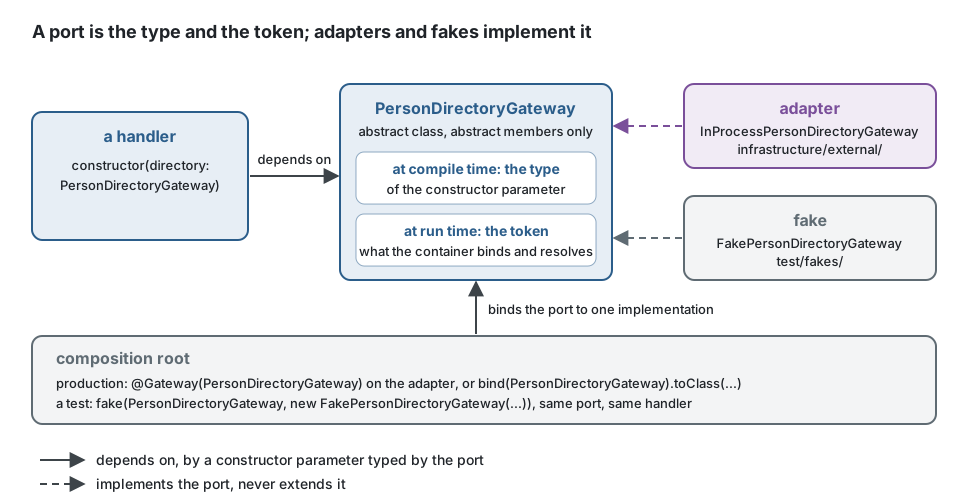
Why an abstract class, and not an interface
Section titled “Why an abstract class, and not an interface”A TypeScript interface is erased by the compiler: nothing of it exists at run time. A container
that must answer "give me the AppointmentRepository" needs a run-time value to key on, so
projects built on interfaces add one by hand: a string, a symbol or a constant, kept in a token
file and kept in step with the interface by discipline.
An abstract class is both things at once:
| Need | An interface plus a token | An abstract class |
|---|---|---|
| a type for the constructor parameter | the interface | the class |
| a run-time identity to bind and resolve | a constant, in a second place | the class itself |
a typed resolve |
a generic on the token, declared by hand | follows from the class |
| a constructor parameter that names what is injected | not possible: the type is erased, a token must be repeated next to it | the type of the parameter is the token |
| renaming | two names to rename | one |
Instead of an interface and a token kept in step by hand:
export interface PersonDirectoryGateway {  namesOf(personIds: readonly string[]): Promise<ReadonlyMap<string, { readonly displayName: string }>>;}
export const PERSON_DIRECTORY_GATEWAY = Symbol('PersonDirectoryGateway'); // ports/no-token-constant
constructor(@Inject(PERSON_DIRECTORY_GATEWAY) private readonly directory: PersonDirectoryGateway) {}
write the abstract class of the previous section, and name it once:
constructor(private readonly directory: PersonDirectoryGateway) {}So the handler below names its dependencies once, as the ports that type its constructor parameters, and nowhere else:
// contexts/scheduling/application/commands/book-appointment/book-appointment.handler.ts (simplified)import { AggregateRoot, Clock, Command, IdGenerator, Repository } from '@ddd-ts-kit/kernel';import { CommandHandler } from '@ddd-ts-kit/kernel/declarations';
declare class Appointment extends AggregateRoot {}declare class Calendar extends AggregateRoot {}
export abstract class AppointmentRepository extends Repository<Appointment> {}export abstract class CalendarRepository extends Repository<Calendar> {}
export class BookAppointmentCommand extends Command<string> {  constructor(readonly calendarId: string) {    super();  }}
@CommandHandler(BookAppointmentCommand)export class BookAppointmentHandler implements CommandHandler<BookAppointmentCommand> {  constructor(    private readonly appointmentRepository: AppointmentRepository,    private readonly calendarRepository: CalendarRepository,    private readonly ids: IdGenerator,    private readonly clock: Clock,  ) {}
  async execute(command: BookAppointmentCommand): Promise<string> {    const calendar = await this.calendarRepository.findById(command.calendarId);    // ... books a slot of the calendar at this.clock.now(), saves it with this.appointmentRepository
    return calendar === undefined ? '' : this.ids.next();  }}
There is no parameter decorator, no reflect-metadata for the kit's own decorators and no
emitDecoratorMetadata: the signature is read from the source by ddd-ts-kit docs, which
writes what it read in the generated file of the context. The next section says why.
How the constructor reaches the composition root
Section titled “How the constructor reaches the composition root”A container needs, at run time, the list of tokens a constructor takes. Three mechanisms can
give it, and they were measured on the compilers and runners a project of the kit meets
(TypeScript 6.0.3 and the native TypeScript 7.0.2, tsx 4, Vitest 5 with and without the
decorator plugin of @ddd-ts-kit/testing, swc 1.16 as Jest runs it; a decorated class whose
constructor takes two ports, read with Reflect.getMetadata('design:paramtypes', ..)):
| Compiler or runner | Legacy decorators with emitDecoratorMetadata |
Standard (TC39) decorators |
|---|---|---|
tsc 6, tsc 7 (the build) |
the two classes | no metadata |
tsx (the dev script, esbuild) |
no metadata | no metadata |
| Vitest 5, own transform | the two classes | does not parse the file |
| Vitest 5 with the kit's plugin | the two classes | no metadata |
swc (Jest) with decoratorMetadata |
the two classes | no metadata |
any of them, the port imported with import type |
Object, Object (or Function): the type is erased |
no metadata |
| A list in the decorator | Compiler metadata | A generated list | |
|---|---|---|---|
| What the developer writes | the constructor, then the same ports again in @CommandHandler(M, [..]) |
the constructor | the constructor |
| Works with standard decorators | yes | no: the proposal emits no parameter types | yes |
Works under tsx, esbuild |
yes | no | yes |
Survives import type and verbatimModuleSyntax |
no: the list needs the value (ports/value-import) |
no: recorded as Object |
yes: the generated file imports the value |
| Can disagree with the constructor | the compiler refuses a mismatch, the repetition remains | no | no: derived; a stale file is refused by a gate and at startup |
| Needs a generation step | no | no | yes: ddd-ts-kit docs, every generate, every start of dev |
Compiler metadata is the only mechanism that needs neither a repetition nor a generated file,
and it holds in three cells out of ten: it would make an application start in its build and
its tests and fail under npm run dev, or work for a project on class-validator and not for
one on zod. The kit therefore reads the signatures itself, statically, and writes them down:
// contexts/scheduling/scheduling.declarations.ts, generated: never edited (an excerpt)import { injected } from '@ddd-ts-kit/kernel/declarations';import { BookAppointmentHandler } from '@/contexts/scheduling/application/commands/book-appointment/book-appointment.handler';import { AppointmentRepository } from '@/contexts/scheduling/domain/repositories/appointment.repository';import { CalendarRepository } from '@/contexts/scheduling/domain/repositories/calendar.repository';import { Clock, IdGenerator } from '@ddd-ts-kit/kernel';
export * from '@/contexts/scheduling/application/commands/book-appointment/book-appointment.command';export * from '@/contexts/scheduling/application/commands/book-appointment/book-appointment.handler';
injected(BookAppointmentHandler, [AppointmentRepository, CalendarRepository, IdGenerator, Clock]);
injected is typed like the list of a decorator was: the compiler refuses a list that does not
match the constructor, so a generated file is type-checked with the rest. Four things keep it
from going stale silently:
- A gate.
ddd-ts-kit check(declarations/barrel-current) andddd-ts-kit docs --checkcompare the file with what the sources say and name the class whose constructor changed;verifyand both pipelines run them. - Development.
npm run devloadsddd-ts-kit/dist/refresh-declarations.jsbefore the application on every start and every reload of the watcher: add a port to a constructor, save, and the process that restarts is given it. - Startup. A class that takes parameters and has no list, or a list of another length,
stops
createApplicationwith aWiringError(MISSING_DEPENDENCIES,DEPENDENCY_ARITY) that names the class and the command to run. Nothing is ever injected asundefined. - A rule.
declarations/constructor-injectionrefuses a parameter that names no single class: a union, an interface, a primitive, an optional or defaulted parameter.
![From a constructor signature to an instance: ddd-ts-kit docs reads the constructor, writes injected(Handler, [ports]) in the generated declarations file, createApplication checks the graph and builds; a rule, the dev script, a gate and the startup keep the generated list in step with the constructor](/ddd-ts-kit/diagrams/ports-and-composition-constructor-to-instance.svg)
What a signature may say, and what it may not:
| Parameter | |
|---|---|
typed by a port, a kernel port (Clock, CommandBus, Logger...), another declared class |
its token |
private readonly, protected, public parameter properties, a parameter decorator of another library |
looked through |
typed by a generic class, Cache<Session> |
the raw class Cache is the token: type arguments say nothing of what is bound |
| a primitive, a value, a settings object | not a token: type the parameter by an abstract class with readonly members and bind it to the value in the platform module |
| an interface, a type alias, a union, an intersection | refused, with the same answer: an abstract class |
optional (?), a default value, a rest parameter, destructured |
refused: the container always gives every parameter a value |
| no constructor, and no base class | zero dependencies, nothing is generated for the class |
| a constructor inherited from a class of the project | read in the base class, through its imports |
| a constructor inherited from a class of a package | refused: write the constructor in the class |
There is deliberately no @Inject(Token) on a parameter. Parameter decorators do not exist
in standard decorators, so such an escape would work in one decorator mode only; a property
decorator would move a dependency off the constructor, which is the one place the kit reads.
The escape for a parameter whose type is not a token is the one the kit already had for
values: an abstract class, bound in the platform. A list written in the decorator,
@CommandHandler(BookAppointmentCommand, [AppointmentRepository, CalendarRepository, IdGenerator, Clock]), is
the form 0.1 projects wrote. It is still read, it is checked by the compiler against the
constructor and it wins over the signature; a project keeps it with
"stack.dependencies": "listed" (what a config without the key means) and leaves it with
"signature", where ESLint removes every list that repeats its constructor.
The port rule
Section titled “The port rule”A port has abstract members only: no body, no constructor parameter, no private or protected
member. An adapter implements its port and never extends it. The reason is that TypeScript
types are structural: as long as the port carries no behaviour, a fake, an in-memory class or a
plain object literal fits it without ceremony, and nothing of the port can leak into an adapter
by inheritance. A value that is not a port (settings, a database handle) is carried the same
way, by an abstract class with readonly members bound to a plain object.
The rules are ports/abstract-class, ports/implements-never-extends,
ports/no-token-constant, ports/no-concrete-dependency (a constructor parameter is typed by
a port, never by an adapter or a fake) and ports/value-import (a port named in a dependency
list or given to bind is imported as a value: the class is the token; a port that only types
a constructor parameter may be imported with import type).
The kernel also refuses a port with a body or an adapter extending its port when the file loads.
The identity limit
Section titled “The identity limit”A class is its own identity. If one process loads two copies of the package that defines a port
(a duplicated install, a bundle next to node_modules), it holds two classes, hence two tokens,
and what is bound under one is not found under the other. The kernel README states the limit and
the answer: a port that may be loaded from two copies declares a static key, which then is its
identity in every copy; the injectable ports of the kernel carry one. A port of an application
compiled once into one program never needs it.
Adapters
Section titled “Adapters”import { Gateway } from '@ddd-ts-kit/kernel/declarations';
// the published language of identity: the contract scheduling may call in processexport abstract class PersonDirectoryContract { abstract byIds(personIds: readonly string[]): Promise<readonly { readonly personId: string; readonly displayName: string }[]>;}
export abstract class PersonDirectoryGateway { abstract namesOf(personIds: readonly string[]): Promise<ReadonlyMap<string, { readonly displayName: string }>>;}
@Gateway(PersonDirectoryGateway)export class InProcessPersonDirectoryGateway implements PersonDirectoryGateway { constructor(readonly upstream: PersonDirectoryContract) {}
async namesOf(personIds: readonly string[]): Promise<ReadonlyMap<string, { readonly displayName: string }>> { const cards = await this.upstream.byIds(personIds);
return new Map(cards.map((card) => [card.personId, { displayName: card.displayName }])); }}When identity runs as a service of its own, this class becomes an HTTP or RPC client behind
the same port: the declaration stays, and nothing else of scheduling changes.
An adapter says which port it implements and which role it plays (@Repository, @Gateway,
@Adapter). The role is what lets cross-cutting behaviour be attached from outside: tracing
wraps every binding that has a kind, a retry policy targets gateways and external adapters (see
Resilience and Observability). Each port has a fake in
test/fakes/, held to the same contract suite as the real adapter
(Testing strategy).
The composition root
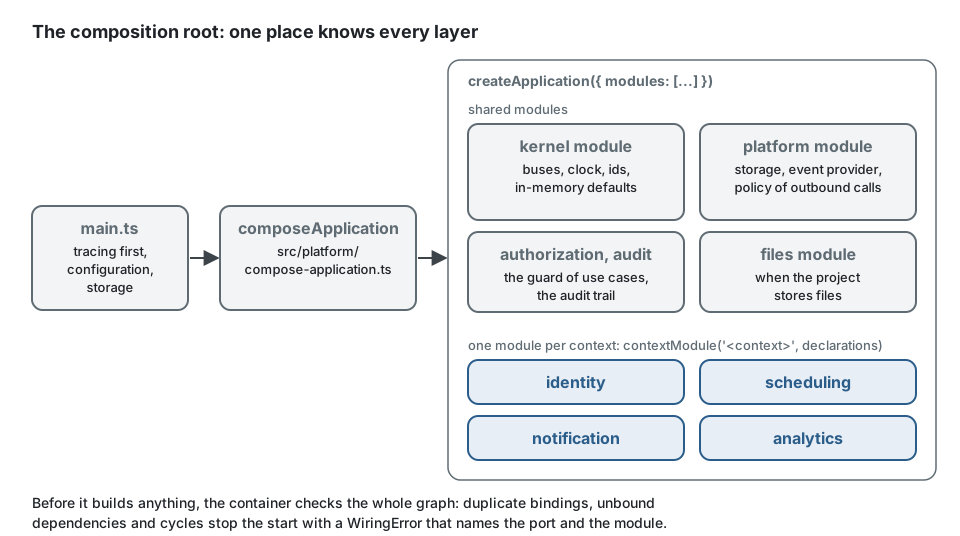
Section titled “The composition root”Something has to know every layer in order to connect them. The kit confines that knowledge:
adapters are instantiated or bound, and declared classes assembled, only in a context's module
file (explicit style), in main.ts and in the platform directory
(composition/only-in-module). main.ts imports tracing first, loads the configuration, opens
the storage and calls composeApplication of src/platform/compose-application.ts, which lists
the modules: the kernel module (default buses, clock, id generator, in-memory defaults), the
platform module (storage, the event provider, the policy around outbound adapters), the
authorization and audit modules, the files module when the project stores files, and one module
per context, built from its declarations. The
container checks the whole graph before anything is instantiated: duplicate bindings, unbound
dependencies and cycles are errors at startup, with the port and the module named (the list of
checks is in the README of @ddd-ts-kit/di).
In the explicit style a whole composition fits in a few lines. The same port is given the adapter in the application and a fake in a test, and the handler does not change:
import { Query, QueryBus, type QueryHandler } from '@ddd-ts-kit/kernel';import { createApplication, createTestApplication, defineContextModule, fake, kernelModule } from '@ddd-ts-kit/di';
export abstract class PersonDirectoryContract {  abstract byIds(personIds: readonly string[]): Promise<readonly { readonly personId: string; readonly displayName: string }[]>;}
export abstract class PersonDirectoryGateway {  abstract namesOf(personIds: readonly string[]): Promise<ReadonlyMap<string, { readonly displayName: string }>>;}
export class InProcessPersonDirectoryGateway implements PersonDirectoryGateway {  constructor(private readonly upstream: PersonDirectoryContract) {}
  async namesOf(personIds: readonly string[]): Promise<ReadonlyMap<string, { readonly displayName: string }>> {    const cards = await this.upstream.byIds(personIds);
    return new Map(cards.map((card) => [card.personId, { displayName: card.displayName }]));  }}
// test/fakes/person-directory-gateway.fake.ts: the same shape, answers what the test gave itexport class FakePersonDirectoryGateway implements PersonDirectoryGateway {  constructor(private readonly names: Readonly<Record<string, string>>) {}
  async namesOf(personIds: readonly string[]): Promise<ReadonlyMap<string, { readonly displayName: string }>> {    return new Map(personIds.flatMap((id) => (id in this.names ? [[id, { displayName: this.names[id] ?? '' }] as const] : [])));  }}
export class GetPatientName extends Query<string | undefined> {  constructor(readonly patientId: string) {    super();  }}
export class GetPatientNameHandler implements QueryHandler<GetPatientName> {  constructor(private readonly directory: PersonDirectoryGateway) {}
  async execute(query: GetPatientName): Promise<string | undefined> {    const names = await this.directory.namesOf([query.patientId]);
    return names.get(query.patientId)?.displayName;  }}
export const schedulingModule = defineContextModule({  name: 'scheduling',  register(builder) {    builder.bind(PersonDirectoryGateway).toClass(InProcessPersonDirectoryGateway, [PersonDirectoryContract]).as('gateway');    builder.query(GetPatientName).handledBy(GetPatientNameHandler, [PersonDirectoryGateway]);  },});
export const identityModule = defineContextModule({  name: 'identity',  register(builder) {    builder.bind(PersonDirectoryContract).toValue({      byIds: async (ids) => ids.map((personId) => ({ personId, displayName: 'Ada Lovelace' })),    });  },});
// the application: the port is given the adapterconst app = createApplication({ modules: [kernelModule(), identityModule, schedulingModule] });await app.resolve(QueryBus).execute(new GetPatientName('patient-1')); // 'Ada Lovelace'
// a test: the same port is given the fakeconst test = createTestApplication({  modules: [identityModule, schedulingModule],  fakes: [fake(PersonDirectoryGateway, new FakePersonDirectoryGateway({ 'patient-1': 'Ada' }))],});await test.get(QueryBus).execute(new GetPatientName('patient-1')); // 'Ada'
The test still lists identityModule: a fake replaces a binding, and the container still checks
every binding a module declares. Without it, createTestApplication stops with
WiringError: "PersonDirectoryGateway" in module "scheduling" depends on "PersonDirectoryContract", which no module binds. (UNBOUND_DEPENDENCY).
Two ways to tell the root what exists
Section titled “Two ways to tell the root what exists”| Declared style | Explicit style | |
|---|---|---|
| Where a binding is written | on the class, as a decorator of the kernel's declarations entry | in <context>.module.ts, one statement per binding |
| Registration file per context | none by hand: a generated barrel, or discovery | the module file |
| What a class is given | what its constructor takes, read from the source into the generated file | the list of .toClass(Adapter, [Ports]) and .handledBy(Handler, [Ports]): explicit stays explicit |
| Adding a use case | add the files; the barrel is regenerated | add the files and a statement |
| Adding a dependency | add the constructor parameter | add the parameter, and the port to the list of the statement |
| Reading the wiring of a context | spread over the classes; ddd-ts-kit describe <context> gathers it |
one file |
| Values, factories, conditional bindings | not expressible by a decorator: written in a module | native |
| Containers | only @ddd-ts-kit/di (on tsyringe) turns declarations into bindings |
tsyringe, NestJS providers or manual wiring |
| Domain | carries no decorator in either style | same |
The declared style is the default with tsyringe; the explicit style remains available and the
two mix in one application and even in one module. Declarations are metadata: a decorator
instantiates nothing and imports no container, which is why the application layer may carry
them. The domain declares nothing (declarations/role-declared).
Barrel or discovery
Section titled “Barrel or discovery”A declared context reaches the root in one of two ways (stack.assembly in
CONFIG.md):
| Generated barrel | Discovery | |
|---|---|---|
| Mechanism | one generated file re-exporting every role file | a scan of the context's folders at startup |
| Where the constructor lists are | in the barrel, after the exports | in a generated <context>.dependencies.ts, which the scan loads with the role files; never compiler metadata |
| Static analysis | bundlers, knip and dependency-cruiser follow it | the loaded files are imported by nothing: the analyzers must be told they are entries |
| Startup | nothing to read | reads directories and imports sequentially |
| Bundled or serverless | fits | a bundler cannot follow it |
| A file written by hand | must be in the barrel: declarations/barrel-current reports a stale one |
picked up by itself; its constructor still has to be in the dependencies file, which the same rule holds |
| Under Vitest | nothing to configure | @ddd-ts-kit/di must be inlined (server.deps.inline), which the generated config does |
What a decorator cannot express
Section titled “What a decorator cannot express”- a value or a factory (a configuration object, a client built from settings);
- an adapter implementing two ports (one declaration per class: bind it explicitly, once per port);
- a binding that depends on configuration;
- inheritance: a declaration is not inherited by a subclass;
- what a class is given when its constructor takes something that is not one class: see the table above.
For these, an explicit module includes the declared classes and adds the statements.
The two decorator modes
Section titled “The two decorator modes”TypeScript has two decorator implementations, and one program uses one. A project bound to the
legacy mode by class-validator, NestJS or TypeORM entities sets experimentalDecorators; any
other project uses standard decorators without a flag. The kit's decorators serve both with the
same source line. One practical consequence is documented in the testing package: Vitest lowers
legacy decorators itself, and needs a plugin of the kit for standard ones.
Limits and when not to use it
Section titled “Limits and when not to use it”- Declared wiring is implicit. Nobody reads one file to see how a context is assembled. The
generated barrel,
ddd-ts-kit describeand the startup checks compensate; a team that wants the wiring in one reviewed file chooses the explicit style. - Constructor injection needs a generated file. What a constructor takes reaches the
container through a file
ddd-ts-kit docswrites. It is committed, regenerated bydevand compared by a gate, but a class edited outside those paths (a script that never runsdocs, a file loaded by nothing the generator reads) is refused at startup rather than injected. Nest and manual wiring are not concerned: Nest injects by its own metadata and providers, manual wiring callsnew Handler(a, b). - A test assembles a context from its generated file, as the composition root does:
contextModule('ordering', orderingDeclarations), or one class taken from it,contextModule('ordering', { PlaceOrderHandler: orderingDeclarations.PlaceOrderHandler }). A class imported from its own file and handed tocontextModulealone has no list. - Ports cost files. A port, an adapter and a fake for a dependency that will only ever have one implementation is overhead. The kit accepts it for anything that leaves the process, because the fake is what keeps handler tests fast; do not add ports between classes of the same layer.
- Factories hide their dependencies. A cycle or a missing port going through a factory is reported when it is resolved, not at startup.
- Decorators need care with other libraries: a class decorator of another library that replaces the class must be written below the declaration (di README, "Limits").
Sources
Section titled “Sources”- Alistair Cockburn, "Hexagonal architecture", 2005, https://alistair.cockburn.us/hexagonal-architecture/
- Mark Seemann, "Composition Root", 2011, https://blog.ploeh.dk/2011/07/28/CompositionRoot/
- Martin Fowler, "Inversion of Control Containers and the Dependency Injection pattern", 2004, https://martinfowler.com/articles/injection.html
- Robert C. Martin, Clean Architecture, Prentice Hall, 2017, chapter 11 (dependency inversion) and chapter 26 ("The Main Component").
- TypeScript handbook, "Decorators" (legacy) and the TypeScript 5.0 release notes (standard decorators), https://www.typescriptlang.org/docs/handbook/decorators.html
- READMEs of
@ddd-ts-kit/kerneland@ddd-ts-kit/di.