
Transactional outbox
Summary. When a use case changes state in a database and must tell other contexts about it,
it has two writes to two systems and no transaction that covers both. Publishing straight to a
broker either loses events (state committed, message never sent) or invents them (message sent,
state rolled back). The transactional outbox removes the second system from the use case: the
event is written to a table in the same transaction as the state change, and a relay publishes
it afterwards, at least once. In this kit the outbox is mandatory as soon as there is a database
(events/outbox-required). This page explains the failure it prevents, the relay strategies and
what remains to design.
The dual write problem
Section titled “The dual write problem”BookAppointmentHandler must save the appointment and announce
appointments.appointment.booked. Whatever order it chooses, a crash between the two steps
leaves the two systems disagreeing.
sequenceDiagram
  participant H as handler
  participant DB as database
  participant B as broker
  Note over H,B: Order 1: commit, then publish. The event is lost.
  H->>DB: insert appointment, commit
  DB-->>H: ok
  H--xB: publish (process crashes, or the broker is away)
  Note over DB,B: the appointment exists, no reminder will ever be scheduled
  Note over H,B: Order 2: publish, then commit. The event is invented.
  H->>B: publish appointments.appointment.booked
  B-->>H: ok
  H--xDB: commit fails (constraint: slot already taken)
  Note over DB,B: a reminder is scheduled for an appointment that does not exist
Common answers that do not work:
- Publish inside the database transaction, before the commit. Same as order 2: the broker cannot be rolled back.
- Catch the publish error and retry in the handler. The process can die between the commit and the retry; nothing remembers that an event is owed.
- A distributed transaction (two-phase commit) across the database and the broker. Most brokers and cloud services do not offer it, and where it exists it couples the availability of the use case to the availability of both systems (Helland; Kleppmann, chapter 9).
The failure is not exotic. A deployment that restarts pods, a broker failover or a connection reset is enough, and the loss is silent: no error is raised anywhere.
The pattern
Section titled “The pattern”Make the second write a write to the same database.
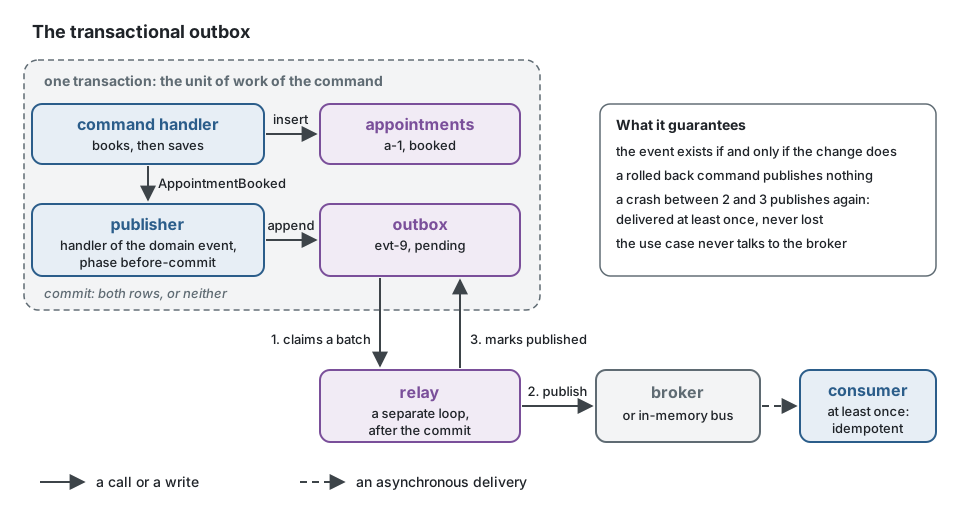
- The appointment and the outbox record commit together or not at all: the event exists if and only if the change does.
- The relay is a separate loop. If it crashes after publishing and before marking, it publishes again on restart. So the outbox turns "maybe lost, maybe invented" into "delivered at least once", and the consumer absorbs the duplicate (see Delivery and idempotency).
In the kit, the publisher of the application layer is a handler of the domain event in the
before-commit phase: it runs at the end of the unit of work of the command, after every save
and before the commit, and only knows the IntegrationEventPublisher port. With a database the
composition root binds that port to the outbox publisher, which only stores; the store is an
adapter of the ORM package (Drizzle, Knex, Prisma, TypeORM), and the relay publishes to the real
provider. Nothing in domain/ or application/ changes when the provider does.
// Instead of: two writes to two systems, in the command handlerawait this.appointments.save(appointment);await this.broker.publish([booked]); // lost if the process stops between the two linesWrite a publisher instead: a handler of the domain event that turns it into the integration event of the published language and hands it to the port:
import type { IntegrationEventDefinition } from '@ddd-ts-kit/events';import type { DomainEvent, IdGenerator, IntegrationEventPublisher } from '@ddd-ts-kit/kernel';import { DomainEventHandler } from '@ddd-ts-kit/kernel/declarations';
// The domain event of the aggregate, and the integration event of the published language:declare class AppointmentBooked implements DomainEvent {  static readonly eventName: 'appointments.appointment.booked';  readonly name: string;  readonly occurredAt: Date;  readonly aggregateId: string;  readonly startsAt: Date;}declare const appointmentBookedV1: IntegrationEventDefinition<{  readonly appointmentId: string;  readonly startsAt: string;}>;
// No phase given: 'before-commit', inside the transaction of the command.@DomainEventHandler(AppointmentBooked)export class AppointmentBookedPublisher implements DomainEventHandler<AppointmentBooked> {  constructor(    private readonly publisher: IntegrationEventPublisher,    private readonly ids: IdGenerator,  ) {}
  async handle(event: AppointmentBooked): Promise<void> {    const booked = appointmentBookedV1.create(      { appointmentId: event.aggregateId, startsAt: event.startsAt.toISOString() },      { id: this.ids.next(), occurredAt: event.occurredAt },    );
    // With a database, the port is bound to the outbox: this appends a row, nothing leaves yet.    await this.publisher.publish([booked]);  }}
The composition root builds the two halves: the publisher the handlers see, which only stores, and the relay, which runs on its own and publishes to the real provider:
// platform/messaging.ts (a module of the container binds the same objects)import { OutboxPublisher, OutboxRelay, type OutboxStore } from '@ddd-ts-kit/events';import {  scopedPublisher,  type Clock,  type ExecutionScope,  type IntegrationEventPublisher,  type Logger,} from '@ddd-ts-kit/kernel';
declare const store: OutboxStore; // the adapter of the ORM package: it joins the transactiondeclare const broker: IntegrationEventPublisher; // RabbitMQ, Kafka, NATS..., or the in-memory busdeclare const scope: ExecutionScope;declare const clock: Clock;declare const logger: Logger;
// What IntegrationEventPublisher is bound to: it appends to the outbox, and stamps the// correlation and the tenant of the work in progress on every event that does not name// them already.export const publisher = scopedPublisher(new OutboxPublisher(store), scope);
// The relay: claims due records, publishes them, marks them published, retries the failures.const relay = new OutboxRelay({  store,  publisher: broker,  clock,  maxAttempts: 8,  onFailure: (failure) => logger.warn('outbox relay failure', { ...failure }), // codes only});
relay.start({ intervalMs: 500 });process.on('SIGTERM', () => void relay.stop()); // waits for the tick in progress
If the command handler throws, a later handler fails or the commit itself fails, the row disappears with the transaction: the relay never publishes for a command that rolled back. The timing of domain events is in Domain and integration events, "When a domain event is handled".
Relay strategies
Section titled “Relay strategies”| Strategy | How it runs | Latency | Fits | Costs |
|---|---|---|---|---|
| polling | the relay claims due records on an interval | the interval | everything; the baseline | a query per tick even when idle; a short interval loads the database |
| polling woken by a signal | the store notifies after an append (PostgreSQL LISTEN/NOTIFY, a Redis publication, an in-memory signal); polling stays on a long interval |
near immediate | low latency without fast polling | one more moving part; the signal is a hint, never the only trigger |
| change data capture | a connector (Debezium and its outbox event router, or a logical replication reader) reads the outbox rows from the database log and publishes them | near immediate | logs such as Kafka, per-key order in commit order | a connector to run and monitor; the relay's retry bookkeeping no longer applies |
Three points the events README insists on:
- Polling remains the safety net under a wake-up signal. A notification missed during a reconnection must only delay the publication until the next interval.
- Change data capture replaces the relay, never the table. Handlers still write events to the outbox. Capturing the business tables instead publishes rows, not events, and couples consumers to the schema.
- One relay or one connector per destination, not both on the same table.
What the relay and the consumer side must do depends on the transport (same process, queue broker, log, cloud queue). The table "Outbox, by transport" in ARCHITECTURE.md section 4 is the reference, and each provider package documents its row.
Several relays can share the work: the SQL stores of the kit claim records with
FOR UPDATE SKIP LOCKED where the database has it (a compare-and-set claim elsewhere) and lease
what they hand out, so the records of a relay that died come back when the lease expires.
Failure handling
Section titled “Failure handling”A record that cannot be published is retried with an exponential backoff. After the configured number of attempts it is marked dead and stays in the table until an operator revives it. The outbox is thus also the dead-letter store of the publishing side.
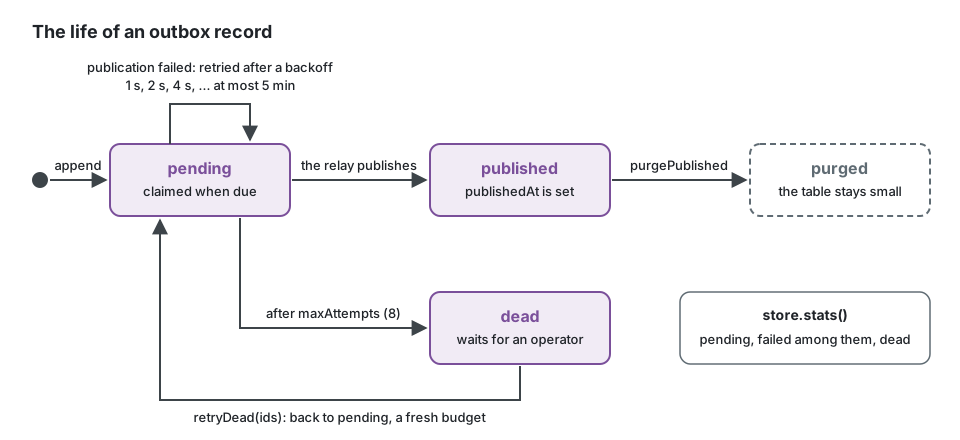
The defaults of OutboxRelay: maxAttempts 8, and a backoff of 1 second before the second
attempt, doubled at each attempt, at most 5 minutes (backoff: { baseMs, factor, maxMs }).
What to monitor
Section titled “What to monitor”The store exposes counts of pending, failed and dead records. The events README gives the reading:
| Signal | Meaning |
|---|---|
| dead above zero | records gave up: alert, fix the cause, revive them |
| failed above zero for long | the provider refuses or is down |
| pending growing | the relay is slower than the producers, or stopped |
| age of the oldest pending record | the real delivery delay; it is a query on the table, the stats do not carry it |
Published records must be purged regularly, or the table and its index grow without bound. The store answers all three needs:
import type { OutboxStore } from '@ddd-ts-kit/events';
declare const store: OutboxStore;
const WEEK_MS = 7 * 24 * 60 * 60 * 1000;
// A health check: any dead record is an alert.export async function outboxHealth() {  const { pending, failed, dead } = await store.stats();
  return { healthy: dead === 0, pending, failed, dead };}
// Housekeeping, from a scheduled job: drop what was published more than a week ago.export async function purgeOutbox(now: Date): Promise<number> {  return store.purgePublished(new Date(now.getTime() - WEEK_MS));}
// Once the cause is fixed, an operator revives dead records with a fresh budget of attempts.export async function reviveDead(ids: readonly string[], now: Date): Promise<number> {  return store.retryDead(ids, now);}
Without a database
Section titled “Without a database”With nothing to be atomic with, there is no dual write: the in-memory bus alone is enough, and the kit does not require an outbox. Choosing in-memory events while an ORM is configured is a deviation that must be recorded with a decision record (CONFIG.md).
Limits and when not to use it
Section titled “Limits and when not to use it”Stated by the events and ORM package READMEs:
- At least once, not exactly once. Duplicates are expected by design.
- No ordering by default, not even per aggregate. A failed record is retried while its successors go out, and several relays may run side by side.
- Per-key ordering is available with caveats: a single relay, head-of-line blocking for the key, and a restart forgets which record blocks which key, so strict order across restarts is not provided. The broker and the consumer must keep the order too.
- Latency. An event leaves after the commit plus the relay delay. A flow that needs an answer in the same request is not an event.
- The table is in the write path. Every command that publishes adds an insert, and the relay adds load. The database is also a single point: if it is down, nothing is published, which is consistent since nothing is committed either.
- The outbox does not help the consumer. What the consumer does with a duplicate or a late event is a separate design.
- It needs a store that shares the transaction of the business write. An outbox in another system (a cache, another database) recreates the dual write. This is why the kit has no outbox or processed-event store on Redis.
- Change data capture in place of the relay was not verified by the kit's test suites (the Kafka package says so).
When not to use it: no database (nothing to be atomic with); an event whose loss is acceptable and recorded as such (a metric-like notification), which is a deviation to write down, not a default.
Sources
Section titled “Sources”- Chris Richardson, Microservices Patterns, Manning, 2018, chapter 3 (transactional messaging); "Transactional outbox", https://microservices.io/patterns/data/transactional-outbox.html; "Polling publisher" and "Transaction log tailing" on the same site.
- Martin Kleppmann, Designing Data-Intensive Applications, O'Reilly, 2017, chapter 9 (distributed transactions) and chapter 11 (change data capture).
- Pat Helland, "Life beyond Distributed Transactions: an Apostate's Opinion", CIDR 2007.
- Gregor Hohpe and Bobby Woolf, Enterprise Integration Patterns, Addison-Wesley, 2003 (Guaranteed Delivery, Transactional Client).
- Debezium documentation, "Outbox Event Router", https://debezium.io/documentation/reference/stable/transformations/outbox-event-router.html
- PostgreSQL documentation,
NOTIFY, https://www.postgresql.org/docs/current/sql-notify.html - READMEs of
@ddd-ts-kit/eventsand of the ORM packages.